美妆

Search documents
上半年欧莱雅中国逆势反弹,CEO:全球美妆市场正回暖
Nan Fang Du Shi Bao· 2025-07-31 05:30
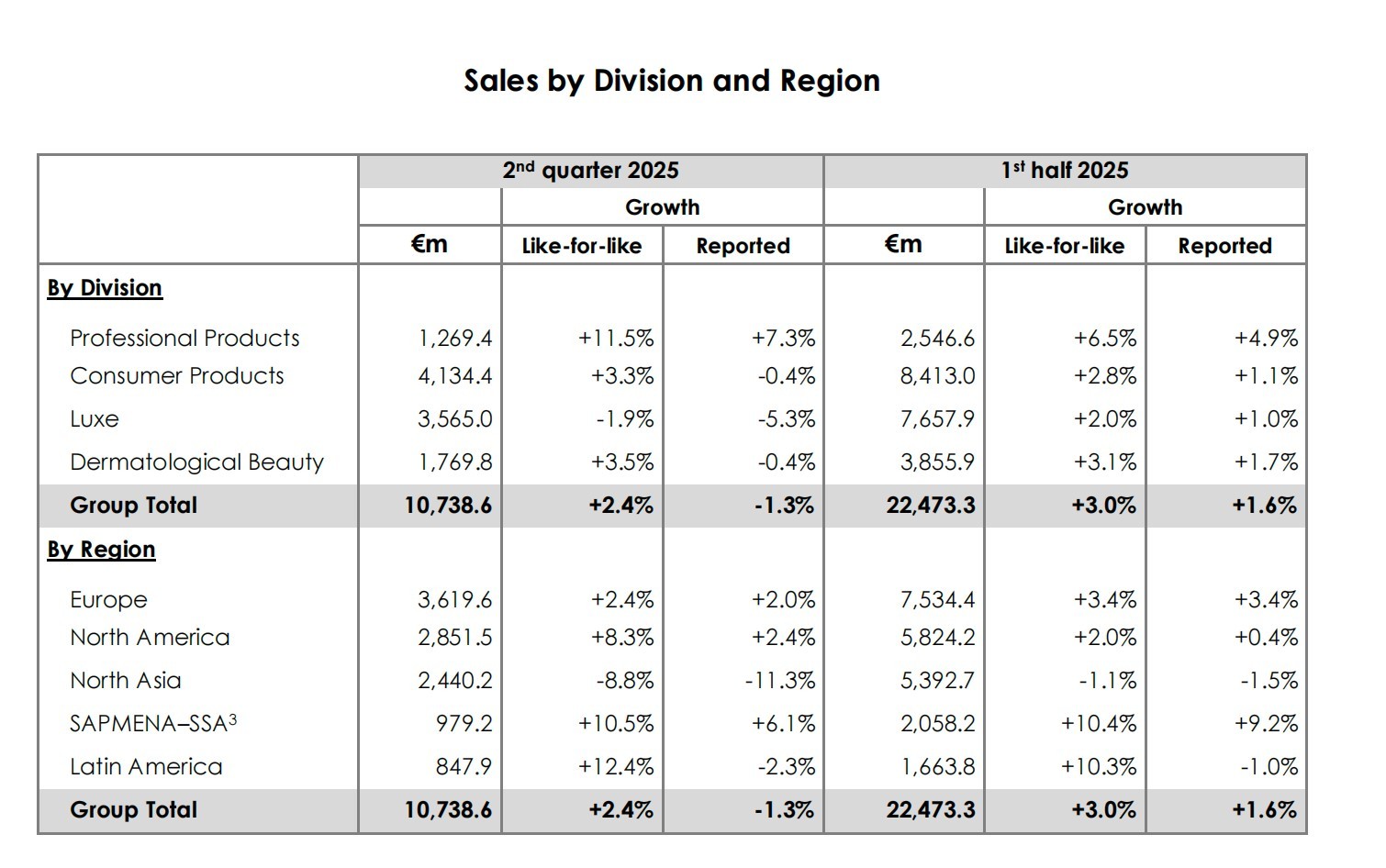
Core Viewpoint - L'Oréal Group reported a notable performance for the first half of 2025, with overall revenue increasing by 3% to €22.47 billion (approximately ¥186.2 billion) and operating profit rising by 3.1% to €4.74 billion (approximately ¥39.28 billion), despite challenges in the high-end beauty market and global economic pressures [2][4][5]. Group Performance - The group's revenue and operating profit have shown growth over the past five years, with double-digit growth from 2021 to 2023. However, growth rates have significantly slowed in recent years, with revenue and operating profit growth dropping to single digits in 2024 and further declining in 2025 [4]. - The CEO, Nicolas Hieronimus, attributed the slowdown to global economic pressures but expressed optimism for the second half of the year, anticipating a gradual recovery in the global beauty market [5]. Division Performance - Professional Products division saw a sales increase of 6.5% to €2.55 billion, marking the strongest performance across all divisions. The Dermatological Beauty division grew by 3.1% to €3.86 billion, with La Roche-Posay being a significant contributor [7]. - Consumer Products division reported a 2.8% increase in sales to €8.41 billion, while the Luxury division experienced a 2% growth to €7.66 billion, indicating ongoing challenges in the high-end beauty market [7]. Regional Performance - The fastest-growing regions for L'Oréal in the first half of 2025 were SAPMENA-SSA and Latin America, with sales growth of 10.4% and 10.3%, respectively [8]. - The North American market grew by 2% to €5.82 billion, while the North Asia market saw a decline of 1.1% to €5.30 billion, with a notable drop of 8.8% in the second quarter [8]. Strategic Developments - L'Oréal announced the acquisition of majority stakes in the high-end haircare brand Color Wow and the skincare brand Medik8, enhancing its brand portfolio in the Professional Products and Luxury divisions [8]. - The company is collaborating with NVIDIA to leverage AI in beauty technology, showcasing innovations at the Viva Technology exhibition [10]. - L'Oréal launched a new "Sustainable Innovation Accelerator" project, planning to invest €100 million over five years to address key industry challenges and enhance sustainability efforts [10]. Upcoming Events - L'Oréal will participate in the upcoming China International Import Expo for the eighth consecutive year, showcasing new brands, products, and technologies, marking its largest presence in the event's history [11].


高端乏力,美发突围 欧莱雅上半年净利润同比增1%,在华销售额现5个季度以来首次正增长
Mei Ri Jing Ji Xin Wen· 2025-07-31 00:11
此外,欧莱雅在上半年还经历了在中国市场销售额止跌回升、专业美发产品部成为最亮眼板块、香水业务跃居高端业务中的高增品类等转变。 但是,高端业务增长乏力、北亚市场承压的迹象仍不容忽视。 在全球不确定性增强的背景下,欧莱雅的"多极化"增长策略是否经得起更长期的检验? 第二季度在华销售额同比增长约3% "公司在中国市场的销售额经历了连续五个季度的下滑后,首次实现(同比)正增长。"欧莱雅集团首席执行官叶鸿慕(Nicolas Hieronimus)在财报电话会上 表示。 在全球美妆行业增速放缓的背景下,欧莱雅于7月30日交出了信息量巨大的2025年上半年财报。 2025年上半年,欧莱雅实现销售额224.73亿欧元(约合人民币1861.91亿元),同比增长3%,净利润为37.83亿欧元(约合人民币311.58亿元),同比增长 1.0%,营业利润率上升30个基点,达到21.1%。 据悉,欧莱雅在中国市场的销售额,从第一季度的同比微幅下滑逆转为第二季度的同比增长约3%。 中国作为欧莱雅集团第二大市场,被公司称为"全球最重要的市场之一"。《每日经济新闻》记者统计发现,欧莱雅在华业绩曾多年保持增长。2018年时,公 司在中国市场的 ...
2025上半年飞瓜抖音电商与广告投放报告
Sou Hu Cai Jing· 2025-07-30 14:06
Core Insights - The report highlights significant growth in Douyin e-commerce during the first half of 2025, with apparel and lingerie leading sales, followed by smart home products, jewelry, and beauty products. The medical health category saw a remarkable increase in sales, approximately quadrupling, while niche categories like virtual recharge also experienced strong growth [1][11]. E-commerce Performance - Apparel and lingerie dominated the sales rankings, with smart home products, jewelry, and beauty following closely. Medical health sales surged by about 400%, and niche categories like virtual recharge showed robust growth [1][11]. - The share of product cards increased by 7.1%, becoming a core growth driver, with a notable 32% turnover rate among the top 50 brands, while the top 10 brands remained relatively stable [1][14]. Advertising Insights - Beauty products led the advertising spend and exposure, with the majority of exposure coming from the "Giant Star Map" platform. General advertising exposure was nearly three times higher than product and live-streaming ads, with effective tags including "life records" and "drama" [1][18]. - The top advertising categories included beauty, personal care, and food and beverage, with beauty products achieving over 119.9 billion in exposure [1][33]. Category Trends - The fashion category saw a significant increase in sales and transaction heat, with 25 million items sold on Douyin. The outdoor sports segment also showed notable growth, driven by various promotional activities [1][22]. - The quality and aesthetics category experienced a sales increase of 30.6% and a transaction heat increase of 38%, with a focus on detailed care products [1][29]. Lifestyle Upgrades - The overall sales heat in the lifestyle upgrade sector grew by 36%, with cleaning appliances contributing the highest sales. Products like fruit and vegetable disinfecting machines saw exponential growth [1][36]. - The report noted that the AWE (China Household Appliances and Consumer Electronics Expo) helped ignite interest in AI-driven home appliances, aligning with current consumer trends [1][36].


欧莱雅Q2增长引擎失速,关税阴云下多极化增长故事面临考验
Hua Er Jie Jian Wen· 2025-07-30 08:27
Core Viewpoint - L'Oréal's second-quarter financial results disappointed investors, with a sales decline and lower-than-expected comparable sales growth, despite exceeding profit expectations [1][2]. Financial Performance - Second-quarter sales decreased by 1.3% year-on-year to €10.74 billion, with comparable sales growth at 2.4%, below the analyst expectation of 2.9% [2]. - For the first half of 2025, net profit (excluding non-recurring items) was €3.78 billion, a 1% year-on-year increase, and operating profit margin improved by 30 basis points [2]. Core Business Analysis - The professional products division led growth with a 6.5% increase, while the high-end cosmetics division grew only 2%, lagging behind the mass market (2.8%) and active health cosmetics (3.1%) [2]. - The fragrance category stood out with double-digit growth, significantly exceeding the market average of 7% [8]. Regional Performance - North Asia, particularly China and South Korea, along with travel retail channels, were major contributors to the sales decline, with North Asia's sales down 1.1% year-on-year [2][5]. - Emerging markets showed strong growth, with South Asia-Pacific, the Middle East, North Africa, and Sub-Saharan Africa achieving 10.4% growth, and Latin America at 10.3% [6]. Tariff Concerns - The European Union's decision to impose a 15% tariff on cosmetics imported from the U.S. poses a significant risk, as approximately 30% of L'Oréal's U.S. sales depend on imports [2][6]. - The CEO expressed serious concerns and plans to lobby for exemptions, while also considering potential price increases or shifting production to U.S. factories [7][6]. Growth Strategy - Despite the challenges, the company remains optimistic about the second half of the year, planning to launch new products like Prada men's perfume and Miu Miu perfume as part of a "beauty stimulus plan" [8].
欧莱雅首席执行官表示,与关税上调相关的价格上涨可能会推动市场增长,有信心今年全球美妆市场将增长4%。
news flash· 2025-07-30 07:27
欧莱雅首席执行官表示,与关税上调相关的价格上涨可能会推动市场增长,有信心今年全球美妆市场将 增长4%。 ...
7月30日电,欧莱雅首席执行官称有信心今年全球美妆市场将增长4%。
news flash· 2025-07-30 07:26
智通财经7月30日电,欧莱雅首席执行官表示,与关税上调相关的价格上涨可能会推动市场增长,有信 心今年全球美妆市场将增长4%。 ...
欧莱雅Q2增长引擎失速,关税阴云下“多极化”增长故事面临考验 | 财报见闻
Hua Er Jie Jian Wen· 2025-07-30 04:24
Core Viewpoint - L'Oréal's Q2 financial results disappointed investors, with a sales decline and lower-than-expected comparable sales growth, raising concerns about its "multi-polar" growth strategy amid pressures from the Chinese market and trade tensions in Europe and the U.S. [1][4] Financial Performance - Q2 sales amounted to €10.74 billion, a year-on-year decline of 1.3%, with comparable sales growth at 2.4%, below the market expectation of 2.9% [4] - Operating profit for the first half reached €4.74 billion, exceeding analyst expectations of €4.69 billion [1] - Net profit (excluding non-recurring items) for the first half was €3.78 billion, a 1% year-on-year increase, with an operating margin improvement of 30 basis points [4] Business Segment Performance - The professional products division led growth with a 6.5% increase, while the core luxury cosmetics division grew only 2%, lagging behind the mass market (2.8%) and active health cosmetics (3.1%) [4][6] - The fragrance category stood out with double-digit growth, significantly outperforming the market average of 7% [6] Regional Performance - Sales in North Asia, particularly in China and South Korea, declined by 1.1% to €5.39 billion, contributing to overall performance challenges [3][4] - Emerging markets showed strong growth, with South Asia-Pacific, the Middle East, North Africa, and Sub-Saharan Africa achieving 10.4% growth, and Latin America at 10.3% [5][6] - Core markets like Europe and North America experienced slower growth, with increases of 3.4% and 2%, respectively [5] External Challenges - The European Union's decision to impose a 15% tariff on cosmetics imported from the U.S. poses a significant risk, as approximately 30% of L'Oréal's U.S. sales rely on imports [4][5] - The CEO expressed serious concerns about the tariff's impact and indicated potential strategies such as price increases or shifting production to U.S. facilities [5][6]
逸仙电商上涨5.59%,报8.975美元/股,总市值8.28亿美元
Jin Rong Jie· 2025-07-29 14:35
Core Viewpoint - Yatsen Holding Limited (YSG) shows positive financial performance with a notable increase in revenue and net profit, indicating growth potential in the beauty market [1][2]. Financial Performance - As of March 31, 2025, Yatsen's total revenue reached 834 million RMB, reflecting a year-on-year growth of 7.78% [1]. - The company's net profit attributable to shareholders was -5.303 million RMB, which represents a significant year-on-year increase of 95.74% [1]. Upcoming Events - Yatsen is scheduled to disclose its interim report for the fiscal year 2025 on August 19, with the actual date subject to company announcement [2]. Company Overview - Yatsen Holding Limited is a Cayman Islands-registered holding company, primarily operating through its subsidiary Guangzhou Yatsen E-commerce Co., Ltd [2]. - Founded in 2016, the company is a leading player in the Chinese beauty market, offering a range of brands including Perfect Diary, Little Ondine, and DR.WU [2]. - The company engages customers through both online and offline channels, with a strong presence on major e-commerce, social, and content platforms in China [2].

广州上半年GDP增3.8%,消费增速跑赢京沪津渝
2 1 Shi Ji Jing Ji Bao Dao· 2025-07-29 11:00
上半年广州经济数据有何特点?南方财经记者梳理发现,上半年广州全市需求端率先回暖,促进效益回 升、预期回稳。从消费看,二季度社会消费品零售总额累计增速逐月提升;从外贸看,上半年进出口持 续两位数增长,远超全国平均水平。 南方财经记者谭海燕 广州报道 7月29日,广州公布上半年经济运行情况。 根据广东省地区生产总值统一核算结果,2025年上半年,广州市地区生产总值(GDP)突破1.5万亿 元,达15080.99亿元,按不变价格计算,同比增长3.8%。 上半年,全市美妆产业继续厚积薄发,规上化妆品制造业增加值、限上化妆品零售额在前两年较快增长 的基础上继续扩容,同比分别增长9.6%和3.7%;金银珠宝、文化办公用品、体育娱乐用品等时尚休闲 产品需求旺盛,实现零售额分别增长16.3%、50.7%、33%。 整体看,虽然上半年GDP增速仍不及全国(5.3%)与广东(4.2%),但已呈现房地产开发投资加快恢 复、汽车和医药制造业降幅收窄趋势,经济转型任务艰巨。 广州市统计局进一步解释称,上半年,随着一系列稳增长政策持续发力显效,全市流量经济激发消费潜 能,新兴产业加速聚势蓄能,经济稳中向好的积极因素加快累积。不过,结构性 ...
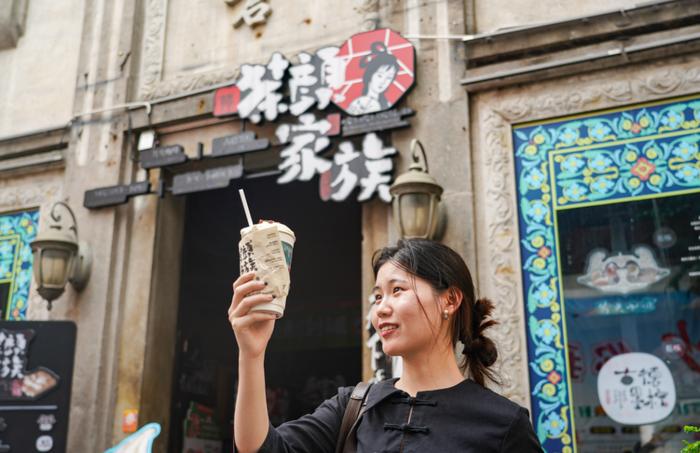
凌晨3点,满街都是一手奶茶一手零食的年轻人,“网红”长沙想变“长红”
Chang Sha Wan Bao· 2025-07-29 07:06
Group 1: Overview of Changsha's Economic Landscape - Changsha is recognized as a vibrant "city that never sleeps," with a significant focus on boosting consumption, particularly in the new retail sector [1] - The city is also known as the "capital of engineering machinery," with over 30% of the national market share, housing five companies listed among the global top 50 engineering machinery firms [1] Group 2: New Consumption Brands - The success of the tea brand "Chayan Yuese" is attributed to its cultural depth and brand recognition, utilizing a "slow philosophy" to counteract industry restlessness [2][3] - Chayan Yuese integrates traditional Chinese culture into its products, creating a unique brand identity that resonates with younger consumers [3][5] - The brand emphasizes quality and a slow-paced approach, maintaining a cautious stance on large-scale delivery and focusing on in-store experiences [6][8] Group 3: Water Sheep Co. (Shuiyang Co.) - Water Sheep Co. has transformed from relying on e-commerce to becoming a leader in the beauty industry, leveraging a unique "CP model" to introduce over 50 international brands into China [11][12] - The company has invested heavily in self-research and production, establishing a smart manufacturing facility capable of producing over 2 billion face masks annually [14][16] - Water Sheep Co. has developed a robust R&D team, creating over 8,000 proprietary formulas and applying for more than 400 patents [16] Group 4: Starbond Intelligent Equipment - Starbond Intelligent Equipment has evolved from relying on imports to becoming a global leader in aerial work platforms, with products sold in nearly 100 countries [19][22] - The company has implemented advanced technologies, such as laser cutting and welding, significantly improving production efficiency and reducing costs [21] - Starbond's transformation has been supported by local government initiatives, providing tailored services to facilitate its growth [23] Group 5: Government Support and Ecosystem - Changsha's government has established a "super incubator" for new consumption brands, providing comprehensive support through research, consulting, and investment services [25][28] - The city has implemented a "1+3" service model to enhance the new consumption industry, focusing on resource integration and talent support [30][31] - The local government has also introduced policies to promote digital transformation and innovation within the engineering machinery sector [34][36] Group 6: Cultural and Demographic Advantages - Changsha's youthful population, with an average age of 37, serves as a strong foundation for new consumption growth [37] - The city's cultural heritage encourages innovation and resilience among local businesses, fostering a unique consumer environment [37][38] - The collaborative approach between government and enterprises has created a supportive ecosystem for new consumption brands to thrive [38][40]