消费电子

Search documents
CES 2026 | 蓝标传媒携手生态伙伴,共话AI时代营销新未来
Xin Lang Cai Jing· 2026-01-13 11:27
Core Insights - The 2026 International Consumer Electronics Show (CES) has officially commenced in Las Vegas, showcasing cutting-edge technology and business solutions, reaffirming its status as a global technology trendsetter [1] Group 1: Chinese Companies at CES - Despite complex environmental and political challenges, Chinese companies demonstrate strong innovation and market participation, with 942 exhibitors, accounting for approximately 22% of the total, making China the second-largest exhibiting country [3][9] - This participation highlights China's critical role in the global consumer electronics and technology supply chain and its commitment to integrating into the global tech ecosystem through innovation [3][9] Group 2: AI and Marketing Discussions - Lyn Lu, head of overseas brand marketing at BlueFocus Media's Madhouse, discussed the practical applications of AI in marketing, future trends, and challenges faced by brands during internationalization, advocating for a strategy of "global strategy, local execution" [5][11] - The discussion emphasized the need for brands to maintain consistent brand identity while tailoring communication narratives to different cultural contexts and consumer behaviors [5][11] Group 3: Networking and Collaboration - The "China Innovation Night" event, co-hosted by Titanium Media and Madhouse, facilitated in-depth exchanges on industry evolution, AI, and global growth, featuring partnerships with companies like Moloco and Uber Ads [5][11] - The event provided a platform for industry elites from technology, marketing, and investment sectors to explore industry trends, market opportunities, and marketing innovations, fostering potential collaboration paths [7][13] Group 4: Future Strategies - BlueFocus Media is advancing its "AI + Globalization 2.0" strategy, focusing on the dual evolution of technology and business, aiming to systematize multimodal AI capabilities to empower clients for high-quality growth [7][13] - The company plans to continue exploring new marketing paradigms in the AI-native era, integrating global resources and innovative strategies to help global brands establish lasting influence in diverse markets [7][13]



雷军转发“诅咒”帖!卢伟冰离职?小米为啥热搜不断?
Sou Hu Cai Jing· 2026-01-13 11:02
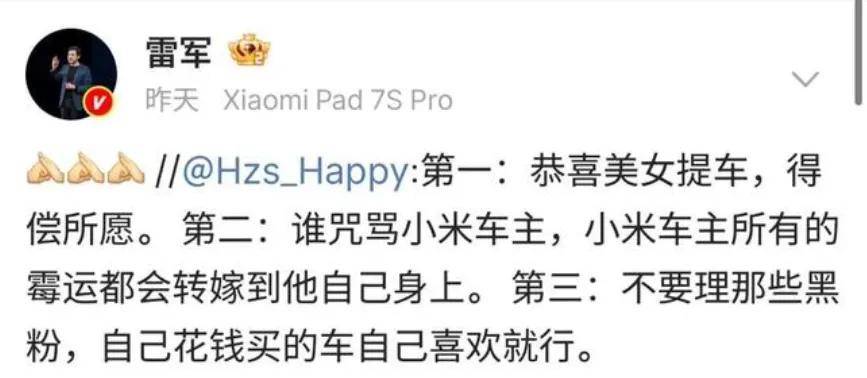
1月12日,"卢伟冰离职"的传闻毫无征兆地在社交平台蔓延,从一个小众账号发酵,不到两小时冲上热搜,60余万的阅读量让这场舆 情迅速扩散。 这谣言从哪里来的?没一个说得清楚!都是"据说" "网传",没有一个可靠的证据证明这个谣言的出处!有人还把锅扣到"京城数码 爷"这个博主身上。 1月11日,雷军转发网友微博"谁骂小米车主!小米车主所有霉运转嫁到他身上"引发争议。有网友说,雷总,这样的评论不该转发。 更有网友感慨,转发"诅咒"贴,颠覆了雷军以往温文尔雅的人设。 同日,雷军还转发一名博主关于小米舆论看法的文章,并评论:"造谣一张嘴,辟谣跑断腿",我们还会坚持辟谣,让更多人了解小 米! 实际上,进入2026年以来,雷军已开启两场针对性直播,通过透明化展示与直面回应的方式应对舆论争议。 都说怕什么来什么,就在雷军竭力辟谣的同时,又有谣言上了热搜。 这场风波的起点,带着几分荒诞。1月11日,微博用户"京城数码爷"以一句模糊的"真假?",将"小米卢伟冰辞职"的话题带入社交媒 体。 没有官方背书,没有具体细节支撑,甚至连最基本的离职原因都未曾提及,却凭借"小米二把手""跨业务掌舵者"自带的流量密码, 像病毒式传播。 1月1 ...

立讯精密:收购闻泰科技部分子公司股权及资产交易进展公告
Xin Lang Cai Jing· 2026-01-13 10:56
立讯精密公告称,公司及立讯通讯收购闻泰科技消费电子系统集成业务相关子公司股权、业务资产包。 截至公告披露日,昆明智通等已完成股权交割及工商变更登记,香港闻泰、印尼闻泰已完成股权实质性 交割。但因印度闻泰相关资产存在交割受限情形,交易未完成权属交割。公司全资子公司已发终止协议 通知,并要求退还已支付的约1.53亿元交易对价及费用。因对方未退还,已提起仲裁申请。该交易终止 不影响公司正常经营和财务状况。 ...


小米集团-W1月13日斥资1.52亿港元回购400万股
Zhi Tong Cai Jing· 2026-01-13 10:16
小米集团-W(01810)发布公告,该公司于2026年1月13日斥资1.52亿港元回购400万股股份,每股回购价 格为37.94-38.04港元。 ...
小米集团-W(01810)1月13日斥资1.52亿港元回购400万股
智通财经网· 2026-01-13 10:07
智通财经APP讯,小米集团-W(01810)发布公告,该公司于2026年1月13日斥资1.52亿港元回购400万股 股份,每股回购价格为37.94-38.04港元。 ...
金鹰基金:天量遭遇主线暂歇 春躁行情踏浪前行
Xin Lang Cai Jing· 2026-01-13 09:38
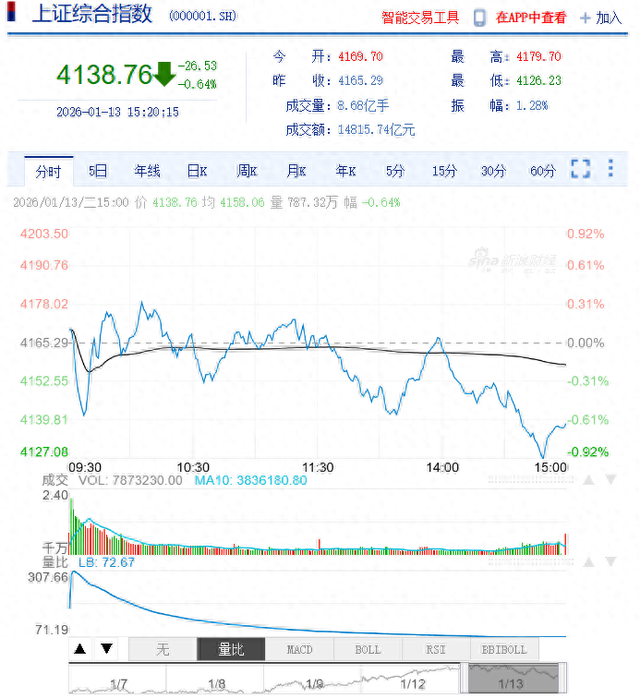
Market Overview - All three major indices closed lower, with the ChiNext index experiencing a significant decline of 1.96%, while the Shanghai Composite Index fell by 0.64% to 4138 points. The Hong Kong Hang Seng Index opened high but closed lower. Trading volume in both markets increased, approaching 3.7 trillion yuan [1][8]. Sector Performance - The commercial aerospace sector saw a substantial drop, leading to a decline in market sentiment. According to WIND data, most of the 31 primary industries tracked by Shenwan experienced declines, with notable gains in oil and petrochemicals (1.62%), pharmaceuticals (1.21%), non-ferrous metals (0.91%), and media (0.67%). In contrast, sectors such as defense, electronics, communications, and computers lagged behind. Out of over 5300 stocks in the market, 3726 saw declines, indicating poor profitability [1][9]. Reasons for Market Correction - The primary reason for the market correction was the cooling off of previously popular speculative themes, particularly in commercial aerospace and controllable nuclear fusion sectors. The commercial aerospace concept stocks notably weakened after several companies issued risk warnings on January 12. This decline raised concerns among investors regarding high-volatility sectors, prompting some to quickly realize profits, which led to concentrated selling pressure [2][9]. Short-term Outlook - The current short-term fluctuations may present a good opportunity for allocation. Historical data from the past two decades indicates that spring market rallies typically occur, although the timing and magnitude can vary. Compared to historical trends, the current bull market has not yet reached its peak, and market sentiment remains subdued. The influx of absolute return funds from insurance, private equity, and retail investors suggests that the spring rally in A-shares has already begun [2][10]. Future Market Dynamics - As the annual performance forecast disclosure window opens for listed companies, the market logic is expected to shift from valuation recovery to profit growth. The current spring market is anticipated to be characterized by a more tradable and significant upward trend after digesting market sentiment [3][10]. Sector Allocation Recommendations - The importance of performance realization is expected to increase, focusing on core technology and manufacturing sectors. Key areas to prioritize include overseas computing power, storage, consumer electronics, and wind energy storage, which currently have low trading congestion and still present buying opportunities. Additionally, sectors like innovative pharmaceuticals and gaming, which may see fundamental improvements in Q1, are also expected to rotate into focus [4][11]. Commercial Aerospace Sector Outlook - Despite the recent adjustments and the need to digest short-term overheating sentiment, the commercial aerospace sector may still hold strong investment appeal. The ongoing developments with SpaceX and robust policy support, along with significant industry catalysts, suggest that the sector could remain active with participation opportunities [5][12].
【兴证策略】60大热门赛道:哪些拥挤度仍在低位?
Xin Lang Cai Jing· 2026-01-13 09:26
Core Insights - The article discusses the investment strategies for the year 2026, focusing on opportunities identified by top fund companies and managers in the market [1][124]. Group 1: Market Sentiment Indicator - The "Congestion Degree" is a unique indicator developed by the company to reflect trading sentiment in popular sectors, combining four dimensions: volume, price, funds, and analyst forecasts [3][126]. - This indicator quantitatively tracks changes in market sentiment and has strong implications for short-term stock price movements [3][126]. Group 2: TMT Sector Insights - The congestion levels for various TMT (Technology, Media, Telecommunications) segments are as follows: - Optical modules: congestion level is moderately low [10][131]. - Servers: congestion level is moderately high [8][133]. - Base stations: congestion level is moderate [10][135]. - Optical fiber and cables: congestion level is moderately high [10][136]. - IDC (Internet Data Center): congestion level is moderately high [10][136]. - Computer equipment: congestion level is high [10][139]. - Optical components: congestion level is high [10][140]. - RF components: congestion level is high [10][145]. - PCB (Printed Circuit Board): congestion level is moderate [10][146]. - IT services: congestion level is moderately high [10][147]. - Semiconductor materials: congestion level is high [10][157]. - Consumer electronics: congestion level is moderately low [10][172]. Group 3: Manufacturing Sector Insights - The congestion levels for various manufacturing segments are as follows: - Automotive parts: congestion level is high [10][181]. - Lithium batteries: congestion level is moderate [10][184]. - Wind power: congestion level is moderately low [10][187]. - Photovoltaic components: congestion level is high [10][197]. - Industrial robots: congestion level is high [10][199]. - Unmanned aerial vehicles: congestion level is high [10][200]. Group 4: Consumer and Pharmaceutical Sector Insights - The congestion levels for various consumer and pharmaceutical segments are as follows: - White goods: congestion level is low [10][207]. - Alcoholic beverages: congestion level is moderately low [10][209]. - Medical services: congestion level is moderately high [10][222]. Group 5: Financial and Real Estate Sector Insights - The congestion levels for various financial and real estate segments are as follows: - Real estate: congestion level is moderate [10][225]. - Insurance: congestion level is high [10][225]. - Banking: congestion level is low [10][226].
消费电子板块1月13日跌3.51%,硕贝德领跌,主力资金净流出114.26亿元
Zheng Xing Xing Ye Ri Bao· 2026-01-13 08:57
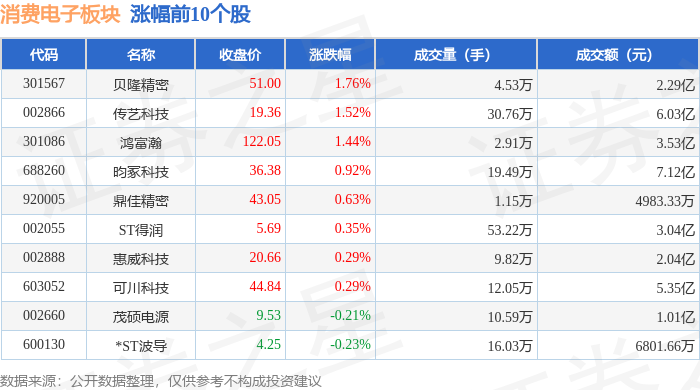
证券之星消息,1月13日消费电子板块较上一交易日下跌3.51%,硕贝德领跌。当日上证指数报收于 4138.76,下跌0.64%。深证成指报收于14169.4,下跌1.37%。消费电子板块个股涨跌见下表: | 代码 | 名称 | 收盘价 | 涨跌幅 | 成交量(手) | 成交额(元) | | --- | --- | --- | --- | --- | --- | | 301567 | 贝隆精密 | 51.00 | 1.76% | 4.53万 | 2.29亿 | | 002866 | 传艺科技 | 19.36 | 1.52% | 30.76万 | 6.03亿 | | 301086 | 灣區灣 | 122.05 | 1.44% | 2.91万 | 3.53亿 | | 688260 | 昀冢科技 | 36.38 | 0.92% | 19.49万 | 7.12亿 | | 920005 | 鼎佳精密 | 43.05 | 0.63% | 1.15万 | 4983.33万 | | 002055 | ST得润 | 5.69 | 0.35% | 53.22万 | 3.04亿 | | 002888 | 惠威科技 | 20.66 | ...


国元证券晨会纪要-20260113
Guoyuan Securities2· 2026-01-13 08:50
Core Insights - The report highlights significant developments in the U.S. debt market, with a notable increase in bond yields across various maturities, indicating potential shifts in investor sentiment and economic outlook [2][4]. - Counterpoint Research forecasts a substantial rise in storage prices by 40%-50% in Q1 of this year, suggesting strong demand dynamics in the technology sector [3]. - TSMC is expected to see a remarkable profit increase of 27% in Q4, reflecting robust performance in the semiconductor industry [3]. Economic Data Summary - The Baltic Dry Index closed at 1688.00, down by 1.75%, indicating a decline in shipping rates [4]. - The Nasdaq Index rose by 0.26% to close at 23733.90, while the Dow Jones Industrial Average increased by 0.17% to 49590.20, reflecting a positive trend in U.S. equities [4]. - Crude oil prices (ICE Brent) increased by 1.52% to $64.30, while gold prices (London Gold Spot) rose by 1.99% to $4598.56, indicating a shift in commodity market dynamics [4]. Market Performance - The Hang Seng Index closed at 26608.48, up by 1.44%, and the Hang Seng Tech Index increased by 3.10%, showcasing strong performance in the Hong Kong market [4]. - The Shanghai Composite Index rose by 1.09% to 4165.29, while the Shenzhen Composite Index increased by 2.05% to 2714.52, indicating positive market sentiment in mainland China [4].
三大指数集体收跌,沪指终结17连阳
Guan Cha Zhe Wang· 2026-01-13 08:19
Market Overview - The three major indices collectively adjusted, with the Shanghai Composite Index ending a 17-day winning streak, closing down 0.64% [1] - The Shenzhen Component Index fell by 1.37%, while the ChiNext Index experienced a decline of 1.96% [1] Trading Data - The Shenzhen Component Index opened at 14,397.69, reached a high of 14,458.89, and closed at 14,366.91, reflecting a decrease of 1.37% [3] - The trading volume for the day was 1.195 billion hands, with a total transaction value of 21,694.11 billion yuan [3] Sector Performance - The total transaction value across the Shanghai, Shenzhen, and Beijing markets reached 36,991 billion yuan, an increase of 541 billion yuan compared to the previous day [5] - Major capital inflows were observed in sectors such as medical devices, gaming, and energy metals, while there were net outflows in consumer electronics, aerospace, and telecommunications [5] Stock Movements - Over 3,700 stocks in the market experienced declines [7] - The AI application concept sector saw gains, with several stocks hitting the daily limit, including Inry Media, Lioo Co., and Shenguang Group [7] - The AI medical concept remained active, with Meian Health achieving three consecutive limit-ups, and stocks like Hongbo Pharmaceutical and Xin Ganjiang also hitting the limit [7] - The power grid equipment sector strengthened in the afternoon, with stocks like Tebian Electric Apparatus and Sanbian Technology reaching the daily limit [7] - Retail concepts showed active performance, with Sanjiang Shopping achieving two consecutive limit-ups [7] - Oil and gas stocks surged during the day, with Zhuan Oil Co. hitting the daily limit and Tongyuan Petroleum rising over 10% [7] - Conversely, sectors such as commercial aerospace and controllable nuclear fusion faced significant declines, with stocks like Shunhao Co. and China Satellite Communications hitting the daily limit [7] - The computing hardware industry chain also saw declines, particularly in the server and CPO segments [7]