
Funds

Search documents
6月新发基金规模破900亿元!债基占主导,新型浮动费率基金成亮点
Huan Qiu Wang· 2025-06-26 06:01
Group 1 - The total scale of newly issued funds since June has surpassed 90 billion yuan, with bond funds significantly contributing to this growth, while passive index products have seen a decline in issuance [1][3] - Among the newly issued funds, mixed FOF funds have emerged as the top performers, with a single fund raising 6.573 billion yuan, marking it as the largest fund issued in June [1][3] - The issuance of bond funds reached 43.285 billion yuan from 22 new funds, accounting for 47.63% of the total issuance, with notable contributions from policy financial bond index funds [3] Group 2 - The issuance of mixed funds in June totaled 21.571 billion yuan, representing 23.74% of the total, while FOF funds raised 9.111 billion yuan, making up 10.03% of the total [3] - The new floating rate funds have gained traction, with 15 out of 26 approved funds already established, collectively raising over 15 billion yuan [3] - Several innovative funds have attracted investor attention, including the first central enterprise commercial real estate REIT, which raised 500 million yuan and concluded fundraising early [4]


闪光的你,赋能徐州高质量发展优秀案例请展示!
Sou Hu Cai Jing· 2025-06-25 23:10
Core Viewpoint - The article discusses the "2025 Xuzhou Financial Services High-Quality Development Case Collection Activity," aimed at showcasing the achievements of Xuzhou's financial industry during the 14th Five-Year Plan and contributing to its goal of becoming a trillion-yuan city by 2025 [1] Group 1: Activity Overview - The activity will last for six months, from May to October 2025, and aims to systematically display the accomplishments of Xuzhou's financial sector during the 14th Five-Year Plan [1] - It seeks to enhance the social responsibility of financial institutions and increase the influence of Xuzhou's financial industry in the Yangtze River Delta and nationwide [1] Group 2: Collection Scope - The collection targets financial institutions in Xuzhou, including banks, insurance, securities, and fund companies, focusing on innovative service cases, digital transformation achievements, and risk prevention practices [2] - Government and industry associations are also included, providing cases on policy innovation and cross-sector collaboration governance models [3] Group 3: Field Directions - The activity emphasizes several key areas: - Serving the real economy through supply chain finance, specialized loans for manufacturing, and technology financial products [4] - Promoting inclusive finance, including financial services for new citizens, rural credit system development, and innovations in microfinance products [5] - Digital transformation initiatives, such as applications of digital currency, intelligent risk control systems, and blockchain technology practices [6] - Green finance projects, including carbon financial products, green credit projects, and ESG investment cases [7] - Innovative governance models, such as diversified financial dispute resolution mechanisms and cross-department data sharing platforms [8] Group 4: Case Requirements - Cases must be inclusive, covering a wide range of beneficiaries [9] - They should demonstrate effectiveness, having been implemented in recent years with quantifiable data and noticeable results [10] - Innovation is key, showcasing policy, technology, or model innovations with potential for broader application [11] - Compliance with laws and regulations is mandatory, aligning with national policy directions [12] Group 5: Evaluation and Display - An expert evaluation committee will be formed, comprising representatives from the central bank, universities, and industry associations, to assess cases based on innovation, effectiveness, and applicability [13] - Selected cases will be showcased through exhibitions and special reports across multiple channels [13] Group 6: Submission and Recommendation Process - Organizations can self-nominate by filling out a case recommendation form and providing a written document of up to 3,000 words detailing the project background, implementation measures, innovative highlights, and social benefits [14] - Experts and media can also recommend cases, requiring a rationale for their nomination [15] Group 7: Activity Timeline - The activity will follow a structured timeline: - Initial selection phase from May to June, involving strict screening of submissions [16] - Publicity and reporting phase from June to July, including on-site evaluations of key cases [16] - Final review phase from August to September, where the expert committee will determine the final selected cases [16] - Promotion and publication phase from September to October, culminating in a ceremony to announce the outstanding cases [16]
80亿,佛山禅城发布“1+1”产业基金体系
FOFWEEKLY· 2025-06-25 10:17
Core Viewpoint - The article discusses the establishment of the "1+1" industrial fund system in Zhancheng District, Foshan, aimed at fostering new productive forces and enhancing the competitiveness of the urban center through a combination of government and state-owned enterprise funds [1][2]. Summary by Sections Industrial Fund System - The "1+1" industrial fund system consists of the Foshan Zhancheng Industrial Innovation Development Investment Fund (Qihang Fund) and the Foshan Zhancheng Linghang Equity Investment Fund (Linghang Fund), designed to leverage government investment and the flexibility of state-owned enterprise funds [1][2]. - The goal is to establish an industrial fund system with a total scale of no less than 8 billion yuan within 8 years, utilizing a market-oriented approach combined with policy guidance [1]. Qihang Fund - The Qihang Fund is a government investment fund with a total scale of 2 billion yuan, initially contributing 250 million yuan, focusing on advanced manufacturing, modern services, industrial transformation mergers and acquisitions, and technological innovation [1][2]. - It aims to accelerate the local high-level technological entrepreneurship and innovation ecosystem by investing early and in small amounts in technology [1]. Linghang Fund - The Linghang Fund is a state-owned enterprise fund with a total scale of 3 billion yuan, with an initial contribution of 1 billion yuan, focusing on direct investments and supporting traditional industries' transformation and enhancement [2][3]. - It aims to cultivate and strengthen emerging urban industries and invest in key links of local industrial chains [2]. Advantages of Zhancheng - Zhancheng has expanded its industrial space significantly, with plans to complete 10 million square meters of high-quality industrial space this year, and has prepared over 3,149 acres of industrial land [3]. - The district benefits from comprehensive advantages, including integrated urban functions and lower costs for innovation elements, which help attract and retain talent [3]. - The industrial fund focuses on four centers: urban manufacturing, industrial services, commercial consumption, and Lingnan culture, aiming to create a balanced and vibrant modern industrial system [3]. Collaborative Efforts - Several banks and securities firms have signed cooperation agreements with Zhancheng to support the fund system and address financing challenges for innovative enterprises [4]. - The district plans to implement a "four-way linkage" strategy to create a unique industrial ecosystem, enhancing collaboration among various stakeholders [4].

ETF资金榜 | 港股通红利ETF(513530)资金加速流入,上证公司债ETF(511070)“吸金”达17亿元-20250624
Sou Hu Cai Jing· 2025-06-25 02:22
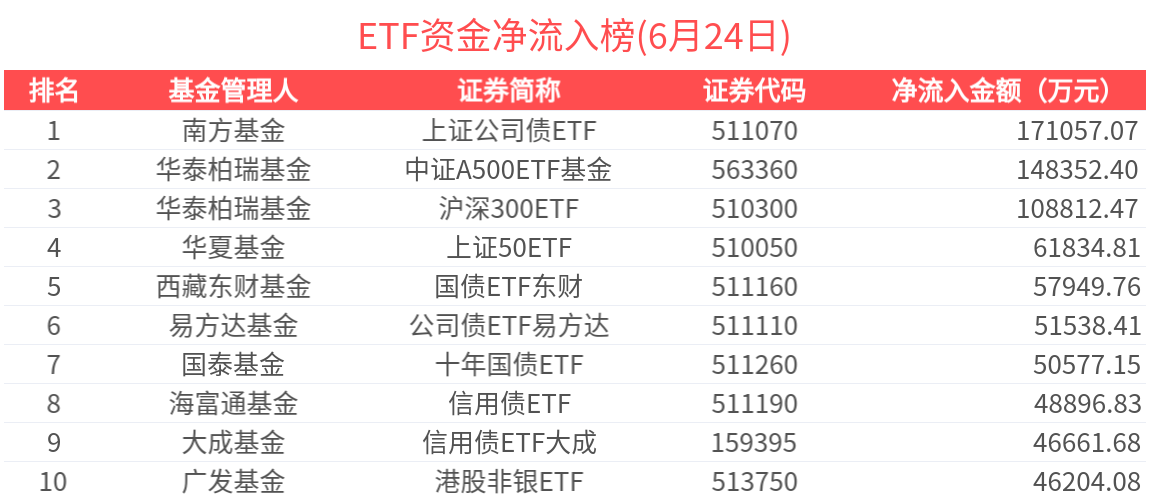
Core Insights - On June 24, 2025, a total of 204 ETFs experienced net inflows, while 474 ETFs saw net outflows, indicating a significant disparity in investor sentiment towards different funds [1][3] - The top five ETFs with net inflows exceeding 100 million yuan included the Shanghai Company Bond ETF, the CSI A500 ETF, the CSI 300 ETF, the Shanghai 50 ETF, and the Treasury ETF Dongcai, with net inflows of 1.711 billion yuan, 1.483 billion yuan, 1.088 billion yuan, 618 million yuan, and 579 million yuan respectively [1][3] - Conversely, 28 ETFs had net outflows exceeding 100 million yuan, with the Short-term Bond ETF, Yinhua Daily ETF, 30-Year Treasury ETF, CSI 300 ETF, and Huabao Tianyi ETF leading the outflows at 747 million yuan, 649 million yuan, 586 million yuan, 486 million yuan, and 466 million yuan respectively [1][5] Fund Performance - A total of 123 ETFs have seen consecutive net inflows, with the top performers being the Hong Kong Stock Connect Dividend ETF, Credit Bond ETF Dacheng, Shanghai Company Bond ETF, Credit Bond ETF Guangfa, and Low Volatility Dividend ETF, accumulating net inflows of 974 million yuan, 6.804 billion yuan, 11.488 billion yuan, 8.442 billion yuan, and 400 million yuan respectively [1][6] - In contrast, 181 ETFs have experienced consecutive net outflows, with the leading ones being the Hang Seng Consumer ETF, Hong Kong Stock Connect Medical ETF, National Development Bond ETF, and Free Cash Flow ETF, with net outflows of 414 million yuan, 188 million yuan, 145 million yuan, and 261 million yuan respectively [1][6][8] Recent Trends - Over the past five days, 78 ETFs have recorded cumulative net inflows exceeding 100 million yuan, with the Credit Bond ETF, Shanghai Company Bond ETF, Short-term Bond ETF, Ten-Year Treasury ETF, and Credit Bond ETF Guangfa leading with inflows of 6.057 billion yuan, 3.804 billion yuan, 3.584 billion yuan, 3.198 billion yuan, and 3.167 billion yuan respectively [1][9] - Conversely, 43 ETFs have seen cumulative net outflows exceeding 100 million yuan in the same period, with the 30-Year Treasury ETF, CSI 300 ETF, and various A500 ETFs leading the outflows at 855 million yuan, 649 million yuan, and 614 million yuan respectively [1][9]
总规模突破2000亿元!信用债ETF驶入快车道
券商中国· 2025-06-25 01:47
Core Viewpoint - The credit bond ETF market has experienced unprecedented growth, with total scale surpassing 200 billion yuan, driven by a shift in investor preference towards stable income assets and supported by favorable policies [1][3][6]. Group 1: Market Growth and Scale - As of June 23, the total scale of credit bond ETFs reached 204.68 billion yuan, accounting for approximately 57% of the entire bond ETF market [3]. - The initial launch of eight benchmark market-making products at the beginning of the year laid the foundation for this growth, with their combined initial issuance scale of 21.71 billion yuan now exceeding 10 billion yuan each [3]. - The Huaxia Shanghai Stock Exchange Benchmark Market-Making Corporate Bond ETF has seen its scale grow from 3 billion yuan at the start of the year to over 20 billion yuan, contributing significantly to the overall growth of credit bond ETFs [3]. Group 2: Policy Support and Market Dynamics - Continuous policy support has been a driving force for the development of credit bond ETFs, including the inclusion of these products in the bond general repurchase pledge library [3]. - The announcement of the ability to conduct general pledge-style repurchase transactions for credit bond ETFs led to a significant increase in subscription volume, with the market value of newly listed corporate bond ETFs rising from 39.1 billion yuan to 64.9 billion yuan, a 66% increase [4]. Group 3: Product Characteristics and Investor Demand - Credit bond ETFs are characterized by low volatility, low cost, and high liquidity, making them an attractive option for investors seeking stable income assets in a market characterized by "asset scarcity" [2][5]. - The passive nature of bond funds has gained favor among institutions, leading to an expansion in the scale of credit bond ETFs as they offer a combination of lower risk and relatively stable returns [6]. Group 4: Performance and Cost Advantages - Credit bond ETFs have demonstrated robust long-term return capabilities, often outperforming actively managed credit bond funds in terms of returns while exhibiting lower volatility [8][9]. - The average management fee for credit bond ETFs is approximately 0.165%, with a total cost of around 0.22%, which is lower than the average fees for actively managed credit bond funds [10]. Group 5: Future Outlook and Investment Strategies - The demand for stable income assets is expected to continue rising, and credit bond ETFs are likely to become a preferred choice for more investors, with potential for further growth in scale [10]. - Investors are advised to select credit bond ETFs based on their specific needs, such as liquidity management or credit risk exposure, given the current market's limited variety of these products [11].
15只新型浮动费率基金结募,单只销量2.59亿至19.91亿
Sou Hu Cai Jing· 2025-06-25 01:33
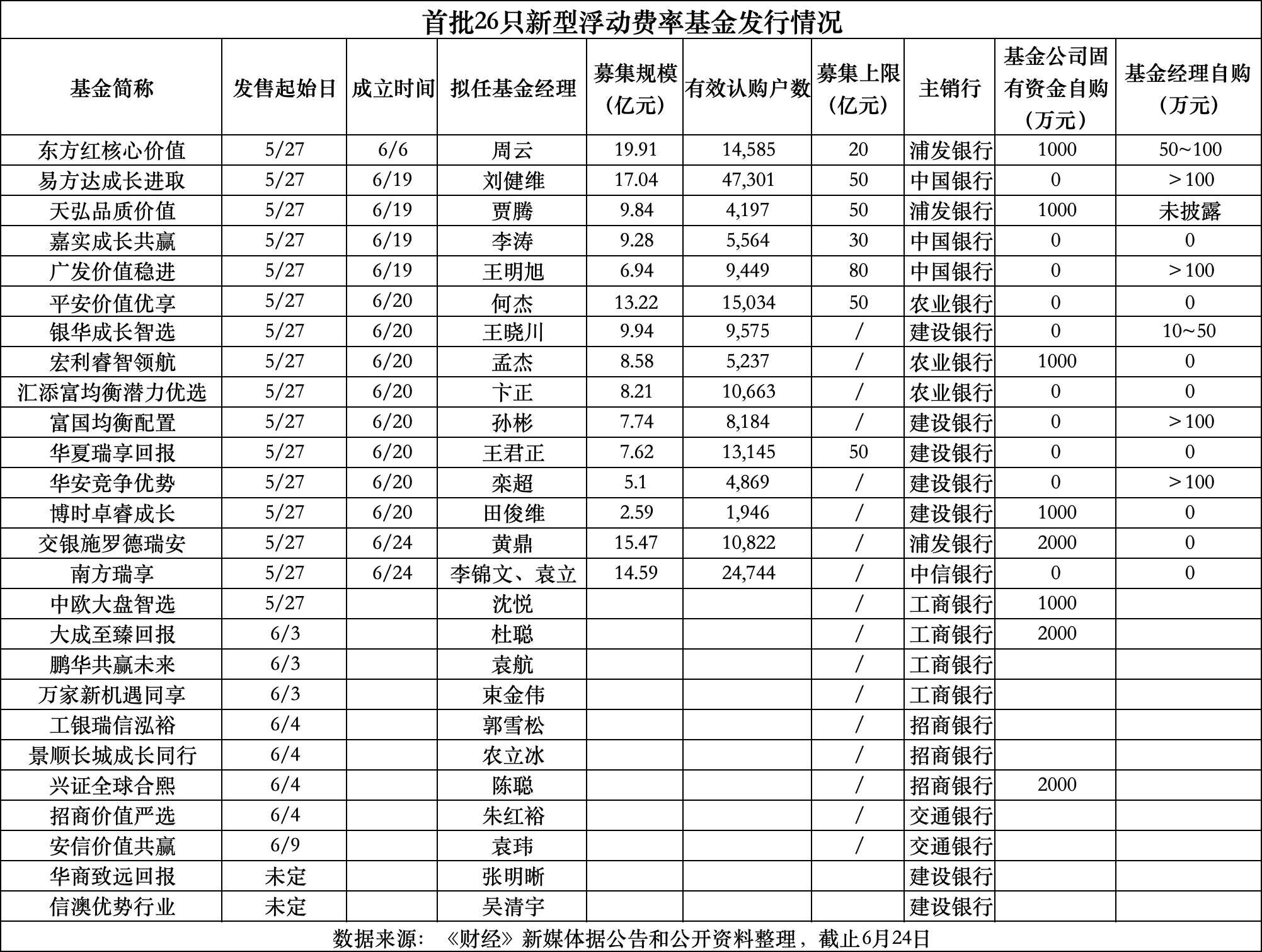
Core Viewpoint - The launch of the first batch of 26 new floating-rate funds has not met market expectations, with only 15 funds successfully established and a total fundraising of 156.07 billion yuan, indicating a lukewarm reception for this innovative product [1][9]. Fund Launch and Performance - Among the 15 established funds, only 5 achieved a fundraising scale exceeding 10 billion yuan, with the highest being 19.91 billion yuan for the "Oriental Red Core Value" fund [1][4]. - The "Oriental Red Core Value" fund was the most successful, completing its fundraising in just 6 trading days and achieving a final scale of 19.91 billion yuan [4][6]. - Other funds such as "E Fund Growth Progress" and "Tianhong Quality Value" also launched successfully, with fundraising scales of 17.04 billion yuan and 9.84 billion yuan respectively [6][7]. Investor Engagement and Market Dynamics - The number of effective subscriptions varied, with "E Fund Growth Progress" attracting the most investors at 47,300, followed by "Southern Wealth Enjoyment" with 24,700 [8]. - The overall investor enthusiasm for these new floating-rate funds has been low, attributed to cautious sentiment in the equity market and a lack of confidence in actively managed equity funds [9]. Challenges in Sales and Understanding - The complexity of the new fee structure, which includes multiple variables such as holding periods and performance benchmarks, has made it difficult for ordinary investors to understand, leading to reduced attractiveness [9]. - Sales channels are reportedly less motivated to promote these funds due to the uncertainty in management fees based on performance, contrasting with the fixed fees of traditional funds [9]. Company and Manager Participation - Despite the low investor enthusiasm, some fund companies and managers have shown commitment by investing their own funds, totaling over 1.1 billion yuan across six companies [10][11]. - Notable self-investments include 2 million yuan from "Jiaoyin Schroder Fund" and "Dacheng Fund," and several fund managers also invested significant amounts in their respective funds [12][13].
年内业绩、人事、合规问题丛生,个人系公募陷“成长之困”
2 1 Shi Ji Jing Ji Bao Dao· 2025-06-24 13:17
Core Viewpoint - The recent personnel changes at Huiquan Fund highlight the challenges faced by personal public funds in China, with many experiencing performance declines and operational issues. Group 1: Company Changes - Huiquan Fund announced the departure of its founder and general manager, Liang Yongqiang, due to "work adjustments," with Chen Hongbin taking over the role [1] - Liang Yongqiang continues to manage three funds, but these have collectively lost over 50% since his tenure began, significantly underperforming their benchmarks [2][3] Group 2: Performance Issues - Huiquan Fund's total management scale is only 2.4 billion yuan, down from 2.8 billion yuan three years ago [3] - Liang's managed funds, including Huiquan Zhenxin Zhiyuan and Huiquan Strategy Preferred, have reported losses of 56.01% and 51.14% respectively since their inception [2] - The largest fund, Huiquan Strategy Preferred, has underperformed its benchmark by nearly 40% since inception [2] Group 3: Industry Trends - Personal public funds have faced significant challenges, with nearly half of the 23 institutions experiencing a decline in total scale over the past year [6] - The total scale of personal public funds decreased by 12.83 million yuan year-on-year, totaling 350.89 billion yuan as of the first quarter of 2025 [6] - Some funds, like Chunhou Fund and Zhonggeng Fund, have seen severe scale reductions, with Chunhou Fund's scale dropping by 11.8 billion yuan to 21.67 billion yuan [7] Group 4: Broader Industry Challenges - The personal public fund sector is experiencing frequent issues such as product liquidation, personnel changes, and legal disputes [4] - Chunhou Fund has faced significant internal conflicts among its shareholders, leading to a mass withdrawal of institutional funds [4] - Legal troubles have also affected other personal public funds, such as Kaishi Fund, which is dealing with a high consumption restriction order against its chairman [5]
近200只公募基金换“舵手” 基金经理“变更潮”背后有何玄机
2 1 Shi Ji Jing Ji Bao Dao· 2025-06-24 12:57
Core Viewpoint - The public fund industry is experiencing a significant wave of fund manager changes, driven by various factors including market conditions, industry competition, incentive mechanisms, the trend of "de-starring," and personal career planning [2][12]. Group 1: Fund Manager Changes - As of June 24, nearly 200 public fund products have announced fund manager changes this month, indicating a trend of frequent adjustments within the industry [2][5]. - The changes in fund managers can be categorized into three main types: new appointments, simultaneous appointments and dismissals, and departures [6][10]. - The increase in fund manager dismissals is attributed to work needs and performance evaluations, with companies adjusting their fund manager assignments based on product style and performance benchmarks [9][11]. Group 2: Industry Changes - The public fund industry is gradually moving away from reliance on "star fund managers" and is transitioning towards a team-based and institutionalized approach [14]. - Talent mobility within the industry is accelerating, with competition shifting from mere salary comparisons to diverse dimensions such as equity incentives and differentiated assessments [14]. - The industry is evolving from extensive growth to high-quality development, emphasizing long-term performance, risk management, and effective communication with investors [14]. Group 3: Team Management Model - The implementation of a team management model for fund managers is expected to increase, as highlighted in the new regulations aimed at enhancing core investment research capabilities [15]. - The team management model allows for resource integration and improved investment quality, while also posing challenges such as decision-making conflicts and coordination costs [16][17]. - This model reduces dependency on individual fund managers and enhances the stability of performance, but it requires careful management to avoid potential pitfalls [17].
又一家公募关停APP!什么原因?
券商中国· 2025-06-24 12:54
Core Viewpoint - The public fund industry is witnessing a trend where even large-scale fund companies are gradually exiting the APP direct sales business due to cost pressures and the dominance of major players in the market [1][2]. Group 1: Industry Trends - The trend of public funds suspending or terminating their APP operations has expanded from smaller funds to mid-sized funds with over 100 billion in assets, and even to those exceeding 300 billion [2][3]. - The operational and maintenance costs of fund APPs are significant, often ranging from millions to nearly ten million, while the customer acquisition through these channels remains low, leading to poor economic viability [4][10]. Group 2: Competitive Landscape - The dominance of major third-party fund distribution platforms, such as Ant Group's fund management, is creating a "winner-takes-all" scenario, making it increasingly difficult for smaller funds to compete [5][6]. - The market share of leading platforms is stark, with Ant Group holding 7,388 billion in equity fund assets, significantly outpacing competitors like China Merchants Bank and Tiantian Fund [6]. Group 3: Strategic Responses - In response to the competitive pressures, some mid-sized funds are seeking to embrace internet platforms through equity acquisitions, as seen with the acquisition of a stake in Pioneer Fund by Zhinanzhen [8][9]. - The shift towards internet platforms reflects the need for smaller funds to adapt their business models in order to survive in a market dominated by larger players [9][10].

中海基金:旗下非货基2024年合亏3亿,收取超8000万元管理费
Sou Hu Cai Jing· 2025-06-24 09:01
Core Viewpoint - The China Securities Regulatory Commission (CSRC) emphasizes the importance of prioritizing investor interests in the mutual fund industry, urging firms to align their operations with this principle, particularly in governance, product issuance, investment operations, and performance evaluation [1]. Group 1: Company Financial Performance - In 2024, China Ocean Fund achieved operating revenue of 125 million yuan and a net profit of 3.65 million yuan [4]. - The total assets of China Ocean Fund as of December 31, 2024, amounted to approximately 309.99 million yuan, with net assets attributable to the parent company at around 231.58 million yuan [3]. Group 2: Fund Performance and Management Fees - China Ocean Fund's non-money market products incurred losses exceeding 300 million yuan in 2024, while the company collected over 80 million yuan in management fees from these products [6][5]. - From 2022 to 2024, the total losses from non-money market products managed by China Ocean Fund exceeded 5 billion yuan, with management fees collected over the past three years surpassing 300 million yuan [5]. Group 3: Specific Fund Performance - The main sources of losses for China Ocean Fund include the "China Energy Strategy" and "China Environmental New Energy" funds, each losing over 1 billion yuan from 2022 to 2024 [9]. - The "China Energy Strategy" fund has seen a net value decline of 53.31% over the past three years, significantly underperforming its benchmark by over 50 percentage points [9].
