电动汽车

Search documents
反向拆股触发抛售狂潮 美国电车新势力Lucid(LCID.US)股价暴跌超10%
智通财经网· 2025-09-03 00:27
Group 1 - Lucid Group's stock price fell over 10% on Tuesday, reaching a historical low of $17.36, primarily due to the implementation of a 10-for-1 reverse stock split [1] - The reverse stock split is intended to consolidate shares, theoretically increasing the price per share while keeping the total market capitalization unchanged; however, it often signals underlying business struggles and can trigger selling pressure [1] - Analysts noted that the stock drop was not due to significant negative changes in fundamentals but rather a market reaction to the reverse stock split being perceived as a negative signal [1] Group 2 - Lucid Group highlighted a strategic partnership with Nuro and Uber Technologies, viewing it as more than just a business transaction, but a significant collaboration in the autonomous driving sector [2] - Uber plans to invest approximately $300 million in Lucid to support the development and integration of the Robotaxi project, reflecting confidence in Lucid's underlying architecture and growth opportunities beyond direct consumer sales [2] - Year-to-date, Lucid Group's stock has declined over 40%, while Tesla's stock has decreased by 18.2%, and Rivian Automotive's stock has seen a slight increase of 1.5% amidst a downturn in the electric vehicle sector [2]

特斯拉发布“宏图4.0”!未来机器人主导80%价值
Ge Long Hui· 2025-09-03 00:14
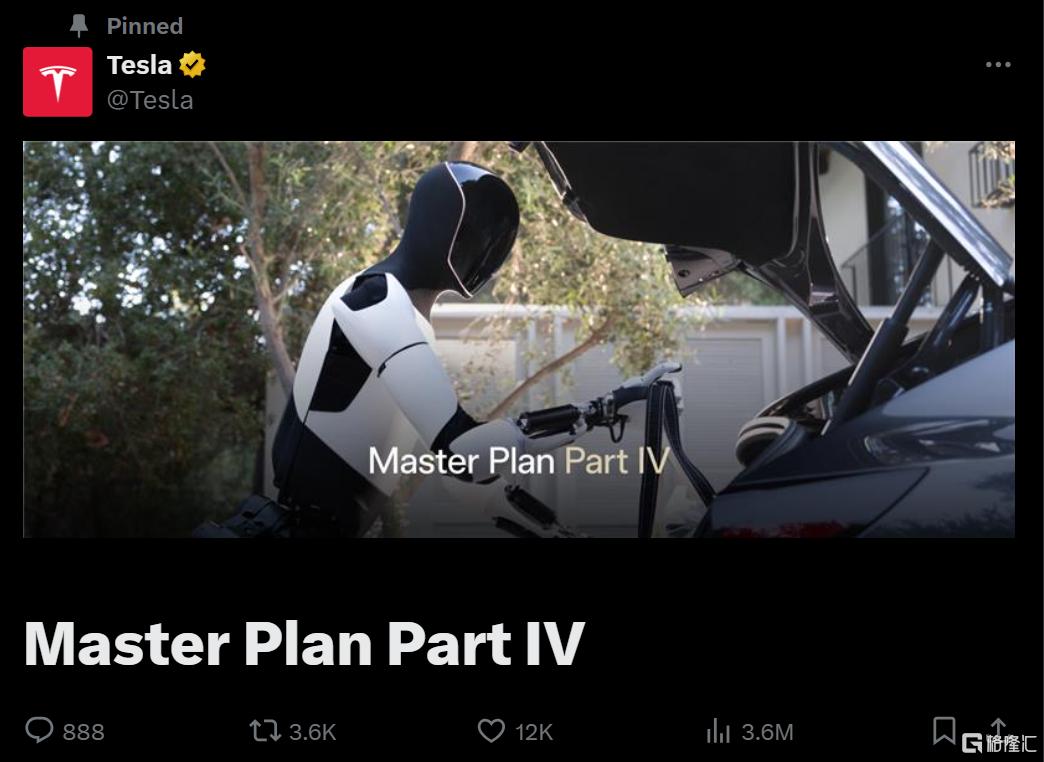
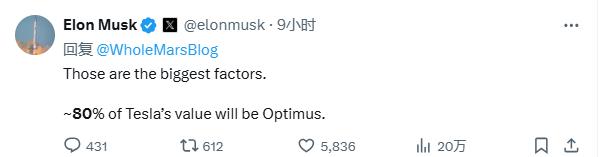
Core Insights - Tesla's "Master Plan Part IV" emphasizes the integration of artificial intelligence (AI) and robotics as the core focus for future growth and sustainability [1][3] - The plan aims to accelerate the transition to "sustainable abundance" through the unification of hardware and software, enhancing safety, cleanliness, and enjoyment in the world [3][4] - Tesla's future value is projected to be significantly derived from the Optimus robot, with approximately 80% of the company's value expected to come from this technology [4] Summary by Sections Master Plan Overview - The fourth chapter of the Master Plan marks a strategic shift from electric vehicles and energy solutions to a focus on AI and robotics [8] - The previous plans (1.0, 2.0, and 3.0) laid the groundwork for electric vehicle feasibility, solar energy solutions, and a roadmap for sustainable energy transition, but faced challenges in execution [5][7] Key Principles of Master Plan Part IV - Endless growth is emphasized, where growth in one area does not hinder another, akin to the industrial revolution and the internet [4] - Innovation is seen as a means to eliminate limitations, with Tesla's battery technology disrupting fossil fuel transportation [4] - Technology is aimed at solving real-world problems, enhancing the availability of clean energy and improving safety in transportation [4] - Autonomy must benefit humanity, making daily life safer and better [4] - Broader accessibility will drive stronger growth, promoting social democratization and improving quality of life through advanced products [4] Historical Context - Master Plan 1.0 focused on proving the viability of electric vehicles and expanding the market with models like the Roadster, Model S, Model X, and Model 3 [5] - Master Plan 2.0 aimed at integrating solar solutions with energy storage and developing significantly safer autonomous driving technology, though progress has been limited [6][7] - Master Plan 3.0 targeted the elimination of fossil fuels and outlined a global sustainable energy economy, but Tesla's involvement outside electric vehicles has been minimal [7]


特斯拉“宏图计划4”发布:大规模地将AI融入物理世界,未来80%的价值在于机器人
3 6 Ke· 2025-09-03 00:10
Core Viewpoint - Tesla's latest "Master Plan Part IV" shifts the company's focus from electric vehicles and energy to artificial intelligence and robotics, aiming to create a "sustainable prosperity" society through AI integration into the physical world [1][3][5]. Group 1: Vision and Goals - The ultimate goal defined in the plan is to achieve "unconstrained sustainability without compromise" [3][5]. - The plan outlines five guiding principles: 1. Growth is unlimited: Technological innovation can solve resource shortages and create more economic opportunities [3][10]. 2. Innovation eliminates limitations: Continuous innovation can overcome seemingly impossible obstacles [3][12]. 3. Technology solves real problems: Products like autonomous vehicles and Optimus robots aim to address issues such as traffic safety and labor efficiency [3][14]. 4. Autonomy must benefit all humanity: The development and application of autonomous technology should enhance human well-being [3][18]. 5. Broader access drives greater growth: Providing advanced technology products at affordable prices is essential for building a prosperous society [3][19]. Group 2: Criticism and Skepticism - Critics argue that the plan lacks concrete execution paths and is seen as vague promises about AI, with some labeling it as a collection of empty AI commitments [2][28]. - There are concerns regarding Tesla's ability to attract top AI talent compared to competitors like OpenAI, Microsoft, and Apple, due to Elon Musk's management style [30]. - Observers question the feasibility of the ambitious goals set in previous master plans, noting that many steps remain unfulfilled, leading to skepticism about the current plan's viability [29][33].
8点1氪丨宇树科技将在四季度提交IPO申请;雀巢CEO因与下属恋爱被解雇;微信客服回应“去世后朋友圈是否会消失”
3 6 Ke· 2025-09-03 00:10
Group 1 - Good Products' acquisition case has entered the acceptance stage, with Wuhan Yangtze International Trade Group acquiring 29.99% of Good Products' shares [6][7] - Bawang Tea has officially entered the Philippine market, opening three stores in key business districts and selling over 23,000 cups in the first three days [8] - Nestlé's CEO was dismissed due to a romantic relationship with a subordinate, which violated the company's code of conduct [3] Group 2 - Yushun Technology plans to submit an IPO application to the Chinese stock exchange between October and December 2025, with quadruped and humanoid robots expected to account for 65% and 30% of sales in 2024, respectively [2] - Tencent responded to a lawsuit from miHoYo, stating it will comply with legal regulations regarding user data requests [6] - The fast delivery industry is experiencing a price increase in core areas, driven by a national "anti-involution" policy aimed at improving profitability [11] Group 3 - The current spot gold price has surpassed $3,500 per ounce, marking a historical high with a year-to-date increase of over 33% [11] - The U.S. stock market saw all three major indices decline, while many Chinese concept stocks experienced gains [12] - Google was ruled not to divest its Chrome and Android systems in an antitrust case, but must share data with competitors [13] Group 4 - The Chinese Ministry of Foreign Affairs announced a visa-free policy for Russian passport holders from September 15, 2025, to September 14, 2026 [5] - WeChat's customer service clarified that inactive accounts may be reclaimed by the system after one year of inactivity, leading to the loss of all associated data [4] - The company "Sina" announced the resignation of its CEO due to an investigation into the purchase of illegal health products [16] Group 5 - Companies such as Jiadou Technology and XGIMI Technology are planning to issue H-shares and list on the Hong Kong Stock Exchange to enhance competitiveness and international presence [17][19] - "Si Ai Ran Medical" completed a financing round exceeding 100 million yuan to advance its ophthalmic medical device product line [22] - "Lai Mu Technology" secured several million yuan in Series A financing to enhance its smart lawnmower product development and market expansion [24]





开售1个半月,特斯拉在印度只卖了600多辆
财联社· 2025-09-02 10:32
Core Viewpoint - Tesla's entry into the Indian market has not met expectations, raising concerns about the company's global growth prospects [3][5]. Group 1: Sales Performance in India - Since starting sales in mid-July, Tesla has received over 600 car orders, significantly below expectations, equating to the number of vehicles delivered globally every four hours in the first half of the year [3]. - Tesla plans to ship 350 to 500 vehicles to India, with the first batch arriving in early September, limited to four cities: Mumbai, Delhi, Pune, and Gurugram [4]. Group 2: Market Challenges - High import taxes have resulted in Tesla's entry-level models being priced over 600,000 INR (approximately 68,000 USD), far exceeding the typical price range of 2,200,000 INR for most electric vehicles in India [5]. - The electric vehicle market in India accounts for only about 5% of total car sales, highlighting the challenges Tesla faces in pursuing new growth markets [6]. Group 3: Global Sales Trends - Tesla's sales in China from January to July were approximately 432,000 units, a decline of 13.6% compared to 500,000 units in the same period of 2024 [6]. - In Europe, Tesla's sales have faced a decline for the eighth consecutive month, with new car registrations in France, Denmark, and Sweden dropping by 47.3%, 42%, and 84% respectively in August [7].
特斯拉“宏图计划4”发布:大规模地将AI融入物理世界,未来80%的价值在于机器人
华尔街见闻· 2025-09-02 10:29
Core Viewpoint - Tesla's latest "Master Plan Part IV" shifts the company's focus from electric vehicles and energy to artificial intelligence and robotics, aiming to create a "sustainable prosperity" society through large-scale AI integration into the physical world [3][4][14]. Summary by Sections Vision and Goals - The ultimate goal defined in the plan is to achieve "unconstrained sustainability without compromise" [7][15]. - Tesla emphasizes its foundational work over the past two decades in electric vehicles, energy products, and humanoid robots to support this vision [8][18]. Guiding Principles - Five guiding principles are outlined: 1. **Growth is Infinite**: Technological innovation can solve resource shortages and create more economic opportunities [9][21]. 2. **Innovation Eliminates Constraints**: Continuous innovation can overcome seemingly impossible barriers, as demonstrated by Tesla's advancements in battery technology [10][23]. 3. **Technology Solves Real Problems**: Products like autonomous vehicles and Optimus robots aim to address real-world issues such as traffic safety and labor efficiency [11][25]. 4. **Autonomy Must Benefit Humanity**: The development and application of autonomous technology should enhance human well-being [12][31]. 5. **Wider Access Drives Greater Growth**: Providing advanced technology products at affordable prices is essential for building a prosperous society [13][32]. Market Reactions - The market response to Tesla's ambitious vision is mixed, with some viewing it as a redefinition of large-scale autonomous driving, while others criticize it as vague and lacking actionable steps [39][40]. - Critics argue that the plan resembles a collection of AI promises without substantial evidence of execution, likening it to a distraction for shareholders [5][43]. Challenges and Criticism - There are concerns regarding Tesla's ability to attract top AI talent compared to competitors like OpenAI and Microsoft, due to Elon Musk's management style and company culture [45][46]. - Skepticism exists about the feasibility of achieving the outlined goals, with past plans having seen significant unfulfilled promises [48][49][50].
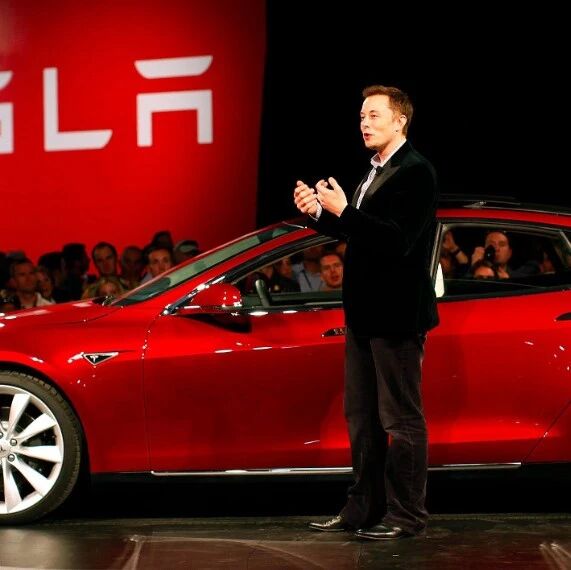
特斯拉“宏图计划4”发布:大规模地将AI融入物理世界,未来80%的价值在于机器人
硬AI· 2025-09-02 10:07
Core Viewpoint - Tesla's latest Master Plan Part IV shifts the company's strategic focus from electric vehicles to artificial intelligence and robotics, aiming to achieve a vision of "sustainable prosperity" through the deep integration of AI with the physical world. CEO Elon Musk stated that approximately 80% of Tesla's future value will come from the Optimus robot [2][3][4]. Group 1: Grand Vision - The ultimate goal defined in the Master Plan IV is to achieve "unconstrained sustainability without compromise" [7]. - The plan emphasizes the integration of AI into physical products and services, building on nearly two decades of experience in electric vehicles, energy products, and humanoid robots [7][14]. - Five guiding principles are proposed: 1. Growth is infinite: Technological innovation can solve resource shortages and create more economic opportunities [8]. 2. Innovation eliminates limitations: Continuous innovation can overcome seemingly impossible obstacles [9]. 3. Technology solves real problems: Products like autonomous vehicles and Optimus aim to address issues such as traffic safety and efficiency [10]. 4. Autonomy must benefit all humanity: The development and application of autonomous technology should enhance human well-being [28]. 5. Broader accessibility drives greater growth: Providing advanced technology products at affordable prices is essential for building a prosperous society [11][30]. Group 2: Mixed Reactions - The market response to Tesla's grand vision has been mixed, with some viewing it as a redefinition of large-scale autonomous driving, while others criticize it as vague promises lacking concrete execution paths [35][36]. - Critics argue that the plan resembles a collection of ambiguous AI commitments, with some questioning the feasibility of delivering on such ambitious goals [5][41]. - Concerns have been raised about Tesla's ability to attract top AI talent compared to competitors like OpenAI, Microsoft, and Apple, due to Musk's management style and company culture [44][45].
马斯克发布《宏伟蓝图4》:特斯拉80%价值在于机器人,还意外露出了一款新车
3 6 Ke· 2025-09-02 07:33
Core Insights - Tesla's latest release, "Master Plan Part IV," indicates a significant shift towards robotics, with Elon Musk stating that approximately 80% of the company's future value will derive from the Optimus robot [1][36] - The plan emphasizes integrating AI into the physical world to achieve "sustainable prosperity," marking a paradigm shift from previous plans focused primarily on electric vehicles and energy solutions [7][36] Summary by Sections Vision and Goals - The core vision of "Master Plan Part IV" is to bring AI into the real world and unify Tesla's hardware and software on a large scale to achieve sustainable prosperity [7][36] - The plan aims to create a world that humanity has just begun to imagine, leveraging Tesla's manufacturing capabilities and innovation to enhance global prosperity and happiness [7][36] Principles Outlined - **Principle 1: Growth is Infinite** - Growth in one area does not necessitate decline in another; technological advancements can alleviate resource scarcity [10][11] - **Principle 2: Innovation Removes Constraints** - Historical innovations, such as electric vehicles, have expanded possibilities rather than limited them [12][12] - **Principle 3: Technology Solves Tangible Problems** - Products and services developed will address real-world issues, enhancing efficiency and sustainability [13][14] - **Principle 4: Autonomy Must Benefit All of Humanity** - Automation technologies should improve human living conditions and promote prosperity [17][17] - **Principle 5: Greater Access Drives Greater Growth** - Making advanced technologies affordable and scalable is essential for societal prosperity [18][18] Challenges and Steps Forward - The company acknowledges that achieving these ambitious goals will be extremely challenging and requires relentless execution [20][20] - The journey begins with incremental steps, as demonstrated by the successful launch of various vehicle models over the years [22][23] Comparison with Previous Plans - "Master Plan Part IV" represents a significant shift from earlier plans, which focused on electric vehicles and energy solutions, to a broader integration of AI and robotics [36][36] - Previous plans laid the groundwork for Tesla's evolution from an automotive company to a comprehensive energy and technology firm, with each iteration building on the last [25][26][34]
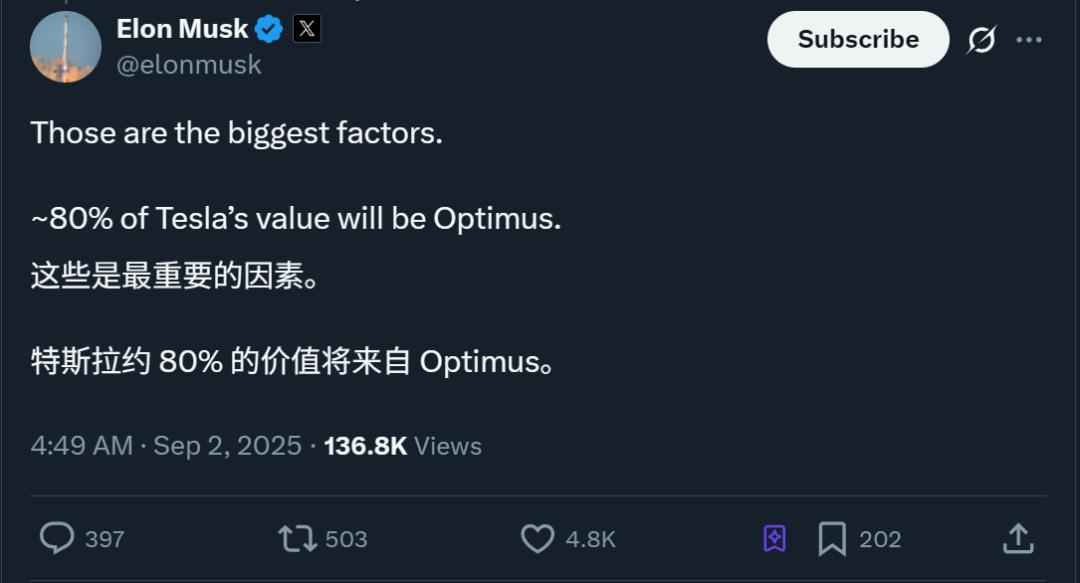
特斯拉“宏图计划4”:AI、人形机器人与自动驾驶的未来蓝图
Jin Shi Shu Ju· 2025-09-02 06:58
Core Viewpoint - Tesla's "Master Plan Part IV" aims to drive the transition to a sustainable and abundant society through electric vehicles, energy products, and humanoid robots, emphasizing the importance of innovation and autonomous technology [2][6][17] Group 1: Infinite Growth - The company asserts that growth in one area does not necessitate a decline in another, and that technological advancements can address resource shortages [8][10] - The mission is to create tools that enhance human life quality through automation and innovation, expanding economic opportunities for all [12][13] Group 2: Innovation and Problem Solving - Tesla has overcome technological limitations in battery development, contributing to the renewable energy sector [10][11] - Products like solar power and large-scale battery storage improve the availability and reliability of clean energy in communities [11] - The Optimus humanoid robot is designed to change perceptions of labor and increase the availability of labor for more fulfilling tasks [11][12] Group 3: Accessibility and Democratization - The company is focused on producing affordable, high-tech products at scale to democratize society and enhance quality of life for everyone [3][13] - The goal is to create opportunities for all individuals to utilize their abilities and achieve their aspirations [14] Group 4: Challenges and Future Vision - The transition to sustainable abundance is acknowledged as a difficult challenge that requires persistent and meticulous execution [15] - The company believes that overcoming these challenges will reveal possibilities previously deemed impossible, ultimately benefiting future generations [15][17]
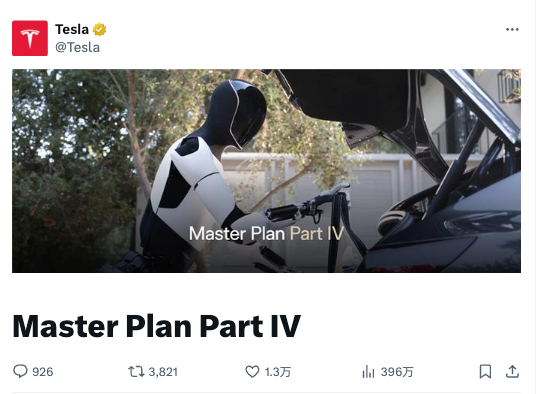
特斯拉进入印度市场期待已久,自7月中旬开始销售以来,仅收到了600多辆汽车订单!这一数字低于公司预期
Sou Hu Cai Jing· 2025-09-02 04:47
Core Insights - Tesla's entry into the Indian market has not met expectations, with low order volumes raising concerns about the company's global growth prospects [1] Group 1: Performance Metrics - Since starting sales in mid-July, Tesla has received over 600 orders, which is below the company's own expectations [1] - This order volume is roughly equivalent to the number of vehicles Tesla delivers globally every four hours during the first half of the year [1] Group 2: Future Plans - Tesla plans to ship between 350 to 500 vehicles to India this year, with the first batch expected to arrive from Shanghai in early September [1]