军工

Search documents
缩量5000亿调整后,A股再获布局良机?
第一财经· 2025-09-04 03:13
Market Overview - On September 3, the stock indices closed mixed, with the Shanghai Composite Index down 1.16% at 3813.56 points, the Shenzhen Component Index down 0.65% at 12472.0 points, and the ChiNext Index up 0.95% at 2899.37 points [2] - The total trading volume for the day was 2.4 trillion yuan, a decrease of over 500 billion yuan compared to September 2 [2] Market Sentiment and Analysis - Industry experts remain optimistic, viewing the current market adjustment as a mid-to-long-term investment opportunity, with sufficient upward momentum still present [2] - The market is experiencing a structural bull market adjustment, characterized by a temporary contraction in risk appetite and a technical pullback [3] - Quality stocks, particularly in the pharmaceutical and consumer sectors, are still considered undervalued, presenting a long-term investment opportunity [2][3] Investment Recommendations - Investors are advised to focus on sectors such as pharmaceuticals, consumer goods, non-bank financials, metals, and military industry [2] - Short-term adjustments are influenced by seasonal factors, real estate data, and external risks, but low-entry opportunities are emerging [3] - Key sectors to watch include non-bank financials, military, and metals, with specific attention to gold and rare earths benefiting from geopolitical changes [3] Market Dynamics - The market is showing signs of a high-low switch within growth styles, indicating a shift in investment focus [3] - New hotspots such as consumer electronics, solid-state batteries, and power equipment are attracting capital, demonstrating resilience [3]


A股指数走弱,创业板指下挫跌逾3%,沪指跌1.64%,深成指跌2.17%,科创50跌近5%!算力硬件、军工、半导体领跌,近2500股下跌
Ge Long Hui· 2025-09-04 02:58
Group 1 - The A-share major indices weakened, with the ChiNext index dropping over 3%, the Shanghai Composite Index down 1.64%, the Shenzhen Component Index down 2.17%, and the Sci-Tech 50 index falling nearly 5% [1] - Sectors such as computing hardware, military industry, and semiconductors experienced significant declines, with nearly 2,500 stocks in the Shanghai, Shenzhen, and Beijing markets falling [1]

A股军工股集体回调,长城军工、建设工业跌停
Ge Long Hui A P P· 2025-09-04 02:41
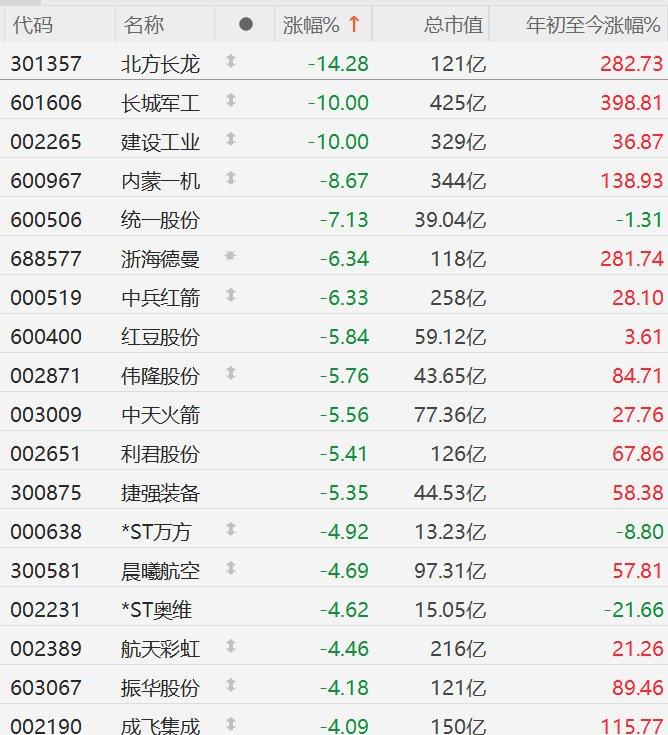
Core Viewpoint - The A-share market experienced a collective pullback in military stocks, with significant declines observed across various companies in the sector [1]. Group 1: Stock Performance - North China Long Dragon (北方长龙) saw a decline of 14.28%, with a total market capitalization of 12.1 billion and a year-to-date increase of 282.73% [2]. - Great Wall Military Industry (长城军工) dropped by 10%, holding a market cap of 42.5 billion and a year-to-date increase of 398.81% [2]. - Construction Industry (建设工业) also fell by 10%, with a market value of 32.9 billion and a year-to-date increase of 36.87% [2]. - Inner Mongolia First Machinery (内蒙一机) decreased by 8.67%, with a market cap of 34.4 billion and a year-to-date increase of 138.93% [2]. - Unified Shares (统一股份) experienced a decline of 7.13%, with a market capitalization of 3.904 billion and a year-to-date decrease of 1.31% [2]. - Zhejiang Haideman (浙海德曼) fell by 6.34%, with a market cap of 11.8 billion and a year-to-date increase of 281.74% [2]. - China Aerospace Rainbow (中兵红箭) decreased by 6.33%, with a market capitalization of 25.8 billion and a year-to-date increase of 28.10% [2]. - Other notable declines include Weilon Shares (伟隆股份) down 5.76%, Zhongtian Rocket (中天火箭) down 5.56%, and Lijun Shares (利君股份) down 5.41% [2].


军工股集体回调,长城军工、建设工业跌停
Ge Long Hui· 2025-09-04 02:26
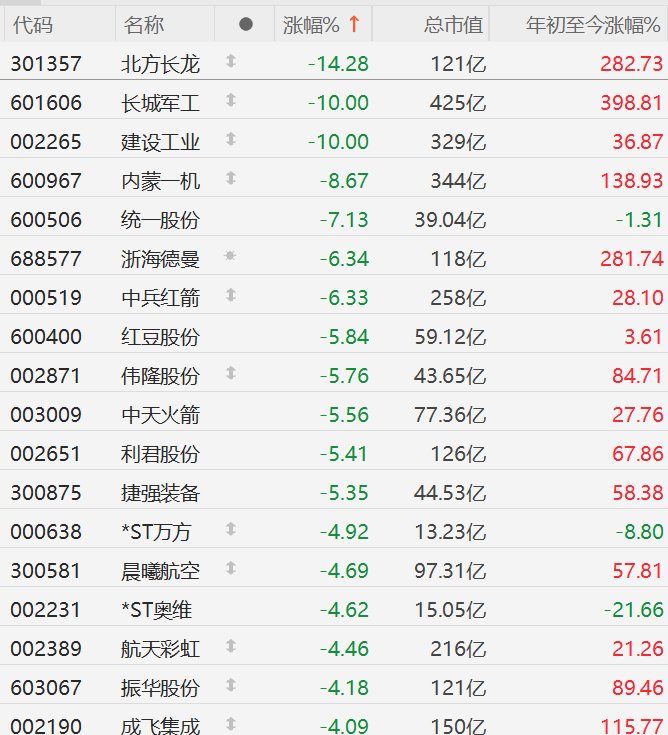
Core Viewpoint - The A-share market has experienced a collective pullback in military stocks, with significant declines observed across various companies in the sector [1] Group 1: Stock Performance - North China Long Dragon (北方长龙) saw a decline of over 14%, with a total market capitalization of 12.1 billion and a year-to-date increase of 282.73% [2] - Great Wall Industry (长城军工) and Construction Industry (建设工业) both hit the 10% daily limit down, with market capitalizations of 42.5 billion and 32.9 billion respectively, and year-to-date increases of 398.81% and 36.87% [2] - Inner Mongolia First Machinery (内蒙一机) dropped over 8.67%, with a market cap of 34.4 billion and a year-to-date increase of 138.93% [2] - Unified Shares (统一股份) fell by over 7.13%, with a market cap of 3.904 billion and a slight year-to-date decrease of 1.31% [2] - Zhejiang Haideman (浙海德曼) and China Aerospace Science and Industry Corporation (中兵红箭) both experienced declines of over 6%, with market caps of 11.8 billion and 25.8 billion respectively [2] - Other notable declines include Weilon Shares (伟隆股份) down over 5.76%, with a market cap of 4.365 billion and a year-to-date increase of 84.71% [2] - Zhongtian Rocket (中天火箭) and Lijun Rainbow (利君彩虹) also saw declines of over 5%, with market caps of 7.736 billion and 12.6 billion respectively [2]


A股三大指数走低,沪指、深证成指跌超1%,创业板指跌1.5%,科创50指数跌近3%,CPO、银行、军工、半导体领跌!1700股下跌
Ge Long Hui· 2025-09-04 02:19
Group 1 - The A-share major indices continued to decline, with the Shanghai Composite Index and Shenzhen Component Index both dropping over 1%, while the ChiNext Index fell by 1.5% and the STAR Market 50 Index decreased by nearly 3% [1] - Sectors such as CPO, banking, military industry, and semiconductors experienced significant declines, contributing to the overall market downturn [1] - Nearly 1,700 stocks in the Shanghai, Shenzhen, and Beijing markets saw declines [1]
A股主要指数走弱,创业板指跌逾1%,沪指跌0.82%,CPO、银行、军工、半导体领跌,下跌个股近1900只
Ge Long Hui· 2025-09-04 02:07
格隆汇9月4日|A股主要指数走弱,创业板指跌逾1%,沪指跌0.82%,深成指跌0.66%。CPO、银行、 军工、半导体等方向跌幅居前,沪深京三市下跌个股近1900只。 (责任编辑:宋政 HN002) 【免责声明】本文仅代表作者本人观点,与和讯网无关。和讯网站对文中陈述、观点判断保持中立,不对所包含内容 的准确性、可靠性或完整性提供任何明示或暗示的保证。请读者仅作参考,并请自行承担全部责任。邮箱: news_center@staff.hexun.com ...
A股开盘速递 | A股走势分化!沪指失守3800点、创指涨超1% 银行板块下挫
智通财经网· 2025-09-04 01:56
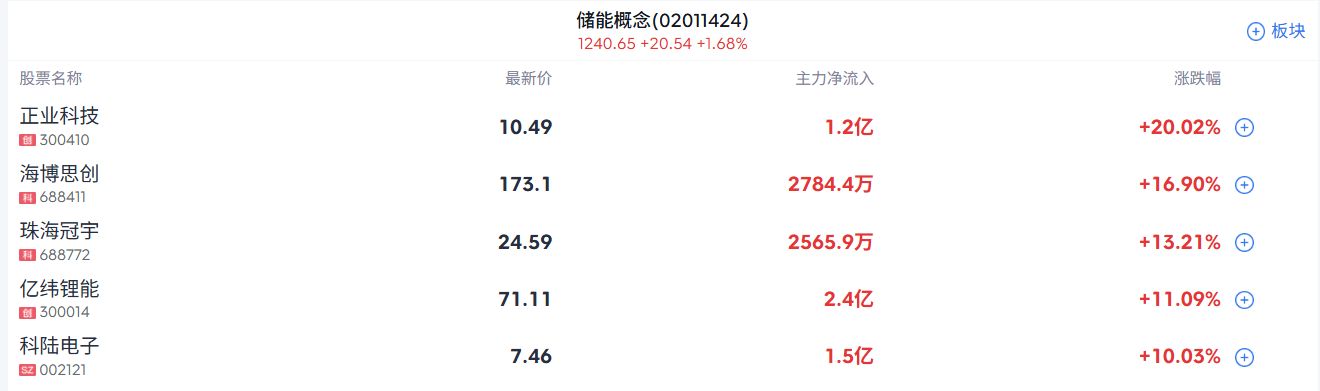
Market Overview - The A-share market showed mixed performance on September 4, with the Shanghai Composite Index falling below 3800 points, down 0.45%, while the Shenzhen Component Index rose by 0.77% and the ChiNext Index increased by 1.47% [1] - The market is expected to enter a phase of high-level fluctuations, with structural adjustments and clear sector rotations, although the extent of the decline is anticipated to be limited [1][5] Key Sectors Energy Storage Sector - The energy storage sector continued its strong performance, with companies like Tongrun Equipment achieving two consecutive trading limits, and Kelu Electronics hitting the daily limit [1] - The surge in demand for energy storage in overseas markets has led to a significant increase in orders for domestic energy storage cell manufacturers, resulting in full production capacity [1] Technology Sector - According to Guangfa Securities, investors holding positions in the technology sector should maintain their investments, as the valuation differentiation is not significant at this stage [3] - Dongwu Securities emphasizes focusing on AI applications, suggesting that if there is a correction in upstream hardware, it could present opportunities for investment in AI-related sectors [4] Investment Recommendations - Guangfa Securities recommends continuing to focus on the technology industry, particularly in areas like overseas computing power and innovative pharmaceuticals, which are still progressing in the bull market [3] - Dongwu Securities suggests that the current market environment, with ample trading volume, favors investments in AI-centric technologies, viewing them as a "bullish option" for future growth [4]
缩量5000亿调整后,A股再获布局良机?
Di Yi Cai Jing· 2025-09-04 01:51
Group 1 - The market experienced a mixed performance on September 3, with the Shanghai Composite Index closing at 3813.56 points, down 1.16%, while the Shenzhen Component Index and the ChiNext Index saw slight declines and gains respectively [1] - The overall trading volume decreased significantly, with a total turnover of 2.4 trillion yuan, down over 500 billion yuan compared to September 2 [1] - Analysts remain optimistic about the market's medium to long-term prospects, suggesting that the current adjustment presents opportunities for strategic investments, particularly in sectors such as pharmaceuticals, consumer goods, non-bank financials, metals, and military industry [1] Group 2 - Short-term market adjustments are attributed to seasonal factors, real estate data, and external risks, but opportunities for low-position investments are emerging, supported by expectations of Federal Reserve rate cuts and domestic policy effects [2] - The market is showing signs of a "high-low switch" within growth stocks, with analysts recommending a focus on undervalued sectors and growth technology, while remaining cautious of real estate chain impacts and global political risks [2] - Specific sectors such as non-bank financials, military industry, and metals are highlighted for their potential due to favorable market conditions and low valuations, with non-bank financials expected to benefit from the bull market cycle [2]
缩量5000亿调整后,A股再获布局良机?|市场观察
Di Yi Cai Jing Zi Xun· 2025-09-04 01:45
Group 1 - The A-share market experienced mixed performance on September 3, with the Shanghai Composite Index closing at 3813.56 points, down 1.16%, while the ChiNext Index rose by 0.95% to 2899.37 points [1] - The total trading volume for the day was 2.4 trillion yuan, a decrease of over 500 billion yuan compared to September 2 [1] - Analysts remain optimistic about the market's medium to long-term prospects, suggesting that the current adjustment presents opportunities for strategic positioning, particularly in sectors such as pharmaceuticals, consumer goods, non-bank financials, metals, and military industry [1] Group 2 - Short-term market adjustments are attributed to seasonal factors, real estate data, and external risks, but opportunities for low-position investments are emerging [2] - Key supporting factors for the market include expectations of interest rate cuts by the Federal Reserve, domestic policy effects, valuation advantages of Chinese assets, and structural industry prosperity [2] - The market is expected to continue experiencing volatility in the short term, but high-quality assets will have investment value post-adjustment [2] Group 3 - The market is showing signs of internal style rotation, with a shift from leading stocks to new hotspots such as consumer electronics, solid-state batteries, and power equipment, indicating a need for sector rotation [2] - Analysts recommend focusing on non-bank financials, military industry, and metals sectors, with non-bank financials benefiting from the bull market cycle and having high earnings improvement certainty [2] - Specific sub-sectors within metals, such as gold and rare earths, are expected to benefit from changes in the geopolitical landscape, while the military sector may continue to be catalyzed by unique demand cycles [2]
稀土技术封锁:中国对全球军事工业的隐形影响
Sou Hu Cai Jing· 2025-09-04 00:55
Core Insights - In April 2023, China intensified export controls on seven types of rare earth materials, initially garnering little attention, but soon causing significant pressure on companies in Japan, Germany, and the United States, particularly in the military sector due to rare earth shortages [1][8] Group 1: Rare Earth Elements - Rare earths are not just ores but a complex of 17 elements including samarium, gadolinium, and neodymium, making the separation and purification process extremely complex [3] - Despite having rich rare earth mines, Western countries lag significantly behind China in separation and purification technology, with China's extraction rate at 91% compared to 82% in the West, leading to substantial cost and technical challenges in high-end manufacturing [5] Group 2: Military Applications - High-end weapons such as the F-35 stealth fighter and nuclear submarines heavily rely on high-performance rare earth materials, with their absence affecting the functionality of radar and guidance systems [7] - The rejection of Rheinmetall's application to purchase rare earths and the stagnation of South Korea's KF-X fighter project highlight the strategic risks posed by Western reliance on Chinese rare earths [8] Group 3: Supply Chain and Strategic Risks - Western countries have long depended on China's low-cost, high-quality rare earth supply without backup plans, leading to vulnerabilities in their defense industries amid tightening supply [10] - The EU's pressure on China has been ineffective, resulting in countermeasures such as increased tariffs, while the U.S. attempts to exchange EDA software for high-end rare earths yielded only low-end materials, indicating a stark difference in the utility of various quality levels of rare earths [10] Group 4: Technological Advantage - The production processes for low-end and high-end rare earths are entirely different, with high-end separation technologies requiring long-term accumulation of expertise, which China possesses [12] - Key rare earth inventories for German wind turbine manufacturers and French nuclear power plants are nearing depletion, reflecting a neglect of technological research and supply chain security in the West, while underscoring China's core position in high-tech manufacturing [14] Group 5: Future Implications - The global recognition of technology and knowledge as more critical than mere resources has emerged, with advanced processing technologies being difficult to replicate, solidifying China's unassailable position in rare earth separation [16] - China's continued leadership in the rare earth sector will directly influence the military industrial landscape and development trajectories of various countries [16]