基金

Search documents
市场本周调整,关注A500ETF易方达(159361)、沪深300ETF易方达(510310)等产品中长期投资价值
Sou Hu Cai Jing· 2026-02-06 15:06
Market Overview - The three major A-share indices collectively adjusted this week, with the Shanghai Composite Index down by 1.3%, the CSI 500 Index down by 1.8%, the ChiNext Index down by 3.3%, the STAR Market 50 Index down by 5.8%, and the Hang Seng China Enterprises Index down by 3.1% [1][3]. Sector Performance - In terms of sector performance, photovoltaic equipment, batteries, power grid equipment, traditional Chinese medicine, banks, and home appliances saw the highest gains, while precious metals, semiconductors, storage chips, and AI applications experienced the largest declines [1]. Index Details - The CSI 300 Index consists of 300 large-cap stocks with good liquidity, covering 11 first-level industries [4]. - The CSI 500 Index includes 500 stocks with larger market capitalization and liquidity, covering 89 of the 93 third-level industries [4]. - The ChiNext Index is composed of 100 stocks from the ChiNext board, with a high proportion of strategic emerging industries, particularly in power equipment, communications, and electronics, which together account for nearly 60% [4]. - The STAR Market 50 Index includes 50 large-cap stocks from the STAR Market, with a significant focus on "hard technology," where semiconductors make up over 50% and combined with medical devices and photovoltaic equipment, they account for nearly 75% [4]. - The Hang Seng China Enterprises Index consists of 50 large-cap, actively traded stocks listed in Hong Kong, covering a wide range of industries, with consumer discretionary, information technology, finance, and energy sectors making up nearly 85% [4]. Valuation Metrics - The rolling price-to-earnings (P/E) ratios for the indices are as follows: CSI 300 at 14.1x, CSI 500 at 17.2x, ChiNext at 41.8x, STAR Market 50 at 162.9x, and Hang Seng China Enterprises at 10.6x [3]. - The rolling P/E ratio percentiles indicate that the CSI 300 is at the 62.9th percentile, CSI 500 at 75.0th percentile, ChiNext at 37.8th percentile, STAR Market 50 at 94.9th percentile, and Hang Seng China Enterprises at 64.8th percentile [3]. Historical Performance - Over the past month, the indices have shown the following cumulative performance: CSI 300 down by 2.8%, CSI 500 down by 1.2%, ChiNext down by 2.8%, STAR Market 50 down by 1.5%, and Hang Seng China Enterprises down by 1.2% [7]. - Year-to-date performance shows the CSI 300 up by 0.3%, CSI 500 up by 2.6%, ChiNext up by 1.0%, STAR Market 50 up by 5.8%, and Hang Seng China Enterprises up by 1.3% [7]. - Over the past year, the cumulative performance is as follows: CSI 300 up by 19.3%, CSI 500 up by 25.7%, ChiNext up by 48.8%, STAR Market 50 up by 39.6%, and Hang Seng China Enterprises up by 16.0% [7].


科创板本周回调,资金回流相关ETF,科创50ETF易方达(588080)本周净流入超8亿元
Sou Hu Cai Jing· 2026-02-06 15:06
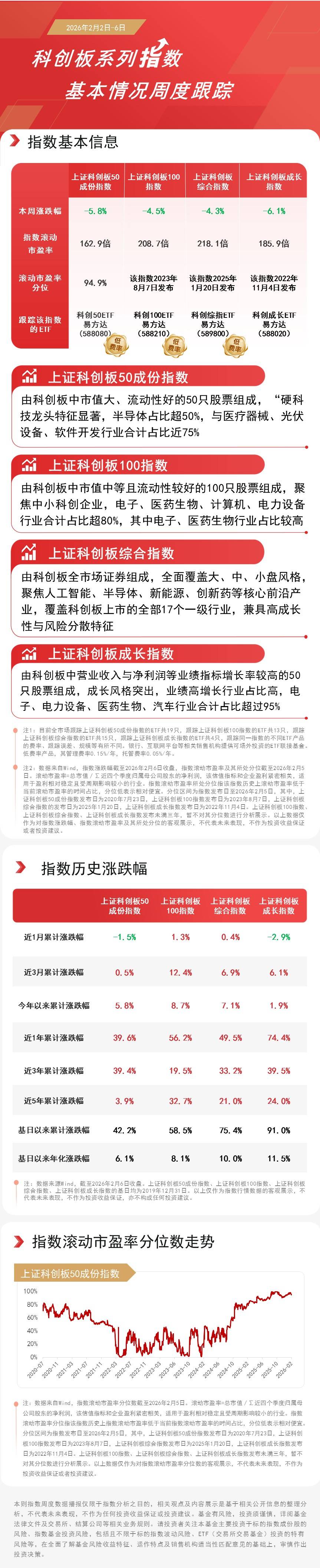
Market Performance - The Sci-Tech Innovation Index fell by 4.3%, the Sci-Tech 100 Index decreased by 4.5%, the Shanghai Sci-Tech 50 Index dropped by 5.8%, and the Shanghai Sci-Tech Growth Index declined by 6.1% this week [1][3]. - The cumulative performance over the past month shows a decline of 1.5% for the Sci-Tech 50 Index, an increase of 1.3% for the Sci-Tech 100 Index, a 0.4% rise for the comprehensive index, and a decrease of 2.9% for the growth index [8]. Fund Flows - The E Fund Sci-Tech 50 ETF (588080) experienced a net inflow of over 800 million yuan in the first four trading days of this week [1]. Index Characteristics - The Shanghai Sci-Tech 100 Index consists of 100 stocks with medium market capitalization and good liquidity, focusing on small and medium-sized innovative enterprises, with over 80% of its composition in the electronics, biomedicine, computer, and power equipment sectors [5]. - The Shanghai Sci-Tech Comprehensive Index covers all securities in the Sci-Tech board, focusing on core industries such as artificial intelligence, semiconductors, new energy, and innovative pharmaceuticals, encompassing all 17 primary industries listed on the Sci-Tech board [5]. - The Shanghai Sci-Tech Growth Index is composed of 50 stocks with high growth rates in revenue and net profit, with over 95% of its composition in the electronics, power equipment, biomedicine, and automotive sectors [5]. Valuation Metrics - The rolling price-to-earnings (P/E) ratios are as follows: 162.9x for the Sci-Tech 50 Index, 208.7x for the Sci-Tech 100 Index, 218.1x for the comprehensive index, and 185.9x for the growth index [3][6].
创业板震荡整固,创业板ETF易方达(159915)本周连续5个交易日获资金净申购
Sou Hu Cai Jing· 2026-02-06 15:06
Core Viewpoint - The ChiNext mid-cap 200 index fell by 2.9%, the ChiNext index decreased by 3.3%, and the ChiNext growth index dropped by 4.2% this week, while ETFs tracking these indices saw a net inflow of over 1.6 billion yuan [1][2]. Group 1: Index Performance - The ChiNext index experienced a weekly decline of 3.3% [2]. - The ChiNext mid-cap 200 index decreased by 2.9% [2]. - The ChiNext growth index fell by 4.2% [2]. Group 2: ETF Activity - The E Fund ChiNext ETF (159915) saw a net inflow of over 1.6 billion yuan in the first four trading days of the week, with an additional 40 million shares net subscribed on Friday [1]. - There are currently 17 ETFs tracking the ChiNext index, 5 tracking the ChiNext mid-cap 200 index, and 1 tracking the ChiNext growth index [4]. Group 3: Sector Composition - The ChiNext mid-cap 200 index consists of 200 stocks with medium market capitalization and good liquidity, with the information technology sector accounting for over 40% [4]. - The ChiNext growth index is composed of 50 stocks with prominent growth styles and high earnings growth, with the power equipment, pharmaceutical, and communication sectors collectively making up about 60% [4]. Group 4: Valuation Metrics - The rolling price-to-earnings (P/E) ratio for the ChiNext index is 41.8 times, for the mid-cap 200 index is 109.5 times, and for the growth index is 40.4 times [2]. - The rolling P/E ratio percentile for the ChiNext index is at 37.8%, while the mid-cap 200 index does not have a percentile analysis available due to its recent launch [5]. Group 5: Historical Performance - The cumulative performance over the past month shows a decline of 2.8% for the ChiNext index, 0.7% for the mid-cap 200 index, and 3.1% for the growth index [6]. - Year-to-date performance indicates a rise of 1.0% for the ChiNext index, 3.9% for the mid-cap 200 index, and 0.8% for the growth index [7]. - Over the past year, the ChiNext index increased by 48.8%, the mid-cap 200 index by 27.3%, and the growth index by 67.8% [7].


中小盘宽基指数本周调整,关注中证2000ETF易方达(159532)、中证500ETF易方达(510580)等配置机会
Sou Hu Cai Jing· 2026-02-06 15:06
Group 1 - The core point of the article highlights the recent performance of various indices, with the 中证2000 index down by 0.3%, 中证1000 down by 2.5%, 中证500 down by 2.7%, 创业板中盘200 down by 2.9%, and 科创100 down by 4.5% [1][3] - The 中证2000 index serves as a benchmark for small and micro-cap growth stocks in the A-share market, consisting of 2000 stocks with smaller market capitalizations and good liquidity, covering 30 first-level industries [1][5] - The 中证2000 ETF managed by 易方达 has the lowest management fee rate of 0.15% per year, facilitating investors' access to quality growth companies [1][5] Group 2 - The rolling price-to-earnings (P/E) ratios for the indices are as follows: 中证500 at 36.9 times, 中证1000 at 49.2 times, 中证2000 at 164.7 times, 上证科创板100 at 208.7 times, and 创业板中盘200 at 109.5 times [3][6] - The historical performance of the indices shows that over the past month, 中证2000 has increased by 4.2%, while 中证500 and 中证1000 have increased by 3.4% and 1.8% respectively [7] - The cumulative performance for the year to date indicates 中证2000 has risen by 7.8%, while 中证500 and 中证1000 have increased by 9.1% and 6.0% respectively [7]

多赚20%以上,小白也能抓的“增强”红利?盘点2025年最强的指数增强基金!
Sou Hu Cai Jing· 2026-02-06 14:54
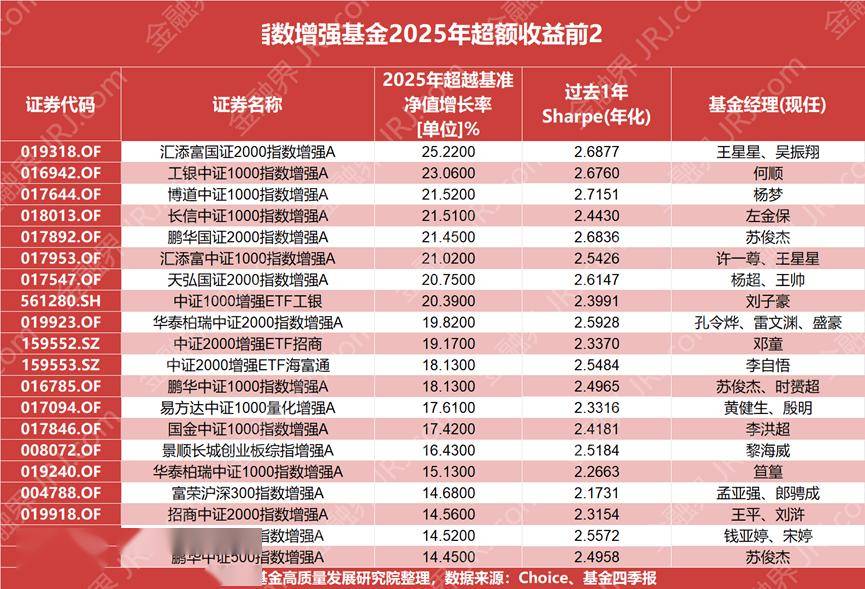
Core Insights - An emerging investment tool, index-enhanced funds, is gaining popularity among investors, with a significant increase in new products and total fundraising in 2025, surpassing previous years' totals [1] - Index-enhanced funds aim not only to track indices but also to outperform them by actively managing a portion of their assets through quantitative models and stock selection [1] Fund Performance - In 2025, the top-performing index-enhanced funds achieved substantial excess returns, particularly those tracking mid and small-cap indices like the Guozhen 2000 and Zhongzheng 1000, with the leading fund, Huaitianfu Guozhen 2000 Index Enhanced A, achieving a net value growth rate of 25.22% [2] - Other notable funds, such as the ICBC Zhongzheng 1000 Index Enhanced A and Baodao Zhongzheng 1000 Index Enhanced A, also reported excess returns exceeding 20% [2] Characteristics of Mid and Small-Cap Funds - Mid and small-cap index-enhanced funds are more successful in generating excess returns due to their index characteristics and the suitability of mainstream enhancement strategies [3] - The large number of constituent stocks in mid-cap indices, such as the Zhongzheng 2000, allows for a broad selection pool, facilitating the identification of potential stocks through quantitative models [3] - Information asymmetry and pricing inefficiencies in mid and small-cap stocks provide opportunities for quantitative strategies to discover mispriced assets and generate alpha returns [3] - The active trading and liquidity of small-cap stocks create a favorable environment for efficient trading execution and short-term price capture, enhancing overall returns [3]
白银LOF五连跌停,超1.7万人集体投诉!国投瑞银基金成立工作组
Mei Ri Jing Ji Xin Wen· 2026-02-06 14:10
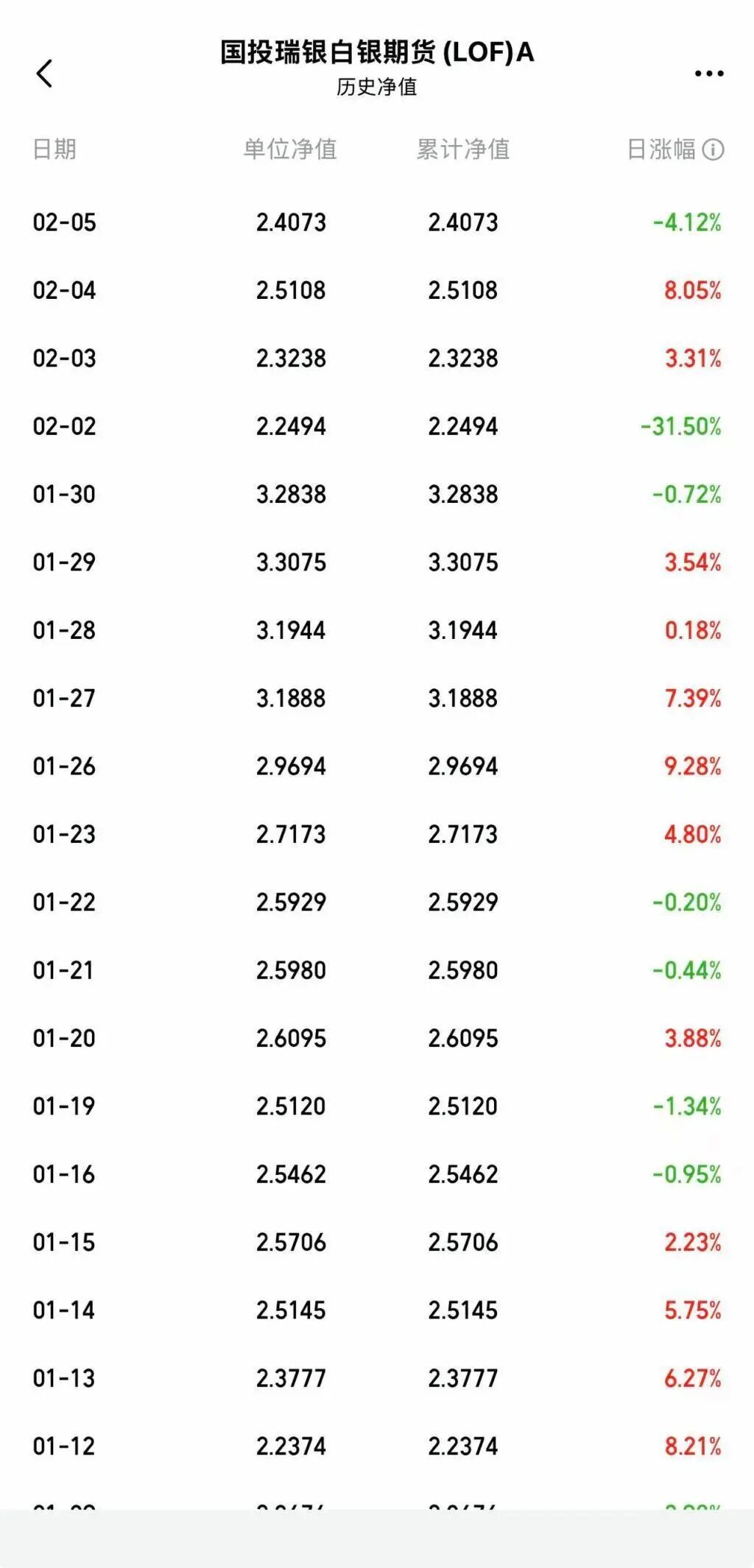
2月6日,国投瑞银基金管理有限公司发布《关于积极解决白银(LOF)基金投资者诉求有关事项的公告》。 公告表示,近期,公司管理的国投瑞银白银期货证券投资基金(LOF)进行估值调整和相关公告引发投资者高度关注。我司高度重视,为积极回 应投资者关切,维护投资者的合法权益,公司现公告如下: 一、践行以投资者为本。公司将秉持依法公开原则,积极回应投资者诉求,努力降低相关估值调整对投资者的影响,保护投资者合法权益。 二、畅通诉求服务渠道。公司已成立工作小组,正在抓紧研究制定相关工作方案,支持投资者便捷地通过和解、调解、仲裁等渠道或方式依法解 决诉求,具体情况将另行公告。 三、公司将积极支持和解、调解、仲裁的有效执行,也有能力保障投资者的合法权益。 2月2日至6日,国投白银LOF场内价格已连续5个交易日"一字跌停",单周大跌40.94%,最新价格报3.099元/份,6日成交金额约2亿元,较场外溢价 28.73%。 (文章内容、数据仅供参考,不构成投资建议。投资者据此操作,风险自担。) 到了2月2日,现货白银价格持续走弱。2月2日晚间,国投瑞银基金宣布自2月2日起,主要投资于上海期货交易所(上期所)挂牌交易白银期货合 约的国 ...
白银LOF连续第5个跌停,高溢价泡沫破裂
Sou Hu Cai Jing· 2026-02-06 14:10
Core Viewpoint - The recent significant decline in the price of silver has led to a drastic drop in the value of the Guotou Silver LOF, which has experienced five consecutive trading halts, resulting in a total price drop of over 40% from its peak [1][5]. Group 1: Price Movement and Market Reaction - The price of Guotou Silver LOF fell from a high of 5.247 to a closing price of 3.099, with a total decline exceeding 40% over five trading days [1][5]. - As of the latest trading session, there were still 7.41 million hands locked at the daily limit down price, indicating a lack of trading activity and opportunities for investors to exit [1][4]. - The premium rate for Guotou Silver LOF, despite the price drop, remains high at 28.7%, although it peaked at 68% during the previous bullish phase [4][5]. Group 2: Causes of the Decline - The sharp decline in silver prices, including a 26% drop on January 30 and a further 20% drop on February 5, has shifted market sentiment, prompting investors to sell off their holdings [6][7]. - Guotou Silver LOF's premium had been sustained above 20% since December, driven by market enthusiasm, but the recent price volatility has led to a rapid correction [5][7]. - The adjustment in valuation methodology by Guotou Ruijin, switching from domestic silver futures to the London Bullion Market Association (LBMA) silver spot price, resulted in a 31.5% drop in net asset value, exacerbating market panic [5][6]. Group 3: Future Outlook - The current market sentiment suggests that if silver prices do not recover, Guotou Silver LOF may continue to face downward pressure, with the possibility of further trading halts [7]. - The premium rate has decreased to 28.73%, but it remains significantly above what is considered a reasonable level, indicating potential for further corrections [7].
蚂蚁基金王珺:财富管理迈入指数投资时代,平台指数基金投资者已超1亿
Sou Hu Cai Jing· 2026-02-06 14:00
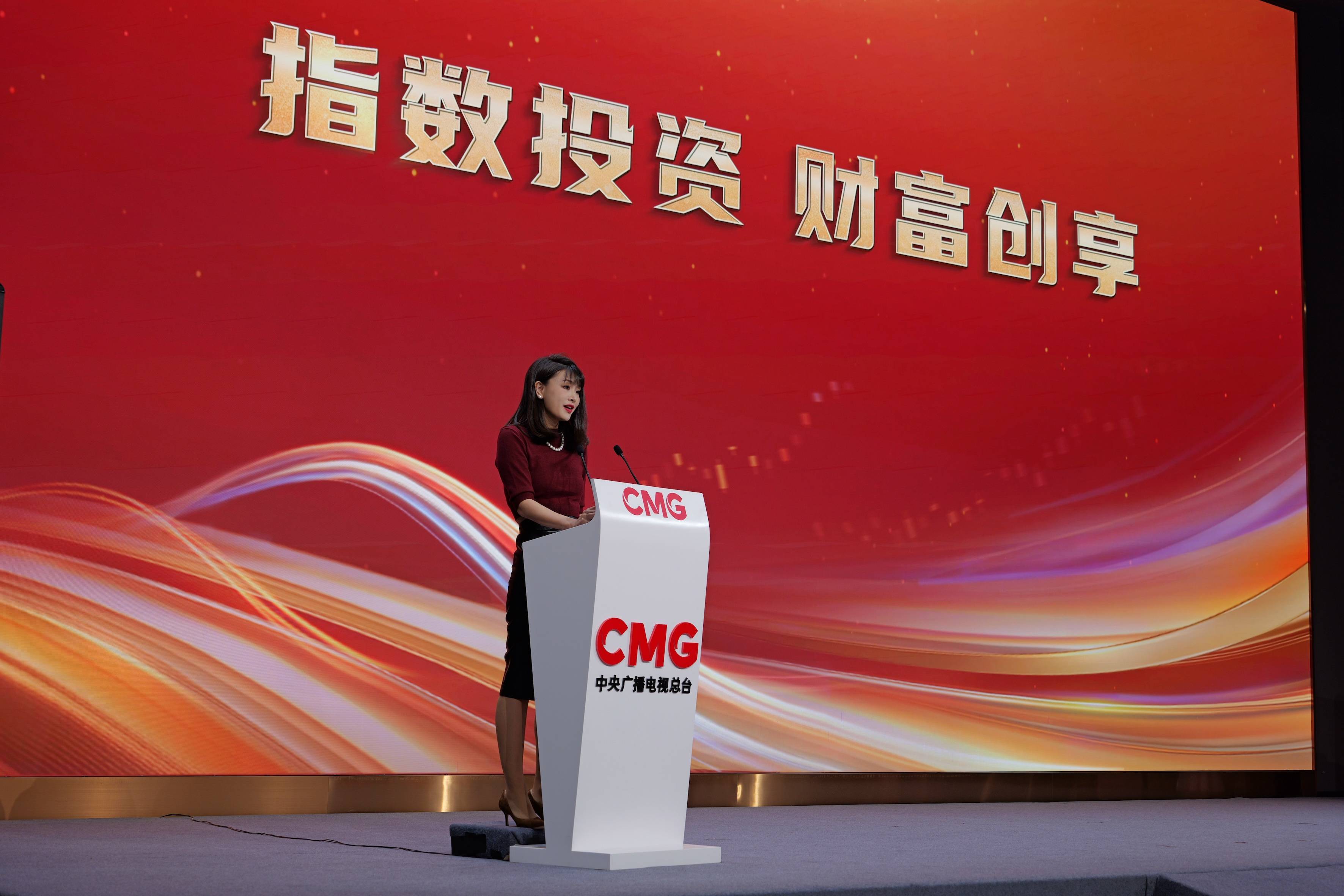
Core Insights - The acceleration of index investment has become a widely accepted consensus, with discussions on how the capital market can enhance its service to the real economy through various dimensions such as policy empowerment and technological drivers [2] Index Investment - As of the end of 2025, the total scale of index fund products is expected to exceed 8 trillion yuan, representing a nearly 40% increase from the beginning of the year, with broad-based funds accounting for 49% of the overall index fund scale [3] Drivers of Index Fund Growth - The growth of index funds is attributed to three irreversible drivers: 1. The achievements of high-quality development in the capital market, providing more investment opportunities through the development of strategic emerging industries 2. The resonance of policy dividends, with the implementation of the new "National Nine Articles" and "long money long investment" policies boosting confidence in the market 3. The reshaping of tool value, where index products gradually replace traditional investment fields due to their low cost, high efficiency, and clear style [6] Investor Behavior and Trends - On the Ant Fund platform, the number of investors trading index products has surpassed those in active equity products, with over 100 million index fund investors expected by the end of 2025, of which over 50% are from the post-90s and post-00s generations [6] - The platform promotes rational scientific allocation and long-term investment, with over 30 million investors having initiated regular investments in index funds. Individual investors hold broad-based funds for an average of over 1,000 days, with 97% of those holding broad-based funds being profitable by 2025, significantly higher than the industry average [7] ETF Development and Financial Inclusion - ETFs are seen as a key tool for fulfilling the capital market's mission, serving as a core vehicle for wealth management and financial inclusion, while also supporting national strategies. The current challenges include insufficient tools and disconnected channels, necessitating optimization in product design, institutional supply, and ecological construction [8] Market Trends and Investment Opportunities - The focus of the market has shifted towards "new resources" that support the intelligent world and green revolution, with historical investment opportunities arising from the collision of rigid supply due to years of insufficient capital expenditure in the global resource sector and sudden demand changes [11] - The artificial intelligence sector is expected to experience significant advancements, with trends indicating a high growth in computing power demand and the arrival of the AI large model application era. Given the complexity and rapid iteration of the AI industry, diversified investment strategies through ETFs are recommended to mitigate risks [11]
白银LOF五连跌停,超1.7万人集体投诉!国投瑞银基金成立工作组:支持投资者通过和解、调解、仲裁等渠道依法解决诉求
Mei Ri Jing Ji Xin Wen· 2026-02-06 13:48
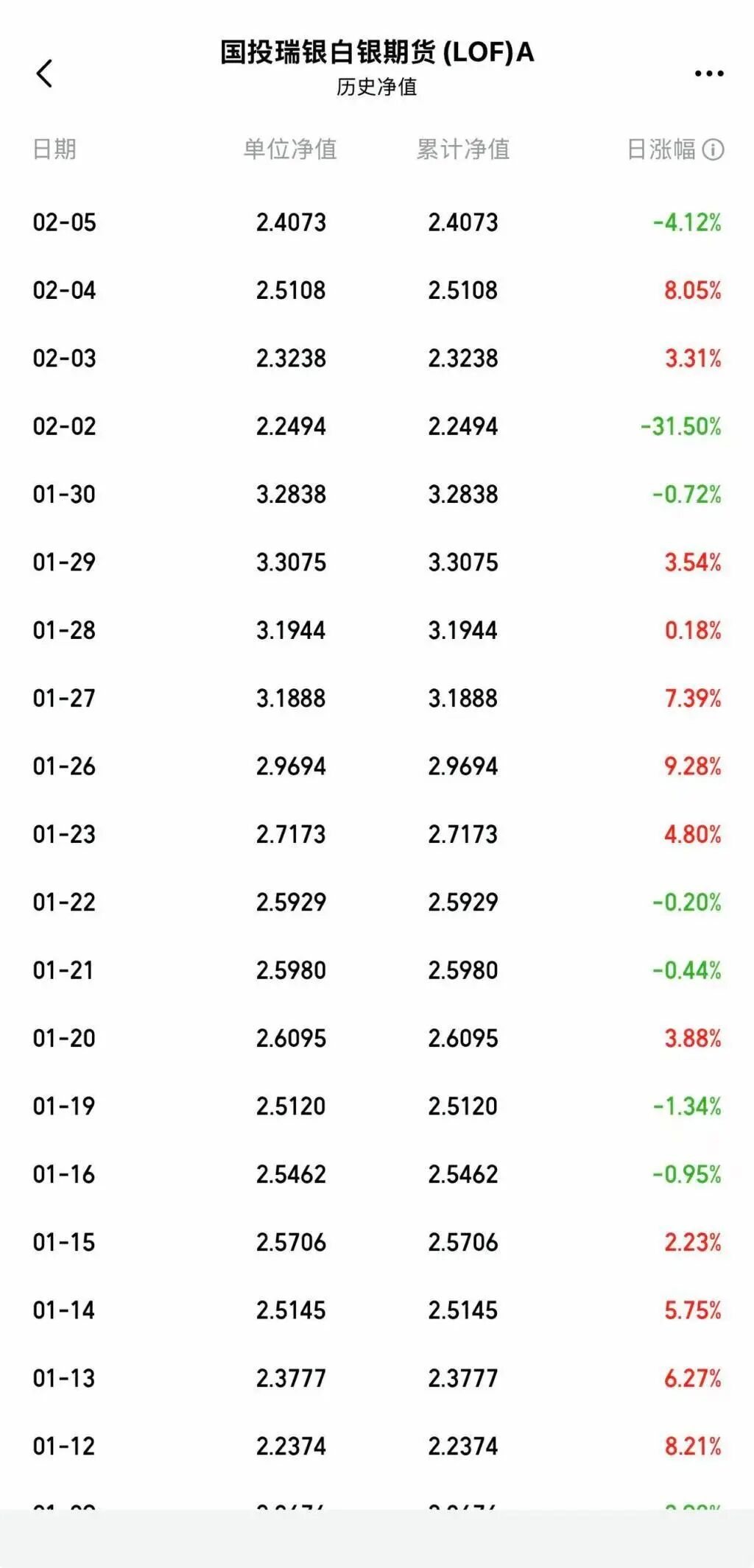
Core Viewpoint - The announcement from Guotou Ruijin Fund Management Co., Ltd. addresses investor concerns regarding the valuation adjustments of the Guotou Ruijin Silver Futures Securities Investment Fund (LOF) following significant price fluctuations in silver [1][2]. Group 1: Company Response - The company emphasizes its commitment to investor interests and will respond to investor demands while striving to minimize the impact of valuation adjustments on investors [1]. - A working group has been established to facilitate the resolution of investor claims through mediation, arbitration, and other legal channels [1][2]. Group 2: Market Impact - On January 30, precious metals experienced a historic drop, with silver prices falling by 35.89% at one point and closing down 26.42%, leading to a 0.72% decline in the net value of the Guotou Silver LOF [2]. - On February 2, the fund's net value was re-evaluated based on international market price fluctuations, resulting in a dramatic 31.50% drop in a single day, marking a rare record in the public fund industry [2][3]. Group 3: Investor Reactions - The valuation adjustment has sparked controversy among investors, with many expressing dissatisfaction over the lack of prior notice regarding the new valuation method, which they believe led to unexpected losses [4][5]. - Complaints regarding the fund's actions have surged on various platforms, with over 17,600 collective complaints recorded, indicating significant investor unrest [5].
白银LOF引爆舆论:普通人投资最怕的不是亏钱,而是被“突然袭击”
Sou Hu Cai Jing· 2026-02-06 13:15
Core Viewpoint - The key lesson from the silver LOF incident is that while price drops are not alarming, a lack of transparency is concerning [4][27]. Group 1: Key Issues of the Incident - The valuation method was abruptly switched from domestic futures settlement prices to international silver prices, which changed the rules unexpectedly [4][6]. - There were inconsistencies in the price reference for gains and losses, leading investors to feel there was a double standard [4][6]. - The sudden adjustment in valuation methods was not communicated in advance, leaving investors unprepared [4][6]. Group 2: Risks Associated with Commodity Funds - Commodity funds are more complex than merely tracking metal prices; they involve various valuation methods including domestic futures, international spot prices, and post-market valuation models [8][9]. - The structure of futures contracts introduces risks, such as high rollover costs, which can lead to discrepancies between commodity price increases and fund performance [10]. - Leverage and margin risks are significant, as futures inherently have higher volatility compared to spot prices, potentially leading to greater fund losses [11][12]. - Liquidity risks are present due to smaller fund sizes and less active trading, which can result in price discrepancies during market fluctuations [14]. - Tracking error risks can occur, especially during volatile overseas markets or when domestic and international prices diverge [14]. Group 3: Key Information for Investors - Investors must understand the underlying assets of the fund, whether they are in spot or futures, and whether they are domestic or international [16]. - Clarity on the valuation method and potential adjustments is crucial, as seen in the silver LOF incident [16]. - The liquidity of the fund should be assessed, as smaller, less active funds are prone to price discrepancies [16]. - Awareness of leverage in commodity funds is essential, as it amplifies volatility [18]. - The investment style and historical performance of the fund manager should be considered to gauge risk [18]. - Long-term holding of commodity funds may not be advisable due to structural risks that can erode returns [18]. Group 4: Alternative Investment Options - For ordinary investors seeking lower-risk options, money market funds are recommended due to their low risk and strong liquidity [20]. - Short and long bond funds offer stable returns with lower volatility, suitable for conservative investors [21]. - Pure bond funds avoid stock and commodity exposure, making them safer for long-term investment [22]. - Broad-based index funds, such as the CSI 300 or the China Dividend Index, provide controlled volatility and are suitable for long-term investment [25]. - Target date funds automatically diversify risk and adjust allocations, making them ideal for investors who prefer a hands-off approach [25].