科技类ETF

Search documents
科技基金密集上新,AI是投资主线
第一财经· 2026-03-18 13:54
Core Viewpoint - The article highlights the accelerating investment in the technology sector, particularly in AI and hard technology, with significant capital inflows and a growing number of funds focused on these areas [3][5][7]. Investment Trends - 15 hard technology-themed funds have recently been approved, expanding investment channels for technology-focused investors [3][5]. - As of March 18, 2023, the total fundraising for technology-related equity funds has reached nearly 240 billion yuan, with 37 new funds established this year [5][6]. - The demand for technology-related products is increasing, with 12 additional products currently in the fundraising stage [5]. AI as a Long-term Investment Focus - AI is viewed as a core investment theme in the capital market, with long-term value and growth potential [3][7]. - The focus is shifting from "what AI can do" to "what AI will replace," prompting a movement of funds from potentially disrupted assets to "AI immune assets" [3][7]. Fund Performance and Market Dynamics - Technology sectors are experiencing significant capital inflows, with over 120 billion yuan attracted to AI-related ETFs this year [6]. - Notable funds, such as the Huaxia Semiconductor ETF, have seen their assets double within a year due to strong net inflows [6][9]. Market Sentiment and Future Outlook - Despite short-term market fluctuations, technology remains a key investment theme for the year, driven by ongoing advancements in AI and related technologies [7][9]. - The overall market risk appetite is expected to stabilize, with a potential return of funds to equity markets as external risks diminish [9][10].


A股尾盘强势拉升,释放什么信号?
Guo Ji Jin Rong Bao· 2026-01-20 15:16
Core Viewpoint - The A-share market is experiencing a structural adjustment, with a shift in investment focus from speculative themes to a combination of policy and performance-driven strategies. Short-term fluctuations are expected as the market digests excess supply, suggesting a cautious approach to high-concept stocks and a preference for high-quality investments [1][5][7]. Market Performance - The Shanghai Composite Index closed down 0.01% at 4113.65 points, while the ChiNext Index fell 1.79% to 3277.98 points. The Shenzhen Component Index dropped nearly 1%, and the Northbound 50 Index decreased by 2% [2]. - Trading volume across the Shanghai, Shenzhen, and Beijing markets reached 2.8 trillion yuan, an increase of 72 billion yuan from the previous trading day. The margin balance in the Shanghai and Shenzhen markets slightly decreased to 2.72 trillion yuan as of January 19 [2][5]. Sector Performance - High-performing sectors such as real estate, oil, and chemicals provided support during the market's downturn, while technology sectors, particularly communications and aerospace, saw significant declines [2][4]. - Notable individual stock movements included China Western Power and TBEA rising against the trend, while companies like Cambricon Technologies and Gree Electric Appliances faced substantial losses [2][3]. Investment Strategy - Analysts recommend a cautious approach, advising investors to reduce holdings in purely speculative stocks and to consider reallocating to high-quality stocks. The focus should be on sectors with solid fundamentals, such as new production capabilities and undervalued cyclical stocks [5][7]. - The market is expected to remain in a "slow bull" phase, with ongoing adjustments needed to digest previous gains. Investors are encouraged to adopt a strategy of gradual positioning and to avoid chasing high-risk stocks [7][8]. Future Outlook - The upcoming two weeks will see a surge in annual report forecasts, which may increase the importance of fundamental factors in stock pricing. Analysts suggest focusing on growth sectors like AI and semiconductors, as well as industries benefiting from policy support [8]. - Despite recent volatility, the overall market trend remains upward, supported by favorable macroeconomic policies and potential positive developments from upcoming political meetings [8].
为投资者创造价值 国泰基金党委书记、董事长周向勇谈行业高质量发展
Sou Hu Cai Jing· 2026-01-09 10:27
Group 1 - The core transformation of the public fund industry is shifting from "emphasizing scale" to "emphasizing returns," which reflects a return to the fundamental principle of asset management institutions as fiduciaries for clients [1] - The industry needs to balance profitability and functionality, prioritizing functionality to create value for investors and enhance their investment experience while supporting national strategic goals [1] - The issue of "funds making money but investors not benefiting" is attributed to the high volatility of actively managed equity funds, highlighting the need for stricter performance benchmarks to clarify product offerings for investors [1] Group 2 - With the continuous growth of the Chinese economy, there is significant development potential for the capital market and various asset management products [2] - Active equity investment will thrive as it focuses more on investor returns, emphasizes benchmark importance, and builds research platforms to generate stable alpha returns [2] - Passive investment tools, particularly ETFs, have vast growth potential, with broad-based ETFs becoming more closely linked to economic fundamentals, allowing investors to share in the economic growth [2]
三重动力助推ETF规模突破6万亿元
Zheng Quan Ri Bao· 2025-12-30 16:12
Group 1 - The total number of ETFs in the market reached 1,391, with a total scale exceeding 6 trillion yuan, marking historical highs in both quantity and scale [1] - Among all ETFs, stock ETFs account for 77.71% of the total number and 63.78% of the total scale, with 1,081 stock ETFs totaling 3.85 trillion yuan [1] - Passive index ETFs have become the market mainstream, with 1,208 such ETFs representing 86.84% of the total number and 5.06 trillion yuan, which is 83.91% of the total scale [1] Group 2 - Bond and commodity ETFs showed remarkable growth, with bond ETFs increasing from 173.91 billion yuan at the end of 2024 to 804.56 billion yuan, a growth rate of 362.62% [2] - Technology-themed ETFs are highly favored, with 134 ETFs containing "technology" or "innovation" in their names, totaling 1.05 trillion yuan, which is 17.41% of the total ETF scale [2] - The rapid growth of bond ETFs and innovative products like technology bond ETFs are key drivers of market expansion, alongside the popularity of commodity and cross-border ETFs [2] Group 3 - The "Matthew Effect" is increasingly evident among fund managers, with 16 leading institutions managing ETFs exceeding 100 billion yuan, collectively accounting for 89.55% of the total ETF scale [3] - The growth of the ETF market is supported by policy guidance, product innovation, and the influx of long-term capital, with new policies creating favorable conditions for rapid development [3] - The variety of ETFs covering multiple asset classes, including broad-based, thematic, bond, cross-border, and commodity ETFs, effectively meets investors' needs for capturing structural opportunities [3]
国泰基金党委书记、董事长周向勇:回归公募基金资管初心,让广大投资者分享经济增长红利
Sou Hu Cai Jing· 2025-12-30 12:13
Group 1 - The core viewpoint emphasizes the shift in the public fund industry from focusing on scale to prioritizing returns, highlighting the importance of asset management institutions returning to their fundamental role of managing clients' investments [1] - The public fund industry should balance profitability and functionality, with a primary focus on creating value for investors and enhancing their sense of gain, while also supporting national strategic goals [1] - Concerns have been raised about the disparity between fund performance and investor returns, attributed to the high volatility of actively managed equity funds, suggesting that stricter performance benchmarks could clarify product offerings for investors [1] Group 2 - The ongoing growth of the Chinese economy presents significant development opportunities for the capital market and various asset management products, with a focus on enhancing investor returns and the importance of research and investment platforms [2] - Passive investment tools, particularly ETFs, are expected to have substantial growth potential, with broad-based ETFs becoming more closely linked to economic fundamentals, allowing investors to benefit from China's economic growth [2] - Technology-focused ETFs are anticipated to continue their growth trajectory, playing a crucial role in China's pursuit of technological self-reliance and strength [2]
年增2万多亿,黄金主题ETF疯狂“吸金”!ETF为何火爆?
Xin Jing Bao· 2025-12-29 11:20
Core Insights - The ETF market is experiencing rapid expansion, with total scale surpassing 6 trillion yuan by 2025, marking a historic growth of over 2.3 trillion yuan within the year [2][3] - The number of ETF products has increased to 1,391, reflecting a year-on-year growth of 32.98% [2] - The market is characterized by a dual dynamic of "stronger getting stronger" and "hotspot rotation," with significant inflows into both broad-based and thematic ETFs [1][4] Market Growth - The ETF market scale grew from 4 trillion yuan to 5 trillion yuan in just 4 months, and then quickly exceeded 6 trillion yuan [2] - The total scale of ETFs has seen a year-on-year increase of 61.66% [2] - Approximately 80% of ETF products are stock-based, totaling 3.85 trillion yuan [2] Product Types and Performance - Bond ETFs and commodity ETFs have shown remarkable growth, with bond ETFs reaching 804.56 billion yuan (up 362.46%) and commodity ETFs at 256.85 billion yuan (up 239.42%) [2] - Cross-border ETFs have also seen a significant increase of 121.49% [2] - The passive index ETF has become the dominant type, accounting for nearly 90% of the total number of products and 5.06 trillion yuan in scale [2] Leading Products and Trends - Seven ETFs have surpassed 100 billion yuan in scale, with the CSI 300 ETF leading at over 420 billion yuan [4][5] - The technology and gold-themed ETFs are particularly popular, with technology-related ETFs totaling 1.05 trillion yuan [4] - The communication equipment index has achieved the highest return, with a growth of 128% this year [5] Institutional Landscape - The ETF market is dominated by 57 public fund institutions, with 16 institutions managing ETFs exceeding 100 billion yuan, collectively managing 5.40 trillion yuan, which accounts for 89.55% of the total market scale [5] - 华夏基金 leads with 117 ETFs totaling 960.14 billion yuan, followed by 易方达基金 with 113 ETFs at 888.33 billion yuan [5]
今年ETF发行创历史新高
Shen Zhen Shang Bao· 2025-12-23 18:28
Group 1: ETF Market Growth - The A-share market has experienced a strong rally, leading to explosive growth in the ETF market, with a total of 351 ETF products issued in 2025, reaching an issuance volume of 2,554.55 million units, surpassing the total issuance of the previous two years [1] - Stock ETFs are the main contributors to this growth, with 312 stock-type ETFs issued, accounting for 88.89% of the total number of ETFs and 62.71% of the total issuance volume [1] - Bond ETFs also saw significant growth, with 32 new bond-type ETFs issued, totaling 914.83 million units, marking a historical high in both issuance quantity and scale [1] Group 2: Thematic and Sector Trends - Technology-themed ETFs have become the most sought-after products in 2025, with 47 ETFs containing "technology" in their names, accounting for 13.39% of the total issuance and 26.04% of the total issuance volume [1] Group 3: QDII ETF Performance - QDII ETFs have also experienced a significant increase, with 7 new QDII ETFs issued in 2025, although this is a decrease from the previous year; however, the issuance volume reached 37.67 million units, and the closing volume was 160.50 million units, indicating a strong demand for global asset allocation [2] Group 4: Issuing Institutions - A total of 47 public fund institutions participated in ETF product issuance this year, with E Fund leading with 31 ETFs issued and an issuance volume of 172.41 million units, followed by Fuguo Fund with 26 ETFs and 160.12 million units, and Penghua Fund with 25 products and 135.27 million units [2]
ETF策略系列:基于QRF分布预测的科技类ETF轮动策略
Yin He Zheng Quan· 2025-12-22 09:36
Quantitative Models and Construction Methods 1. Model Name: Quantile Regression Forest (QRF) - **Model Construction Idea**: QRF is an extension of Random Forest, designed to estimate the full conditional distribution of response variables. It predicts not only the conditional mean but also the quantiles of the distribution, making it suitable for short-term risk control and tail risk identification in volatile markets like technology indices [28][40][41] - **Model Construction Process**: 1. Random Forest generates a collection of decision trees using subsets of data. Each tree predicts the conditional mean of the response variable [36][37] 2. QRF extends this by retaining all observed values in each node, enabling the estimation of conditional quantiles. The conditional distribution is expressed as: $$F(y|X=x)=P(Y\leq y|X=x)=E(1_{[Y\leq y]}|X=x)$$ [40] 3. The prediction for a quantile is calculated as: $$E(1_{\{Y\leq y\}}|X=x)=\sum_{i=1}^{n}w_{i}(x)\,1_{\{Y\leq y\}}=P(Y\leq y|X=x)$$ [41] 4. The process involves selecting dense quantile points, generating trees, calculating weights, and approximating the distribution through quantile interpolation [43] - **Model Evaluation**: QRF effectively captures the short-term distribution of asset returns, especially for tail risks, and provides reliable predictions for risk control and asset selection [28][40][41] 2. Model Name: Fama-French Five-Factor Model - **Model Construction Idea**: This model evaluates and attributes the returns of risky assets by incorporating five systematic risk dimensions: market, size, value, profitability, and investment factors [44][45] - **Model Construction Process**: 1. The model extends the CAPM formula: $$E(R_i) = R_f + \beta_1(R_m - R_f) + \beta_2SMB + \beta_3HML + \beta_4RMW + \beta_5CMA$$ [45] 2. Factor definitions: - **MKT**: Market factor, calculated as the weighted average return of all stocks minus the risk-free rate [49] - **SMB**: Size factor, representing the return difference between small-cap and large-cap stocks [49] - **HML**: Value factor, representing the return difference between high book-to-market and low book-to-market stocks [49] - **RMW**: Profitability factor, representing the return difference between high and low profitability stocks [49] - **CMA**: Investment factor, representing the return difference between conservative and aggressive investment firms [49] 3. Weekly factor data is used as input variables for QRF to predict weekly return quantiles of technology indices [52] - **Model Evaluation**: The model provides a comprehensive framework for explaining asset returns and serves as a robust input for QRF predictions [44][45][49] --- Model Backtesting Results 1. QRF Model - **Annualized Return**: 24.19% (2020-2025), 87.17% (2025) [86] - **Sharpe Ratio**: 1.16 (2020-2025), 2.91 (2025) [86] - **Calmar Ratio**: 0.91 (2020-2025), 8.73 (2025) [86] - **Maximum Drawdown**: -26.70% (2020-2025), -9.99% (2025) [86] - **Cumulative Return**: 245.45% (2020-2025), with an excess return of 156.10% over the Sci-Tech Innovation 50 Index [86] --- Quantitative Factors and Construction Methods 1. Factor Name: Quantile-Based Return Metrics - **Factor Construction Idea**: Quantile-based metrics (e.g., 50% and 75% quantiles) represent the central tendency and upper tail of the predicted return distribution [61] - **Factor Construction Process**: 1. Use QRF to predict the 50% and 75% quantiles of the return distribution [61] 2. Calculate the average return as: $$E(X) = \int_{-\infty}^{+\infty} Xf(X)dX$$ where \(f(X)\) is the probability density function [61] - **Factor Evaluation**: The Spearman IC values for these metrics are 0.0642 (50% quantile), 0.0582 (75% quantile), and 0.0719 (average return), indicating predictive effectiveness [62] 2. Factor Name: Risk-Adjusted Return Metrics - **Factor Construction Idea**: These metrics evaluate returns per unit of risk, incorporating Sharpe, Sortino, and Omega ratios [63] - **Factor Construction Process**: 1. **Sharpe Ratio**: $$Sharpe = \frac{E(R) - R_f}{\sigma}$$ 2. **Sortino Ratio**: $$Sortino = \frac{E(R) - R_f}{\sigma_{down}}$$ 3. **Omega Ratio**: $$Omega = \frac{E(R_{up}) \cdot P_{up}}{E(R_{down}) \cdot P_{down}}$$ where \(P_{up}\) and \(P_{down}\) are the probabilities of positive and negative returns, respectively [63] - **Factor Evaluation**: The Spearman IC values are 0.0616 (Sharpe), 0.0581 (Sortino), and 0.0602 (Omega), confirming their effectiveness [64] 3. Factor Name: Win Rate - **Factor Construction Idea**: Win rate measures the probability of achieving positive returns [64] - **Factor Construction Process**: $$WinRate = \frac{\text{Number of positive return samples}}{\text{Total number of samples}}$$ [64] - **Factor Evaluation**: The Spearman IC value is 0.0586, indicating its predictive validity [64] --- Factor Backtesting Results 1. Quantile-Based Return Metrics - **50% Quantile IC**: 0.0642 [62] - **75% Quantile IC**: 0.0582 [62] - **Average Return IC**: 0.0719 [62] 2. Risk-Adjusted Return Metrics - **Sharpe Ratio IC**: 0.0616 [64] - **Sortino Ratio IC**: 0.0581 [64] - **Omega Ratio IC**: 0.0602 [64] 3. Win Rate - **Win Rate IC**: 0.0586 [64]
加仓!资金持续涌入
Zhong Guo Zheng Quan Bao· 2025-12-10 12:20
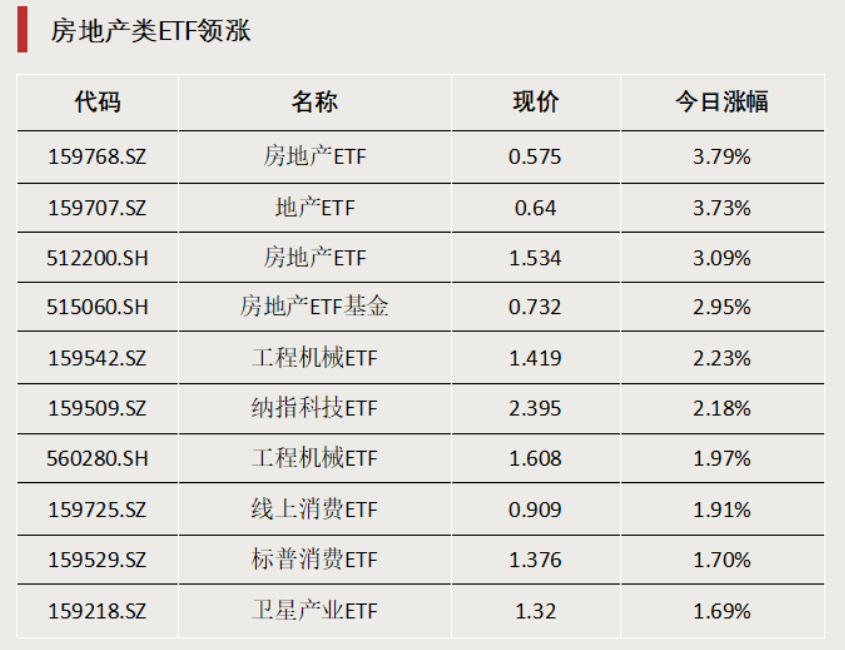
Group 1: Real Estate Sector - The real estate sector showed strong performance on December 10, with multiple stocks hitting the daily limit, leading real estate ETFs to rank high in the ETF market's gainers list [1][3] - Notable real estate ETFs included: - 159768.SZ Real Estate ETF with a price of 0.575 and a daily increase of 3.79% - 159707.SZ Real Estate ETF with a price of 0.64 and a daily increase of 3.73% - 512200.SH Real Estate ETF with a price of 1.534 and a daily increase of 3.09% [4] Group 2: Agriculture Sector - The agriculture sector performed well, with themes such as seed industry, land transfer, and aquatic products showing strong performance, leading agriculture-related ETFs to rank among the top gainers [2][5] - The sentiment in the seed industry has been notably boosted, with ongoing commercialization of biological breeding benefiting leading companies [5] Group 3: Technology Sector - Technology ETFs experienced significant inflows, with several ETFs seeing net inflows exceeding 1 billion yuan last week, and continued inflows in the first two trading days of this week [2][9] - The top net inflows for technology ETFs included: - 159352.OF Southern CSI A500 ETF with a net inflow of 15.66 billion yuan - 159600.OF Harvest CSI AAA Technology Innovation Corporate Bond ETF with a net inflow of 10.95 billion yuan [10] Group 4: Bond ETFs - Bond ETFs were actively traded, with several types such as Short-term Bond ETF, Benchmark Treasury Bond ETF, and Yinhua Daily Benefit ETF seeing transaction amounts exceeding 10 billion yuan [7][8] - The Short-term Bond ETF had a transaction amount of 401.12 billion yuan and a turnover rate of 54.79% [8] Group 5: Investment Recommendations - Institutions suggest focusing on gold and innovative pharmaceuticals as key investment directions, with gold expected to benefit from potential monetary easing and a shift in global credit dynamics [11] - The release of China's first commercial insurance innovative drug catalog is seen as a significant step for the innovative drug industry, potentially enhancing investment opportunities in the healthcare sector [11]
基金早班车丨公募年末抢占指数市场,科技赛道成上报主力
Sou Hu Cai Jing· 2025-12-10 00:37
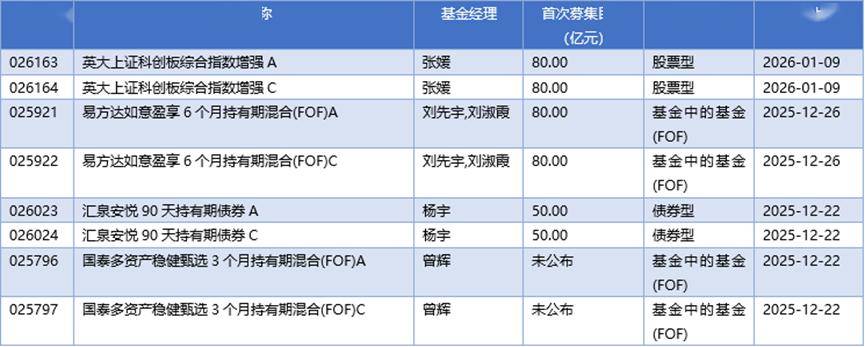
Group 1 - As of December 9, over 70 new funds have been reported, with nearly half being index funds, primarily targeting the technology sector [1] - The domestic index investment is in a rapid expansion phase, with significant room for penetration compared to mature markets, as public funds aim to position themselves for the next wave of capital inflow [1] - On December 9, the three major A-share indices experienced fluctuations, with the Shanghai Composite Index closing down 0.37% at 3909.52 points and the Shenzhen Component Index down 0.39% at 13277.36 points, while the ChiNext Index rose 0.61% to 3209.60 points [1] Group 2 - On December 9, a total of 8 new funds were launched, mainly consisting of Fund of Funds (FOF) and bond funds, with the Yingda Shanghai Stock Exchange Sci-Tech Innovation Board Composite Index Enhanced A fund targeting a fundraising goal of 8 billion yuan [2] - The private equity industry is expected to set multiple records by 2025, with total assets exceeding 22 trillion yuan and securities private equity surpassing 7 trillion yuan, indicating a significant trend towards early, small, and hard technology investments [2] - In December, new fund issuance has entered a sprint mode, with over 120 products either currently or soon to be launched, reflecting institutional optimism about the current market position [2] Group 3 - On December 9, major public funds such as E Fund, Huaxia, and Southern Asset Management issued warnings about the premium risk in the secondary market for their cross-border ETFs, with over 200 premium risk warning announcements made by 14 public funds since December [3] - High premiums indicate that the buying cost exceeds the actual net value, and if premiums converge, it could directly erode the principal, prompting companies to consider applying for trading halts to curb irrational speculation [3]