
智能家居

Search documents
闪耀全球消费电子展!松山湖硬核力量组团出海
Sou Hu Cai Jing· 2026-01-07 05:17
每年年初在拉斯维加斯举行的全球消费电子展(CES)是窥见技术浪潮、检视产业成果、洞察未来的最佳窗口。日前,松山湖多家硬科技企业组团参展,凭 借精准的市场洞察与扎实的技术积累,在智能家居、企业级解决方案等多个赛道集体发声,向世界传递来自松山湖的"新价值主张"。 此次XbotPark联动体系共有近50家企业及共享工厂参展,其中,墨现科技、库犸科技、未知星球和云鲸智能4家代表企业,与体系内其他企业共同组成中 国"智造"的亮眼方阵。 在智能家居产品领域,云鲸智能将发布Flow 2扫地机器人,搭配全新推出的无线吸尘器和除螨仪,构建起由AI驱动的智能清洁生态。这款搭载双RGB摄像头 的扫地机器人,凭借AI+云端协同的"物体识别"技术,在检测到宠物或儿童时能够自动降低边刷转速,发现钥匙、钱包等贵重物品立即拍照提醒,赢得 《Verge》《Engadget》等国际媒体的关注与好评。 库犸科技带来的割草机器人旗舰机型LUBA3 AWD,在导航系统、越野能力和智能化方面实现重大升级,被ZDnet杂志编辑盛赞"最爱的无边界割草机器人有 了新版本",展现出松山湖企业在户外智能设备领域的领先实力。 未知星球也以特色创新产品亮相独立展位, ...


CES2026|扫地机器人进化具身智能形态 追觅全产品矩阵亮相CES
Zhong Guo Jing Ying Bao· 2026-01-07 04:59
Core Insights - The annual Consumer Electronics Show (CES) will take place in Las Vegas from January 6 to 9, 2026, where the company will showcase its largest exhibition to date, highlighting its cutting-edge technology developments [1] - The company will unveil its next-generation embodied intelligent robotic vacuum cleaner and globally launch the X60 series, alongside several groundbreaking technological achievements, including the world's first bionic six-legged tracked climbing vacuum cleaner, Cyber X, which addresses the long-standing challenge of autonomous cleaning across floors [1] - The company aims to demonstrate its systematic R&D capabilities driven by continuous innovation, showcasing a comprehensive product and technology matrix [1] Exhibition Details - The company will debut in two core exhibition halls at CES, establishing a flagship ecological exhibition area of over 1,200 square meters at the Las Vegas Convention Center and a high-end smart cleaning experience zone at the Venetian Expo [1] - Visitors will have an immersive experience to understand how cutting-edge technology is reshaping daily cleaning tasks [1] Product Highlights - The Cyber X, which gained significant attention at IFA, will reappear in an upgraded form, featuring industry-leading climbing performance, speed, stability, and safety, with a design that allows compatibility with future main vacuum models [2] - The company will also showcase its complete product matrix, including the Cyber10 Ultra with multi-joint bionic robotic arms for detailed cleaning and item organization, the Aqua10 Ultra Roller combining live water washing and AI smart lifting cover, and the Matrix10 Ultra for intelligent scenario-based cleaning [2]

追觅科技携全屋智能生态亮相CES 2026,以AI构建高端智慧生活
Huan Qiu Wang· 2026-01-07 04:35
Core Insights - The company,追觅科技, showcased its "whole-home smart ecosystem" at CES 2026, featuring a range of core products including smart appliances, cleaning devices, kitchen electronics, personal care products, smart garden solutions, and smart audio-visual equipment [1] - The CEO, 俞浩, emphasized the goal of creating an "active intelligence" product experience that requires minimal user intervention, providing around-the-clock proactive services to enhance users' quality of life [3] Product and Technology Overview - The whole-home smart ecosystem covers various living scenarios, integrating smart appliances like washing machines, refrigerators, and air conditioners, along with efficient cleaning products such as vacuum cleaners and floor washers, to create a comfortable, efficient, and healthy living experience [3] - The ecosystem utilizes a multi-modal perception system and intelligent control algorithms to enhance the products' ability to perceive, recognize, understand, and plan tasks within the home environment [4] - The company is focusing on embodied intelligence technology, which is reshaping the interaction between smart devices and the real world, enabling products to autonomously make decisions and execute tasks in dynamic environments [4] Future Directions - The company plans to increase investment in core technology research and development to further enhance the collaborative and efficient whole-home smart ecosystem, aiming to create a smart living experience that understands user needs [4]

石头科技推出可爬楼梯的扫地机器人
Ge Long Hui A P P· 2026-01-06 22:40
Core Viewpoint - Roborock, a Chinese manufacturer of robotic vacuum cleaners, has introduced a new home robot named Saros Rover, which is capable of climbing stairs and navigating uneven surfaces using advanced technology [1] Company Summary - Roborock showcased the Saros Rover, which features two legs that can independently lift and lower, allowing it to traverse stairs and navigate rough terrain [1] - The robot utilizes artificial intelligence, multiple motion sensors, and 3D spatial information for navigation [1] Product Features - Saros Rover successfully demonstrated its ability to climb several steps, descend slopes, and perform small jumps during a media presentation [1] - The jumping capability may be utilized for descending stairs or avoiding obstacles [1]

股市必读:乐歌股份(300729)1月6日董秘有最新回复
Sou Hu Cai Jing· 2026-01-06 18:38
Core Viewpoint - The company is actively developing its logistics capabilities, particularly through the use of self-developed robots in its overseas warehouses, while also addressing market changes and regulatory impacts in Europe. Group 1: Stock Performance - As of January 6, 2026, the stock price of Lege Co., Ltd. (300729) closed at 13.9 yuan, up 0.87%, with a turnover rate of 0.95% and a trading volume of 30,200 shares, amounting to 41.93 million yuan in transaction value [1]. Group 2: Corporate Communication - The company will disclose the number of shareholders in accordance with regulations from the CSRC and Shenzhen Stock Exchange in its periodic reports [2][3]. - The company has developed warehouse robots aimed at improving operational efficiency, primarily for internal use at this stage [2][3]. - The company is monitoring changes in EU tax policies and has established a European overseas warehouse network to adapt to market changes [2][3]. - The company is focusing on self-built warehouses, which are expected to reduce costs significantly compared to leased warehouses, with profit release dependent on various operational factors [2][3]. Group 3: Strategic Initiatives - The company has received recognition as a "Zhejiang Province Eagle Enterprise," which may enhance its brand reputation and attract more clients and partners [3]. - The company is exploring partnerships with strategic investors to accelerate its global warehouse network expansion and improve automation levels [3][4]. - The company is actively applying for government subsidies related to its overseas warehouses and will account for any received subsidies according to accounting standards [3][4]. Group 4: Operational Efficiency - The company is enhancing its overseas warehouse network through automation and information technology investments, aiming to improve operational efficiency and reduce costs [4][5]. - The company has established a partnership with FedEx, which has improved its last-mile delivery efficiency and provided a competitive pricing advantage [4][5]. - The company is utilizing self-developed logistics robots in its overseas warehouses, achieving a 50% increase in processing speed and a 60% reduction in error rates [5][6]. Group 5: Research and Development - The company has invested 194 million yuan in R&D in 2024, a 33.83% increase year-on-year, with a workforce of 1,080 R&D personnel and a total of 1,291 patents [5]. - The company is focusing its R&D resources on core technology needs related to its smart home and public overseas warehouse services [5][6]. - The company is collaborating with universities for research and development in robotics and automation, ensuring technological leadership in its field [5][6].

具身智能新品领衔 追觅扫地机将携全新产品矩阵登陆CES 2026
Huan Qiu Wang· 2026-01-06 10:45
Core Insights - The 2026 International Consumer Electronics Show (CES) will take place from January 6 to 9 in Las Vegas, where the company will showcase its largest exhibition to date, highlighting its cutting-edge technology and product innovations [1][4] Group 1: Product Launches - The company will unveil its next-generation embodied intelligent vacuum robot and the X60 series, which features a slim design of 7.95 cm, achieving unprecedented cleaning coverage [4] - The Cyber X, a bionic six-legged climbing vacuum robot, will also be presented, overcoming the long-standing challenge of autonomous cleaning across floors [5] Group 2: Technological Innovations - The X60 series includes an ultra-wide dual-camera navigation and obstacle avoidance system, enhancing cleaning efficiency and adaptability in complex environments [4] - The Cyber X is designed for high compatibility with future vacuum models, allowing users to upgrade without additional investment in climbing capabilities [5] Group 3: Experience Zones - The company will establish a flagship ecological exhibition area of over 1,200 square meters at the Las Vegas Convention Center and a high-end smart cleaning experience zone at the Venetian Expo, providing immersive experiences for global visitors [4] Group 4: Future Vision - The showcased products and technologies not only address current cleaning needs but also define future lifestyles, illustrating the company's commitment to technological pathways that shape smart home environments [5]
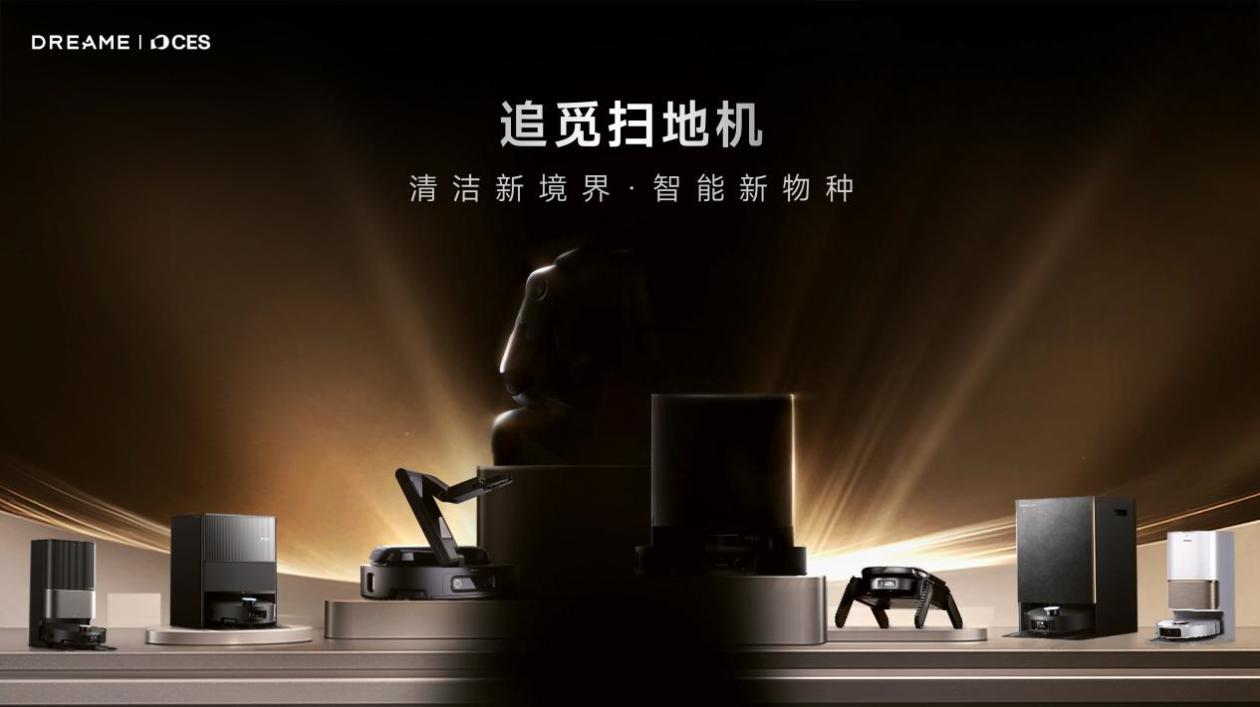
具身智能领衔,追觅扫地机将携强大阵容亮相CES 2026
Zhi Tong Cai Jing· 2026-01-06 08:45
Core Insights - The 2026 International Consumer Electronics Show (CES) will take place from January 6 to 9 in Las Vegas, where the company will showcase its largest exhibition to date, highlighting its cutting-edge technology and the launch of the next-generation intelligent cleaning robot and the X60 series [1][3] Group 1: Product Launches - The company will unveil the world's first bionic six-legged climbing cleaning robot, Cyber X, which overcomes the long-standing challenge of autonomous cleaning across floors [1][4] - The flagship X60 series cleaning robot will be globally launched, featuring an ultra-thin body of 7.95 cm and an ultra-wide dual-camera navigation obstacle avoidance system, significantly enhancing cleaning efficiency and coverage [3][4] Group 2: Technological Innovations - The company will present advancements in embodied intelligence, aiming to redefine how intelligent cleaning solutions serve households, moving from mere cleaning to organizing [3][4] - The Cyber X robot will feature industry-leading climbing performance, speed, stability, and safety, with a design that allows compatibility with future cleaning devices, eliminating the need for repeated investments in climbing functionality [4] Group 3: Comprehensive Product Matrix - The exhibition will also showcase a complete product matrix, including the Cyber10 Ultra with multi-joint bionic mechanical arms for detailed cleaning and organizing, the Aqua10 Ultra Roller combining water washing and AI smart lifting, and the Matrix10 Ultra for intelligent scenario-based cleaning [4] - These products demonstrate the company's collaborative innovation capabilities across mechanical structures, intelligent algorithms, and cleaning systems, positioning it as a leader in the industry [4]
深圳悦享智眠科技有限公司获“Pre-A轮”融资,金额近亿人民币
Sou Hu Cai Jing· 2026-01-06 01:47
1月4日,天眼查融资历程显示,深圳悦享智眠科技有限公司近日获得"Pre-A轮"融资,涉及融资金额近 亿人民币,投资机构为Stareep希瑞完成第二轮近亿元融资:投后估值10亿,AI睡眠中枢驱动全场景智 能家居,剑指百亿目标。 资料显示,深圳悦享智眠科技有限公司法定代表人为陈淑仪,成立于2025年,位于深圳市,是一家以从 事零售业为主的企业。企业注册资本1000万人民币,并已于2026年完成了Pre-A轮,交易金额近亿人民 币。 通过天眼查大数据分析,深圳悦享智眠科技有限公司知识产权方面有商标信息39条,专利信息4条,此 外企业还拥有行政许可4个。 天眼查信息显示,深圳悦享智眠科技有限公司的股东为:广东睡力矩阵科技有限公司。 来源:市场资讯 ...
狄耐克20260105
2026-01-05 15:42
Summary of Dineike Conference Call Company Overview - **Company**: Dineike - **Industry**: Brain-Computer Interface (BCI) and Health Technology Key Points Industry and Market Position - Dineike is entering the health consumer market by miniaturizing serious medical technology for home use, focusing on smart hardware and EEG data to ensure revenue streams [2][5] - The company has established channel advantages in smart communities, homes, and hospitals, particularly in digital wards and smart hotel room control systems, aiding the rapid promotion of its BCI products [2][6] Product Development and Research - Dineike is collaborating with Xiamen University Medical College to research Alzheimer's disease using 40 Hz optoelectronic technology, continuously improving data collection devices and establishing a big data cloud platform for model training [2][7] - The accuracy of Dineike's BCI algorithm in PSG tests reached 84.3%, close to the international benchmark of 85%, but further improvements are needed to meet consumer market demands [2][8] Strategic Focus - The future strategy includes consolidating the smart community business, expanding into self-funded hospitals, entering overseas markets, and developing BCI technology, with a product launch expected in the first half of 2026 [2][9] - Dineike is focusing on non-invasive BCI technology, which has a broader market appeal, and plans to consider invasive BCI technology in 8-10 years based on social acceptance and technological advancements [3][18] Revenue Assurance and Market Expansion - The company aims to ensure stable revenue by transforming medical devices into consumer products, utilizing smart hardware and EEG data for a closed-loop solution [5][9] - Dineike has successfully transitioned into the self-funded hospital market, covering nearly 3,000 top-tier hospitals nationwide and becoming the first to implement the HarmonyOS [9] Challenges and Solutions - Key challenges include improving the accuracy of BCI technology and establishing a viable business model. Dineike's current algorithm is close to medical-grade accuracy but requires further validation for consumer use [8][19] - The company is in the process of obtaining a Class II medical device certificate, with expectations to receive it within one to two months [11] Future Developments - Dineike plans to host a BCI product launch in 2025 to accelerate domestic market expansion and is negotiating with the Xiamen government for the construction of a new R&D building [9][10] - The company is also developing AI algorithms for sleep analysis and attention assessment, with a focus on building a proprietary EEG database [12][21] Collaboration and Clinical Trials - Dineike is in discussions with hospitals for clinical trials in cognitive rehabilitation and is working with Xiamen University on cutting-edge scientific research [13][21] Market Feedback and Sales - Currently, Dineike has not launched consumer-grade sleep products due to the rigorous medical certification process, with sales expected to begin in late 2025 or early 2026 [12][16] Conclusion - Dineike is strategically positioned to leverage its existing channels and technological advancements in the BCI space, with a clear focus on non-invasive solutions and a robust plan for market entry and expansion in the health technology sector [2][21]

智能消费主导元旦家居市场 政策与观念双轮驱动产业升级
Bei Jing Shang Bao· 2026-01-05 11:17
Core Insights - The smart home market is experiencing a significant transformation, with AI technology becoming a central component of consumer demand, evolving from an "efficiency tool" to a "collaborative partner" in daily life [1][4] - The market performance during the New Year holiday reflects a deep change in consumer expectations, emphasizing a shift towards a human-centered, all-encompassing ecological experience in smart home solutions [1][3] Group 1: Market Trends - The smart home market is projected to exceed 300 million units shipped in China by 2026, with smart security, lighting, and appliances leading the market [3] - There is a notable increase in consumer interest in smart home products, particularly during the New Year period, with sales of smart appliances rising as consumers seek comprehensive smart solutions [2][3] Group 2: Policy and Consumer Behavior - Government policies are driving the growth of the smart home market, with new subsidies for smart products and initiatives to promote interconnected smart home solutions [4][5] - A shift in consumer demographics is evident, with nearly 60% of home appliance consumers being under 35, who prioritize quality of life and convenience, viewing smart homes as essential for enhancing happiness [5][6] Group 3: Challenges and Industry Insights - The industry faces challenges such as "pseudo-intelligence," data security issues, and system instability, which can undermine consumer confidence and experience [7][8] - Experts emphasize the need for a transition from "manual control" to "seamless intelligence," advocating for a focus on understanding user habits and creating a cohesive smart ecosystem rather than merely connecting devices [8]