
全屋智能解决方案

Search documents
好莱客发布“高端定制+AI智能家居”战略 参股公司合觅科技全系新品亮相
Zhong Zheng Wang· 2026-01-29 05:15
Group 1 - The core strategy of the company is to upgrade to a "high-end customization + AI smart home" model, aiming to enhance consumer experience and create competitive market barriers for distributors [1] - The home furnishing industry is facing challenges such as product homogenization, ongoing price competition, and insufficient supply chain collaboration, with the market entering a phase of stock housing [1] - The establishment of Heimi Technology, a joint investment by the company and partners, focuses on providing a comprehensive smart home solution with a product matrix covering seven categories [1][2] Group 2 - Heimi Technology's core technological advantage lies in its self-developed Ho-mesh networking technology, which supports over 100 devices for centralized control with features like strong anti-interference and low power consumption [2] - The company aims to create a "zero-threshold, high-aesthetic, all-scenario, ultra-friendly" smart home experience, emphasizing ease of use and minimal deployment [2] - A design center has been established in Guangzhou to provide a tangible experience of the integration between customized furniture and smart devices, showcasing the company's 2026 annual master series products [3]

“上市公司价值发现之旅”佛山站—走进悍高集团:探寻家居智造企业的成长密码
Quan Jing Wang· 2026-01-21 12:31
Core Insights - The event "Journey of Value Discovery for Listed Companies" in Foshan showcased Hanhigh Group as a benchmark enterprise in China's home hardware manufacturing, providing investors with insights into the company's growth logic through on-site visits and executive dialogues [1][4] Group 1: Company Overview - Hanhigh Group, a national high-tech enterprise, has accumulated over 1,100 patents and participated in drafting three industry standards, winning more than 30 international design awards [2] - The company has maintained a compound annual growth rate (CAGR) of over 30% in revenue over the past three years, emphasizing its commitment to high-quality development in the industry [2] Group 2: Product and Innovation - The visit to the Original Home Hardware Museum deepened investors' understanding of Hanhigh's product capabilities and design philosophy, showcasing a range of products that reflect the company's keen insight into user needs and a pursuit of craftsmanship [2] - Hanhigh integrates practical functionality with aesthetic value through continuous design iteration and technological breakthroughs, positioning its hardware products as artful creations [2] Group 3: Management Insights - Hanhigh's Vice General Manager and Board Secretary, Xia Qi, outlined the company's journey since its establishment in 2004, highlighting its vision to become a leading global home hardware manufacturer and its transition from single manufacturing to design innovation and scenario-based solutions [3] - The company aims to increase R&D investment, optimize products and services, and seize market opportunities arising from home automation and consumer upgrades, ensuring sustainable long-term development [3] Group 4: Investor Engagement - The event facilitated a lively interaction where investors inquired about the company's technological advantages, market expansion strategies, and future plans, with management providing detailed responses [3] - The series of activities aims to create a communication platform between investors and quality listed companies, enhancing resource allocation efficiency in the capital market [4]
“上市公司价值发现之旅”佛山站——走进悍高集团:探寻家居智造企业的成长密码
Quan Jing Wang· 2026-01-21 05:52
Core Insights - The event "Journey of Value Discovery for Listed Companies" in Foshan showcased Hanhigh Group as a benchmark enterprise in the home hardware manufacturing sector, providing investors with an opportunity to gain insights into the company's growth logic through on-site visits and executive dialogues [1][4] Company Overview - Hanhigh Group's headquarters, covering nearly 40,000 square meters, exemplifies the company's innovative spirit with a blend of technology and fashion design [2] - As a national high-tech enterprise, Hanhigh has accumulated over 1,100 patents, participated in drafting three industry standards, and won more than 30 international design awards [2] - The company has achieved a compound annual growth rate of over 30% in revenue over the past three years, indicating strong business performance [2] Product and Innovation - The original home hardware museum visit deepened investors' understanding of Hanhigh's product capabilities and design philosophy, showcasing a range of products that reflect the company's keen insight into user needs and commitment to quality craftsmanship [2] - Hanhigh integrates practical functionality with aesthetic value through continuous design iterations and technological breakthroughs, positioning its products as both functional and artistic [2] Market Strategy and Future Plans - Hanhigh's vision since its establishment in 2004 has been to create a leading world-class home hardware enterprise, transitioning from single manufacturing to design innovation and scenario-based solutions [3] - The company has expanded its market presence to over 110 countries and regions, including Europe, the Middle East, and Southeast Asia, through sustained product innovation and reliable quality service [3] - Hanhigh plans to continue increasing R&D investment, optimizing products and services, and seizing market opportunities arising from home automation and consumer upgrades to ensure long-term sustainable growth [3]


海尔智家:公司已围绕最新补贴方向进行全面布局
Zheng Quan Ri Bao Zhi Sheng· 2026-01-14 12:37
Core Viewpoint - The company is actively aligning with national policy directions and has made comprehensive arrangements around the latest subsidy initiatives, focusing on technological leadership in core product categories like refrigerators and washing machines [1] Group 1: Company Strategy - The company is enhancing its technological advantages in key categories, ensuring a rich lineup of first-level energy-efficient products that meet subsidy policy requirements and promote green consumption upgrades [1] - The company is leveraging its "Three Wings Bird" scenario brand to accelerate the development of whole-home smart solutions, integrating smart appliances into a broader smart consumption ecosystem [1] Group 2: Policy Alignment - The company is committed to continuous technological innovation and scenario upgrades to seize policy opportunities, aiming to create value for consumers and drive high-quality business development [1]

智能消费主导元旦家居市场 政策与观念双轮驱动产业升级
Bei Jing Shang Bao· 2026-01-05 11:17
Core Insights - The smart home market is experiencing a significant transformation, with AI technology becoming a central component of consumer demand, evolving from an "efficiency tool" to a "collaborative partner" in daily life [1][4] - The market performance during the New Year holiday reflects a deep change in consumer expectations, emphasizing a shift towards a human-centered, all-encompassing ecological experience in smart home solutions [1][3] Group 1: Market Trends - The smart home market is projected to exceed 300 million units shipped in China by 2026, with smart security, lighting, and appliances leading the market [3] - There is a notable increase in consumer interest in smart home products, particularly during the New Year period, with sales of smart appliances rising as consumers seek comprehensive smart solutions [2][3] Group 2: Policy and Consumer Behavior - Government policies are driving the growth of the smart home market, with new subsidies for smart products and initiatives to promote interconnected smart home solutions [4][5] - A shift in consumer demographics is evident, with nearly 60% of home appliance consumers being under 35, who prioritize quality of life and convenience, viewing smart homes as essential for enhancing happiness [5][6] Group 3: Challenges and Industry Insights - The industry faces challenges such as "pseudo-intelligence," data security issues, and system instability, which can undermine consumer confidence and experience [7][8] - Experts emphasize the need for a transition from "manual control" to "seamless intelligence," advocating for a focus on understanding user habits and creating a cohesive smart ecosystem rather than merely connecting devices [8]
从一场展会,看美的为何能重新定义“家”的万亿价值?
Ge Long Hui· 2025-12-05 13:37
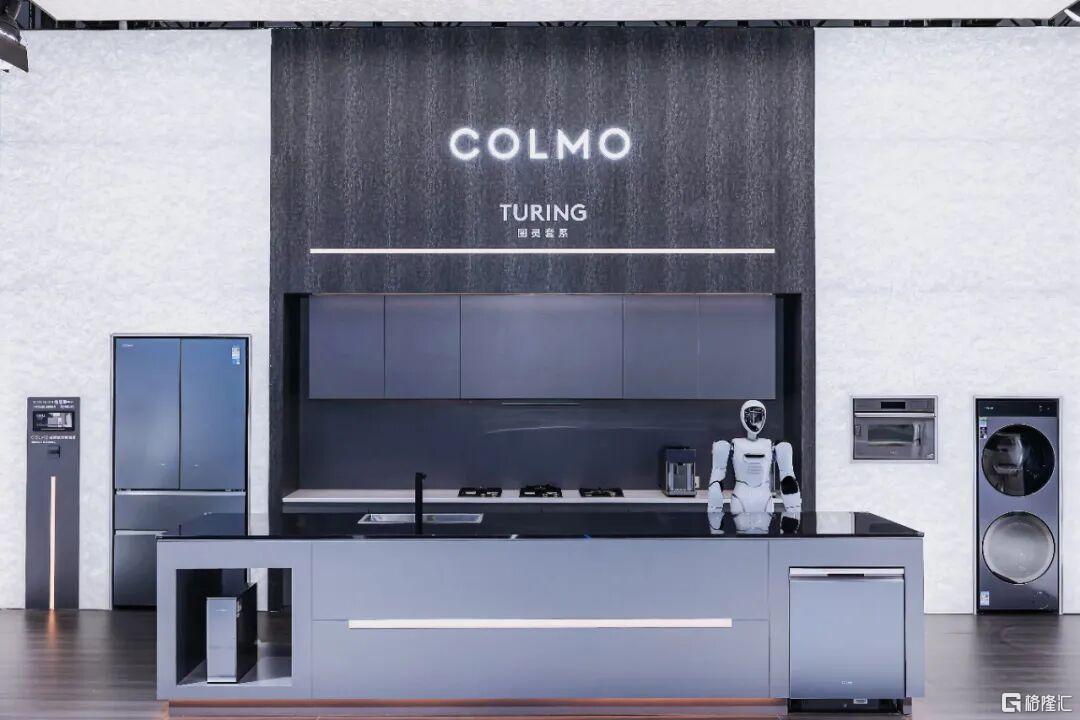
Core Viewpoint - The first Global Intelligent Machinery and Electronic Products Expo (AIE) in Zhuhai showcased Midea's vision for the future of smart home ecosystems, indicating a shift from basic functionality to integrated ecosystems and data fusion in the smart home market [1] Group 1: Midea's Smart Home Strategy - Midea presented two distinct yet complementary smart living "operating systems" at the expo: one targeting high-end users with AI HOME and the other focusing on broader accessibility with Smart for Joy [2][3] - The AI HOME system, centered around the COLMO brand, offers comprehensive smart home solutions, emphasizing user experience through autonomous learning and proactive service [3][5] - The Smart for Joy initiative aims to engage younger consumers by simplifying smart home technology, making it more accessible and user-friendly [6][8] Group 2: Market Positioning and Revenue Potential - Midea's high-end offerings are designed to enhance brand value and profitability by providing expensive, integrated smart home solutions to affluent customers, creating high switching costs and ongoing revenue opportunities [5] - The broader strategy aims to expand Midea's user base and cultivate an ecosystem, leveraging lightweight products to increase smart appliance penetration [8] Group 3: Strategic Partnerships and Data Integration - Midea's collaboration with BYD to create a "people-car-home" smart ecosystem represents a significant strategic advancement, integrating data and control between smart appliances and vehicles [10][12] - This partnership is expected to generate a powerful "data flywheel," enhancing user experience and enabling personalized smart services through continuous data flow [12][13] - The collaboration also opens avenues for innovative service models, such as energy and health management, transitioning Midea from hardware sales to ongoing service and data monetization [12][13] Group 4: Future Outlook - Midea's presentation at AIE signals a profound transformation in its business model, focusing on the potential for service monetization and the unique advantages of cross-scenario data assets [15] - The company's ability to define new living paradigms and convert them into reality will be crucial for its long-term value and market positioning [15]

突发,美的“停服”小米、格力?
3 6 Ke· 2025-11-21 10:58
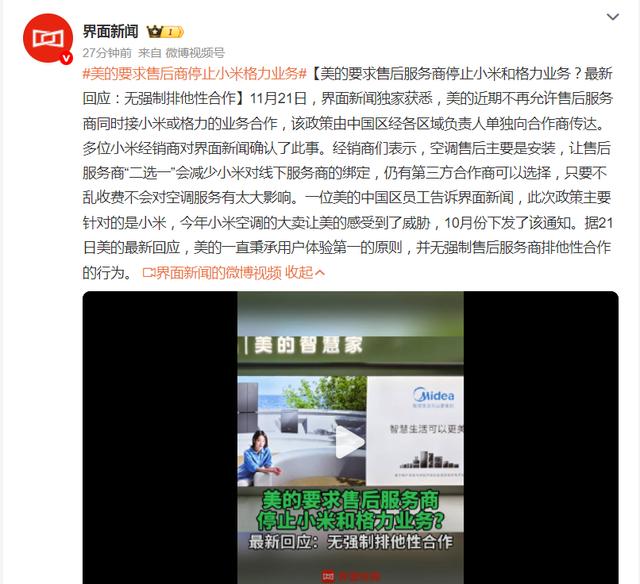
Core Viewpoint - Midea has implemented a policy prohibiting its after-sales service providers from simultaneously collaborating with Xiaomi or Gree, primarily targeting Xiaomi due to its significant sales growth in air conditioning this year, which has posed a competitive threat to Midea [1][5] Group 1: Industry Competition - The competition among major home appliance brands is intensifying, with Midea's policy change quickly becoming a trending topic on social media [1] - Midea has denied any forced collaboration restrictions, indicating a potential discrepancy in reports from various media outlets [1][4] - The relationship dynamics between Xiaomi and Gree are complex, with historical factors influencing public perception of their rivalry [5] Group 2: Market Position and Performance - In July, the top five air conditioning brands in China were Midea, Gree, Haier, Xiaomi, and Aux, with Midea experiencing a 1% decline and Xiaomi emerging as a notable competitor [6] - During the recent Double Eleven shopping festival, the sales rankings for air conditioning brands were Gree, Midea, Xiaomi, Hualing, and Haier, indicating Xiaomi's strong market presence [7] - Price competition is escalating, with average prices for air conditioning units dropping significantly, reflecting the aggressive strategies of leading brands [8] Group 3: Financial Insights - Xiaomi's air conditioning segment has a net profit margin of approximately 2%, while Midea's and Haier's margins are significantly higher, indicating a challenging financial landscape for Xiaomi [8] - Despite a 5.6% year-on-year revenue growth in Xiaomi's IoT and lifestyle products segment, there was a noticeable decline compared to the previous quarter, highlighting the competitive pressures in the home appliance sector [8] Group 4: International Expansion - Midea's overseas revenue reached 107.2 billion yuan in the first half of 2025, marking a 17.7% year-on-year increase, establishing it as a significant growth driver [9] - Haier's overseas revenue accounted for over 50% of its total revenue, showcasing its strong international presence [9] - Gree's overseas revenue reached 16.78% of its total, indicating room for growth in international markets [9] Group 5: Technological Advancements - The leading home appliance brands are heavily investing in technology and innovation, with Haier holding the highest number of smart home invention patents globally [10] - Xiaomi is pursuing a comprehensive ecosystem strategy, integrating its products with smart home technology, which may provide a competitive edge [10][11] - The smart home market in China is projected to reach 1.36 trillion yuan by 2030, indicating significant growth potential for all major players [11]


美的集团发布中期业绩,归母净利润 260.14亿元 同比增加25.04%
Zhi Tong Cai Jing· 2025-08-29 11:50
Core Insights - Midea Group reported a revenue of 252.33 billion yuan for the six months ending June 30, 2025, representing a year-on-year increase of 15.68% [1] - The profit attributable to shareholders was 26.01 billion yuan, up 25.04% year-on-year, with an interim dividend proposed at 5 yuan per 10 shares [1] - The domestic home appliance market showed signs of recovery due to the "trade-in" subsidy policy, although competition around "user traffic" and "product pricing" intensified [1] Group Performance - Despite challenges in overseas markets due to trade protectionism, currency fluctuations, and geopolitical conflicts, Midea Group's overall scale continued to grow, with improvements in profitability and cash flow [1] - The company emphasized a strategy of "simplification to promote growth and self-disruption to face challenges," focusing on core businesses and products, particularly in overseas markets [1] R&D and Innovation - Midea is committed to its vision of "Technology for Perfection, Life for Beauty," increasing R&D investment to support the implementation of the "Three Generations" strategy [2] - The company aims to provide differentiated smart home solutions by integrating "smart appliances + smart home" based on user needs and consumption trends, supporting high-end brand breakthroughs [2] - Midea is enhancing its overseas R&D centers and manufacturing bases through localized innovation and brand development, aiming to improve brand influence [2] Research Organization and Technology Strategy - The company is optimizing its R&D model and improving the operational mechanism of its research organization, focusing on key areas such as technologies, people, projects, and processes (TP3 elements) [2] - Midea is driving the exploration of cutting-edge technologies, breakthroughs in core technologies, and the rational layout of project portfolios to align technology strategy with long-term product planning [2]
海尔智家股价微跌0.20% 校企合作拓展智能制造领域
Jin Rong Jie· 2025-08-15 21:00
Core Viewpoint - Haier Smart Home's stock price closed at 25.46 yuan, reflecting a slight decline of 0.20% from the previous trading day, with significant trading activity recorded [1] Group 1: Company Overview - Haier Smart Home's main business includes the research, production, and sales of home appliances such as refrigerators, air conditioners, and washing machines [1] - The company is actively expanding into the smart home ecosystem, offering comprehensive smart solutions for entire homes [1] - In recent years, Haier has been focusing on emerging fields such as smart manufacturing and industrial internet [1] Group 2: Recent Developments - The company has engaged in discussions for collaboration with Fuyao University of Technology on smart manufacturing, industrial robotics, and smart home initiatives [1] - On August 14, Haier repurchased 100,000 A-shares for 2.558 million yuan as part of its equity incentive plan [1] - Haier is promoting green and low-carbon development in buildings through smart building solutions, achieving energy efficiency improvements in the BYD Industrial Park project [1] Group 3: Financial Performance - On the day of reporting, Haier Smart Home experienced a net inflow of main funds amounting to 94.47 million yuan, with a cumulative net inflow of 1.26 billion yuan over the past five days [2]
家居产业“焕新势能”步入快车道
Zhong Guo Jing Ji Wang· 2025-05-27 02:14
Core Viewpoint - The home furnishing and decoration materials industry is experiencing a transformation as its deep connection with the real estate market loosens, leading to increased consumer demand driven by policy support and changing consumption patterns [1][2]. Group 1: Market Dynamics - The furniture manufacturing industry is projected to generate revenues of 677.15 billion yuan in 2024, with a year-on-year growth of 0.4%, while total profits are expected to decrease by 0.1% to 37.24 billion yuan [2]. - The real estate market is entering a phase of renovation and upgrading, particularly in first- and second-tier cities, with an expected 57% of home renovations in 2027 coming from existing homes [3]. - The demand for home improvement is being driven by policies promoting consumption and the growing trend of upgrading living conditions [2][3]. Group 2: Consumer Trends - Young consumers, particularly those under 35, represent 60% of the home furnishing market, with 95% using both online and offline channels to gather product information [4]. - There is a significant shift towards one-stop home decoration services, with 70.4% of consumers in first- and new first-tier cities preferring this option over traditional methods [4]. - Consumers are increasingly focused on the practicality of home products, with heightened awareness of environmental health and smart technology [4]. Group 3: Industry Innovations - The home furnishing market is expected to reach a scale of 4.8 trillion yuan by 2025, with furniture accounting for 38% (1.82 trillion yuan) of this market [6]. - The retail sales of smart home devices are projected to exceed 1.2 trillion yuan, with growth rates in specific segments like voice-controlled devices and environmental monitoring systems exceeding 40% [7]. - The proportion of eco-friendly materials in the industry is anticipated to rise from 12% in 2018 to 39% by 2025, indicating a significant shift towards sustainable practices [7]. Group 4: Company Spotlight - Rabbit Baby, a leading company in the industry, has established a robust quality control system and has achieved significant advancements in environmental standards, reaching ENF+ level [5]. - The company reported nearly 10 billion yuan in revenue for 2024 and has over 6,000 specialized stores nationwide, making it one of the most widely covered enterprises in the industry [7]. - Rabbit Baby is actively expanding its sales channels beyond traditional retail, collaborating with over 20,000 custom furniture companies to enhance consumer service [7]. Group 5: Future Outlook - The home furnishing sector is expected to recover from historical low valuations, with a projected retail scale of 4.89 trillion yuan by 2026, driven by consumption recovery and favorable real estate policies [8].
