
算力

Search documents
国泰海通晨报-20260107
GUOTAI HAITONG SECURITIES· 2026-01-07 06:35
Group 1: Strategy Research - The current overseas computing power valuation is reasonable, and subsequent performance upgrades are key; domestic computing power awaits performance realization and is catalyzed by the decline in risk-free interest rates; AI application valuations are cost-effective, with a focus on internet and media sectors [2][3][6] Group 2: Dairy Industry Research - The ruling on import beef safeguard measures has been implemented, with a nearly 6% reduction in quotas for major supplying countries in 2026, and an additional 55% tariff on beef imported outside the quota, which is expected to boost domestic beef demand and sustain the upward trend in the beef cattle industry [7][8][9] - The price of raw milk is stabilizing and is expected to rise in 2026 due to the reduction in supply-side expansion and decreased replenishment, along with the release of processing capacity on the demand side [7][9] Group 3: Non-Metallic Building Materials Research - China Jushi has announced a restricted stock incentive plan, which reflects the company's confidence in future operations, covering a wide range of employees including executives and core middle management [3][10][11] Group 4: Fixed Income Research - The January 2026 convertible bond portfolio is biased towards aggressive and elastic sectors, supplemented by a balanced combination of relatively low-priced and undervalued industries [2][14][16] - The convertible bond market is expected to experience a "New Year rally" due to policy expectations and seasonal capital inflows, with a focus on technology innovation and expanding domestic demand as key investment themes [29][30][31]


国泰海通:AI应用估值性价比高 关注互联网与传媒
Zhi Tong Cai Jing· 2026-01-06 22:56
Core Viewpoint - The report from Guotai Junan Securities indicates that the current overseas computing power valuations are reasonable with potential for upward adjustments, while domestic computing power has significant long-term growth potential driven by performance expectations and a decline in risk-free returns [1][2]. Group 1: Historical Analysis of Technology Bull Markets - Historical technology bull markets align closely with industrial trends, and the current market consensus on AI industry trends is high, raising questions about the future performance of the AI market after significant price increases [2]. - The report reviews past technology bull markets (2009-2010 consumer electronics, 2013-2015 gaming, and 2019-2021 lithium battery sectors) to analyze price performance characteristics during valuation expansion and profit-driven phases, providing a historical reference for the current AI industry chain [2]. Group 2: Valuation Expansion Phase - During the valuation expansion phase, the significance of crowding indicators is limited, while risk premiums effectively measure valuation boundaries [3]. - Historical data shows that high crowding indicators are common, and after reaching extreme values, there is a high probability of a market correction within 20 trading days, but over 60-90 trading days, the market is likely to reach new highs [3]. - When the industry risk premium falls below one standard deviation of the rolling two-year average, the market's positive response to favorable news diminishes, leading to a period of consolidation while waiting for profit realization [3]. - High valuation ranges are sensitive to changes in liquidity; when valuations are low, tightening liquidity expectations can trigger adjustments, while a loose liquidity environment can elevate valuations further [3]. Group 3: Profit-Driven Phase - In the profit-driven phase, exceeding performance expectations is the core driver of market upward movement, as seen in historical instances like iPhone sales in 2010 and new energy vehicle penetration rates in 2021 [4]. - Attention should be paid to valuation constraints under endgame thinking, where leading companies' peak stock prices correspond to future three-year valuation levels (PE-FY3) typically between 30-40 times [4]. - The risk of intensified industry competition and overcapacity should be monitored, as excessive capital expansion during profit upturns can negatively impact profitability, signaling the end of investment trends [4]. Group 4: Investment Recommendations - For overseas computing power, the profit-driven phase is expected to continue, with ROIC accelerating until Q3 2025, and no signs of increased competition or overcapacity, suggesting reasonable valuations (PE-FY3 between 20-30 times) and performance upgrades as key drivers for future stock price increases [4]. - For domestic computing power, the valuation expansion phase presents significant long-term growth potential due to domestic substitution, with short-term risk premiums nearing one standard deviation below the rolling two-year average, and performance realization expectations serving as catalysts for the next market phase [4]. - In AI applications, the valuation expansion phase shows high cost-performance ratios based on risk premiums, though the timing and fields for breakout applications are unpredictable; however, Hong Kong-listed internet platform companies are expected to benefit, with the media industry being particularly noteworthy in the A-share trend [4].

国泰海通 · 深度|策略:从历次科技牛规律,定位当下AI产业链投资阶段
国泰海通证券研究· 2026-01-06 14:27
Core Viewpoint - The current overseas computing power valuation is reasonable with potential for upward revision, while domestic computing power has significant long-term growth potential and performance expectations are being met [1] Historical Analysis of Technology Bull Markets - The article reviews past technology bull markets (2009-2010 consumer electronics, 2013-2015 gaming, and 2019-2021 lithium battery) to analyze the price performance characteristics during valuation expansion and profit-driven phases, providing a historical reference for the current AI industry chain [2][8] Valuation Expansion Phase Characteristics - During this phase, new technologies emerge without profit support, and industry and policy catalysts create imagination space, driving up valuations. Historical data shows that: - High levels of industry crowding are common, but short-term trading crowding does not affect the overall trend [3][15] - Risk premium effectively measures valuation boundaries, with significant reactions to positive news diminishing when the risk premium falls below a certain threshold [18] - High valuation ranges are sensitive to liquidity changes, with tightening liquidity potentially triggering adjustments [3][18] Profit-Driven Phase Characteristics - In this phase, exceeding profit expectations drives market performance, with historical examples showing: - The need to be cautious of competitive pressures and valuation constraints under endgame thinking [4][21] - Overcapitalization during profit upturns can lead to increased competition and excess capacity, negatively impacting profitability [22][25] Investment Recommendations - Overseas Computing Power: Currently in the profit-driven phase, with ROIC expected to continue rising until Q3 2025, and leading companies' valuations (PE-FY3) are reasonable at 20-30 times, indicating no bubble [5][26] - Domestic Computing Power: Significant long-term growth potential exists, with performance expectations being met and a systemic decline in risk-free rates acting as a catalyst for the next market phase [5][28] - AI Applications: Valuation is attractive, particularly in the internet and media sectors, although the timing and areas for breakout applications are uncertain [5][29]


以法治之力构筑“数智贵州”新格局
Jiang Nan Shi Bao· 2026-01-06 07:16
Core Viewpoint - The newly revised Guizhou Provincial Big Data Development and Application Promotion Regulations marks the first local legislation on big data in China, representing a significant institutional upgrade and strategic restructuring after nine years of exploration. The core legislative purpose is to establish a collaborative development path for "computing power, data, applications, and industry," providing a solid legal guarantee for Guizhou to consolidate its leading advantage in big data and build a modern industrial system led by the digital economy [1] Group 1: Strengthening Computing Power - The new regulations elevate "computing power infrastructure" to a dedicated chapter, emphasizing its strategic position as a key foundation for "Smart Guizhou" [2] - The principle of "integrated storage and computing, prioritizing intelligent computing" is established to promote the collaborative development of various computing resources [2] - A "computing-electricity collaboration" mechanism is proposed to address energy consumption issues of data centers, emphasizing low-carbon development and requiring new data centers to meet green standards [2] Group 2: Activating Data Elements - The regulations aim to resolve key issues in the data element market, establishing a comprehensive governance system for data resource management, circulation, and security [4] - A data resource management system is created, including measures like establishing a data resource directory and promoting public data collection [4] - An innovative mechanism for data value release is introduced, supporting the construction of trusted data spaces and promoting data sharing among enterprises [4][5] Group 3: Enhancing Application Empowerment - The regulations focus on digital government construction to enhance governance capabilities and promote more inclusive public services [6] - A unified government cloud platform is mandated to avoid redundant construction and data interoperability barriers [7] - A collaborative governance system is established to enhance internal government efficiency and optimize public service processes [7] Group 4: Focusing on Core Industries - The regulations concentrate on four key industries: computing power, data, artificial intelligence, and electronic information, aiming to build a supportive digital industry ecosystem [8] - The focus is on strengthening the computing power industry, transitioning from basic services to high-end fields like intelligent and supercomputing [8] - The development of a data industry centered on high-quality data sets is emphasized, along with the promotion of artificial intelligence applications in various sectors [8] Group 5: Legislative Framework and Future Implications - The revision of the regulations is based on the evolution of the digital economy and Guizhou's development realities, establishing a forward-looking and systematic framework for "Smart Guizhou" [9] - The collaborative effects of "computing power, data, applications, and industry" are expected to continuously release benefits, providing a fundamental legal guarantee for the enhancement of the digital economy in Guizhou [9]
东阳光集团携手秦淮数据 与宜昌市、宜都市签署绿色智算合作协议
Xin Hua Cai Jing· 2026-01-06 02:46
Core Viewpoint - The strategic cooperation agreement signed between Yichang City Government, Yidu City Government, Dongyangguang Group, and Qinhuai Data Group aims to develop a significant green intelligent computing park in Central China, marking a new phase in the integration of digital economy and green energy for Yichang [1][2]. Group 1: Strategic Cooperation - The agreement involves the establishment of a zero-carbon intelligent computing research and production base in Yidu, enhancing Yichang's position as a "computing power capital" in Central China [1]. - The collaboration is expected to leverage Yichang's geographical and energy advantages, as well as its strong data security measures, to foster the development of computing power and big data industries [1]. Group 2: Company Contributions - Dongyangguang Group has invested over 26 billion yuan in Yidu since its establishment in 2001, creating leading bases in electronic new materials, biomedicine, and health industries [1]. - The CEO of Qinhuai Data Group highlighted Yichang's potential as an ideal location for a zero-carbon intelligent computing park, emphasizing the strategic integration of production, computing, and electricity [2]. Group 3: Project Goals and Impact - The project aims to integrate Yichang's green power resources with Dongyangguang Group's technological expertise in electronic materials and Qinhuai Data's operational capabilities in data centers [2]. - This initiative is expected to not only expand the local computing power industry but also attract upstream and downstream enterprises in artificial intelligence and big data, fostering a cluster development effect [2].


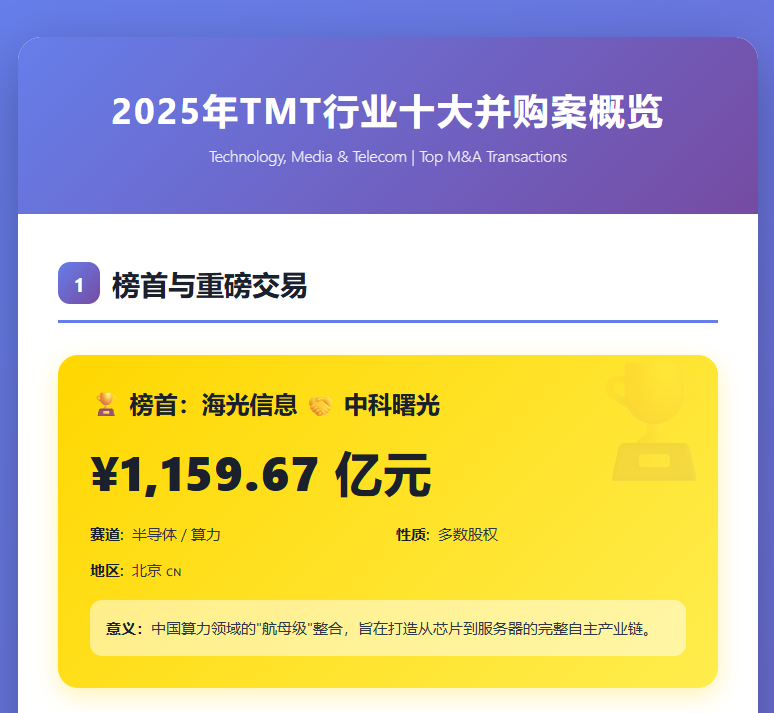
中国2025年 TMT Top10并购案例一图概览
Xin Lang Cai Jing· 2026-01-06 01:12
Core Insights - The article outlines the top ten mergers and acquisitions (M&A) in the Technology, Media, and Telecom (TMT) sector for 2025, highlighting significant transactions that shape the industry landscape [1][11]. M&A Transactions Overview - The largest transaction is the acquisition of Zhongke Shuguang by Haiguang Information for approximately 115.97 billion RMB, focusing on the semiconductor and computing power sectors, aiming to create a complete autonomous industrial chain from chips to servers [2][19]. - Tencent Music acquired a majority stake in Ximalaya for around 24 billion RMB (approximately 2.4 billion USD), enhancing its audio content ecosystem [7][19]. - Baidu purchased YY Live for about 21 billion RMB (approximately 2.1 billion USD), strengthening its position in the live streaming and content sector [8][20]. - TCL Technology acquired Shenzhen Huaxing Semiconductor for 11.56 billion RMB, focusing on the semiconductor display industry to enhance vertical integration [8][20]. - Focus Media acquired New潮传媒 for 8.3 billion RMB, consolidating its position in the outdoor advertising market [8][20]. - Fulede acquired 100% of Fulehua for 6.55 billion RMB, expanding its capabilities in the industrial software sector [8][20]. - JD Technology completed the privatization of Dada Group for approximately 39 billion RMB (around 546 million USD), enhancing its e-commerce technology capabilities [8][20]. - Ant Group acquired a majority stake in Bright Smart for about 2.8 billion RMB (approximately 362 million USD), expanding its fintech operations in Hong Kong [9][21]. - Alibaba invested 1.8 billion RMB (approximately 250 million USD) in Meitu through convertible bonds, focusing on AI applications [9][21]. - China Mobile acquired approximately 10 billion RMB (around 137.6 million USD) of a minority stake in HKBN, aiming to expand its telecommunications market share in Hong Kong [9][21]. Geographic Distribution of M&A - The M&A transactions are concentrated in major Chinese cities, including Beijing, Shanghai, Guangzhou, Chengdu, and Hong Kong, reflecting a strategic focus on key economic regions [4][16].
赛迪顾问发布2026年IT趋势 AI+成发展主线
Jing Ji Guan Cha Wang· 2026-01-05 04:45
Core Insights - The 2026 IT trends conference hosted by CCID Consulting highlighted key areas such as computing power, storage, AI, industrial software, cybersecurity, satellite communication, industrial internet, financial digital transformation, and urban trusted data spaces, with insights from ten senior analysts [2] Group 1: Artificial Intelligence - The integration of cloud and data intelligence will solidify AI infrastructure, with AI-enhanced SaaS and task-oriented terminals accelerating adoption in key sectors like industry, government, and healthcare [2] - After the general model craze, large models will focus on vertical small models and autonomous intelligent agents, evolving from a "general base" to an "intelligent engine" driving industrial transformation [5] Group 2: Computing Power - The local computing ecosystem is maturing, with domestic brands expected to sell over 280,000 computing servers in 2026, leading to large-scale implementation of interconnected computing power [2][3] Group 3: Storage - The demand for AI is driving a "super cycle" in the storage industry, with prices for consumer-grade SSDs potentially doubling and high-bandwidth memory (HBM) demand continuing to rise [3] Group 4: Industrial Software - Industrial software is crucial for transitioning manufacturing from experience-driven to data-driven, enhancing efficiency and resource allocation [3] Group 5: Cybersecurity - The Chinese cybersecurity system will increasingly focus on intelligent upgrades and resilience, driven by evolving market demands and mature core technologies [4] Group 6: Satellite Communication - Satellite communication is becoming a core pillar of national strategic technological strength, facilitating seamless coverage and supporting future industries like low-altitude economy and space resource development [3] Group 7: Digital Transformation in Finance - New AI technologies are reshaping the foundational logic and operational methods of financial services, driving digital transformation in the financial sector [6] - The integration of generative AI in financial verticals is transforming IT from a supportive tool to a core engine of financial innovation [6] Group 8: Urban Trusted Data Spaces - The construction of a secure and trusted data circulation ecosystem is essential for driving high-quality urban development, enhancing modern governance and digital collaboration [5]

新华基金赵强:以ROIC为锚逆向抄底源杰科技,算力+科技全链条布局拒绝短期博弈
Sou Hu Cai Jing· 2026-01-05 03:35
Group 1 - The core viewpoint of the articles highlights the significant rise in the Shanghai and Shenzhen stock indices in 2025, driven by policy support, capital inflow, and sectoral benefits, with the Shanghai Composite Index reaching 3963.68 points and the Shenzhen Component Index at 13603.89 points as of December 26 [2] - The China Securities Regulatory Commission has implemented reforms such as the Sci-Tech Innovation Board and expanded Sci-Tech bonds to promote deep integration of technology and capital, resulting in 102 strategic emerging industry companies entering the A-share market in 2025 [2] - Northbound capital significantly increased its holdings in the electronics and communications sectors in Q3, with the electronics sector's market value rising by 67.78% quarter-on-quarter, contributing to the index's rise [2] Group 2 - Fund manager Zhao Qiang's investment strategy focuses on a high-quality stock selection system anchored by ROIC, emphasizing long-term value over short-term speculation [3] - Zhao Qiang's funds, such as Xinhua Strategy Selected Stock A, achieved returns of 78.52% in 2025, benefiting from a focus on high-growth sectors like communications and electronics, which saw returns of 81.7% and 45.9% respectively [2][3] - The Xinhua Preferred Dividend Mixed A fund has shown exceptional performance with a year-to-date return of 74.66% and a total return of 1243.24% since inception, attributed to Zhao Qiang's unique investment strategy and precise industry allocation [6] Group 3 - The Xinhua Trend Leading Mixed Fund also performed well, with a year-to-date return of 77.93% and a total return of 452.98% since inception, driven by a focus on technology innovation and high-quality companies [19] - Key holdings in the fund include Ding Tong Technology and Maiwei Bio, both of which have shown significant price increases, with Ding Tong Technology's stock price rising by 210% during the holding period [10][7] - The fund's strategy includes dynamic adjustments to the portfolio, increasing exposure to high-quality companies while avoiding high-volatility risks, enhancing the overall risk management of the portfolio [15][20] Group 4 - The investment philosophy emphasizes capturing structural opportunities in technology and high-end manufacturing sectors, with a focus on companies with ROIC exceeding 15% [6][7] - The fund manager's approach includes a diversified investment across different segments of the technology chain, such as chip design and equipment manufacturing, to mitigate concentration risk [15] - The strategy of "value as an anchor, trend as a sail" has proven effective in navigating the structural market conditions of 2025, providing a replicable reference model for long-term investors [31]


中信证券裘翔:2026年A股公司盈利增速将呈现前低后高态势
Zheng Quan Shi Bao Wang· 2026-01-05 01:37
Core Viewpoint - The chief A-share strategist at CITIC Securities, Qiu Xiang, predicts that the profit growth rate of A-share companies will exhibit a pattern of low growth followed by high growth in 2026 [1] Group 1: Market Phases - The market trend is expected to be influenced by the US-China trade agreement and the US midterm elections, divided into three phases: 1. From now until the trade agreement is finalized, the market's upward slope is expected to slow down 2. From the agreement's implementation to the end of the midterm elections, A-shares are likely to experience sustained growth in a stable external environment 3. After the midterm elections, uncertainties from external disturbances may increase sharply, prompting investors to refocus on domestic factors [1] Group 2: Investment Opportunities and Sector Allocation - Four major themes are highlighted for investment opportunities: 1. The manufacturing sector's competition for global pricing power, with a focus on industries such as non-ferrous metals, chemicals, and new energy, which can convert market share advantages into pricing power and profit margin increases 2. The globalization of Chinese enterprises, significantly expanding market capitalization and profit growth potential, with key industries including machinery, innovative pharmaceuticals, electric equipment, and military industry 3. The continuation of the technology trend, particularly in AI, which is expected to further expand its commercial applications and enhance the competitive advantages of Chinese companies, focusing on sectors like semiconductors, computing power, edge hardware, and AI applications 4. The potential for unexpected recovery in domestic demand, where although the outlook for domestic demand-related sectors is generally moderate, there exists significant room for recovery and valuation elasticity [2]

从估值重估走向业绩驱动 2026年中国股市将延续涨势
Shang Hai Zheng Quan Bao· 2026-01-05 00:45
Group 1 - The core viewpoint of the articles indicates a positive outlook for the Chinese stock market in 2026, driven by factors such as AI innovation, supportive policies for private enterprises, and improved corporate earnings [1][4][5] - The Shanghai Composite Index achieved an 18.41% increase in 2025, marking its best annual performance since 2020, with the Shenzhen Component Index and ChiNext Index rising by 29.87% and 49.57% respectively [1] - Domestic and foreign institutions are increasingly optimistic about Chinese assets, particularly in the technology sector, which is expected to be a key growth driver in 2026 [2][4][6] Group 2 - Domestic securities firms, such as CITIC Securities, emphasize a shift from valuation-driven gains to performance-driven earnings, suggesting that investors should focus on companies' earnings rather than expecting further valuation increases [2][3] - International investment banks, including UBS and Morgan Stanley, predict a favorable environment for Chinese stocks, citing ongoing support for innovation and the resilience of corporate earnings in a complex trade environment [4][5] - The AI sector is highlighted as a critical area for investment, with expectations for new applications and growth in related industries such as semiconductors and advanced manufacturing [6][7] Group 3 - The overall sentiment among foreign institutions is that structural improvements in the Chinese market will support a broader upward trend, with predictions of significant earnings growth for Chinese companies in 2026 and 2027 [4][5] - The focus on AI and technology is expected to enhance the profitability of the Chinese stock market, with a notable increase in R&D investments driving the digital economy's contribution to GDP [6][7] - Asset allocation strategies suggest an overweight position in Chinese stocks and gold, with a cautious approach to gold due to its current high valuation [7]
