
保险

Search documents
港股10日涨0.58% 收报27183.15点
Xin Hua She· 2026-02-10 14:56
中资金融股方面,中国银行涨0.43%,收报4.72港元;建设银行涨0.5%,收报8.12港元;工商银行 涨0.77%,收报6.57港元;中国平安涨0.62%,收报73.45港元;中国人寿涨1.37%,收报35.52港元。 石油石化股方面,中国石油化工股份涨1.69%,收报5.42港元;中国石油股份涨1.64%,收报9.31港 元;中国海洋石油涨2.67%,收报24.64港元。 蓝筹股方面,腾讯控股跌1.61%,收报551港元;香港交易所跌0.33%,收报417.2港元;中国移动跌 0.13%,收报78.4港元;汇丰控股涨0.72%,收报140.3港元。 香港本地股方面,长实集团涨0.21%,收报46.72港元;新鸿基地产跌1.9%,收报129港元;恒基地 产涨0.06%,收报32.8港元。 新华社香港2月10日电 香港恒生指数10日涨155.99点,涨幅0.58%,收报27183.15点。全日主板成交 2340.4亿港元。 国企指数涨74.42点,收报9242.75点,涨幅0.81%。恒生科技指数涨33.43点,收报5451.03点,涨幅 0.62%。 ...
金融行业的鄙视链
集思录· 2026-02-10 14:52
Core Viewpoint - The article critiques the insurance industry, suggesting that traditional insurance products often yield low returns compared to other investment options, and highlights the importance of alternative financial strategies such as investing and preventive health measures [1][4][7]. Group 1: Insurance Products - Many individuals perceive insurance products, particularly life and health insurance, as inadequate due to their low returns and high costs, with some arguing that the real inflation rate in China is around 10% to 12%, making 3% returns from insurance unappealing [2][3]. - The article emphasizes that critical illness and medical insurance often do not provide sufficient coverage, suggesting that individuals could spend less on specialized health check-ups instead of high insurance premiums [3][6]. - It is noted that accident insurance typically only covers the out-of-pocket expenses not reimbursed by health insurance, which may not justify the cost of the policy [3]. Group 2: Investment Alternatives - The article advocates for investing money rather than purchasing insurance, arguing that funds allocated to insurance could yield better returns if invested in other financial instruments [4][5]. - The discussion includes personal anecdotes about the effectiveness of low-cost health insurance options, such as the "惠民保" (Huimin Bao), which provided significant coverage for medical expenses, demonstrating that affordable insurance can be beneficial [5]. Group 3: Financial Industry Perceptions - There is a prevailing sentiment in the financial industry that insurance is viewed as a "negative expected return" product, with estimates suggesting a negative return of up to 50% in the domestic market [7]. - The article highlights a "financial hierarchy" where different sectors within finance look down on each other, illustrating a culture of elitism and competition among financial professionals [8][10].


横琴人寿换帅,券业老将燕文波赴任,这家亏损险企将何去何从?
券商中国· 2026-02-10 14:49
华金证券党委书记、总裁燕文波拟调任横琴人寿,接任董事长。 券商中国记者独家获悉,燕文波将于春节后赴任横琴人寿。燕文波系券业老将,于2021年末出任华金证券党委 书记、总裁,此外,华金证券和横琴人寿同属于珠海国资旗下的金融机构。原董事长钱仲华据称于1月22日在 董事会上请辞并获得批准。 近期,非上市保险公司公布2025年第四季度偿付能力报告,57家人身险公司净利润大幅增长,其中仍有10家亏 损,横琴人寿便是其中之一。这家已完成国有资本注入但尚未扭亏为盈的险企,未来将何去何从? 钱仲华掌舵一年多辞任 日前,市场传言横琴人寿拟换帅,原因是原董事长钱仲华辞任。据称1月22日,钱仲华在董事会上请辞并获得 批准,这距离他正式出任董事长仅一年多,不过他早已到了退休年龄。 去年12月25日,横琴人寿保险的增资事项获国家金融监督管理总局广东监管局批复,注册资本由31.37亿元增 至49.89亿元。当时由四家公司共同出资近20亿元,包括原股东珠海铧创投资管理有限公司、亨通集团有限公 司,以及新股东横琴深合投资有限公司、横琴金融投资集团有限公司,一共认缴了18.52亿元注册资本。 据业内知情人士透露,增资完成后,钱仲华曾在朋友圈表 ...

险资购金试点一周年:配置克制,显“耐心资本”本色
Bei Jing Shang Bao· 2026-02-10 14:32
Core Viewpoint - The cautious entry of insurance funds into the gold market, despite the potential for significant investment, reflects a careful strategy rather than the anticipated aggressive buying behavior [1][5][10]. Group 1: Policy and Market Entry - The pilot program for insurance funds to invest in gold was officially launched on February 7, 2025, allowing ten insurance companies, including major players like China Life and PICC Property and Casualty, to participate [3][7]. - Six out of the ten approved insurance companies have completed the membership process with the Shanghai Gold Exchange, marking their entry into direct gold investment [1][3]. - Initial transactions were completed by several companies, with China Life and PICC Property and Casualty executing the first trades shortly after gaining membership [3][4]. Group 2: Investment Strategy and Behavior - Despite the theoretical investment limit of nearly 200 billion yuan, actual investments by insurance companies remain low, indicating a cautious approach to gold investment [5][8]. - Many insurance firms are still in a trial phase, with some reporting minimal gold investment proportions, reflecting a strategy of "testing the waters" rather than aggressive accumulation [5][6]. - The overall sentiment among insurance companies is one of prudence, as they navigate the complexities of gold investment amidst market volatility and high prices [6][10]. Group 3: Challenges and Professional Barriers - The investment in gold presents challenges due to its volatile nature and the need for specialized knowledge, which many insurance companies currently lack [8][9]. - Regulatory requirements impose strict limits on the proportion of total assets that can be allocated to gold, further constraining investment strategies [7][9]. - There is a recognized need for insurance companies to enhance their professional capabilities in gold market analysis and risk management to effectively engage in gold investments [8][9]. Group 4: Long-term Perspectives - Long-term, insurance companies are beginning to recognize the strategic value of gold in their asset allocation, particularly as a hedge against inflation and market volatility [10][11]. - The shift towards including gold in investment portfolios is seen as a response to the limitations of traditional fixed-income assets in the current low-interest-rate environment [10][11]. - Future expectations suggest that insurance companies may gradually increase their gold investment ratios, although current market conditions and high prices necessitate a cautious approach [12].



中国人寿:公司一直以来坚持资产负债匹配原则和长期投资、价值投资、稳健投资理念
Zheng Quan Ri Bao· 2026-02-10 14:10
Group 1 - The company emphasizes its adherence to the principle of asset-liability matching and its commitment to long-term, value, and prudent investment strategies [1] - The company aims to seize market opportunities and effectively manage cross-cycle investment layouts [1] - Investors are encouraged to pay attention to the company's regular reports for more detailed information [1]
中国人寿回应投资者:黄金投资是公司积极参与的创新品种投资之一
Mei Ri Jing Ji Xin Wen· 2026-02-10 14:05
随后,试点险企逐步启动布局。2025年3月,中国人寿、平安人寿、太保人寿、人保财险率先成为上海 黄金交易所会员,拿下投资黄金的"入场券",并陆续完成首笔黄金交易。但是相比于10家机构获批试点 业务,当前仅有6家试点险企跻身上海黄金交易所会员,这意味着仍有4家试点险企尚未入会。 有业内人士表示,黄金是具有风险复杂度和专业门槛的投资品种,其定价受国际政治经济因素影响较 多,黄金无法直接产生可预期的利息收入,只能通过价格上涨获利,需要耐心观察并把握交易时机。另 一方面,逐步建设完善黄金投资相关的投研和交易能力还需要一个过程。 封面图片来源:每经媒资库 每经记者|袁园 每经编辑|张益铭 2026年初,国际黄金价格在快速冲高后大幅回落,现货金价自5500美元/盎司高位"急刹车",极端波动 引发市场对避险资产稳定性的重新审视。在此背景下,保险资金投资黄金试点的推进节奏与策略选择受 到关注。 2月10日,中国人寿董秘在互动平台上就投资人关注的黄金业务试点情况进行了回复。中国人寿表示, 黄金投资是公司积极参与的创新品种投资之一,公司坚持长期主义的投资理念,以中长期配置为目的, 稳健审慎开展相关投资工作。 2025年2月7日, ...
港股投资策略报告:冰火两重天的港股如何配置?-20260210
INDUSTRIAL SECURITIES· 2026-02-10 14:04
Group 1 - The report highlights a significant divergence in the Hong Kong stock market, with technology and telecommunications sectors dragging down the Hang Seng Index, while other industries have shown positive returns. The Hang Seng High Dividend Yield Total Return Index has reached a historical high, and the relatively balanced Hong Kong Stock Connect Index has outperformed the A-share CSI 800 Index [2][13]. - The Hang Seng Technology Index has faced pressure from short sellers, exacerbated by multiple narratives, including concerns over tax policy adjustments and the potential disruption of AI on traditional business models, leading to a negative sentiment in the market [2][13]. Group 2 - The outlook suggests that the Hong Kong market may see an influx of foreign capital in 2026 due to the ongoing loose liquidity environment and the potential for the Federal Reserve to continue lowering interest rates. Recent trends indicate a significant increase in net inflows from the Stock Connect program, particularly into technology stocks that have experienced substantial declines [3][24]. - Domestic investors are also accelerating their investments in Hong Kong stocks, taking advantage of market adjustments. The average daily net inflow from the Stock Connect has rebounded to a high level not seen since 2024, indicating renewed interest in the market [3][24]. Group 3 - The report recommends a strategy of combining "technology as a core holding + cyclical recovery + beta opportunities in dividends" to embrace the upcoming spring market. Current market sentiment is at a relatively low point, suggesting potential for a short-term rebound [4][31]. - Technology remains a long-term focus, with AI expected to be a key driver. The report notes that leading internet and application companies have already priced in pessimistic expectations, making them attractive for investment as they are near historical valuation lows [4][31]. Group 4 - The cyclical leaders in the Hong Kong market are expected to see improvements as the Chinese economy transitions towards "slower growth + increased efficiency." This shift is anticipated to enhance the competitive landscape and gradually restore profitability for leading companies in sectors such as chemicals, real estate, and machinery [4][34]. - The report emphasizes the importance of consumer data during the Spring Festival as a potential catalyst for market performance, particularly for consumer service leaders in sectors like gaming, dining, and travel [4][34]. Group 5 - The report identifies that the ongoing geopolitical landscape in 2026 is more favorable for Chinese assets, with the risk premium of the Hang Seng Index relative to 10-year U.S. Treasury yields being significantly higher than that of developed markets. This situation is expected to attract more foreign capital to Hong Kong stocks [5][22]. - A stable RMB is projected to enhance the attractiveness of RMB-denominated assets, with historical trends indicating that significant RMB appreciation often correlates with rising Hong Kong stock prices [5][22].
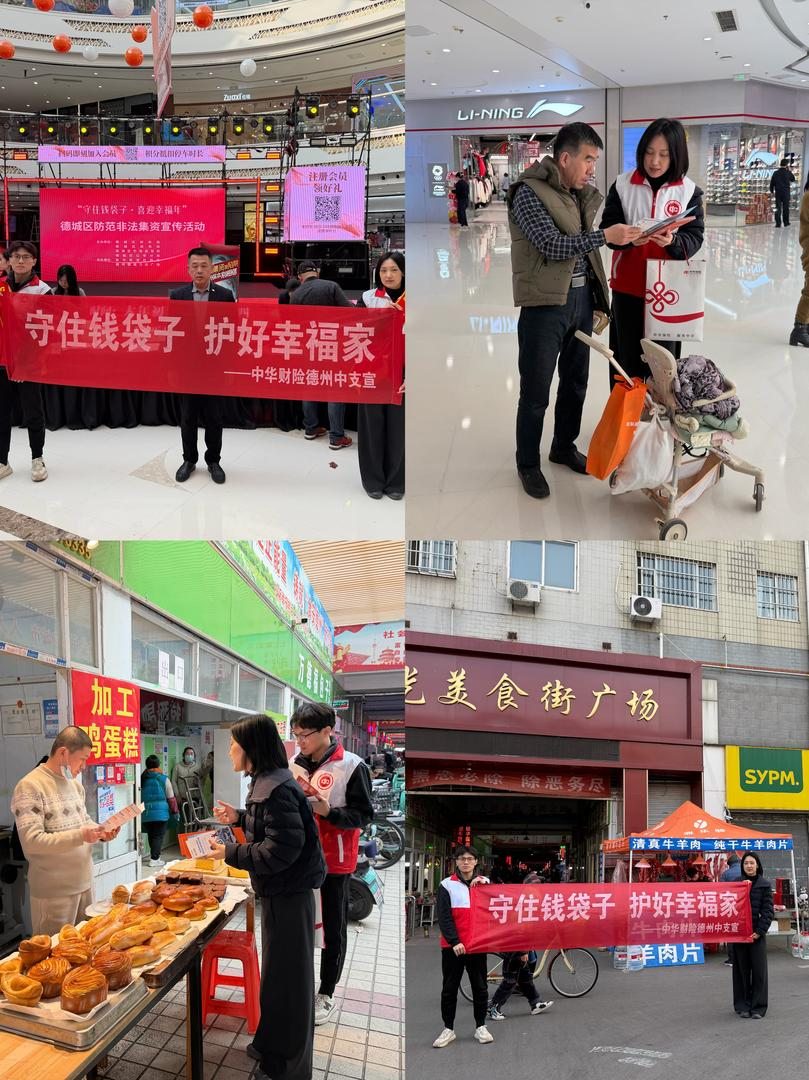
守护“钱袋子”,中华财险山东德州中支伴您护好幸福家
Qi Lu Wan Bao· 2026-02-10 13:54
Core Viewpoint - The company is actively engaging in financial safety education to prevent illegal financial activities during the Spring Festival, providing essential knowledge to the public [1] Group 1: Financial Safety Education Activities - The company organized a series of promotional activities to deliver financial safety knowledge to citizens, termed as "special New Year gifts" [1] - A "mobile classroom" was established in the Wanda business district, where staff provided face-to-face explanations of common illegal financial activities, particularly targeting vulnerable groups like the elderly [2] - The promotional team conducted one-on-one explanations in busy areas, revealing common tactics and dangers of illegal fundraising and telecom fraud [4] Group 2: Key Messages and Guidelines - The company emphasized the safety principles of "do not trust, do not disclose, do not transfer" to help the public protect their financial assets [5] - The diverse forms and relevant content of the educational activities were designed to resonate with the community's needs, enhancing the financial security of citizens during the festive season [5] - The initiative reflects the company's commitment to service, promise-keeping, and social responsibility, contributing to a safer and more secure environment for the public [5]
中国平安发起2026春节风险减量行动
Zheng Quan Ri Bao· 2026-02-10 13:35
Core Viewpoint - Ping An Property & Casualty Insurance is launching the "2026 'Safe Journey for Thousands of Families' Spring Festival Risk Reduction Initiative" to proactively address safety risks during the Spring Festival travel period, marking a significant upgrade to its 15-year tradition of Spring Festival safety activities [1]. Group 1 - The initiative focuses on risk reduction by utilizing historical claims data and emphasizes collaboration between police and insurance services, leveraging technology to implement localized risk management strategies [1]. - The action targets provinces with historically high average daily claims during the Spring Festival, including Sichuan, Anhui, Henan, and Hunan, while also being implemented in Shandong, Hubei, Gansu, and Guangxi [1]. - The risk reduction model includes data analysis, police-enterprise collaboration, and tailored strategies for different regions, addressing challenges posed by increased traffic and potential hazards during the Spring Festival [1]. Group 2 - For the past 15 years, Ping An Property & Casualty Insurance has provided various supportive services at key locations such as highway entrances and scenic areas, including accident quick processing, claims consultation, travel assistance, safety checks, tire changes, and supply provisions [2].

欧洲保险股下跌 此前人工智能担忧引发美国同行遭抛售
Xin Lang Cai Jing· 2026-02-10 13:33
来源:滚动播报 周二,欧洲股市基准指数中保险类股表现最差,因美国同行因市场担忧人工智能颠覆性影响而遭抛售, 导致市场对该板块情绪恶化。斯托克600保险分类指数一度下跌1.9%,安联保险、苏黎世保险集团和英 杰华集团跌幅居前。尽管市场对私营在线平台Insurify推出的人工智能工具日益担忧,但周二的跌幅较 周一纽约股市更显温和。标普500保险指数收跌3.9%,创10月以来最大单日跌幅。 ...