Banks

Search documents
Treasury yields nudged higher as investors await Fed meeting minutes
CNBC· 2026-02-18 08:07
One basis point is equal to 0.01%, and yields and prices move in opposite directions.At 2:48 a.m. ET, the 10-year Treasury yield rose over 2 basis points to 4.075%, and the 30-year Treasury bond yield was up 1 basis point to 4.7%. The 2-year Treasury note yield was 1 basis point higher at 3.453%.U.S. Treasury yields edged higher on Wednesday as investors anticipated the Federal Reserve's meeting minutes and key inflation data.Investors will be keeping an eye out for the FOMC meeting minutes, which will be r ...


年内近30家村镇银行注销解散
2 1 Shi Ji Jing Ji Bao Dao· 2026-02-18 08:02
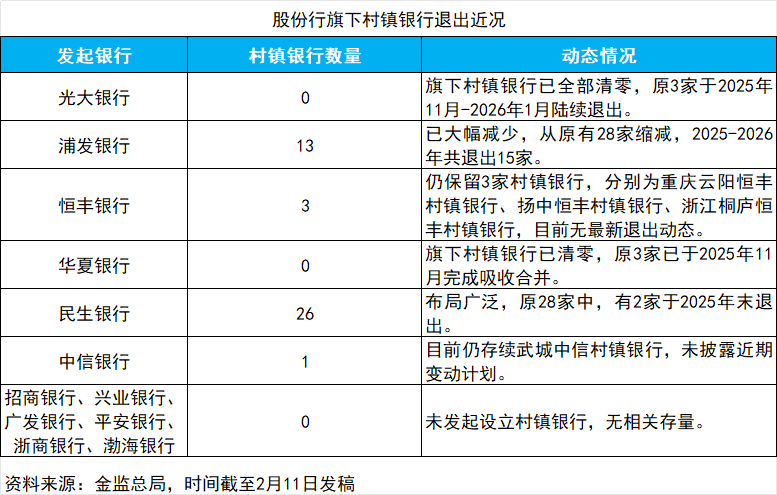
2026年开年,股份行整合与退出旗下村镇银行的步伐加快,"村改支"的行业浪潮已席卷股份制银行领域。 日前,21世纪经济报道记者注意到,截至今年1月底,光大银行(601818)在三个月内迅速完成了旗下三家村 镇银行的退出,实现了存量机构的全面"清零"。与此同时,浦发银行(600000)也正以"村改支"模式密集推进 整合,仅在2月5日、6日就接连有旗下两家村镇银行退出,成为近期股份行中退出动作最为频繁的机构。 专业人士指出,这一系列退出行动属于"主动申请+合规审批"的良性模式。早在2025年10月,湖南、江苏两地 金融监管部门就已批复同意两家机构解散,并明确主发起行光大银行承继所有权利义务,同时要求机构在批复 后15个工作日内缴回金融许可证。这一环节明确了"主发起行兜底"的核心原则,为后续的人员安置与资产交割 奠定了坚实基础。 值得注意的是,尽管上述三家村镇银行在2024年全部实现盈利,但其2025年的业绩却出现了分化。比如,光大 银行2025年半年报显示,截至2025年6月末,韶山光大村镇银行总资产为8.32亿元,净资产为2.46亿元,但上半 年亏损116.88万元。 股份行整合路径分化 浦发银行退出步伐最快 ...


年内近30家村镇银行注销解散
21世纪经济报道· 2026-02-18 07:53
Core Viewpoint - The article highlights the accelerated pace of integration and exit of village banks by joint-stock banks, marking a shift from rapid expansion to a focus on high-quality development in the industry [1][6]. Group 1: Recent Developments in Village Bank Exits - As of the end of January 2026, Everbright Bank has completed the exit of its three village banks, achieving a total "zero" status for its village banking operations [1][3]. - Shanghai Pudong Development Bank (SPDB) is also actively pursuing the "village to branch" model, with two of its village banks exiting in early February 2026, making it one of the most active banks in this regard [1][5]. - Nearly 30 village banks have been deregistered since the beginning of 2026, significantly higher than the same period last year [1][6]. Group 2: Integration and Exit Strategies - The exit actions by Everbright Bank are characterized as a "proactive application + compliance approval" model, with the bank inheriting all rights and obligations of the exited banks [3][4]. - The trend indicates a shift towards a more specialized and high-quality development phase for village banks, as the government emphasizes risk management and transformation of local financial institutions [6][10]. - The restructuring of over 230 village banks in 2025 through mergers, acquisitions, and exits reflects a deep reshaping of the industry, driven by both state-owned and joint-stock banks [6][9]. Group 3: Differentiated Approaches Among Joint-Stock Banks - SPDB has notably accelerated its exit process, reducing its village banks from 28 to approximately 13, with significant exits occurring between July 2025 and February 2026 [8][9]. - In contrast, Minsheng Bank has retained a broader network of village banks, exiting only two out of 28, indicating a different strategic focus [9]. - Other banks like Huaxia Bank and several others have completed their exits, while some banks have not engaged in village banking at all, highlighting varied strategies across the sector [7][9]. Group 4: Implications for Industry Personnel - The integration and exit of village banks signal a transition for employees, potentially moving from subsidiary roles to formal positions within parent banks, which may offer better resources and processes [9][10]. - However, this transformation also poses challenges, including changes in job roles and assessment systems, as well as potential impacts on existing business structures and client relationships [9][10].
Emerging market consumers are going to play a 'HUGE ROLE' in this, CEO says
Youtube· 2026-02-18 07:45
Market Trends - There has been a significant shift towards markets outside of the United States, with emerging markets gaining momentum and outperforming U.S. stocks [1][5][14] - A recent survey indicated that 27% of investors believe emerging markets will perform extremely well, while 26% believe the S&P 500 will do similarly [3] Emerging Markets - Emerging markets are seen as leveraged plays on global growth, benefiting from a 10% decline in the dollar over the past year [5][6] - The earnings of companies in emerging markets are improving, and their valuations are considered cheap compared to U.S. stocks [6] Valuation Concerns - The S&P 500 has been trading flat for four months, with a notable rotation occurring within the market, particularly affecting high-priced stocks [9][10] - There is a high correlation between stock valuations and market capitalization, with expensive stocks lagging behind [10][14] Economic Indicators - A strong economy, supported by tax refunds projected to be $150 billion more than last year, may lead to higher interest rates [11] - The decline of the dollar is also expected to support higher yields in the future [12] Company Performance - Citigroup's stock has seen a 50% increase over the past year, despite recent volatility due to AI concerns in the financial sector [13] - The performance of mega-cap tech stocks, referred to as the "mag seven," has been mixed, with some being considered oversold [15][17] Capital Expenditure - Concerns exist regarding the return on capital expenditures (capex) for major tech companies, with Apple being noted for its lower spending compared to peers [16][17] - Apple's stock has declined 6% year-to-date, raising questions about the effectiveness of its capex strategy [17]

春节期间,全球资本市场涨跌情况,与节后市场预测
Sou Hu Cai Jing· 2026-02-18 07:29
Core Viewpoint - The global capital markets exhibited a stable performance during the Spring Festival holiday, setting a favorable external environment for the A-share market's reopening, with key drivers including expectations of interest rate cuts by the Federal Reserve and a recovery in industrial metal demand [3][6][13]. Equity Markets - The A-share market experienced a slight decline before the holiday, with the Shanghai Composite Index closing at 4082.07 points, down 1.26%, and the Shenzhen Component Index down 1.28% [4]. - The Hong Kong stock market was the only major Asian market open during the holiday, with the Hang Seng Index rising 0.52% to 26705.94 points, driven by sectors such as semiconductors and AI applications [5]. - The U.S. stock market remained stable, with the Dow Jones increasing by 0.10% and the S&P 500 maintaining a strong position, supported by robust corporate earnings and expectations of interest rate cuts [5][14]. Debt Market and Currency - The U.S. Treasury yields declined, with the 10-year yield falling to 3.85%, reflecting an 80% probability of a rate cut by June, driven by easing inflation data [6][13]. - The exchange rate remained stable, with the USD/CNY rate at 6.9225, supported by the People's Bank of China's liquidity measures and narrowing interest rate differentials [6]. Commodity Market - Industrial metals showed strong performance, with copper prices rising by 1.4% to $13,176 per ton, benefiting from global demand recovery and expectations of liquidity easing [7]. - Oil prices remained stable, with WTI crude oil slightly increasing to $62.89 per barrel, influenced by geopolitical factors and supply-demand dynamics [7]. Market Outlook - The A-share market is expected to experience a bullish trend post-holiday, with historical data indicating a 76% probability of an increase in the first five trading days after the Spring Festival [9]. - The Hong Kong market is anticipated to undergo a structural rebound, with a 60% probability of an increase in the month following the holiday, driven by external sentiment and capital inflows [11]. - The U.S. market is projected to continue its strong performance, particularly in technology sectors, supported by favorable interest rate expectations and solid corporate earnings [14].

孩子存1000比你存20万利息高各大银行盯上压岁钱
Xin Lang Cai Jing· 2026-02-18 07:00
【#孩子存1000比你存20万利息高##各大银行盯上压岁钱#】新年到来,孩子们收到压岁钱后,家长们又 在发愁如何打理。@中新经纬 采访发现,今年各大银行仍然对压岁钱进行营销,并推出专属的存款产 品。在存款利率上,部分银行针对压岁钱推出专属存单,并且利率也较银行挂牌利率有所上浮。比如, 北京农商行推出阳光宝贝卡专属储蓄产品,起存金额1000元,1年期、2年期和3年期年利率分别为 1.5%、1.6%、1.75%,而同期限定期存款挂牌利率分别为1.15%、1.2%、1.3%,该行APP显示最新发售 的20万起存、2年期大额存单产品年利率为1.5%。 转自:贝壳财经 ...
EFG International reports increase in full year profits
Reuters· 2026-02-18 06:15
Core Viewpoint - EFG International reported a 1% increase in full year net profits, reaching 325.2 million Swiss francs ($421.95 million) [1] Financial Performance - The bank's net new assets amounted to 11.3 billion francs in 2025, reflecting a growth rate of 6.8% [1] - This level of net new assets is the highest since the global financial crisis [1]

百年老街,资本暗战|故乡里的中国
经济观察报· 2026-02-18 06:13
Core Viewpoint - The article explores the historical significance of Harbin's Central Avenue as a financial hub in Northeast Asia, highlighting the evolution of currency and banking institutions over the past century [2][30]. Group 1: Historical Context - Central Avenue in Harbin was once bustling with financial activity, hosting over twenty banks and financial institutions, including Citibank and HSBC, which played a crucial role in capital flow in Northeast Asia [2][9]. - The area transformed from a marshland in the early 1900s to a vibrant financial center, with the first Russian merchants bringing rubles to the region [2][9]. Group 2: Currency Evolution - In 1914, the circulation of rubles in Harbin exceeded one hundred million, surpassing that of some major cities in Russia, indicating the city's economic significance [9]. - The October Revolution in 1917 led to the devaluation of the old ruble, causing significant financial losses for local merchants, exemplified by a case where a merchant's savings turned worthless overnight [9][10]. - By 1924, the Soviet government abolished all Tsarist currency, marking the end of the ruble era in Harbin [10][21]. Group 3: The Role of Autumn Company - The Autumn Company, established in 1900, became a major retail entity in the region, issuing its own vouchers that functioned as a quasi-currency amidst the chaotic monetary environment [17][19]. - The company's ability to adapt to currency fluctuations allowed it to thrive, even during times of hyperinflation and currency devaluation [19][21]. Group 4: Transition to Modern Currency - After the establishment of the People's Republic of China in 1949, the renminbi became the sole legal tender in Harbin, concluding a long period of currency instability [28][29]. - The introduction of modern banking systems in the late 1990s, such as the Harbin Bank, reflects the evolution of financial services in the region, integrating with global financial networks [29][30]. Group 5: Cultural Significance - The article emphasizes that the physical remnants of Central Avenue, such as its cobblestones and historical buildings, serve as a testament to the financial history and cultural memory of the region [30][34].



股份制银行差异化竞争,头部效应显著
Xin Lang Cai Jing· 2026-02-18 05:56
Core Insights - The mobile banking user base in China is expected to peak in 2025, shifting the industry focus from acquiring new users to enhancing existing user engagement [1] - Financial institutions must achieve extreme efficiency and precision in their ecosystems to survive in this new environment [1] Industry Overview - According to an iResearch report, joint-stock banks are adopting differentiated survival strategies, leading to significant head effects [1] - China Merchants Bank leads joint-stock banks with 71.854 million monthly active users (MAU), surpassing some state-owned banks due to its focus on wealth management and intelligent interaction [1] - Ping An Bank and CITIC Bank form the second tier, maintaining MAUs between 20 million and 30 million, with Ping An Bank leveraging AI to reconstruct service chains and CITIC Bank integrating consumer ecosystems [1] Competitive Landscape - Third-tier institutions, such as Minsheng Bank and Everbright Bank, have seen their MAUs drop to between 10 million and 20 million, indicating a tightening survival space [1] - Local banks are experiencing growth by focusing on their local markets, with city commercial banks like Jiangsu Bank and Beijing Bank maintaining MAUs above 3 million [1] - Among rural commercial banks and rural credit cooperatives, Fujian Rural Credit has surpassed 4.5 million MAUs, capturing traffic in county and rural areas [1] Challenges for Private Banks - The situation for private banks is dire, with the top 50 list for 2025 nearly extinct due to a lack of physical branches, local living ecosystems, and high customer acquisition costs, leading to a loss of competitiveness in the mobile banking sector [1] - In the era of stock competition, ecological and regional capabilities are becoming the key to success [1]




手机银行TOP50再无民营 生态壁垒高筑草根绝迹
Jing Ji Guan Cha Wang· 2026-02-18 05:47
Core Insights - The monthly active users (MAU) of mobile banking apps in China have stabilized between 648 million and 739 million, indicating that user growth has reached a ceiling, marking the end of a decade-long traffic dividend period [2] - User behavior has shifted significantly, with average session duration decreasing from 4.9 minutes in 2023 to approximately 2.7 minutes by mid-2025, reflecting a preference for high-frequency, short-duration, and function-oriented usage [2] - Major state-owned banks have solidified their market dominance, with all six major state-owned banks ranking in the top ten for MAU, led by Agricultural Bank of China with 249 million MAU [2] Industry Dynamics - The core competitive advantage of state-owned banks lies in their "full-scenario integration" capabilities, providing financial services deeply embedded in public services such as government, social security, healthcare, and education [3] - Joint-stock banks are adopting specialized development strategies, with China Merchants Bank leading its peers with 71.85 million MAU, while Ping An Bank and Citic Bank are leveraging AI technology to enhance service processes and maintain user engagement [3] - Local banks are experiencing polarization, with some city commercial banks maintaining MAU above 3 million due to their deep understanding of local markets, while private banks like WeBank and MYbank have fallen out of the top 50 due to challenges in customer acquisition and retention [3] Future Trends - As the industry standard for single-session usage time becomes 3 minutes, banks must rethink their value creation strategies [4] - AI-driven service process optimization, real-time risk control systems, and multi-device collaboration within ecosystems are reshaping the competitive landscape [4] - Key factors for institutional success in the future will include precise user insights, prudent risk management, and robust ecosystem integration capabilities [4]