基金

Search documents
食品饮料ETF领涨;14只ETF单月扩容超百亿元丨ETF晚报
2 1 Shi Ji Jing Ji Bao Dao· 2026-02-02 11:54
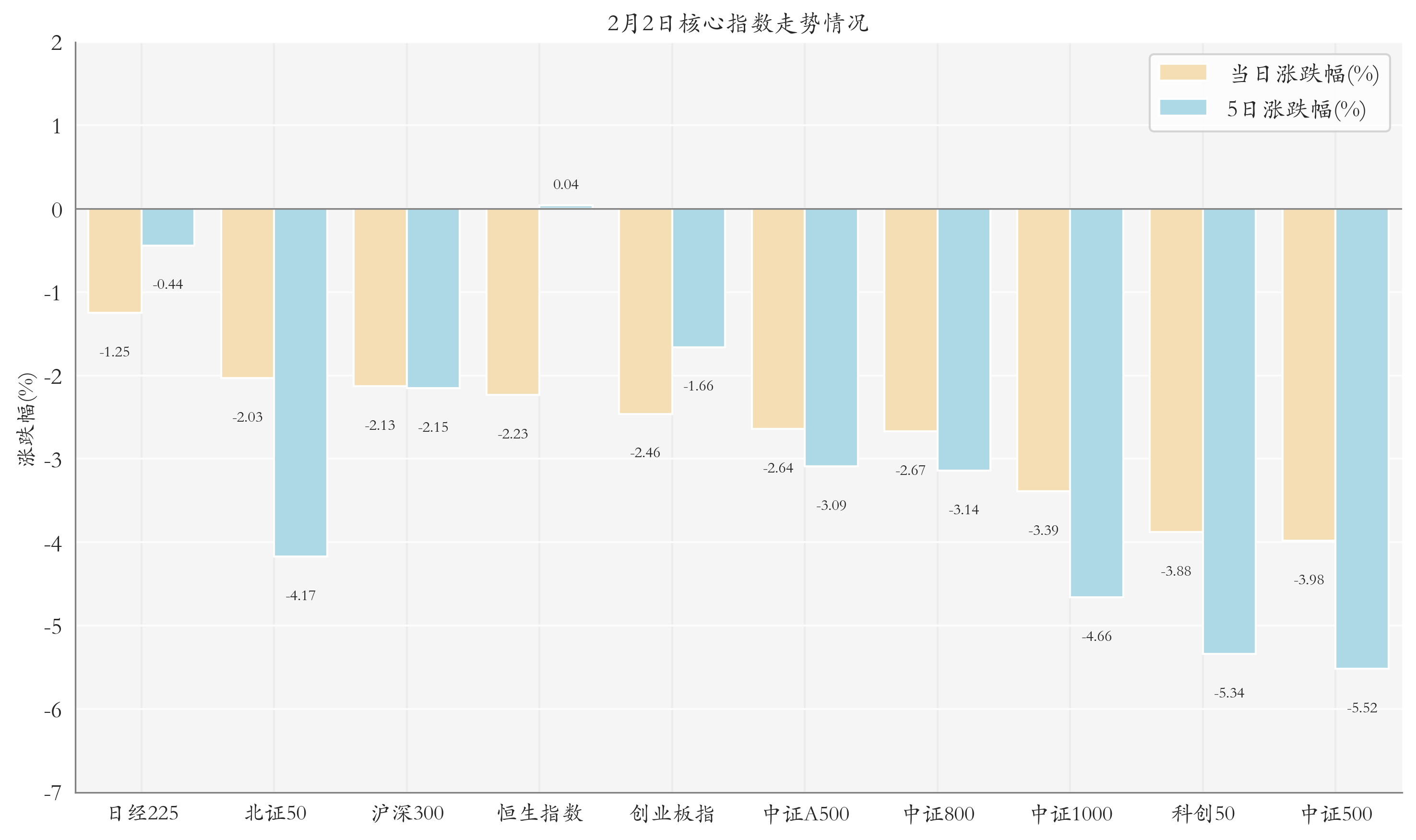
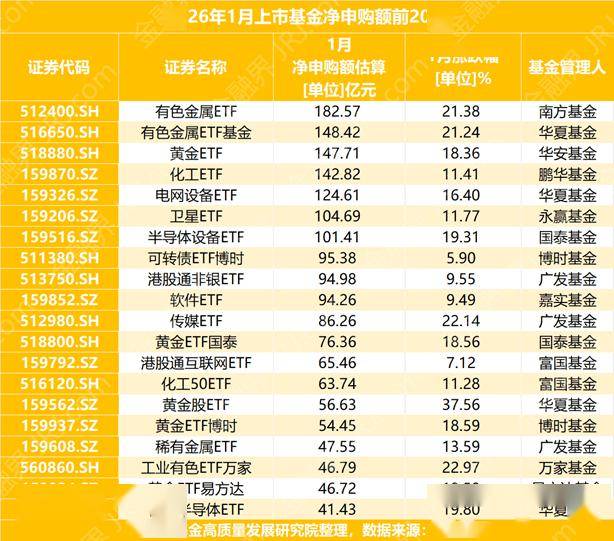
ETF Industry News - The three major indices experienced fluctuations and declines, with the Shanghai Composite Index down 2.48%, the Shenzhen Component Index down 2.69%, and the ChiNext Index down 2.46%. However, several ETFs in the food and beverage sector saw gains, including the Wine ETF (512690.SH) up 1.48%, the Huabao Food and Beverage ETF (515710.SH) up 0.86%, and the Yinhua Food and Beverage ETF (159862.SZ) up 0.79% [1] - The non-ferrous metal sector saw multiple ETFs decline significantly, with the Industrial Bank Gold ETF (159315.SZ) down 10.02%, the Gold Stocks ETF (159321.SZ) down 10.01%, and the Guotai Non-ferrous Metal ETF (159881.SZ) down 10.01% [1] - Guotai Junan Securities predicts a positive outlook for the food and beverage sector by 2026, highlighting four main lines of focus: cost dividend release, operational efficiency improvement, innovation-driven growth, and opportunities for reversal in certain sub-industries. The upcoming Spring Festival is expected to be a significant catalyst, and the imminent introduction of national standards for prepared dishes is also seen as a positive for the industry [1] ETF Market Performance - In January, the stock ETF market experienced a cumulative net outflow of over 790 billion yuan, with the last trading day seeing a net outflow of over 3.7 billion yuan. Popular thematic ETFs such as non-ferrous metals, chemicals, and satellite ETFs saw inflows, while broad-based ETFs like the CSI 300 ETF and the SSE 50 ETF faced significant outflows [2] - The thematic ETFs have gained popularity, with 14 ETFs expanding by over 10 billion yuan each in January. Resource-related and technology-related ETFs have shown particularly strong performance, with the Gold ETF seeing a scale increase of 33.54 billion yuan and the Southern CSI Non-ferrous Metal ETF increasing by 24.22 billion yuan [3][4] - The overall performance of ETFs varied, with money market ETFs showing the best average performance at 0.00%, while commodity ETFs had the worst average performance at -8.88% [11] Sector Performance - In terms of sector performance, the food and beverage, banking, and household appliance sectors ranked highest today, with daily gains of 1.11%, 0.17%, and -0.49% respectively. Conversely, the non-ferrous metals, steel, and basic chemicals sectors ranked lowest, with daily declines of -7.62%, -5.93%, and -5.69% respectively [8] - Over the past five trading days, the food and beverage, communication, and banking sectors have shown positive performance, with gains of 3.14%, 2.47%, and 0.59% respectively, while the non-ferrous metals, steel, and comprehensive sectors have shown declines of -8.68%, -7.66%, and -7.6% respectively [8]

超1800万手封死跌停板,国投白银LOF悬了,溢价仍超40%,还有人进场吗
3 6 Ke· 2026-02-02 11:42
2月2日,白银价格继续下挫,现货白银一度抹去今年迄今全部涨幅,最低至71.31美元/盎司,截至发稿 回升至79美元/盎司左右,沪银主连合约继续封死跌停。 白银此轮暴跌造成的余波还在持续。 2月2日,国投白银LOF复牌后直接跌停,截至当日收盘,封单量达1835.5万手,溢价率从 58.64%收窄至43.80%,不过当日仍有13.94万手成交,成交额为6583万元。 此前,国投白银LOF因存在一定套利空间吸引资金持续涌入,溢价率在基金公司连续多日通过停牌提示 风险后仍不见回落。该基金跌停后,有投资者表示,"吃一堑长一智,以后再也不买高溢价的产品了。" 苏商银行特约研究员武泽伟向时代周报记者表示,短期内,白银价格暴跌与基金复牌跌停,市场恐慌情 绪将驱动溢价率快速下行。但中期回归节奏取决于两个关键变量:一是基金何时能重启或放宽申购,这 是恢复套利功能、从根本上消除溢价的前提;二是白银价格自身的走势,若底层资产继续剧烈波动,可 能引发新的投机交易,延缓回归正常区间的进程。 复牌一字跌停,四季度份额增超75% 1月30日晚,白银市场上演恐慌性抛售,沪银全合约跌停,伦敦现货白银整日最大跌幅超35%,创下历 史最大日内跌幅。 ...
“红利+”指数集体回调,价值ETF易方达(159263)、自由现金流ETF易方达(159222)受资金关注
Sou Hu Cai Jing· 2026-02-02 11:37
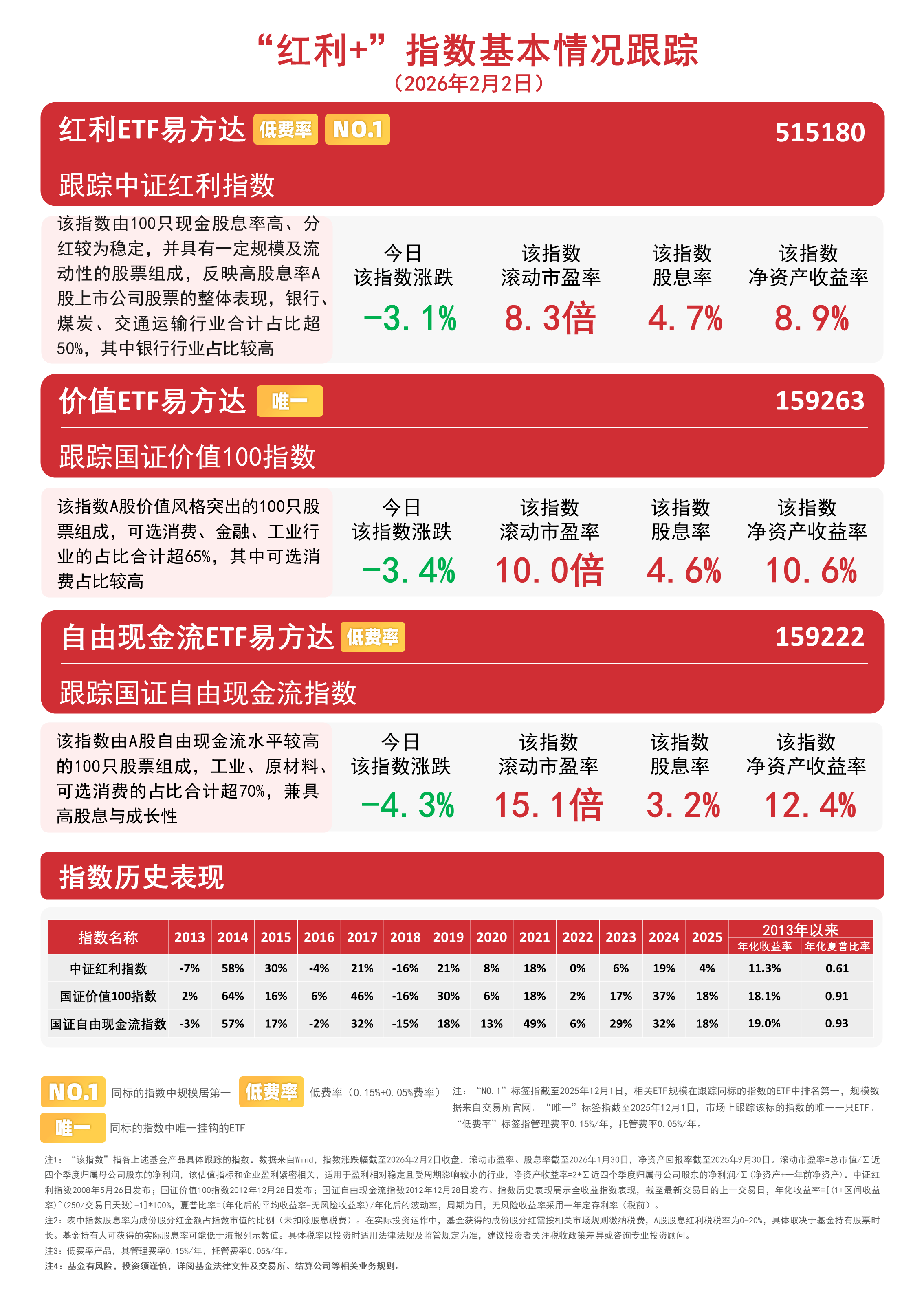
Core Viewpoint - The "Dividend +" index experienced a collective pullback on February 2, with significant declines in various indices, while related ETFs saw substantial net subscriptions, indicating investor interest in value and cash flow strategies [1][5]. Group 1: Index Performance - The CSI Dividend Index fell by 3.1%, the National Value 100 Index decreased by 3.4%, and the National Free Cash Flow Index dropped by 4.3% [1]. - Historical performance of the indices shows fluctuations, with the National Value 100 Index achieving a 64% increase in 2014 and the National Free Cash Flow Index showing a 57% increase in the same year [7]. Group 2: ETF Subscriptions - The value ETF E Fund (159263) and the free cash flow ETF E Fund (159222) saw net subscriptions of 3 million and 38 million units, respectively, indicating strong investor interest [1]. - Both ETFs track indices that focus on high dividend yields and free cash flow, providing investors with opportunities in these investment styles [1][5]. Group 3: Index Composition - The National Free Cash Flow Index consists of 100 stocks with high free cash flow levels, with over 70% of the composition in industrials, materials, and consumer discretionary sectors, combining high dividends with growth potential [5].
金融破段子 | 那熟悉的拉扯感既怕错过又怕买错
中泰证券资管· 2026-02-02 11:31
Core Viewpoint - The article discusses the current market volatility and suggests that instead of chasing rapidly changing investment trends, investors should consider index-enhanced funds as a pragmatic strategy to achieve returns that exceed market averages [2]. Group 1: Index-Enhanced Funds - Index-enhanced funds are designed to actively manage investments while passively tracking an index, aiming to achieve both beta returns from the index and alpha returns through enhancement strategies [3]. - When selecting index-enhanced funds, it is crucial to evaluate their historical net asset value performance since inception, as past performance can provide insights into potential future returns [5]. - The article emphasizes the importance of understanding the enhancement strategy before making a selection, as any strategy may experience periods of underperformance [7]. Group 2: Performance Metrics - The example of the Zhongtai CSI 300 Index Enhanced Fund illustrates that since its inception on April 1, 2020, the A share's net asset value growth rate reached 69.63%, significantly outperforming the benchmark growth rate of 24.85% by 44.78% [5][9]. - The fund consistently generated excess returns relative to its benchmark across all complete half-year periods since its establishment, indicating stable performance in various market conditions [5]. - The article suggests that a fund's ability to generate consistent small victories over time is more valuable than sporadic outstanding performance in a single year [5].

易方达基金减持光大证券(06178)69.48万股 每股作价约8.87港元
智通财经网· 2026-02-02 11:28
智通财经APP获悉,香港联交所最新数据显示,1月27日,易方达基金减持光大证券(06178)69.48万股, 每股作价8.8706港元,总金额约为616.33万港元。减持后最新持股数目为5583.2万股,最新持股比例为 7.93%。 ...

贵金属资金流向逆转:投机资金集中撤离,品种分化行情将至!
Sou Hu Cai Jing· 2026-02-02 11:21
除了宏观政策面的风向突变,交易层面的因素也放大了波动。在1月份价格飙升至历史高位的过程中, 黄金的相对强弱指数(RSI)等技术指标已进入严重超买区间,积累了巨大的获利了结压力。早期涌入 的投机资金与高杠杆交易盘在价格转向时集中平仓,引发了连锁式的技术性抛售。其中,白银因市场规 模相对较小、金融与工业属性交织且投机资金参与度更高,其价格波动较黄金更为剧烈。 针对后市走向,光大期货认为,贵金属价格剧烈调整是对前期极端超买与过度拥挤交易的一次"挤泡沫 和降杠杆"式的强制性清算,但支撑贵金属的长期核心变量(如美元信用体系重构、去美元化储备趋 势、地缘政治裂痕常态化)并未发生逆转,长期驱动逻辑依然完整。进入2月,市场将更加关注宏观、 政策信号与地缘事件驱动寻求贵金属的支撑点,波动率仍将维持高位,但各品种将走向分化。 从长周期来看,国联期货表示,贵金属整体趋势依然稳定。在全球秩序重构大势不可逆、地缘政治仍处 于高度不确定性、全球信用货币体系重构(美元信用松动)的长期宏观趋势背景下,黄金作为重要储备 资产,在避险、货币对冲及抗通胀的配置需求支持下,仍将维持强势格局。而白银在全球战略资产储备 需求升温、结构性供需缺口长期存在 ...

中证1000成长ETF(562520)开盘涨0.47%,重仓股航天工程跌0.35%,臻镭科技涨1.44%
Xin Lang Cai Jing· 2026-02-02 11:16
Group 1 - The China Securities 1000 Growth ETF (562520) opened with a gain of 0.47%, priced at 1.484 yuan [1] - The ETF's performance benchmark is the China Securities Selected 1000 Growth Innovation Strategy Index return rate [1] - Since its establishment on March 8, 2022, the fund has achieved a return of 47.91%, with a one-month return of 11.67% [1] Group 2 - Major holdings in the ETF include Aerospace Engineering, which opened down 0.35%, and Zhenlei Technology, which rose by 1.44% [1] - Other notable stock movements include Platinum Power up 1.68%, Aerospace Intelligence down 0.64%, and Zhongrong Electric up 1.06% [1] - The fund is managed by Huaxia Fund Management Co., with Zhang Jinzhi as the fund manager [1]

A股大跌,原因来了!公募最新研判
Zhong Guo Ji Jin Bao· 2026-02-02 11:13
Core Viewpoint - The recent adjustment in A-shares is attributed to a combination of technical corrections and emotional releases, rather than systemic risks, with a continued positive outlook for the spring market driven by economic recovery and liquidity easing [1][2][4]. Market Adjustment Reasons - The primary disturbance in the market is linked to the nomination of Kevin Warsh as the next Federal Reserve Chairman by President Trump, which is interpreted as a hawkish stance advocating for "rate cuts + balance sheet reduction," leading to a stronger dollar and impacting commodity prices [2][3]. - The direct trigger for the adjustment was the significant drop in international precious metals markets, particularly gold and silver, which negatively affected the A-share market, especially in the non-ferrous metals sector [2][3]. Market Structure and Performance - Despite the overall market decline, certain sectors such as electric grid equipment, liquor, and banking showed resilience and strength, indicating a structural differentiation rather than a complete market downturn [2][4]. - The market is expected to enter a phase of consolidation, with a focus on verifying corporate earnings and fundamental performance as the Chinese New Year approaches [4][5]. Future Market Outlook - The spring market rally is anticipated to continue, supported by domestic policies aimed at stabilizing expectations and expanding domestic demand, with a focus on sectors like consumption and technology [4][6]. - The market is likely to experience a balanced structural feature, with opportunities in previously lagging sectors such as consumption and finance, as well as in technology growth stocks that are supported by industry trends [6][7]. Investment Focus Areas - Investment strategies should consider sectors with clear industry trends and low macroeconomic dependence, such as computing power and energy storage, as well as undervalued high-beta index sectors like non-bank financials [6][7]. - Post-earnings announcement, the market may focus on themes such as commercial aerospace, AI applications, and sectors experiencing price increases like petrochemicals and construction materials [7].
ETF周报|4000点保卫战打响,你慌了吗?
Sou Hu Cai Jing· 2026-02-02 11:10
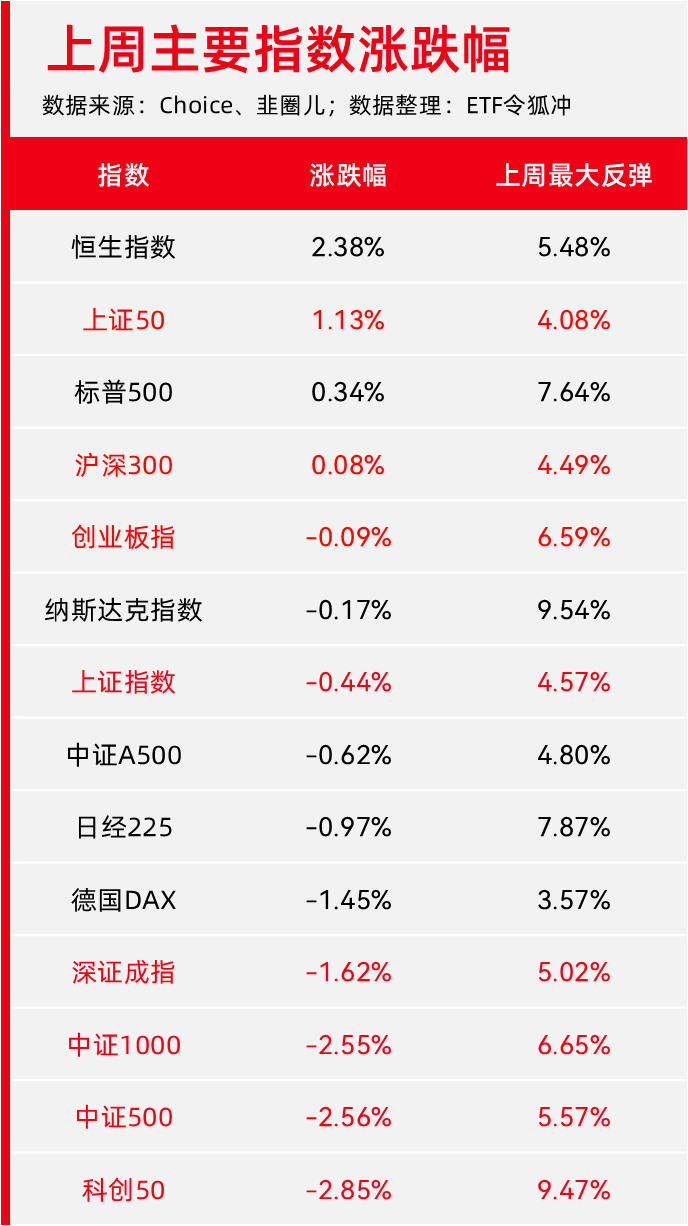
Overall Market Trends - The market experienced significant fluctuations, with the Shanghai Composite Index showing a decline of 0.44% last week, while the Hang Seng Index rose by 2.38% [3][4] - The overall market sentiment has shifted, with a noticeable rotation from small-cap stocks to undervalued large-cap stocks, particularly in the banking and consumer sectors [22][23] ETF Performance - Major ETFs such as the CSI 300 ETF saw a substantial decrease in scale, with the total assets of the top four CSI 300 ETFs shrinking from 1.19 trillion yuan to 570 billion yuan, a drop of over 50% [13][28] - The Gold ETF experienced a significant increase in scale, rising by 12.28% last week, making it the third-largest ETF in terms of scale [14][24] Sector Analysis - The banking sector showed resilience, with the Bank ETF increasing by 0.78% and the scale rising by 7.15% [22] - The consumer sector, particularly the liquor and food and beverage ETFs, saw a surge in trading volume, with the liquor ETF's trading volume increasing over 100% [22][23] - The agricultural sector is showing signs of recovery, supported by rising pork prices and favorable government policies [23] Global Market Context - Global indices such as the Nasdaq and DAX experienced declines, indicating a broader market fatigue after a prolonged period of growth [4][7] - The Fear and Greed Index indicated a drop to 78.99, reflecting a shift in market sentiment towards caution, although it remains in the greed zone [7][10] Fund Management Trends - Major fund management companies like E Fund and Huatai-PB saw significant reductions in their ETF scales due to major shareholders reducing their holdings [28] - Despite the overall decline in ETF scales, companies like Guotai and Huaan managed to grow their scales, benefiting from balanced industry allocations and strong gold ETFs [28]
寻找未来阿尔法!点拾高端论坛第二站,共探主动权益回归之路
点拾投资· 2026-02-02 11:00
Core Viewpoint - The event "Dian Shi 100" hosted by Dian Shi Investment focused on high-quality discussions among leading fund managers from various prominent public funds, addressing critical topics such as the future of active management in the context of ETF trends, the potential of growth styles in the Chinese stock market, and the impact of emerging industries like AI and commercial aerospace on investment strategies [1][3]. Group 1: Active Management and Alpha Generation - The discussion highlighted the challenges faced by active equity funds as passive investment strategies have gained popularity, yet since 2025, active equity fund indices have outperformed the CSI 300, indicating their resilience [3]. - Fund managers emphasized the importance of building a robust team capable of generating excess returns, with a focus on creating a systematic approach rather than relying on individual talent [7][5]. Group 2: Growth Opportunities in A-shares - Fund manager Cao Jin discussed the significance of growth as a primary source of alpha in the A-share market, emphasizing the need to differentiate between genuine growth opportunities and mere thematic speculation [8][11]. - He introduced a simple metric for evaluating growth potential based on the payment capabilities of end-users, stressing that only trends that can translate into actual company performance should be prioritized [11]. Group 3: Insights from Foreign Fund Managers - The roundtable discussion featured foreign fund managers who shared their strategies, with a focus on balancing growth and value investments, particularly in the context of current market conditions [14][15]. - They highlighted the importance of combining high-dividend assets with cutting-edge technology growth stocks to optimize risk-return profiles, especially in light of declining interest rates and improved corporate governance [15]. Group 4: Fund Manager Selection and Performance - The event concluded with a presentation on the unique methodology for selecting top-performing fund managers, which combines qualitative interviews and quantitative analysis to identify those who consistently outperform benchmarks [22][23]. - The selection process has resulted in significant excess returns, with the equity manager list achieving an accumulated excess return of 8.38% since its inception, indicating the effectiveness of the selection criteria [25].