
乳制品

Search documents
贝因美股份有限公司关于公司重大诉讼事项的进展公告
Zhong Guo Zheng Quan Bao - Zhong Zheng Wang· 2026-02-24 22:45
Core Viewpoint - The company, Beiyinmei Co., Ltd., is currently involved in two lawsuits regarding patent contract disputes, with significant financial implications pending court decisions [8][10]. Group 1: Main Lawsuit Details - The main lawsuit involves Beiyinmei suing Heilongjiang Fengyou for a patent contract dispute, with the case accepted by the Hangzhou Intermediate People's Court and yet to be heard [8][9]. - The amount claimed in the main lawsuit is 56,852,397.26 yuan, including interest losses calculated until November 20, 2025 [3]. - The impact of this lawsuit on the company's current and future profits is uncertain due to the pending court hearing [3][13]. Group 2: Counterclaim Details - Heilongjiang Fengyou has filed a counterclaim against Beiyinmei, also accepted by the Hangzhou Intermediate People's Court and yet to be heard [9][10]. - The counterclaim seeks compensation of 77,253,939.28 yuan for economic losses allegedly caused by Beiyinmei's breach of contract [6][11]. - The counterclaim asserts that Heilongjiang Fengyou fulfilled its contractual obligations, while Beiyinmei failed to meet its primary obligations as the contract's leading party [10][11]. Group 3: Other Legal Matters - As of the announcement date, the company and its subsidiaries are involved in minor lawsuits that do not meet the disclosure standards for significant litigation as per the Shenzhen Stock Exchange regulations [12].

15.65亿元,优诺中国完成易主
Zhong Guo Ji Jin Bao· 2026-02-24 15:57
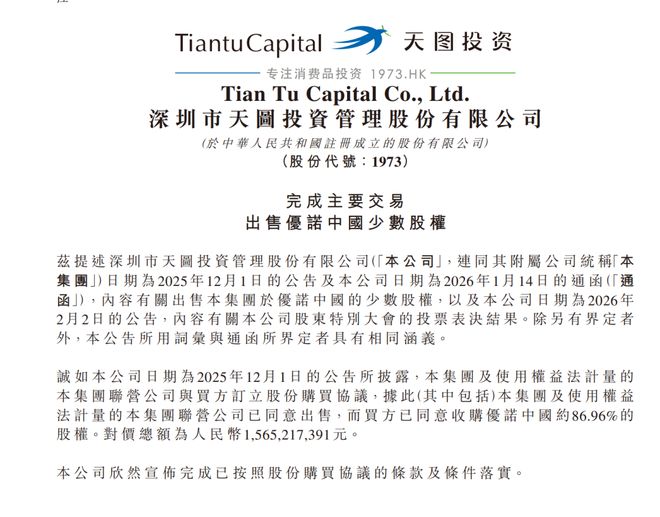
Core Insights - Yoplait's China business has been sold, marking a significant transition for the brand under new ownership by IDG Capital [1][3] - The sale represents the end of TianTu Investment's nearly seven-year investment in Yoplait China, which faced challenges during the pandemic [4][5] Group 1: Transaction Details - TianTu Investment announced the completion of the sale of approximately 86.96% of Yoplait China for a total consideration of about 1.565 billion RMB [1] - The transaction allows TianTu Investment to exit a venture that had been a significant loss-maker, with losses recorded from 2020 to 2022 totaling 19.37 million RMB [4] - Yoplait China achieved revenues of 810 million RMB and a net profit of 95.45 million RMB in 2024, reflecting growth of 78% and 1038% respectively compared to 2023 [5][6] Group 2: Market Context - The low-temperature yogurt market in China is projected to reach 67.28 billion RMB by 2025, with a compound annual growth rate of 8.5% from 2021 to 2025 [8] - Despite Yoplait's recent performance improvements, its market share remains low, ranking around 15th in the industry [8] - The competitive landscape is characterized by a high concentration of market share among the top five players, which hold over 70% of the market [8] Group 3: Future Prospects - IDG Capital aims to leverage its resources to expand Yoplait's presence in southern and northern China, enhancing its market strategy [9] - The plan includes diversifying sales channels and exploring synergies with other brands in the consumer sector [9]

15.65亿元 优诺中国完成易主
Zhong Guo Ji Jin Bao· 2026-02-24 15:54
Core Insights - TianTu Investment has completed the sale of approximately 86.96% of its stake in Yoplait China for a total consideration of about 1.565 billion RMB, marking its exit from the joint venture after nearly seven years of investment [2][4]. Company Performance - Yoplait China was a significant loss-maker for TianTu Investment, with losses of 96.3 million RMB, 57.7 million RMB, and 39.7 million RMB from 2020 to 2022, respectively. It only achieved a profit of 839,000 RMB in 2023 [5]. - In 2024, Yoplait China reported revenues of 810 million RMB and a net profit of 95.45 million RMB, representing growth of 78% and 1038% compared to 2023 [6]. Market Context - The low-temperature yogurt market in China is expected to reach a size of 67.28 billion RMB by 2025, with a compound annual growth rate of 8.5% from 2021 to 2025. However, the market is highly competitive, with the top five companies holding over 70% market share [9]. - Despite Yoplait's recent performance improvements, its market share remains low, ranking around 15th, indicating a lack of significant influence in the market [9]. Future Prospects - IDG Capital, which has taken over Yoplait China, plans to leverage its resources to support the brand's expansion into Southern and Northern China, as well as to diversify sales channels [11]. - The ability of IDG Capital to help Yoplait China overcome growth challenges and navigate industry competition is a key focus for market observers [10].
重视原奶产业机会-2026年可能是乳制品大年
2026-02-24 14:16
Summary of Conference Call Records Industry Overview - The conference call focuses on the dairy and beef cattle industries in China, highlighting challenges and opportunities within the raw milk and beef markets [1][2][3]. Key Points on Raw Milk Industry - The domestic raw milk market is facing significant challenges, with market share shrinking to 15% and 70% of farms operating at a loss due to high feed costs, which account for 60%-70% of cash costs [1][2]. - Feed prices are expected to remain stable with slight increases in 2026, despite pressures from rising silage corn prices in 2025 [1][2]. - Demand for dairy products is showing marginal improvement, with production fluctuations in the first three quarters of 2025, and government policies aimed at boosting consumption are anticipated to enhance consumer confidence [1][2]. - Long-term potential for dairy consumption in China remains significant, with deep processing capacity expansion expected to increase demand for fresh milk [1][4]. - A balanced supply-demand situation is projected for the raw milk industry in 2026, indicating a potential turning point [1][4]. Key Points on Beef Cattle Industry - The beef cattle market has shown signs of recovery since 2025, with beef and cattle prices increasing by 11% and 10% respectively as of January 2026 [6][7]. - The supply of breeding cows is tight due to high culling rates, leading to slow recovery in production capacity [3][8]. - The reliance on beef imports is significant, with approximately 30% of beef being imported, and global supply constraints are expected to maintain high prices [3][9][10]. - The beef market is projected to experience a continued upward trend in prices due to supply-demand mismatches and upstream clearances [7][12]. Additional Insights - The impact of imported bulk powder on the domestic market is limited, as prices for imported products are higher than domestic fresh milk prices, and the expected increase in imports is not significant [5]. - The overall beef cattle industry is cautious despite turning profitable, with a slow recovery in production capacity due to high culling rates and a lengthy replenishment cycle [8][9]. - Dairy companies such as Yili and Mengniu are expected to benefit from rising milk prices and reduced promotional pressures, which will help restore profit margins [11][12]. Market Expectations - The current beef cattle cycle is expected to last 2 to 3 years, with moderate price increases anticipated due to cautious upstream expansion [12]. - Leading dairy companies are likely to benefit from improved gross sales margins as cost pressures remain limited [12].
中国必需消费品_新年专家电话会议_白酒_茅台、五粮液重回复苏轨道;乳制品定价自律但表现平淡-China Consumer Staples_ LNY expert calls_ Spirits_ Moutai_Wuliangye pivoting to recovery path; Dairy saw disciplined pricing yet unexciting
2026-02-24 14:16
Summary of Key Points from the Conference Call on China Consumer Staples: Spirits and Dairy Industry Overview - The conference call focused on the spirits and dairy sectors in China, particularly in the Hunan province, highlighting the performance of major brands like Moutai, Wuliangye, and Mengniu. Spirits Sector Moutai - Feitian Moutai's retail sales volume increased by over 20% year-on-year during the Chinese New Year (CNY) period, exceeding expectations despite shipment controls on non-standard SKUs [1][9] - Moutai 1935 showed mild growth, outperforming other products in the Moutai series [1][9] - The wholesale price of Feitian Moutai rose to approximately Rmb1,700, with channel inventory remaining stable at around 0.5 months [1][9] - The expert anticipates that Moutai could bottom out around mid-2026 if retail sales momentum remains strong [2][6] Wuliangye - Common Wuliangye experienced mid-single-digit percentage retail volume growth in early February, gaining market share from Guojiao 1573 due to enhanced affordability [1][9] - The effective ex-factory price for Common Wuliangye decreased to around Rmb810, with expectations of further reductions [1][9] - The company achieved a 40% prepayment target by the end of CNY, although this pace is slightly slower than the previous year [1][9] Luzhou Laojiao - Guojiao 1573's retail volume dropped by approximately 30% during the CNY period, facing challenges in maintaining wholesale price stability [1][8] - Luzhou Laojiao is under pressure to stabilize prices amid declining demand [2][6] Other Brands - Brands like Fen Wine, Yanghe, Jiugui, and Shede saw broad-based sales declines of 15-20% [1][14] - Fen Wine's Qinghua series experienced a low-teens percentage decline, while Bofen remained slightly positive [1][14] Dairy Sector - Both Yili and Mengniu reported positive sell-in shipments during January, but holiday sell-through saw a slight decline due to weakening gifting demand [1][12] - Premium products like Satine and Deluxe outperformed basic white milk, indicating a shift in consumer preference [1][12] - Mengniu's sales decline narrowed to low-single digits compared to low-teens last year, aided by a lower comparison base [1][12] - The expert remains cautious about 2026 full-year sell-in targets, suggesting a more realistic outlook of flat to -5% for Yili and +6% for Mengniu [1][12] Beverages Sector - Nongfu's small-pack water and sugar-free tea registered high-single-digit percentage sell-through growth, while large-pack volume doubled due to strong promotions [1][13] - CR Beverages and Wahaha experienced declines in water sales, indicating competitive pressures [1][13] - Eastroc is on track to meet its 20% sales growth target, with energy drinks growing just under 15% [1][16] Inventory and Prepayment Insights - Moutai and Wuliangye maintain low channel inventories of 0.5 to 1 month, while other upper-mid-end brands face over 2.5 months of inventory [1][11] - Prepayment progress for various brands is lagging behind last year, with Wuliangye and Laojiao showing slower prepayment paces [1][14] Conclusion - The spirits sector shows a divergence in performance, with Moutai leading and Wuliangye following, while other brands face significant challenges. The dairy sector is experiencing a shift towards premium products, and the beverage sector is consolidating with strong growth from Nongfu. Overall, cautious optimism is noted for the upcoming periods, with varying recovery timelines across brands.






乳制品行业深度-原奶价格周期向上-板块配置价值愈显
2026-02-24 14:16
Summary of Dairy Industry Conference Call Industry Overview - The dairy industry in China has experienced cyclical fluctuations in milk prices since 2008, influenced by factors such as seasonal demand during the Spring Festival and supply declines in winter [1][2] - The domestic raw milk supply is affected by the number of dairy cows and their productivity, with feed prices, subsidy policies, environmental regulations, and breeding expectations impacting cow numbers [1][4] - The proportion of large-scale farming has approached 80%, improving production efficiency [1][4] Key Insights and Arguments - Recent trends indicate that while the number of dairy cows has increased since 2023, a decline in embryo numbers suggests a potential slowdown in herd expansion [1][4] - The price of imported dairy products has a substitutive effect on domestic milk prices, with fluctuations in international markets directly impacting local prices [1][4] - The beef price increase has implications for the milk price cycle, but significant recovery in milk prices is not expected in the short term (2026) due to ongoing operational pressures on farms [1][5] - The average milk yield per cow in China has been steadily increasing, but leading dairy companies are nearing biological limits, limiting further productivity gains [1][6][7] Demand Dynamics - Short-term demand for dairy products in China is weak, with a trend towards consumption downgrade; however, long-term prospects remain optimistic due to rising GDP and consumer preferences [9][10] - Structural opportunities exist in low-temperature dairy products, particularly in lower-tier cities, which may support demand in the medium to long term [10][11] - The development of deep processing dairy products is expected to significantly consume raw milk, with capacity releases projected to occur between 2027 and 2028 [11][12] Price Impact on Downstream Companies - Changes in milk prices directly affect the revenue and profitability of downstream dairy companies, with low prices leading to a "Davis double kill" scenario (both revenue and valuation decline) [13][15] - Conversely, during recovery phases, companies may experience a "Davis double hit" (both revenue and valuation increase) [15] - The cost structure of dairy companies, where raw material costs account for 60-70% of expenses, means that fluctuations in milk prices have significant implications for profit margins [14] Recommendations for Investment - Recommended leading dairy companies include Yili as a benchmark, followed by Miaokelando, which is expected to expand its market share through domestic substitution and consumer education [16] - New Hope Liuhe is noted for its strong performance in low-temperature products in lower-tier cities, while Tianrun is highlighted for its potential due to its fully owned raw material base [16]


春节动销渠道观察
2026-02-24 14:16
Summary of Conference Call on Food and Beverage Industry Industry Overview - The conference focused on the food and beverage industry, particularly during the Chinese New Year period, with insights from experts in the field [1][2]. Key Points and Arguments Sales Performance by Category - Overall sales during the Chinese New Year period showed a growth of approximately 10% compared to the previous year, primarily driven by gift boxes [2]. - Specific categories reported varied growth rates: - **Dairy Products**: - Growth in ambient yogurt was around 3-4%, marking a positive shift from previous negative growth trends [3]. - Liquid milk showed a growth rate of about 7%, with Yili at approximately 8% and Mengniu around 5-6% [3]. - Infant formula experienced a negative growth due to inventory issues and recalls affecting brands like Nestlé and Feihe, while A2 and Junlebao performed well [4][5]. - **Frozen Foods**: - The leading brand, Anjing, reported an 18% growth, while the second tier brands averaged around 5-6% growth [6]. - **Condiments**: - Growth was lower than the previous year, with Hai Tian at 3% compared to 6% last year, attributed to a decline in restaurant sales [7][8]. - **Beverages**: - Notable growth in brands like Nongfu Spring and Dongpeng, with Nongfu Spring achieving a 15% growth [8][9]. Factors Influencing Sales - Seasonal factors played a significant role, with the timing of the Chinese New Year affecting sales cycles, resulting in fewer business days compared to previous years [12][13]. - Inventory management was crucial, with many products sold being produced in January, leading to a fresh stock perception among consumers [14][15]. - Consumer behavior shifted towards essential goods, with a focus on necessary items rather than premium or novelty products [16][17]. - Price stability was noted, with fewer discounts compared to previous years, indicating a healthier pricing environment [17]. Market Trends - Community and convenience stores contributed significantly to sales, while traditional supermarkets showed weaker performance [18][41]. - The growth of community group buying and snack retailing was highlighted as a key trend, especially in rural and suburban areas [18][41]. - The beverage market saw a rise in demand for sugar-free and health-oriented products, with unsweetened tea growing at around 18% [21]. Brand-Specific Insights - **Yili and Mengniu**: Both brands set ambitious growth targets of 5-8% and 10% respectively, with cautious optimism based on early performance [20][21]. - **Dongpeng**: Reported a 14% growth, driven by energy drinks and electrolyte water, although growth rates were expected to slow down due to market saturation [24][25]. - **Hai Tian**: Aiming for a 5% growth target, with challenges in the restaurant sector impacting overall performance [43][51]. Challenges and Risks - The industry faces challenges from fluctuating consumer preferences and potential economic downturns affecting discretionary spending [12][13]. - Brands like Three Squirrels and others reported lower-than-expected growth, indicating potential market saturation and changing consumer tastes [29][32]. Additional Important Content - The conference highlighted the importance of adapting marketing strategies to current consumer trends, emphasizing the need for brands to focus on essential products and maintain competitive pricing [16][17]. - The discussion also touched on the impact of seasonal employment patterns on restaurant sales, which could affect future growth in the condiment sector [44][50]. This summary encapsulates the key insights and trends discussed during the conference call, providing a comprehensive overview of the food and beverage industry's performance during the Chinese New Year period.


阳光乳业:截至2026年2月13日公司股东为23547户
Zheng Quan Ri Bao· 2026-02-24 11:37
Group 1 - The core point of the article is that Sunshine Dairy has reported its shareholder count as of February 13, 2026, which stands at 23,547 households [2]
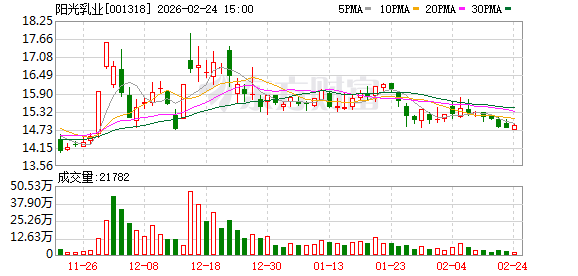
天润乳业:截至1月30日公司股东人数是22693户
Zheng Quan Ri Bao Wang· 2026-02-24 10:10
Group 1 - The core point of the article is that Tianrun Dairy (600419) reported a total of 22,693 shareholders as of January 30 [1]

天图投资(01973.HK):完成出售优诺中国少数股权
Ge Long Hui· 2026-02-24 09:53
Core Viewpoint - Tian Tu Investment (01973.HK) has announced the sale of approximately 86.96% equity in Younuo China for a total consideration of RMB 1.565 billion, resulting in the company no longer holding any stake in Younuo China, which will be removed from its consolidated financial statements as an equity accounted associate [1]. Group 1: Transaction Details - The company and its equity-accounted associate have entered into a share purchase agreement with the buyer [1]. - The total consideration for the sale is RMB 1.565 billion [1]. - Upon completion of the transaction, the company will no longer have any equity interest in Younuo China [1]. Group 2: Company Background - Younuo China was established on July 8, 2013, and is primarily engaged in the production and sale of yogurt and other dairy beverages in China [1].