3D打印

Search documents
消费级3D打印行业专题解读-创意点亮生活-3D打印入万家
2026-01-15 01:06
Summary of the Consumer-Level 3D Printing Industry Conference Call Industry Overview - The global consumer-level 3D printing industry is experiencing rapid growth, with a compound annual growth rate (CAGR) of 28% from 2020 to 2024, expected to reach nearly 30 billion RMB by 2024. However, household penetration is only 1.8%, indicating significant growth potential. The industry is projected to maintain a CAGR of over 30% in the coming years [1][3]. Market Position of Chinese Companies - Chinese companies dominate the global consumer-level 3D printing market, accounting for 45% of global export value in 2024, with a CAGR of 51% over the past two years. Top companies include Tuozhu Technology with a 29% market share and Creality 3D with a 17% market share. The market concentration (CR5) among the top five companies is 80% [1][4][5]. Application Areas - Consumer-level 3D printers are primarily used in consumer goods (43%), education (34%), and trendy stationery (13%). The demand for personalized products and the push for 3D printing in education are key growth drivers [1][6]. Future Growth Drivers - Several factors will continue to drive the growth of the consumer-level 3D printing industry, including ongoing technological upgrades (e.g., AI integration), diverse material applications, and the leading position of top Chinese companies. The market is expected to exceed 60 billion RMB by 2029 [1][7]. Export Performance - China is a major exporter of consumer-level 3D printing equipment, with 45% of global export value in 2024 and a CAGR of 51% over the past two years. The U.S. and Europe are the primary import regions, each accounting for about 30% [1][8]. Revenue Contribution by Product Type - In the industry chain, approximately 50% of revenue comes from complete machine sales, while consumables and accessories contribute around 20%. The revenue growth rate for complete machines is 21%, while consumables and accessories see a higher growth rate of 40% due to increased ownership [1][9]. Investment Opportunities - Investors are advised to focus on Creality 3D, which is set to go public in Hong Kong, and Jia Lin Technology, a leader in modified plastics. Creality 3D has a strong technological edge, while Jia Lin Technology is experiencing profit recovery and growth from overseas base construction. Additionally, companies related to consumables are also worth considering due to the rapid growth in demand [2][10]. Financial Performance of Creality 3D - Creality 3D is projected to achieve revenue of 2.3 billion RMB in 2024, with a CAGR of 30% over the past three years. The revenue from 3D printers accounts for nearly 62%, while other products like 3D scanners and laser engravers contribute about 10%. The gross margin remains stable at around 30%, but net profit margin has decreased from 8% in 2022 to 4% in 2024 due to increased sales expenses [12]. Channel Development - Creality 3D's revenue sources are well-balanced, with China, North America, and Europe each contributing 20%-30% of revenue. The company has significantly increased its online channel presence, growing from 6 overseas stores in 2022 to 57 in 2024, with online revenue achieving a CAGR of 127% [13]. Technological Advantages of Tuozhu Technology - Tuozhu Technology has notable advantages in smart integration, leveraging technology from the drone industry to enhance user experience in 3D printing. The company has rapidly become the global leader in consumer-level 3D printers since its establishment in 2020 [14]. Recommendations for Consumables Companies - The consumables sector is expected to grow at a CAGR of 36% from 2024 to 2029, outpacing the overall industry growth. Key recommendations include Jia Lian Technology and Yinxi Technology, both of which are well-positioned to benefit from the increasing demand for consumables [15]. Overall Industry Outlook - The consumer-level 3D printing industry shows strong growth potential driven by both supply and demand factors. Key players like Creality 3D and fast-growing consumables companies such as Jia Lian Technology and Yinxi Technology are expected to benefit significantly from industry growth [16].
铂力特融资净买入3276.67万元,正被调查受损投资者索赔麻烦待解
Sou Hu Cai Jing· 2026-01-14 12:21
Group 1 - Company received financing buy-in of 369 million yuan and repayment of 336 million yuan on January 13, resulting in a net financing buy-in of 32.77 million yuan [2] - Company announced on December 31, 2025, that it received a notice of investigation from the China Securities Regulatory Commission, allowing affected investors to claim compensation if they held shares as of that date [3] - Company held a half-year performance briefing on September 2, 2025, addressing investor questions and showcasing its management team [3] Group 2 - Company is focused on exploring the application of metal 3D printing in thermal management, providing innovative solutions for industries such as new energy vehicles, consumer electronics, and aerospace [4] - The company has optimized the internal structure of its liquid cooling plates to enhance overall performance, addressing the high-efficiency cooling needs of the radiator industry [4] - The company has seen a significant increase in production and R&D personnel in its 2025 semi-annual report compared to the previous year [4] Group 3 - Company, established in 2011, is located in Xi'an, Shaanxi Province [5]



南风股份:南方增材3D打印业务进展顺利 暂无融资需求
2 1 Shi Ji Jing Ji Bao Dao· 2026-01-14 08:04
Core Viewpoint - Nanfeng Co., Ltd. is nearing completion of its procurement of additive manufacturing equipment and factory renovations, with normal progress in sample delivery and business negotiations [1] Group 1: Company Developments - The procurement and renovation work for the Southern Additive Manufacturing is expected to be completed soon [1] - Sample delivery and business negotiations are proceeding normally [1] Group 2: Financial Position - Currently, there is no financing demand for Southern Additive Manufacturing [1] - Future financing plans will be determined based on the usage of funds and market expansion progress [1]

商业航天系列报告:3D打印:制造降本,助推商业航天产业化加速
Changjiang Securities· 2026-01-14 00:49
Investment Rating - The report maintains a "Positive" investment rating for the 3D printing industry, particularly in its application within the commercial aerospace sector [3]. Core Insights - The report emphasizes that 3D printing technology is a cost-reduction tool that accelerates the industrialization of commercial aerospace, driven by high demand for advanced applications [5][48]. - The growth of the 3D printing market is significantly influenced by the increasing demand for high-end applications, which is expected to lead to continuous market expansion [22][39]. Summary by Sections Section 1: Disruption of Traditional Industrial Systems - Additive manufacturing, also known as 3D printing, revolutionizes traditional manufacturing by allowing for the "free manufacturing" of parts without the need for traditional tools and multiple processing steps, thus reducing processing time and increasing material utilization [9][19]. - Various types of additive manufacturing processes, such as Powder Bed Fusion and Directed Energy Deposition, are highlighted for their efficiency and precision [14][18]. Section 2: High-End Application Demand - The global market for metal additive manufacturing equipment has seen significant growth, with sales increasing from 202 units in 2012 to 3,793 units in 2023, reflecting a CAGR of 25.15% [27]. - The average price of industrial-grade additive manufacturing equipment has risen from $98,100 in 2019 to $316,900 in 2024, indicating a trend towards larger and more expensive systems [28][29]. - The aerospace and defense sectors are identified as key growth areas for 3D printing, with the market expected to reach approximately $3.379 billion in 2024 and grow to $10.48 billion by 2031, at a CAGR of 17.8% [45]. Section 3: 3D Printing as a Cost-Reduction Tool - The report notes that the high costs associated with rocket launches drive the urgent need for cost reduction through 3D printing, which can significantly lower manufacturing costs and weight of components [51][55]. - 3D printing allows for the integration of complex structures, reducing the need for traditional assembly methods, thus enhancing design flexibility and reducing manufacturing time [55][63]. - The application of 3D printing in rocket engines is highlighted, with examples from SpaceX demonstrating substantial cost and weight reductions in engine components [59][72].

智能硬件创新赋能出口升级 细分赛道深圳领跑全球
Zheng Quan Shi Bao· 2026-01-13 18:10
Core Insights - The rise of consumer hardware innovation in Shenzhen, driven by companies like DJI, has significantly boosted the export of electromechanical products, which reached 15.4 trillion yuan in the first three quarters of 2025, marking a 4.5% increase and accounting for 75.7% of Shenzhen's total exports [1] - The emergence of the smart hardware industry, including products like 3D printers and translation headsets, is reshaping global industrial competition and enhancing the "Shenzhen Creation" brand [1] Group 1: 3D Printing Industry - TuoZhu Technology has become a leading player in the desktop 3D printing market, holding over 80% market share in China, with its flagship product, Bambu Lab X1, simplifying operations for ordinary users [2][3] - The launch of MakerWorld, a 3D model community, has connected creators with users, achieving nearly 10 million monthly active users and over one million models [3] - China exported 3.491 million 3D printers (excluding parts) in the first three quarters of 2025, nearing the total export of 3.778 million units for 2024, with four of the top five global consumer 3D printing companies based in Shenzhen [3] Group 2: Translation Technology - TimeSpace Pot's translation headset utilizes real-time simultaneous translation technology, addressing the need for seamless cross-language communication [4] - The company achieved a breakthrough in dual-direction simultaneous translation, allowing for efficient communication without waiting for complete sentences [4][5] - The headset's design focuses on precise sound capture, utilizing multiple microphones to filter out background noise, enhancing translation accuracy [5] Group 3: Smart Kitchen Appliances - Tiger One Technology is innovating in the traditional kitchen appliance sector by integrating "cooking science" to simplify cooking processes [6][8] - The company has developed a new oven that automatically adjusts temperature based on food data, and its air fryer has become a top seller on Amazon [8] - Tiger One's proprietary technology has led to a gross margin increase from 58% to 64%, with projected revenues of $70-80 million in 2025, representing over 300% growth [8] Group 4: Shenzhen Hardware Innovation Ecosystem - The growth of companies like TuoZhu, TimeSpace Pot, and Tiger One exemplifies the rise of Shenzhen's hardware innovation sector, which focuses on user needs and technological advancements [9] - These companies are enhancing the autonomy and completeness of Shenzhen's manufacturing chain, contributing to a robust hardware innovation ecosystem [9]
A股三大指数下挫,沪指17连阳终结,成交额3.7万亿元,再刷历史纪录
Mei Ri Jing Ji Xin Wen· 2026-01-13 10:01
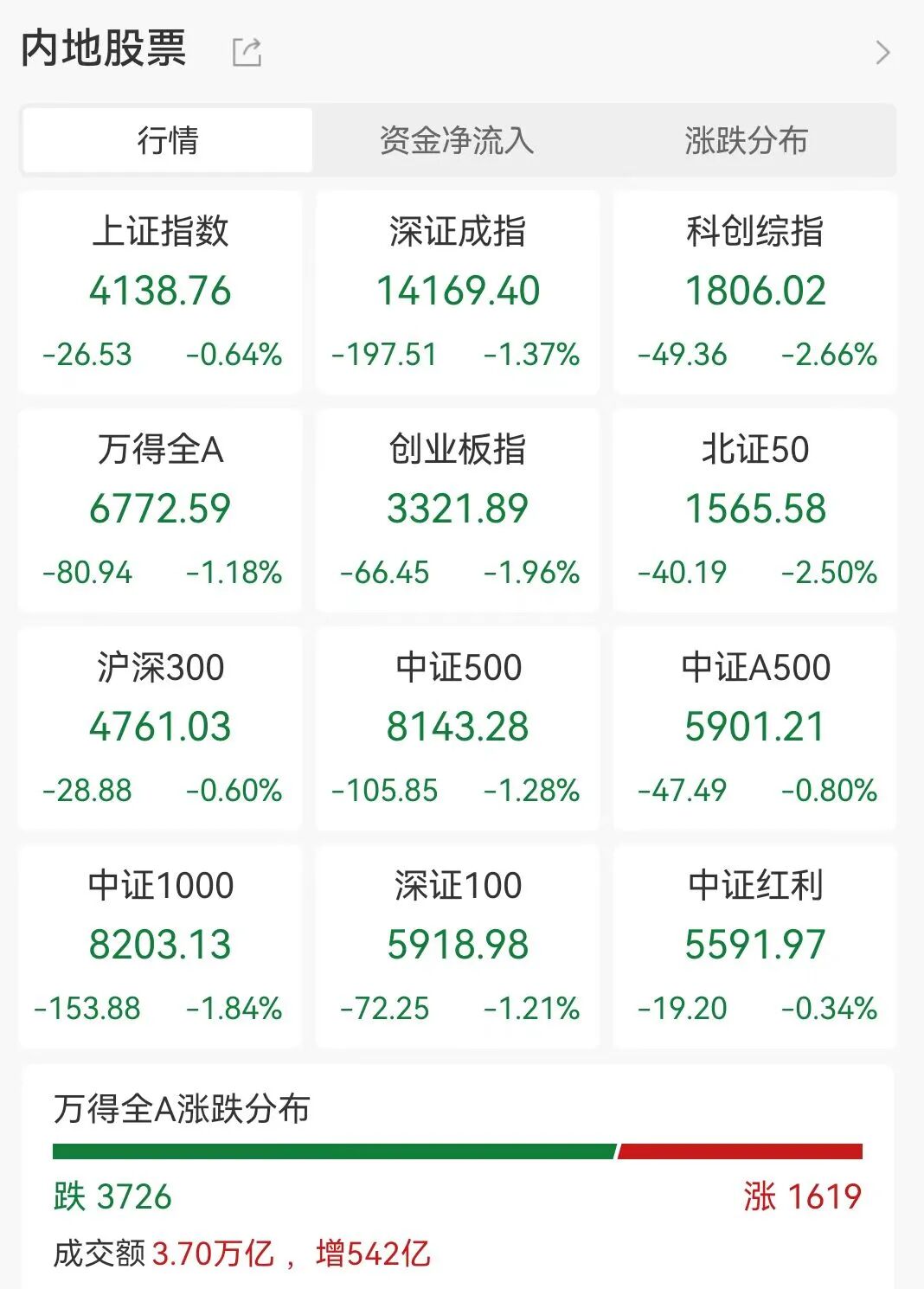
Market Overview - The A-share market experienced a collective pullback on January 13, ending a 17-day winning streak, with the Shanghai Composite Index down by 0.64%, the Shenzhen Component down by 1.37%, and the ChiNext Index down by 1.96% [1][2] - The trading volume in the Shanghai and Shenzhen markets reached a record high of 3.7 trillion yuan [1] Sector Performance - Multiple companies issued risk warnings, leading to significant declines in sectors such as commercial aerospace and satellite internet, with nearly a hundred stocks, including Aerospace Electronics and China Satellite Communications, dropping over 8% [3] - The large aircraft and military sectors also saw declines, with stocks like Zhongtian Rocket and Leike Defense hitting their daily limit down [3] - The controllable nuclear fusion sector faced a downturn, with Wangzi New Materials hitting its daily limit down [3] - The communication equipment sector declined, with Changjiang Communication hitting its daily limit down [3] - Other sectors such as Beidou Navigation, quantum technology, 3D printing, CPO concepts, and F5G concepts experienced significant losses [3] Analyst Insights - Analyst Liu Hangdeng from Haineng Investment noted that after the 17-day rally, the market faced a volume adjustment of 3.65 trillion yuan, with commercial aerospace being the main sector under pressure [4] - The market encountered resistance near the 4180 level, indicating a short-term pullback, with support expected around the 4090 level [4] - The AI application sector, which had a strong performance previously, opened high but closed lower, although its structural trend and fundamental application logic remain strong [4] - The afternoon session saw a rapid surge in the electric power and grid equipment sector, indicating potential short-term opportunities [4] Precious Metals - Gold and silver prices showed volatility, but precious metal stocks led gains in the non-ferrous metal sector, with Mingbai Jewelry hitting the daily limit up and Hunan Silver approaching the daily limit up [4] - As of the report, spot gold fell slightly below 4590 USD/ounce, while spot silver fell below 85 USD/ounce [4][5]
众源新材:公司目前持有洛阳盈创21%的股份
Ge Long Hui· 2026-01-13 08:47
Group 1 - The company holds a 21% stake in Luoyang Yingchuang [1] - The company's 3D printing equipment can be applied in the aerospace sector [1]

商业航天等产业快速发展,3D打印或迎来机遇
NORTHEAST SECURITIES· 2026-01-13 06:57
Investment Rating - The report maintains a positive investment rating for the 3D printing industry, highlighting its growth potential and opportunities in various sectors [1]. Core Insights - The 3D printing industry, also known as additive manufacturing, is experiencing rapid growth, with a market size of 367 billion yuan in China for 2023 and an average growth rate of approximately 25% from 2019 to 2023 [2][61]. - Key applications of 3D printing include aerospace (16.8%), medical/dental (15.6%), automotive (14.6%), consumer electronics (11.8%), and academic research (11.1%) [2][34]. - The technology offers significant advantages over traditional manufacturing methods, particularly in cost control for small batch production, personalized production, and material utilization [1][12]. Summary by Sections 1. 3D Printing vs. Traditional Manufacturing - 3D printing has clear advantages in cost control for small batches, personalized production, and material efficiency compared to traditional methods, which excel in material variety and precision [1][12]. - The main technologies in China include SLS/SLM (32%) and FDM (15%) [25]. 2. Core Components of 3D Printing - Key components include lasers and scanning systems, with lasers being the primary heat source for metal 3D printing [41][42]. - The software aspect is crucial, with major CAD software providers including Dassault Systems, Siemens, and Autodesk [57]. 3. Market Growth and Trends - The 3D printing market is expected to continue its growth trajectory, with significant adoption in aerospace, consumer electronics, and other sectors [2][61]. - The U.S., China, Japan, and Germany are identified as the core markets for 3D printing applications, with the U.S. accounting for approximately 33% of global equipment applications [2][61]. 4. Commercial Aerospace Opportunities - The commercial aerospace sector is poised for significant growth, with 3D printing being well-suited for manufacturing complex and lightweight components [2][61]. - Notable products include rocket engine components and satellite parts, indicating a broad application range [2]. 5. Key Companies in the Industry - Notable companies in the 3D printing sector include Platinum Technology, Huazhu High-Tech, Dazhu Laser, and others, which are making strides in technology and market presence [2][5].




九鼎新材、江顺科技参股公司入股商业航天3D打印公司九宇建木
Zheng Quan Shi Bao Wang· 2026-01-13 05:44
Group 1 - The core viewpoint of the article highlights the recent business changes at Jiuyu Jianmu Aerospace Technology (Shanghai) Co., Ltd, including new shareholders and an increase in registered capital to 3.5185 million yuan [1] - The new shareholders include Jiangyin Yihe Yisi Venture Capital Partnership (Limited Partnership), which is co-held by Jiuding New Materials (002201) and Jiangshun Technology (001400) [1] - Jiuyu Jianmu was established in 2022, focusing on 3D printing services, additive manufacturing equipment sales, and sales of 3D printing materials [1] Group 2 - The company has established its headquarters in Wuxi High-tech Zone and has already served several leading domestic commercial aerospace enterprises [1] - The project aims to create a commercial aerospace headquarters that integrates DED metal 3D printing technology development, new materials, and component manufacturing [1]

国信证券:3D打印行业成长红利释放 关注技术领先的头部企业
Zhi Tong Cai Jing· 2026-01-13 01:28
Core Insights - The consumer-grade 3D printing industry is expected to experience rapid growth driven by supply breakthroughs and personalized demand, with a recommendation to focus on leading companies in this sector [1] - The industry is entering a period of widespread adoption due to advancements in technology, which lower operational barriers, and increasing personalized demand in areas such as toys, education, and daily goods [2] - China dominates the global 3D printing equipment export market, holding a 45% share, with leading companies leveraging supply chain advantages and rapid product iteration [3] Industry Growth - The global consumer-grade 3D printing market is projected to exceed $4 billion by 2024, with a compound annual growth rate (CAGR) of 28% from 2020 to 2024; 3D printer sales are expected to reach $2.1 billion with a CAGR of 21% [2] - By 2024, the online 3D printing market in China is anticipated to reach 1.2 billion yuan, also reflecting a CAGR of 28% from 2020 to 2024 [2] - The number of consumer-grade 3D printers is expected to reach approximately 15.8 million units by 2024, indicating a penetration rate of only 1.8% among 860 million households in major regions [2] Competitive Landscape - The competition in the consumer-grade 3D printing market is primarily driven by product capabilities, with technology research and development and supply chain efficiency being critical factors [3] - Leading companies such as Creality and Topbot are positioned strongly, with Creality holding a 28% market share and Topbot leading with a 29% share in 2024 [3] Company Profiles - Creality has a diversified product portfolio including 3D printers, consumables, services, and accessories, with projected revenues of 2.3 billion yuan in 2024 and a gross margin around 30% [4] - Topbot focuses on 3D printers and consumables, showcasing strong R&D capabilities by integrating advanced technologies like laser radar detection and visual navigation into their products [4] Consumables Market - The 3D printing consumables market is expected to grow faster, reaching $1 billion by 2024, with a projected CAGR of 36% from 2024 to 2029 [5] - Domestic companies are gradually capturing market share, particularly in upstream resin production and midstream modified plastics, with leading firms like Haizheng Materials and Jialian Technology demonstrating strong technical and product capabilities [5]