
火锅

Search documents
21特写|“焦虑”海底捞,欲批量制造餐饮品牌
2 1 Shi Ji Jing Ji Bao Dao· 2025-11-07 12:09
Core Insights - Haidilao is actively expanding its brand portfolio and experimenting with new restaurant concepts to adapt to changing consumer preferences and market conditions [3][9][12] Group 1: Brand Expansion and Strategy - Haidilao has launched the "Red Pomegranate Plan" to encourage internal entrepreneurship and develop new restaurant brands across various price segments [9][10] - The brand "Jugaogao," acquired from former Haidilao employees, offers a self-service hot pot experience at a significantly lower price point of 59.9 yuan per person, attracting high customer traffic [4][5][11] - The company has rapidly expanded "Jugaogao" to over 50 locations within six months, indicating a strong market demand for affordable dining options [6][11] Group 2: Market Position and Consumer Response - Despite the initial success of new brands, there are concerns about service quality and operational issues, with some consumers reporting inconsistent food quality and slow service [8][11][14] - The overall dining market is experiencing a downturn, with average consumer spending in the restaurant sector declining, which poses challenges for Haidilao's growth strategy [12][13] Group 3: Financial Performance and Challenges - Haidilao's aggressive expansion strategy has led to significant financial losses in the past, prompting a reevaluation of its growth approach [13][14] - The company's market valuation has fluctuated significantly since its IPO, reflecting a shift from high-growth expectations to a focus on sustainable profitability [13][14] - The new brands launched under the "Red Pomegranate Plan" have yet to contribute significantly to overall revenue, highlighting the challenges of scaling new concepts effectively [11][14]

2025Q3餐饮行业季度观察
Tai Mei Ti A P P· 2025-11-07 10:08
Group 1 - The restaurant industry in China is entering a phase of rational growth and high-quality competition, with a decline in the growth rate of the overall economy observed in the third quarter of 2025 [2][4] - The national restaurant industry prosperity index showed a significant increase in July and August due to summer vacations and graduation season, but fell to 98.0 in September, a decrease of 14.5% month-on-month [5][8] - Key segments such as Chinese dining, hot pot, barbecue, fast food, and ready-to-drink beverages all experienced a decline in their prosperity indices in September after rising in July and August [9][11] Group 2 - The number of stores in major segments showed a slight decline in the third quarter, with only the ready-to-drink beverage segment experiencing continuous growth over three quarters [12][15] - The average consumer spending in the restaurant sector increased slightly to 33.0 yuan in the third quarter, with variations across different segments [16][18] Group 3 - In the third quarter, 330 brands were monitored, with 235 brands launching a total of 3,039 new products across six major segments [19] - The Western fast food segment saw the highest number of new products, with 301 items launched, primarily focusing on spicy flavors [20][21] - The noodle segment introduced 127 new products, with nearly 60% being noodle dishes, emphasizing regional flavors [22][24] - The tea beverage segment launched 756 new products, with a focus on seasonal fruits and floral elements [27][28] - The coffee segment introduced 548 new products, with a notable emphasis on fruit and floral ingredients [29][31] - The bakery segment saw 1,025 new products, with a significant number related to traditional Chinese pastries due to the Mid-Autumn Festival [32][34] - The hot pot segment introduced 282 new products, focusing on ingredient sourcing and innovative uses of lesser-known ingredients [36][37] Group 4 - The quarterly new rising restaurant brands highlighted six brands that excelled in expansion, marketing, and product innovation [38][41] - The quarterly supply chain new products emphasized quality upgrades, diverse flavors, and technological empowerment in product innovation [42][43]

《餐饮行业季度观察报告(2025年Q3)》发布
3 6 Ke· 2025-11-07 07:57
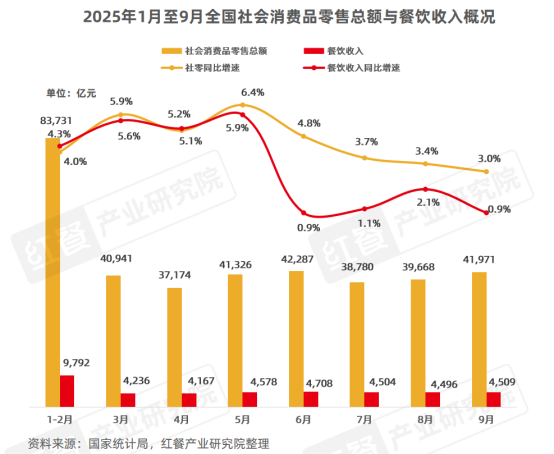
Core Insights - The report analyzes the development of the restaurant industry in Q3 2025, highlighting the performance of six major dining segments and new product launches [1][2] Industry Overview - The restaurant industry in China is experiencing a phase of rational growth and high-quality competition, with a decline in the growth rate of the overall economy [3] - National retail sales growth slowed from 3.7% to 3.0% from July to September 2025, indicating a broader economic trend [3] - Restaurant revenue growth also showed fluctuations, with a year-on-year increase of only 0.9% in September 2025 [5] Restaurant Industry Prosperity Index - The national restaurant prosperity index increased in July and August due to summer vacations and graduation season but fell to 98.0 in September, a decrease of 14.5% month-on-month [6][9] - Key dining segments such as Chinese dining, hot pot, barbecue, fast food, and ready-to-drink beverages all experienced a decline in their prosperity indices in September [10][12] Store Count and Consumer Spending - The number of stores in major segments showed a slight decline, with only the ready-to-drink beverage segment experiencing continuous growth over three quarters [13][16] - The average consumer spending in the restaurant sector rose slightly to 33.0 yuan in Q3 2025, with variations across different dining segments [18] New Product Launches - A total of 330 brands were monitored, with 235 brands launching 3,039 new products in Q3 2025 [19] - The Western fast food segment led with 301 new products, primarily focusing on spicy flavors [20][22] - The noodle segment saw 127 new products, with a strong emphasis on regional flavors [23][25] - The tea beverage segment introduced 756 new products, with a focus on seasonal fruits and floral elements [27][28] - The coffee segment launched 548 new products, highlighting the use of fruit and floral ingredients [29][31] - The bakery segment released 1,025 new products, with a significant focus on traditional Chinese pastries due to the Mid-Autumn Festival [35][33] - The hot pot segment introduced 282 new products, emphasizing ingredient sourcing and innovative uses of lesser-known ingredients [35][36] Emerging Brands and Supply Chain Innovations - The report features "Quarterly Emerging Restaurant Brands" and "Quarterly Supply Chain New Products," showcasing brands that have excelled in expansion, marketing, and product innovation [37][38] - Notable emerging brands include Puda Uncle's Rice and Wild Man, which have rapidly expanded their store counts [41] - Supply chain innovations focus on product quality, flavor diversity, and technological enhancements to meet diverse consumer needs [43]

立冬 ・ 火锅经济,何以沸腾?|财经二十四节气
21世纪经济报道· 2025-11-07 03:16
Group 1 - The hot pot industry is experiencing significant growth, with the market size expected to reach 650 billion yuan in 2025, reflecting a 5.6% year-on-year increase in 2024 [5][12] - The emergence of "small hot pot" has gained popularity among young consumers due to its price advantage and casual dining experience, with 23,000 small hot pot outlets accounting for 5.5% of the total hot pot stores in China by July 2025 [8][9] - The trend towards "fresh" ingredients is reshaping consumer preferences, with brands like Haidilao focusing on fresh-cut offerings and transparency in food preparation [16] Group 2 - The hot pot market is characterized by diverse regional styles, with Sichuan and Chongqing hot pot maintaining a dominant position, while Guizhou sour soup hot pot has gained traction, showing a 118.14% increase in search interest on Douyin [13][16] - The competition is shifting from price wars to value creation, with brands emphasizing unique regional flavors and immersive dining experiences to attract consumers [22] - Innovative "hot pot+" concepts are emerging, enhancing the dining experience through thematic environments and collaborations with popular IPs, such as Haidilao's partnerships with various entertainment franchises [18][19]

百胜中国回应必胜客出售评估,称不影响中国市场运营
Cai Jing Wang· 2025-11-06 12:55
Core Viewpoint - Yum Brands has initiated a strategic review of the Pizza Hut brand, including a potential sale, but this will not affect Pizza Hut's operations in China, which continues to show strong growth [1] Group 1: Company Performance - Yum China reported a total revenue of $3.2 billion for Q3 2025, representing a year-on-year increase of 4% [1] - The net profit attributable to the parent company for Q3 2025 was $282 million, a decrease of 5% year-on-year [1] - The company added a record 536 new stores in Q3 2025, with 32% of these being franchise stores [1] - As of September 30, 2025, Yum China operates a total of 17,514 stores, including 12,640 KFC locations and 4,022 Pizza Hut locations [1] Group 2: Market Position - Yum China operates KFC, Pizza Hut, and Taco Bell exclusively in mainland China, along with other brands such as Little Sheep hot pot and Huang Ji Huang stewed pot [2]
推出畅吃自助、一人食,火锅品牌的模式创新之路能否走通?
Bei Ke Cai Jing· 2025-11-05 11:40
Core Insights - The hot pot industry is experiencing a shift from "incremental competition" to "stock competition," with a noticeable slowdown in market growth and a decline in per capita consumption [3][4] - The company, Xiabuxiabu, has launched a dual-point model for its brand "CaoCao," which includes a "selected single point + all-you-can-eat" approach, now available in 130 stores nationwide [1][2] - The company has introduced a single-person lunch set priced at 78 yuan per person, currently available in six cities in South China [2] Industry Trends - The hot pot market's growth rate is slowing, with per capita consumption expected to drop from 86.7 yuan in 2022 to 77.1 yuan by 2025, marking an 11% decline over four years [3] - There is a significant reduction in the proportion of stores with per capita consumption above 90 yuan, which has decreased by 16.9 percentage points, while stores with prices below 70 yuan have increased by 20.9 percentage points [3] Company Strategy - To support the "all-you-can-eat" model, the company emphasizes the need for a robust supply chain, which is crucial for maintaining quality and price competitiveness [4] - The company employs a supply chain management system that combines centralized control with regional operations, ensuring fresh produce and flexibility in menu offerings [4] - The company has invested in its supply chain by acquiring a halal meat processing company and establishing its own organic pastures and vegetable bases to ensure high-quality ingredients [4]
海底捞,正在抢夺西贝大金主
盐财经· 2025-11-05 09:39
Core Viewpoint - The competition for the children's dining market is intensifying among major restaurant brands, with Haidilao making significant investments in family-friendly dining experiences as a response to challenges faced by competitors like Xibei [2][10][40]. Group 1: Market Dynamics - The children's dining market in China has reached a scale of 450 billion yuan, with expectations to exceed 500 billion yuan in the next five years, indicating a strong growth trend [5][20]. - Haidilao's entry into the children's dining segment is driven by the declining performance of its core hot pot business, which has seen a drop in revenue and table turnover rates [15][19]. - The overall restaurant industry is experiencing increased competition and declining average prices, with the average dining price dropping to 39.8 yuan, a 6.6% decrease year-on-year [14][15]. Group 2: Haidilao's Strategy - Haidilao has launched various initiatives targeting family customers, including themed restaurants and special children's menus, to attract more diners and increase average spending per table [21][22]. - The introduction of family-friendly features, such as play areas and specialized children's meals, has resulted in a significant increase in family customer traffic, with some locations reporting up to 60% of weekend customers being families [25][26]. - Despite the increase in family traffic, the longer dining times associated with families may negatively impact table turnover rates, posing a challenge for profitability [25][39]. Group 3: Competitive Landscape - The children's dining market has historically been dominated by Western fast-food brands like McDonald's and KFC, but Chinese brands are increasingly entering this space, with Xibei leading the way in developing specialized children's meals [28][30]. - Other restaurant brands, such as Jiumaojiu and Laoxiangji, are also beginning to explore children's dining options, indicating a broader trend within the industry [31][33]. - The competition for family dining is not just about menu offerings but also about creating a safe and engaging environment for children, which requires significant investment in facilities and staff [37][39].

备战火锅消费旺季 湊湊双点模式已在全国130余家门店上线
Zheng Quan Shi Bao Wang· 2025-11-03 11:36
Core Insights - The recent drop in temperatures across China has led to a surge in hot pot consumption, prompting the company to prepare for the peak season [1] - The company has launched its innovative "Selected Single Order + Unlimited Eating" dual ordering model in over 130 locations nationwide [1] - The new menu features an expanded selection of dishes, with significant increases in the number of items across various price tiers, all while maintaining the same price [1][2] Group 1 - The company’s brand, Cuocuo, has introduced the "Selected Single Order + Unlimited Eating" model to cater to diverse consumer needs through flexible ordering [1] - The dual ordering model was first tested in September in cities like Beijing and Shanghai, achieving high rankings on local dining platforms [1] - The menu expansion includes an increase from 87 to 94 items in the 158 RMB tier, from 99 to 107 items in the 198 RMB tier, and from 117 to 121 items in the 258 RMB tier [1] Group 2 - The company has launched a new dish, "Imperial Style Spicy Chicken Feet Pot," along with several other meat and vegetable options that reflect regional specialties [2] - The supply chain management system combines centralized control with regional operations, ensuring fresh ingredients and menu flexibility [2] - The company acquired a meat processing company in 2019, which has a large organic pasture and significant processing capacity, enhancing its supply chain stability [2]
呷哺呷哺举步维艰,海底捞 、杨国福为何纷纷入局小火锅赛道? | 声动早咖啡
声动活泼· 2025-11-03 09:03
Core Viewpoint - The rise of "one-person dining" is reshaping the restaurant industry, prompting major players like Haidilao and Yang Guofu to enter the small hot pot market, which caters to the growing demand for individual dining experiences [4][6][12]. Group 1: Market Trends - The trend of "one-person dining" has gained significant traction, with related content on platforms like Douyin and Xiaohongshu receiving billions of views, indicating a strong consumer interest [6]. - The small hot pot format, characterized by individual pots, aligns well with the preferences of consumers seeking convenience and independence in their dining experiences [6][12]. Group 2: Competitive Landscape - Haidilao's new brand "Jugaogao" and Yang Guofu's small hot pot offerings are both priced under 60 yuan, aiming to attract a broad consumer base by emphasizing value for money [4][7]. - Despite the entry of established brands, the small hot pot market faces challenges due to high competition and a significant number of existing players, with over 50,000 small hot pot restaurants in China [12]. Group 3: Business Strategies - Haidilao has adopted a strategy of rapid brand expansion through its "Pomegranate Plan," launching multiple new brands and focusing on low-cost, high-turnover small hot pot outlets [8][9]. - Yang Guofu is also diversifying its offerings by introducing new brands and product lines, aiming to capture a wider audience and increase revenue [9][10]. Group 4: Consumer Behavior - Consumers are increasingly value-conscious, seeking affordable dining options, which has led to a shift in preferences from higher-priced offerings to more budget-friendly alternatives [7][12]. - The average consumer is now gravitating towards small hot pot options priced between 20 to 60 yuan, with a notable increase in the 20 to 40 yuan segment [12].

菜单扩容 湊湊双点模式全国上线
Bei Jing Shang Bao· 2025-11-03 07:21
Core Insights - The company Xiabuxiabu's mid-to-high-end hot pot brand, Coucou, has launched a nationwide "selected single point + unlimited eating" dual-point model in 130 stores [1] - The new unlimited menu features an expanded selection, increasing the number of high-quality dishes from 87 to 94 in the 158 RMB tier, from 99 to 107 in the 198 RMB tier, and from 117 to 121 in the 258 RMB tier [1] Summary by Sections - **Menu Expansion**: The new unlimited menu includes innovative dishes such as "Imperial Style Spicy Chicken Feet Hot Pot" and various new meat options like Coucou's signature beef rolls and spicy beef [1] - **Supply Chain Management**: The company employs a "centralized control + regional operation" supply chain management system, sourcing locally to ensure freshness and flexibility in menu offerings [1] - **Regional Adaptation**: In regions like South China, the menu has been enhanced with local specialties such as colorful potatoes and fresh vegetable options, showcasing a blend of national integration and regional characteristics [1] - **Market Positioning**: The dual-point model allows consumers to choose between "precise single ordering" and "unlimited eating within a time limit," differentiating Coucou from traditional single self-service or single-point models in the market [1]