智能手机

Search documents
卖疯了!小米17系列出货破百万,Pro Max卖断货,雷军亲自下场催货
Sou Hu Cai Jing· 2025-09-30 07:40
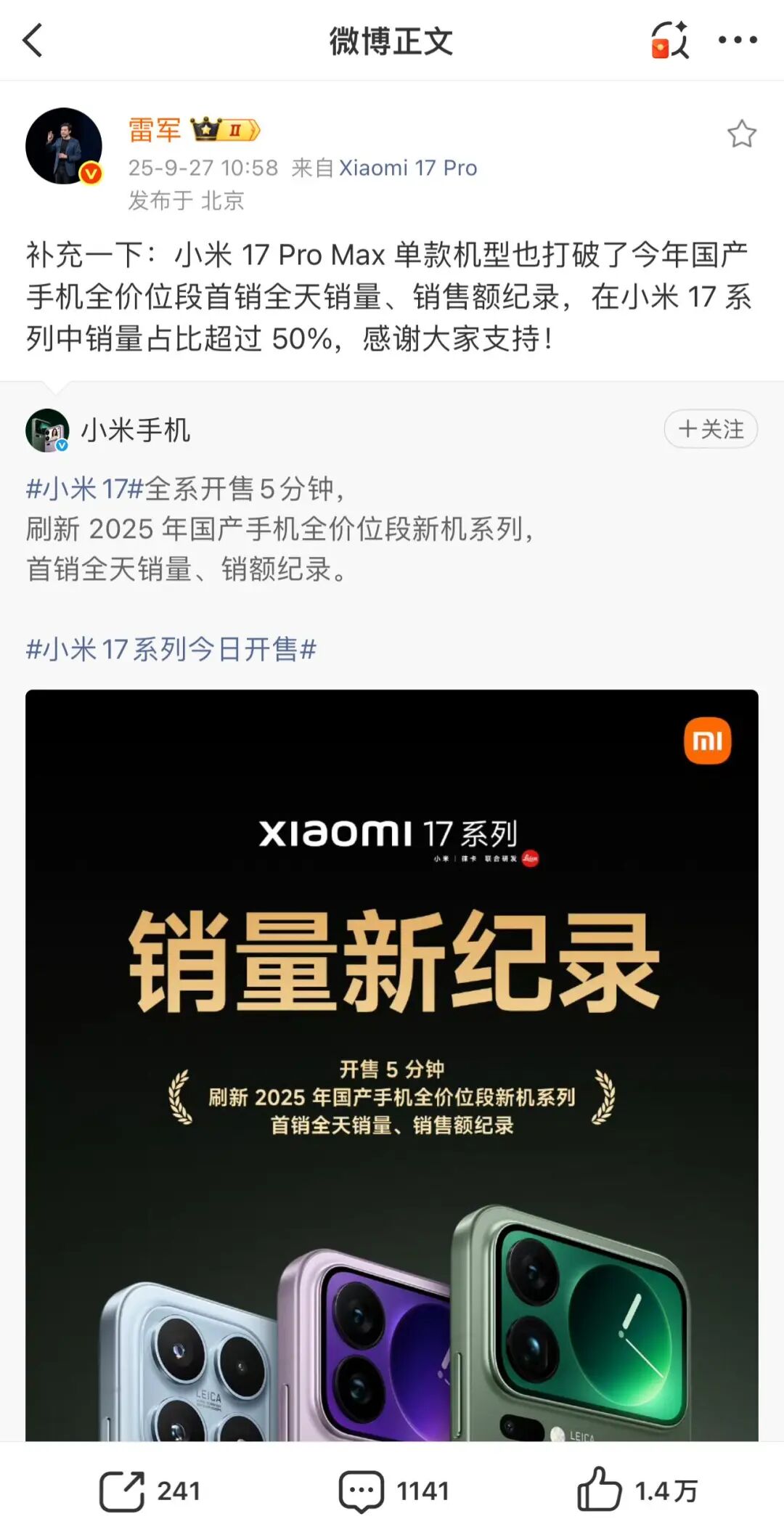
Core Viewpoint - Xiaomi's 17 series has achieved significant sales success, with over 1 million units sold within two days of launch, driven primarily by the high demand for the Pro Max model [1][5][8] Group 1: Product Launch and Sales Performance - The Xiaomi 17 series includes three models: Xiaomi 17, Xiaomi 17 Pro, and Xiaomi 17 Pro Max, with the Pro Max being the most popular [1][5] - The Pro Max model has already sold out in some stores, indicating strong market demand [1][5] - The series set a new sales record for domestic smartphones within the first five minutes of launch, with the Pro Max accounting for over 50% of first-day sales [5][8] Group 2: Technical Specifications - All three models are equipped with Qualcomm's fifth-generation Snapdragon 8 processor, built on a 3nm process, with a clock speed of 4.6GHz, achieving over 4 million on AnTuTu benchmark [3] - The Xiaomi 17 and 17 Pro feature a 6.3-inch 1.5K AMOLED display with a 120Hz refresh rate, while the Pro Max has a 6.85-inch 2K Real RGB OLED display [3] Group 3: Camera and Battery Features - The Xiaomi 17 Pro features three 50MP Leica lenses, including a main camera, telephoto, and ultra-wide, along with a 50MP front camera [5] - The Pro Max model includes a 7500mAh battery with 100W wired and 50W wireless fast charging capabilities, while the Pro model has a 6300mAh battery [5] Group 4: Market Challenges and Adjustments - Despite the initial success, analyst Ming-Chi Kuo has lowered the overall shipment target for the Xiaomi 17 series by 20%, predicting it may not exceed 8 million units, compared to the previous model's 10 million target [5][7] - The standard version of the Xiaomi 17 is underperforming, accounting for only 15-20% of total sales, which is significantly lower than the expected 50% [7] - Xiaomi's public relations manager stated that there are no plans to cut orders and that production of the standard version and Pro series will be increased [7][8]


传音控股股价连续3天下跌累计跌幅8.72%,鹏华基金旗下1只基金持35.46万股,浮亏损失319.18万元
Xin Lang Cai Jing· 2025-09-30 07:23
Group 1 - The core viewpoint of the news is that Transsion Holdings has experienced a decline in stock price, with a cumulative drop of 8.72% over three consecutive days, closing at 94.20 CNY per share on September 30, with a total market capitalization of 1074.21 billion CNY [1] - Transsion Holdings was established on August 21, 2013, and went public on September 30, 2019. The company focuses on the design, research and development, production, sales, and brand operation of smart terminals, primarily mobile phones [1] - The revenue composition of Transsion Holdings is as follows: smart devices account for 83.91%, other products for 10.22%, and feature phones for 5.86% [1] Group 2 - From the perspective of major fund holdings, Penghua Fund has one fund heavily invested in Transsion Holdings, specifically the Penghua Sci-Tech Innovation Board Comprehensive ETF, which held 354,600 shares as of the second quarter, representing 1.31% of the fund's net value [2] - The estimated floating loss for the fund due to the recent decline in Transsion Holdings' stock price is approximately 638,400 CNY, with a total floating loss of 3,191,800 CNY over the three-day decline [2] Group 3 - The Penghua Sci-Tech Innovation Board Comprehensive ETF was established on February 26, 2025, with a current scale of 2.162 billion CNY and has achieved a return of 33.12% since inception [3] - The fund manager, Su Junjie, has been in position for 7 years and 245 days, managing total assets of 19.779 billion CNY, with the best fund return during his tenure being 84.87% and the worst being -21.6% [3]

荣耀全球首家阿尔法旗舰店落地深圳湾 CEO李健:阿尔法战略走向实体化落地
Zheng Quan Shi Bao Wang· 2025-09-30 07:16
Core Insights - Honor's Alpha strategy has transitioned from planning to physical implementation with the opening of its first flagship store in Shenzhen Bay, marking a significant milestone in its transformation from a smartphone manufacturer to an AI terminal ecosystem company [1][3] Group 1: Alpha Strategy Overview - The Alpha strategy was officially launched in March 2025, aiming to transform Honor into an AI terminal ecosystem company, with a three-phase approach: starting with smart phone development, then expanding into AI ecosystems, and ultimately exploring general artificial intelligence [2] - The flagship store serves as a core platform for the Alpha strategy, designed as an "AI terminal smart living innovation workshop" to enhance consumer experience and foster collaboration among creators [1][2] Group 2: Flagship Store Features - The flagship store features interactive experiences, including a creative interaction between a robotic dog and a traditional lion dance, showcasing the blend of technology and tradition [3] - The store includes an AI assistant experience area with four thematic scenarios: AI lifestyle, AI device assistance, AI creation, and AI companionship, emphasizing convenience and accessibility [3] Group 3: IPO and Future Prospects - Honor's IPO is progressing smoothly, with the company having received listing counseling approval, and the fundraising will focus on key areas of AI research and development [3][4] - The IPO is expected to mark the beginning of a new chapter for Honor in the capital market, potentially making it the first stock in the A-share market focused on the AI terminal ecosystem [3]
小米集团斥资近2700万港元回购超50万股,回购价格为历史最高
Mei Ri Jing Ji Xin Wen· 2025-09-30 06:11
Group 1 - Xiaomi Group announced a share buyback of 507,400 shares at a price range of HKD 53.150 to HKD 53.250 per share, totaling HKD 26.9962 million [1] - The buyback price represents the highest historical repurchase price for Xiaomi, indicating management's long-term confidence in the company's development [1]
小米最近的境遇,让我想起一则古老寓言
3 6 Ke· 2025-09-30 02:18
Group 1 - The narrative of "benchmarking" is outdated and no longer aligns with current market trends, as seen in Xiaomi's recent product launch strategy [2][4][6] - Investors are increasingly looking for differentiation rather than imitation, expecting companies to present unique value propositions instead of merely comparing themselves to competitors like Apple [9][10][14] - The Chinese tech landscape has shifted, with companies like CATL and SMIC focusing on innovation and exploring new frontiers rather than simply trying to match established players [3][4][13] Group 2 - Xiaomi's reliance on "benchmarking" against Apple may hinder its growth, as the market now demands more than just comparable specifications; it seeks innovative solutions that define the future [10][12][14] - The company has invested heavily in developing its own technologies, such as chips and electric vehicles, but has yet to effectively communicate these advancements to the market [10][14] - The competitive landscape is evolving, with new leaders emerging in AI and other technologies, making it crucial for Xiaomi to adapt its narrative to reflect contemporary challenges and opportunities [13][14]
小米17系列手机销量如何,一线调查来了
3 6 Ke· 2025-09-30 01:21
Core Insights - The Xiaomi 17 series is experiencing a disparity in sales performance between the Pro Max and standard versions, leading to controversy over overall sales figures [1][10] - Despite breaking sales records during the launch, the standard version's underperformance may negatively impact total shipments [1][8] - Xiaomi remains optimistic about surpassing the previous generation's sales figures, despite analyst predictions of a potential 20% decline in total shipments [8][10] Sales Performance - The Xiaomi 17 series achieved record sales within the first five minutes of launch, but specific sales numbers were not disclosed [1][2] - The Pro Max model accounted for over 50% of the sales within the series, while the standard version's sales were significantly lower, with approximately 3,000 units sold compared to over 10,000 for the Pro models [2][5] - In-store observations indicated a strong demand for the Pro models, with reports of them selling out quickly, while the standard version remained in stock [5][7] Market Analysis - Analysts predict a potential 20% decrease in the total shipment target for the Xiaomi 17 series, originally set at 10 million units, due to lower-than-expected demand for the standard model [8][10] - The standard version's performance is being compared unfavorably to the iPhone 17's strong sales in the Chinese market [8] - Xiaomi's management has expressed confidence in increasing overall sales compared to the previous generation, citing adjustments in product offerings and order structures [8][10] Consumer Sentiment - There is a noticeable preference among consumers for the Pro series over the standard version, attributed to better performance and features [5][10] - The marketing strategies employed by Xiaomi have faced criticism, with some consumers questioning the authenticity of promotional claims [10]
17系列出货不及预期?小米高管:没有削减订单计划
Sou Hu Cai Jing· 2025-09-30 01:08
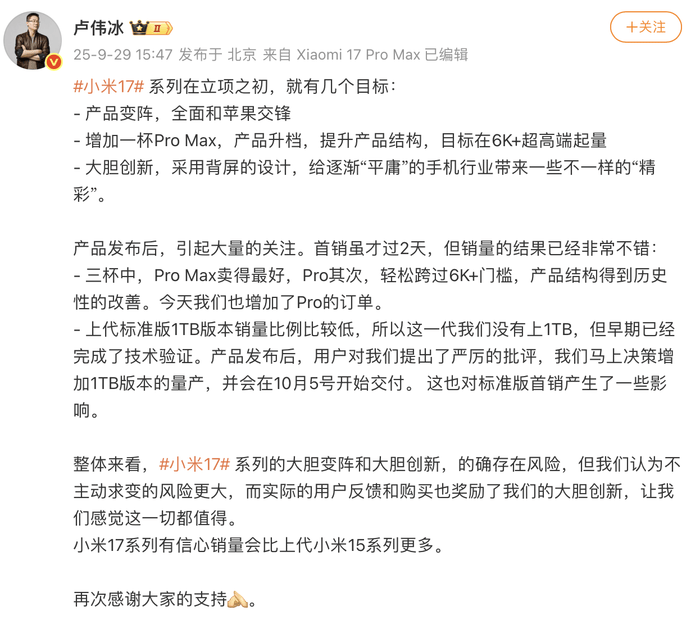
Group 1 - The core viewpoint of the news is that Xiaomi's 17 series smartphone shipments are significantly lower than expected, with a downward adjustment of 20% from the original target of approximately 10 million units, potentially falling below the 8 million units of the 15 series if no aggressive pricing or marketing strategies are implemented [1] - Analyst Guo Mingqiang noted that the main reason for the downward adjustment is the lower-than-expected demand for the standard version of the 17 series, which was initially expected to account for 50%-55% of total shipments but only accounted for about 15%-20% after launch [1] - The 17 series faces competitive pressure from iPhone and Huawei smartphones, with the iPhone 17 standard version exceeding sales expectations in the Chinese market, and upcoming models in 2026 posing further competition [1] Group 2 - Xiaomi Group President Lu Weibing stated that despite the initial two days of sales, the results for the 17 series are satisfactory, with the Pro Max model performing the best and surpassing the 6,000 yuan sales threshold [2] - The company’s public relations manager Wang Hua reiterated that there are currently no plans to reduce orders, as a new 16GB+1TB version of the standard model has been added, and additional orders for the Pro series will change the overall product mix [4][5] - Xiaomi launched the 17 series on September 25, with starting prices of 4,499 yuan for the 17, 4,999 yuan for the Pro, and 5,999 yuan for the Pro Max, claiming to have set sales records within the first five minutes of launch [6] Group 3 - In Q2, Xiaomi reported total revenue of 116 billion yuan, a year-on-year increase of 30.5%, marking three consecutive quarters of revenue exceeding 100 billion yuan, with adjusted net profit of 10.8 billion yuan, up 75.4% year-on-year [7] - The smartphone business generated revenue of 45.5 billion yuan with a gross margin of 11.5%, and global smartphone shipments reached 42.4 million units, a year-on-year increase of 0.6% [7]
小米涨价,远超iPhone
36氪· 2025-09-30 00:38
以下文章来源于36氪财经 ,作者宋婉心 张帆 36氪财经 . 36氪旗下官方账号。洞见市场,比99%的投资者更聪明。 小米吃掉苹果丢失的份额? 文 | 宋婉心 编辑 | 张帆 来源| 36氪财经(ID:krfinance) 封面来源 | IC Photo 2021年底,小米首次宣布在产品上对标苹果、学习苹果。如今五年探索之后,小米17系列产品线全面对齐苹果。 值得注意的是,小米17定价4499起,标准版保持了上一代小米15的定价水平,高端配置则分别较上一代涨价200元至500元。 小米手机的十余代产品以来,从一开始的性价比定位到高端定位,其手机定价步步高升,甚至超过了苹果的同期涨幅。与此同时,尤其近五年来,苹果 则"加量不加价"。 价格涨幅大于苹果 梳理从小米1的定价涨幅,可以发现,从小米6首次提价开始,此后其每年定价涨幅几乎均超过10%——小米6提价15%、小米8提价17.4%、小米9提价 11.1%。 2020年,小米发布小米10手机,这一代开始,小米开始冲击高端市场,价格直接从2999元起跃升至3999元起,涨幅达1000元,同比涨幅更是超过30%,是 幅度最大的一次调整。 此后,3999起的定价维持了 ...

华尔街见闻早餐FM-Radio|2025年9月30日
Sou Hu Cai Jing· 2025-09-29 23:27
Market Overview - Technology stocks supported the three major US stock indices, which rose for two consecutive days to a one-week high, with Nvidia up over 2% and Micron up over 4% [1] - The US Treasury bonds saw a rise, with the ten-year yield declining for the first time in four days [1] - Bitcoin surged nearly $4,000, surpassing the $114,000 mark, while Ethereum rebounded over 4% [1] - Crude oil prices fell over 3%, marking the largest drop in three months, with WTI down over 4% [1] - Gold prices hit a historical high, with spot gold rising nearly 2% to break the $3,800 mark for the first time [1] Key News - The Central Committee of the Communist Party of China held a meeting to discuss documents to be submitted for review at the 20th Central Committee's Fourth Plenary Session [11] - The National Development and Reform Commission announced a new policy financial tool with a total scale of 500 billion yuan, aimed at supporting private enterprises' deep participation in the "Artificial Intelligence +" initiative [11][12] Company News - Facing competition from the iPhone 17, analyst Guo Mingqi lowered the shipment target for Xiaomi 17 by 20% [17] - Anthropic launched Claude Sonnet 4.5, claiming it to be the "best coding model globally" [17][23] - OpenAI plans to launch Sora 2, an independent app that defaults to using copyrighted content, which has sparked controversy [17] Industry Insights - The A-share market is experiencing a bull market characterized by high volume, moderate enthusiasm, and distinct structural features, with no clear bubble signals [18] - The semiconductor industry is seeing significant developments, with Shenzhen's new semiconductor company attracting external investors [15] - The education sector is undergoing transformation due to digital technology and AI, with a focus on enhancing digital education services [24]

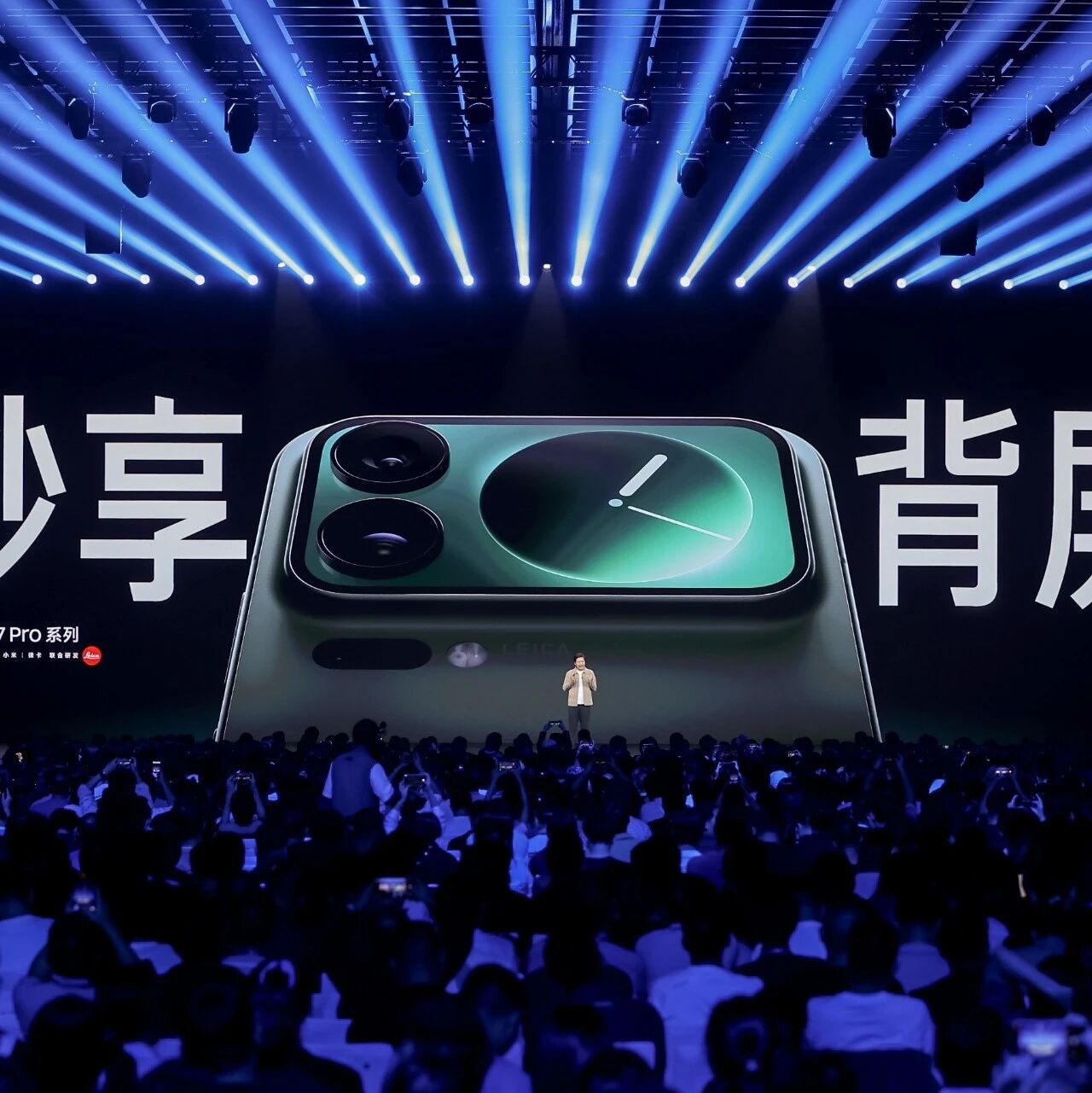
沉闷十年后,智能手机的背面终于「活」了
36氪· 2025-09-29 13:35
Core Viewpoint - The article discusses the "back screen revolution" initiated by Xiaomi, which represents a significant innovation in human-computer interaction, driven by breakthroughs in multiple technologies [2][19]. Group 1: Evolution of Smartphone Interaction - The evolution of smartphones over the past two decades has been primarily driven by changes in screen technology, with each breakthrough reshaping interaction paradigms [4][5]. - Despite advancements in various components like chips and batteries, the interaction model has remained largely fixed on a single front screen [6][7]. - Xiaomi's upcoming 17 series aims to challenge this stagnation by introducing a functional back screen, marking a shift towards dual-sided interaction [9][16]. Group 2: Technological Innovations - The back screen of the Xiaomi 17 series allows for personalized wallpapers and dynamic notifications, enhancing user interaction without needing to flip the phone [9][10]. - It supports advanced features like real-time preview for selfies and high-quality imaging, addressing common pain points in photography [12][13][25]. - The introduction of a high-density battery and advanced screen materials aims to tackle energy consumption concerns associated with dual screens [21][22][23]. Group 3: Competitive Landscape - The smartphone market is shifting from a focus on hardware specifications to differentiated user experiences driven by technological innovation [18][19]. - Xiaomi's back screen revolution positions it to compete directly with established players like Apple, emphasizing experience over mere specifications [25][33]. - The company's commitment to high-end market penetration is underscored by significant investments in R&D, aiming to establish a strong foothold in the competitive landscape [26][30][34].