黄金交易

Search documents
美联储降息浪潮下,2025香港黄金交易平台如何守护您的投资信心?
Sou Hu Cai Jing· 2025-11-03 15:08
Core Insights - The Federal Reserve's ongoing interest rate cuts are reshaping the global financial landscape, leading to increased volatility in gold prices, with historical data indicating potential price increases of 28%-35% during such periods [1] - Hong Kong is accelerating its transformation into an international gold trading center, benefiting from gold prices surpassing $4,000 per ounce, which presents both investment opportunities and challenges in platform selection [1] - The global gold demand showed a robust recovery in Q3 2025, with a year-on-year increase of 3%, reaching a record high of 1,313 tons, driven by geopolitical uncertainties and inflation pressures [3] Market Dynamics - The surge in gold demand is attributed to central banks and investors turning towards physical assets amid economic uncertainties [3] - Hong Kong's gold exchange saw a significant trading volume increase of 68.7%, reaching 2.5 million troy ounces, highlighting its potential as a pricing center [3] - The entry of Swiss precious metals giant MKS PAMP into Hong Kong is expected to enhance infrastructure and challenge London's traditional dominance in gold trading [3] Platform Selection Criteria - New investors are advised to prioritize compliance, such as ensuring the platform holds AA class membership with the Hong Kong Gold Exchange, which guarantees traceable transaction codes [4] - Key factors for platform selection include the speed of deposit and withdrawal processes, with ideal platforms offering instant deposits and withdrawals within two hours [4] - The technology underpinning the trading platform is crucial, with platforms utilizing MT4/MT5 systems for fast order execution and transparent pricing mechanisms [4] Trading Strategies - Investors often face challenges in executing trades during favorable market conditions; thus, platforms that provide flexible contract sizes and transparent pricing mechanisms are essential [5] - Implementing stop-loss and take-profit settings can automate risk management and avoid unexpected overnight interest charges [5] - The importance of data integrity is emphasized, with reputable platforms providing synchronized market data to prevent manipulation [5] Avoiding Trading Pitfalls - Verification of regulatory backing and the isolation of client funds from company operations are critical to ensuring long-term safety in trading [7] - Platforms should have robust measures against slippage and network attacks, ensuring accurate order execution [7] - Practical steps for selecting a platform include comparing membership codes, conducting small-scale test trades, and consulting independent analysts to align with personal risk preferences [7]


点评报告:国家黄金税收政策变化解读
Guang Fa Qi Huo· 2025-11-03 14:31
Report Summary 1. Report Industry Investment Rating No information provided. 2. Core Viewpoints of the Report - The new gold tax policy aims to address tax regulatory pressures in the current "gold - buying boom" by implementing refined tax management and distinguishing between "investment" and "non - investment" uses of gold, plugging "tax arbitrage" loopholes [4]. - The policy may lead to increased costs for non - exchange physical gold transactions, potentially causing investment demand to shift to virtual trading markets and affecting the scale of the spot market [4]. - Due to the lack of implementation details, market participants are in a wait - and - see state, and short - term trading volume may be affected [4]. - In the long run, global macro - economic, fiscal and monetary policies, and geopolitical events are the core factors affecting gold prices, but the new policy may dampen market enthusiasm in the short term [5]. - The new policy can enhance the international competitiveness of China's gold market and contribute to the internationalization of the RMB [5]. 3. Summary by Related Content Policy Core - For gold transactions on the Shanghai Gold Exchange and Shanghai Futures Exchange, when the seller sells standard gold, VAT is exempted. For physical delivery, different VAT policies apply based on the use of the gold [1]. - For investment - use standard gold purchased by member units, the exchange implements VAT immediate refund, exempts urban maintenance and construction tax and education surcharges, and issues VAT special invoices. The buying member unit pays VAT when reselling and can only issue ordinary invoices [1]. - For non - investment - use standard gold purchased by member units, the exchange exempts VAT and issues ordinary invoices. General VAT - paying member units can calculate input tax at a 6% deduction rate and can issue VAT special invoices when reselling [2]. - For standard gold purchased by customers, the exchange exempts VAT and issues ordinary invoices. General VAT - paying customers can calculate input tax at a 6% deduction rate and can issue VAT special invoices when reselling [2]. Specific Policy Changes - Investment gold is not tax - exempt when sold to individual investors, and downstream cannot obtain special invoices for deduction. Non - investment gold can have 6% of its VAT deducted in the processing link and is sold at a VAT - included price in the retail link [3]. - Member units or customers need to clearly indicate the type of gold use on invoices. If the use of gold changes, member units should report to the exchange within 6 months and can only apply for a change once [3]. Impact on the Market - The policy helps plug tax loopholes, forcing enterprises to choose between "investment gold" and "consumer goods" tracks and refine their financial and tax management [4]. - Non - exchange physical gold transactions may face cost increases, leading to a potential shift of investment demand to virtual trading markets. Non - investment gold products still face at least 7% VAT cost [4]. - Due to the lack of implementation details, short - term trading volume may be affected as market participants are in a wait - and - see state [4]. - The new policy may dampen short - term market enthusiasm during a gold bull market, but in the long run, macro - factors are the core determinants of gold prices [5]. - The policy can enhance the international competitiveness of China's gold market and contribute to RMB internationalization [5].
黄金税收新政对个人旧金饰无影响 零售金价或现短期波动
2 1 Shi Ji Jing Ji Bao Dao· 2025-11-03 11:20
Core Viewpoint - The new tax policy for gold trading in China, effective from November 1, 2025, aims to categorize gold transactions into "investment" and "non-investment" uses, establishing different VAT treatments for each category, thereby enhancing the regulation and transparency of gold trading in the country [3][10]. Tax Policy Highlights - The new regulation distinguishes between "investment" and "non-investment" uses of gold, which is a significant breakthrough in tax classification [3][5]. - Investment use includes direct sales and the production of gold bars, ingots, and legal tender with a purity of 99.5% or higher, while non-investment use covers items like jewelry and industrial gold [5][6]. VAT Treatment - For investment purposes, VAT will be refunded immediately upon physical delivery, and no city maintenance or education fees will be levied, allowing buyers to fully deduct input VAT [7]. - For non-investment purposes, VAT will be exempted, but buyers can only deduct input VAT at a lower rate of 6%, which increases the tax burden on purchasing enterprises [7][11]. Trading Environment - The new policy encourages trading on national platforms like the Shanghai Gold Exchange by providing significant tax advantages for transactions conducted there, as opposed to off-exchange transactions which incur higher VAT rates [9][10]. - Off-exchange transactions will be subject to a 13% VAT for general taxpayers and 3% for small-scale taxpayers, while transactions through the exchange will be exempt from VAT [9][10]. Impact on Retail Market - The new regulations are expected to have minimal impact on individual sales of used gold jewelry, which remain exempt from VAT, but frequent sellers may be classified as business operators and subject to VAT [11]. - Retail gold prices may experience short-term fluctuations due to the new tax policy, as upstream costs may be passed down to consumers, influenced by international gold prices and market dynamics [11][12].

财政部、税务总局就涉黄金税收发文;证监会、中基协发布涉公募领域重要文件|每周金融评论(2025.10.27-2025.11.2)
清华金融评论· 2025-11-03 11:01
Focus on Gold Tax Policy - The Ministry of Finance and the State Administration of Taxation announced a tax policy regarding gold transactions, exempting value-added tax (VAT) for members or clients trading standard gold through the Shanghai Gold Exchange and Shanghai Futures Exchange [9] - For investment purposes, VAT will be levied but immediately refunded, while non-investment gold will be exempt from VAT, potentially increasing costs for non-investment enterprises by approximately 60 yuan per gram [10] APEC Meeting Insights - President Xi Jinping emphasized China's commitment to an open world economy during the APEC meeting, proposing five key recommendations to maintain multilateral trade, stabilize supply chains, and promote inclusive development [10] - The APEC mechanism is recognized for its significant influence in promoting economic cooperation in the Asia-Pacific region, with China being viewed as a stabilizing force amid global uncertainties [11] US-China Trade Developments - The US announced the cancellation of a 10% tariff on Chinese goods related to fentanyl, while maintaining a 24% tariff on other products for another year, indicating a potential easing of trade tensions [11][13] - Recent discussions between US and Chinese leaders focused on enhancing economic cooperation and addressing mutual concerns, including trade and export controls [13] Regulatory Changes in Public Fund Sector - The China Securities Regulatory Commission (CSRC) released guidelines for public fund performance benchmarks, aiming to enhance stability and clarity in investment behaviors [12][14] - These guidelines are seen as a critical step in standardizing public fund regulations and reinforcing investment management discipline [14] Resumption of National Debt Trading - The People's Bank of China (PBOC) announced the resumption of national debt trading operations to improve monetary policy tools and enhance the financial function of government bonds [15] - This move is expected to stabilize the bond market and improve liquidity management, following a period of suspension due to market imbalances [15] Hainan Duty-Free Policy Update - A new duty-free shopping policy in Hainan, effective November 1, 2025, expands the range of eligible products and allows for increased purchase limits for travelers, aiming to enhance consumer experience and stimulate local economic growth [16] - The policy changes are projected to significantly boost Hainan's duty-free market, which has seen a substantial increase in sales and consumer participation in recent years [16] Manufacturing Sector Performance - The manufacturing Purchasing Managers' Index (PMI) for October recorded at 49.0, indicating a decline from September, reflecting weakened production and demand in the sector [18][19] - The decrease in manufacturing activity is attributed to external uncertainties and seasonal factors, with the production index falling into contraction territory [19]

专家分析:黄金交易税收政策迎来调整,对普通消费者无直接影响
Sou Hu Cai Jing· 2025-11-02 23:11
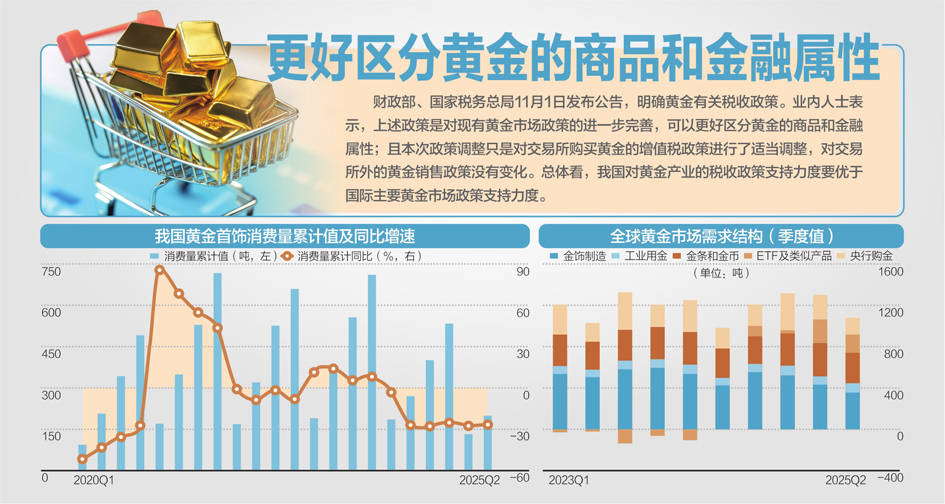
黄金交易税收政策迎来调整。11月1日,财政部、国家税务总局发布的《关于黄金有关税收政策的公 告》正式生效。公告明确了黄金交易相关税收政策,自实施起执行至2027年12月31日,适用时间以发生 实物交割出库的时间为准。新规明确划清"投资性黄金"与"非投资性黄金"的增值税征管边界,行业人士 认为,这标志着我国黄金交易税收体系向精细化、规范化迈出关键一步。近期国际金价宽幅震荡,黄金 税收政策将如何影响投资者、产业链及市场生态?不同交易主体的交易成本如何分化?西安交大客座教 授景川分析称,本次政策并未设立新税种,而是对黄金交易增值税的征管方式进行了精细化改革,强化 用途管理与发票合规,对普通消费者无直接影响,主要影响的是黄金生产、加工及贸易企业的税务处理 方式。(第一财经) ...
贵金属交易员:税收成本上升可能进一步加剧投机资金的短期抛压
Ge Long Hui· 2025-11-02 20:44
格隆汇11月3日|值得注意的是,此次政策出台恰逢黄金市场多空博弈加剧。"税收成本上升可能进一步 加剧投机资金的短期抛压。"一位贵金属交易员提到,部分前期囤货待涨的投资客或选择提前变现,而 新入场者则会因税费顾虑降低杠杆,短期内可能导致市场流动性收紧。"假设买入100万元金条,持有一 段时间后卖出,若金价涨幅不足13%,扣除税费后反而亏损。"该交易员提示,短期投机客需谨慎,长 期持有或通过黄金ETF等工具可规避部分税负。对于金饰消费者来说,日常购买几乎无影响,但"伪投 资金"溢价或收窄。此外,政策不是限制黄金投资,而是规范路径。长期看,有助于市场去泡沫。资金 将更倾向于配置高流动性的标准金或黄金ETF,而非高溢价的非投资品。 ...
两部门明确黄金有关税收政策影响几何?
Zheng Quan Ri Bao· 2025-11-02 17:15
中国商业经济学会副会长宋向清对《证券日报》记者表示,此次政策对市场结构或也有影响,场内交易 地位可能强化。长期看,这将持续支持我国黄金市场提升国际竞争力和定价话语权。 《公告》明确,纳税人不通过交易所销售标准黄金,应按照现行规定缴纳增值税。 本报记者韩昱 财政部11月1日发布消息称,财政部、国家税务总局日前发布《关于黄金有关税收政策的公告》(以下 简称《公告》)。《公告》自2025年11月1日起实施,执行至2027年12月31日,适用时间以发生实物交 割出库的时间为准。 《公告》明确,在2027年年底前,对会员单位或客户通过上海黄金交易所、上海期货交易所(以下简 称"交易所")交易标准黄金,卖出方会员单位或客户销售标准黄金时,免征增值税。未发生实物交割出 库的,交易所免征增值税;发生实物交割出库的,区别标准黄金的投资性用途和非投资性用途,分别按 规定适用增值税即征即退政策,以及免征增值税、买入方按照6%扣除率计算进项税额政策。 陕西巨丰投资资讯有限责任公司高级投资顾问于晓明在接受《证券日报》记者采访时表示,相关税收政 策或将吸引投资者向场内集中,尤其是大额资金,提升交易所的流动性与定价影响力。 于晓明认为,对 ...
不同渠道购买黄金税负差异大
Sou Hu Cai Jing· 2025-11-02 16:12
Core Viewpoint - The announcement from the Ministry of Finance and the State Taxation Administration clarifies tax policies related to gold trading, particularly providing a VAT exemption for standard gold transactions through designated exchanges until the end of 2027, which is expected to influence investment behaviors in the gold market [1][4][5]. Tax Policy Implications - The new policy extends existing tax benefits for gold transactions conducted through the Shanghai Gold Exchange and Shanghai Futures Exchange, allowing sellers to be exempt from VAT until December 31, 2027 [4][5]. - Non-exchange channels, such as banks and jewelry stores, will still require sellers to pay VAT, highlighting a significant tax advantage for exchange-based transactions [3][4]. Impact on Investment Channels - The tax burden for individual investors will be a crucial factor in choosing investment channels, with exchange transactions offering lower tax costs compared to non-exchange purchases, which include VAT in their prices [5][6]. - The new policy may lead to a concentration of investors in exchange channels, especially for larger investments, while ordinary investors might prefer bank-mediated products like gold ETFs for convenience [6][11]. Consumer Behavior and Gold Jewelry - The tax policies for gold jewelry remain unchanged, with consumers typically paying VAT and consumption tax included in retail prices, suggesting limited direct impact from the new policy on gold jewelry consumption [8][9]. - However, fluctuations in the raw material prices due to shifts in investment demand could indirectly affect the prices of gold jewelry [9][10]. Market Dynamics - The announcement is expected to enhance the international competitiveness and pricing power of China's gold market, potentially leading to stronger prices for exchange-traded gold as demand shifts away from non-exchange channels [10][11]. - The tax differences are likely to increase liquidity in exchange transactions while constraining supply in non-exchange markets, which may lead to a long-term restructuring of the gold market [11].
【新华解读】黄金税收新规落地 市场迎来精准化治理新阶段
Xin Hua Cai Jing· 2025-11-02 14:46
Core Viewpoint - The new tax policy for gold in China marks a shift towards refined and categorized management, aiming to close tax arbitrage opportunities and guide gold resources to better serve the real economy [1][2]. Summary by Sections Tax Policy Changes - The announcement specifies that "standard gold" traded on the Shanghai Gold Exchange and Shanghai Futures Exchange is exempt from value-added tax (VAT) for on-exchange transactions. However, upon physical delivery, different tax paths apply based on the purpose of the gold [2]. - For investment purposes, sellers are subject to immediate VAT refund and exemption from additional taxes, while buyers must pay VAT when selling or processing the gold into investment products, but can only issue ordinary invoices [2]. - For non-investment purposes, VAT is exempt, and buyers can calculate input tax based on the ordinary invoice amount and a 6% deduction rate [2]. Regulatory Framework - The new regulations establish a classification management model based on the "purpose" of gold, distinguishing between investment and non-investment uses, which enhances regulatory oversight [2][3]. - The policy increases the compliance burden on members regarding the change of gold use post-delivery, with strict penalties for violations [3]. Market Impact - The new rules are expected to have structural impacts on different market participants, particularly benefiting members dealing in investment gold due to favorable VAT treatment [4]. - The policy may lead to a short-term scarcity of small-sized investment gold bars (50g and 100g) due to increased demand [4]. - Traders are encouraged to focus on the real industry chain rather than tax arbitrage, pushing the industry towards higher value-added services [4]. Price Dynamics - The new policy may lead to a rise in domestic gold retail prices, particularly affecting investment gold bars more than jewelry, providing short-term support for domestic gold prices [5]. - Long-term gold price trends will still be influenced by global macroeconomic fundamentals, with expectations of continued price increases through 2026 driven by investment demand [5].
黄金税收新政实施!你的买金成本会变吗
Bei Jing Shang Bao· 2025-11-02 13:28
Core Viewpoint - The new tax policy for gold trading, effective from November 1, 2025, aims to enhance the attractiveness of on-exchange trading, promote the standardization and centralization of gold transactions, and improve market transparency and regulatory efficiency [1][5]. Summary of Key Adjustments - The announcement specifies that members or clients trading standard gold through the Shanghai Gold Exchange and Shanghai Futures Exchange will be exempt from value-added tax (VAT) on sales of standard gold [3]. - The policy differentiates between "investment use" and "non-investment use" for physical delivery, with varying tax treatments for each category [3][4]. - For investment use, VAT will be refunded immediately, and other taxes will be exempted, while for non-investment use, VAT will also be exempted but with different invoicing rules [4]. Market Impact - The new policy is expected to strengthen the appeal of on-exchange trading, guide the rational allocation of gold resources, and potentially shift some off-exchange trading to on-exchange, benefiting the long-term health of the gold market [5][6]. - The policy may lead to a clearer distinction in consumer behavior regarding investment and consumption gold products, with consumers likely favoring standardized products from exchanges due to cost advantages [6][8]. Affected Groups - The new tax policy will impact four main groups: members of the exchanges, institutional investors, ordinary consumers purchasing physical gold, and downstream businesses in the gold processing and retail sectors [6]. - Institutional investors may accelerate their shift to on-exchange trading to benefit from lower tax burdens, while ordinary consumers may become more discerning in their purchasing decisions based on tax advantages [6][7]. Challenges for Small Gold Merchants - Small gold merchants may face structural challenges due to increased cost pressures and compliance requirements, potentially leading to a market consolidation where only those with strong connections to exchange resources survive [7][8]. - The traditional profit models of small merchants may need to evolve, focusing on enhancing product value and brand differentiation rather than relying solely on price adjustments [8].