
畜牧业

Search documents
生猪周报:等待反弹后抛空-20251025
Wu Kuang Qi Huo· 2025-10-25 13:29
Report Industry Investment Rating No relevant content provided in the report. Core Views - The current slaughter scale and future theoretical出栏量 remain high, and the weight has decreased slightly during this decline. In the medium term, with a significantly high supply pressure, pig prices are likely to fall rather than rise. In the short term, due to the resonance of multiple factors and the persistence of factors supporting the spot rebound, the futures market is prone to fluctuations due to changes in market drivers under high positions. A short - term rebound is expected. Mid - term, one can gradually establish reverse spread positions during the rebound and wait for the pressure level to arrive before gradually short - selling [11][12]. - For trading strategies, it is recommended to wait for the 01 and 03 contracts to rebound and then short - sell at high prices for the unilateral strategy, and gradually establish 3 - 7 and 3 - 9 reverse spreads for the arbitrage strategy [13]. Summary by Section 1. Weekly Assessment and Strategy Recommendation - **Spot Market**: Due to the warming demand after the temperature drop, along with the reluctance of small - scale farmers to sell and the entry of second - round fattening, domestic pig prices continued to rise last week, but the increase was small, and a wait - and - see sentiment emerged after the price increase. The slaughter volume remained high during the week. Group farms accelerated their sales, with a high plan completion rate, while the reluctance of small - scale farmers to sell increased, and the number of pigs in pens rose. The spread between fat and standard pigs continued to widen. The average price in Henan rose by 0.56 yuan to 11.96 yuan/kg, in Sichuan by 0.7 yuan to 11.6 yuan/kg, and in Guangdong by 0.2 yuan to 11.72 yuan/kg. The group's plan completion rate has been high this month, and there is room for a short - term reduction in supply near the end of the month, which supports prices. The demand side is stimulated by the temperature drop, with high slaughter orders, and there is still enthusiasm for second - round fattening in some areas. Pig prices may still rise slightly from next week to the end of the month [11][22]. - **Supply Side**: In September, the official sow inventory was 40.35 million heads, a slight month - on - month decrease of 0.1%, still 3.5% more than the normal sow inventory. The continuous increase in sow production capacity since last year may lead to a weak fundamental situation this year. However, there is a strong expectation of forced capacity reduction on the policy side, which may improve the supply next year in the context of no significant losses this year. The implementation of policy - driven capacity reduction needs to be closely monitored in the coming months. According to the published data, the month - on - month decrease in sow inventory in September was 0.33% according to Steel Union and 0.84% according to Yongyi, indicating that capacity reduction is still slow. From the perspective of piglet data, there is a significant increase in the basic supply from now to March next year. However, the continuous weight reduction of group farms from June to August has led to some pre - emptive supply, which may partially offset the current supply pressure. It is necessary to focus on where this wave of weight goes and whether there will be inventory accumulation at the beginning of the fourth quarter. In the short term, the market still has a large and excessive supply, as the slaughter volume has remained high after the National Day, the frozen meat inventory has continued to rise, and the average trading weight of live pigs is larger year - on - year and rising month - on - month [11]. - **Demand Side**: After the National Day, the demand side has shown some improvement. On the one hand, low prices have stimulated consumption, and the entry of frozen meat and second - round fattening has increased. On the other hand, basic consumption has increased after the temperature drop. However, the temperature drop from October to November is limited, and there is still some time until the Spring Festival. A significant increase in consumption will have to wait until December [11][59]. - **Trading Strategies**: For the unilateral strategy, wait for the 01 and 03 contracts to rebound and then short - sell at high prices, with a profit - to - loss ratio of 2:1 and a recommended cycle of 0.5 - 1 months, driven by supply, weight, and consumer demand. For the arbitrage strategy, gradually establish 3 - 7 and 3 - 9 reverse spreads, with a profit - to - loss ratio of 2:1 and a recommended cycle of 2 months, driven by policies, weight, basic supply, and the spread between fat and standard pigs [13]. 2. Spot and Futures Market - **Spot Price Trend**: Pig prices continued to rise slightly last week due to demand warming, reluctance of small - scale farmers to sell, and second - round fattening. The average prices in Henan, Sichuan, and Guangdong all increased. Pig prices may still rise slightly from next week to the end of the month [11][22]. - **Basis and Spread Trend**: The spot price rebounded slightly, but the futures market had a weak expectation. The basis has converged, and the monthly spread still tends towards reverse spreads [25]. - **Piglet and Sow Prices**: Relevant price trend charts are provided, but no specific analysis of price trends is given in the text. 3. Supply Side - **Reproductive Sows and Changes**: In September, the official sow inventory was 40.35 million heads, a slight month - on - month decrease of 0.1%, still 3.5% more than the normal level. The continuous increase in sow production capacity since last year may lead to a weak fundamental situation this year. The expectation of policy - driven capacity reduction is strong, but capacity reduction is still slow [33]. - **Inventory and Slaughter**: From the piglet data, there is a significant increase in the basic supply from now to March next year, but the pre - emptive supply from group farms may partially offset the current pressure. The short - term market has a large and excessive supply due to high slaughter volume, rising frozen meat inventory, and increasing average trading weight [43][50]. - **Sow Culling and Sales**: Relevant data charts are provided, but no specific analysis of trends is given in the text. - **Theoretical Slaughter Volume**: There is a significant increase in the basic supply from now to March next year, but the pre - emptive supply may partially offset the pressure [43]. - **Proportion of Small and Large Pigs in Slaughter**: The low proportion of small pigs indicates limited impact of diseases, and the low proportion of large pigs means a limited number of fat pigs [46]. - **Trading and Average Weight after Slaughter**: The average trading weight of live pigs is larger year - on - year and rising month - on - month, indicating a large short - term supply [50]. - **Import and Pig Feed Month - on - Month**: Relevant data charts are provided, but no specific analysis of trends is given in the text. - **Second - Round Fattening and Pen Utilization**: Relevant data charts are provided, but no specific analysis of trends is given in the text. 4. Demand Side - **Slaughter Volume**: After the National Day, the demand side has improved, but the significant increase in consumption will have to wait until December [59]. - **Slaughter Capacity Utilization and Gross Margin**: Relevant data charts are provided, but no specific analysis of trends is given in the text. - **Spread and Price - Volume Relationship**: Relevant data charts are provided, but no specific analysis of trends is given in the text. - **Fresh - Frozen Spread and Fresh Sales Rate**: Relevant data charts are provided, but no specific analysis of trends is given in the text. 5. Cost and Profit - **Cost and Breeding Profit**: Due to factors such as feed cost and efficiency improvement, the cost is continuously declining. Pig prices are the weakest in the same period in recent years, and there have been overall losses this year despite the low cost [70]. 6. Inventory Side - **Cost and Breeding Profit**: No new content is provided in this section. - **Frozen Meat Inventory**: The frozen meat inventory is in a state of slow recovery and passive inventory accumulation [75].
欧洲农业快“断代”!超市靠进口填货架,中国耕地却有保障
Sou Hu Cai Jing· 2025-10-25 10:03
Core Insights - The article highlights the stark contrast between the agricultural systems in Europe and China, focusing on the generational crisis in European farming and China's robust agricultural policies that ensure food security and land preservation [1][19]. Group 1: European Agricultural Challenges - Over one-third of farm managers in the EU are over 65 years old, with less than 12% under 40, indicating a significant aging issue in the farming workforce [4]. - The high cost of land in the EU, averaging around €12,000 per hectare, and soaring to €90,000 in the Netherlands, poses a barrier for young farmers [4]. - Economic pressures and policy uncertainties contribute to a vicious cycle in rural areas, leading to land consolidation by large farms and reliance on food imports [7]. Group 2: EU Policy Responses - The EU's agricultural value chain generated €900 billion in added value in 2022, supporting 30 million jobs, but is now facing a structural crisis due to the lack of new entrants [7]. - The upcoming "Agricultural Intergenerational Renewal Strategy" aims to increase the proportion of farmers under 40 to 25% by 2040 and proposes a doubling of funds for intergenerational renewal [9]. - Concerns exist regarding the non-binding nature of the proposed funding increase, with fears that some governments may reduce their contributions [9][11]. Group 3: Comparison with China's Agricultural Policies - China has established a comprehensive system for land protection, with over 100 million acres of high-standard farmland built by the end of 2023, ensuring a stable agricultural foundation [11][13]. - The Chinese government employs economic incentives linked to land protection, rewarding provinces that exceed targets and penalizing those that fall short, thus motivating local authorities to safeguard farmland [11][13]. - Unlike Europe, where young farmers face significant financial barriers, China offers subsidies and specialized loans to lower entry thresholds for new farmers [13]. Group 4: Systemic Differences - The differences in agricultural development between Europe and China stem from systemic design rather than natural conditions, with China's policies effectively linking land protection to farmer profitability [15][19]. - European agricultural technology is advanced, but fragmented policies hinder the conversion of this technological advantage into attractive opportunities for new farmers [15]. - The article concludes that agricultural intergenerational transfer requires a cohesive approach involving land, funding, and policy, as demonstrated by China's successful practices [19].


江苏前三季度主要农产品生产稳定,农业经济运行良好
Yang Zi Wan Bao Wang· 2025-10-25 09:05
Core Insights - Jiangsu Province's agricultural economy is performing well, with stable production of major crops and gradual release of livestock capacity in 2023 [1][2] Group 1: Crop Production - The foundation for autumn grain production is generally good, with a significant harvest of dryland corn and better rice seedling growth compared to the same period last year [1] - The area planted with vegetables reached 17.685 million acres, an increase of 1%, with a total output of 49.474 million tons, up 2.6% [1] - Fruit production reached 9.178 million tons, reflecting a growth of 2.2% [1] Group 2: Livestock Production - The number of pigs reached 14.514 million, an increase of 6%, with 17.874 million pigs slaughtered, up 5.4% [2] - Poultry stock reached 310 million, growing by 2.6%, with 660 million birds slaughtered, an increase of 9.2% [2] - Major livestock product output reached 2.542 million tons, up 6.8%, with pork production at 1.429 million tons, increasing by 5.3% [2] Group 3: Agricultural Prices - The total agricultural product price index for the first three quarters was 96.1, with declines of 3.1%, 4.3%, and 6.7% in the first, second, and third quarters respectively [2] - Prices for major agricultural products showed varied trends, with wheat and corn price declines narrowing, while live cattle prices rebounded [2] - Prices for pork and poultry eggs continued to decline, with vegetable and fruit prices primarily decreasing [2]

南农晨读丨七星有阁 揽月听风
Nan Fang Nong Cun Bao· 2025-10-25 07:35
Group 1 - The first legislation in China specifically aimed at strengthening farmland protection and quality improvement was submitted for review on October 24 [3][4]. - The draft law consists of 8 chapters and 65 articles, focusing on clarifying overall requirements for farmland protection, enhancing target constraints, and improving protection layout [4][5]. - Key measures include strict control over farmland occupation, efforts to enhance farmland quality, and rigorous accountability [5]. Group 2 - The 2025 "Dabeinong Cup" Healthy Pig Farming Technology Competition has officially launched, focusing on feed nutrition [8][9]. - Participating pig farms can submit samples of the feed types they use for free, with the competition assessing feed quality through simulated digestion tests [9][10]. - The competition will evaluate various feed categories and award first, second, and third prizes in each category during the 52nd Pig Industry Conference in Guangzhou from December 11-13, 2025 [11][12]. Group 3 - The harvest season for the unique Lingnan fruit, olive, is underway in Sanbai Cave Village, which has a long history of olive cultivation [14][20]. - The village has approximately 1,000 acres of olive cultivation, with an expected yield of over 300,000 pounds this year, generating an estimated income of around 2 million yuan for the village and its residents [21][22]. Group 4 - The 2025 Global High-end Food and Quality Agricultural Products Expo was held in Shenzhen, featuring an exhibition area of 60,000 square meters and showcasing products from over 30 countries and regions [26][27]. - The Heyuan exhibition group, consisting of 81 enterprises and 297 ecological quality products, participated in the expo, highlighting its unique ecological heritage and Hakka characteristics [28][29].

价格周报|本周猪价反弹,气温普降刺激需求小幅回暖
Xin Lang Cai Jing· 2025-10-25 07:04
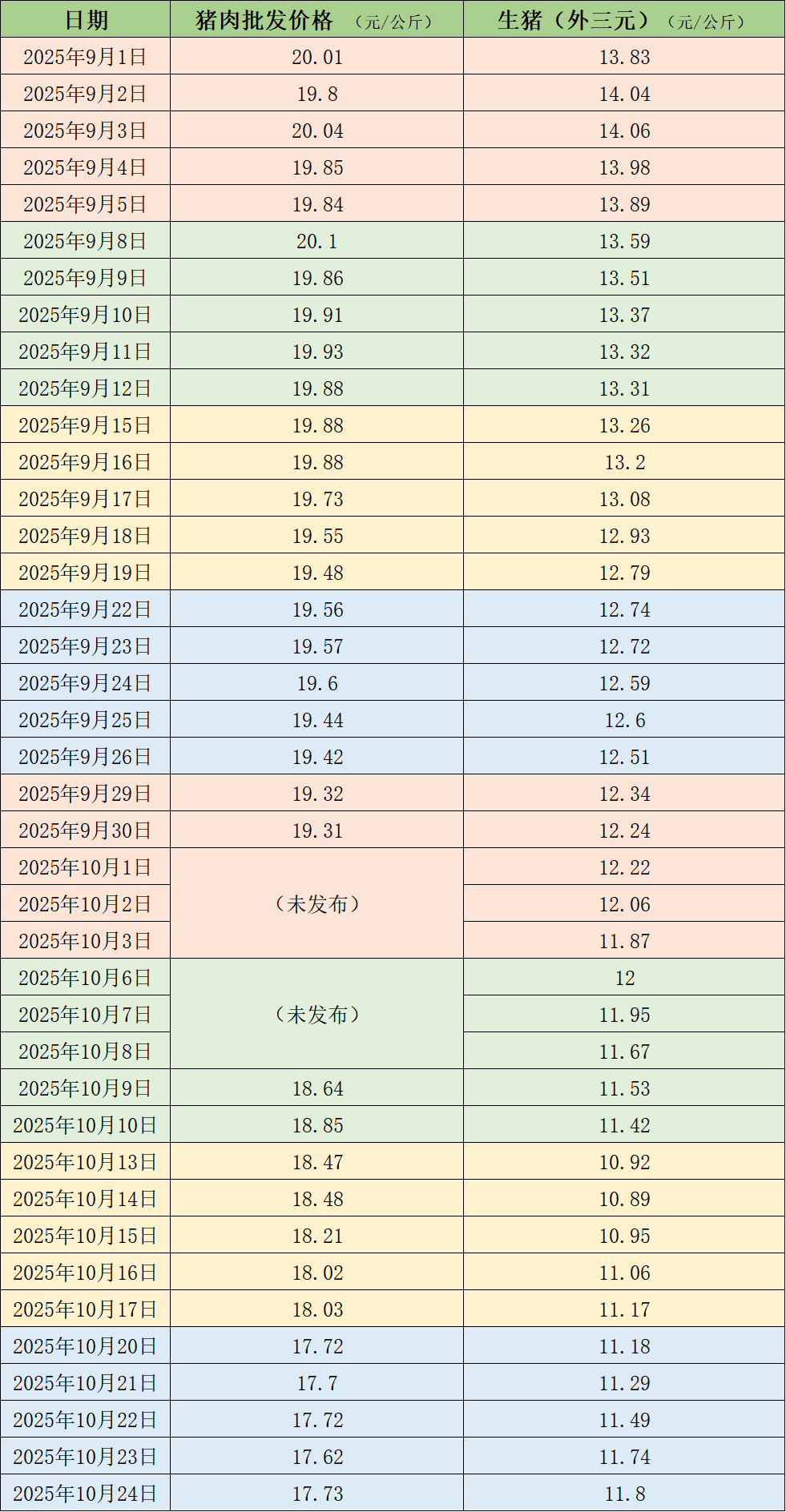
据农业农村部监测,10月24日,全国农产品批发市场猪肉平均价格为17.73元/公斤,与上周五(10月17日)的18.03元/公斤相比,下降 1.7%。本周的平均价格为17.7元/公斤,与上周18.24元/公斤的均价相比,下降2.9%。 本周国内生猪价格持续上涨,周均价环比上涨。据中国养猪网的数据,10月24日,生猪(外三元)价格为11.8元/公斤,与上周五(10月17 日)的11.17元/公斤相比,上涨5.6%。从一周均价来看,本周生猪均价为11.5元/公斤,与上周11元/公斤的均价相比,上涨4.5%。 | 日期 | 猪肉批发价格 (元/公斤) | 生猪(外三元)(元/公斤) | | --- | --- | --- | | 2025年9月1日 | 20. 01 | 13. 83 | | 2025年9月2日 | 19. 8 | 14. 04 | | 2025年9月3日 | 20. 04 | 14. 06 | | 2025年9月4日 | 19. 85 | 13. 98 | | 2025年9月5日 | 19. 84 | 13. 89 | | 2025年9月8日 | 20. 1 | 13. 59 | | 2025年9 ...
瞭望·治国理政纪事丨做好现代特色农业大文章
Xin Hua Wang· 2025-10-25 01:18
Core Insights - The development of modern characteristic agriculture in Guangxi is emphasized by the government, focusing on agricultural technology innovation, high-quality product development, and the establishment of agricultural industry clusters to enhance competitiveness and efficiency [1][4][5]. Group 1: Agricultural Development Initiatives - In December 2021, the Ministry of Agriculture and Rural Affairs signed a cooperation framework agreement with Guangxi to promote high-quality modern characteristic agriculture from 2021 to 2025, focusing on six key areas [1][5]. - By the end of 2024, Guangxi has recognized 641 "Gui" agricultural brands, with a total output value exceeding 160 billion yuan and a brand value surpassing 500 billion yuan [2][10]. - Guangxi has built 4,873 cold storage facilities since 2020, significantly improving the freshness and storage capacity of fruits and vegetables, leading to an average premium of about 25% for fresh agricultural products [2][15]. Group 2: Agricultural Production and Standards - Guangxi is a major producer of various agricultural products, with significant contributions to national production, including 60% of the world's jasmine flowers and 1/7 of the country's fruits [3][24]. - The region has established 50 standards for agricultural production and processing that are recognized by ASEAN countries, enhancing international cooperation [3][24]. Group 3: Financial and Technological Support - Guangxi has implemented innovative financial models to support modern facility agriculture, including collateral loans for livestock and agricultural facilities, easing financing difficulties for small farmers [13][14]. - The total output value of facility agriculture in Guangxi exceeded 280 billion yuan in 2024, with a year-on-year growth of 12% [14]. Group 4: Talent Development and New Farmers - The total number of practical agricultural talents in Guangxi has surpassed 1 million, with over 2,800 modern young farmers and 3,200 agricultural managers trained [2][21]. - The region is focusing on cultivating "new farmers" who are skilled in modern agricultural practices and technologies, enhancing the overall agricultural workforce [19][21]. Group 5: International Cooperation and Market Expansion - Guangxi is enhancing agricultural cooperation with ASEAN countries, with agricultural product imports and exports exceeding 30 billion yuan in 2024, a growth of 10.5% from the previous year [24][25]. - The region is actively promoting its agricultural products internationally, with significant export increases for specific products like the "Gui" brand fruits [23][24].

2025年1—9月蒙古全国牲畜死亡近20万头
Shang Wu Bu Wang Zhan· 2025-10-24 14:54
Core Insights - In the first nine months of 2025, Mongolia reported a total livestock death of 198,600 heads, with goats and sheep accounting for the majority of the losses [1] Livestock Death Breakdown - The breakdown of livestock deaths includes 75,200 goats, 73,800 sheep, 25,800 cattle, 23,300 horses, and 454 camels, with goats and sheep representing 37.9% and 37.2% of the total deaths respectively [1] Regional Distribution - The highest livestock deaths were concentrated in three provinces: Khentii (29,300 heads, 14.7%), Khovd (25,400 heads, 12.8%), and Dornogovi (20,500 heads, 10.3%), collectively accounting for nearly 40% of the total deaths [1] - Other provinces such as Khuvsgul, Bayankhongor, Uvs, Gobi-Altai, and Bulgan together contributed to 71.3% of the total livestock deaths [1] Factors Influencing Death Rates - Experts attribute the significant decrease in death rates to improved pasture conditions, early forage storage, and enhanced local disaster prevention measures [1]
*ST天山:2025年前三季度净利润约-1170万元
Mei Ri Jing Ji Xin Wen· 2025-10-24 10:41
Group 1 - *ST Tianshan reported a revenue of approximately 58.48 million yuan for the first three quarters of 2025, representing a year-on-year decrease of 44.98% [1] - The net profit attributable to shareholders of the listed company was a loss of approximately 11.7 million yuan [1] - The basic earnings per share showed a loss of 0.0374 yuan [1] Group 2 - As of the report, the market capitalization of *ST Tianshan is 2.6 billion yuan [2] - The Chinese innovative drug sector has generated 80 billion US dollars in overseas licensing this year [2] - There is a contrast in the biopharmaceutical secondary market being active while the primary market is facing challenges in fundraising [2]

*ST天山:拟转让全资孙公司巴尔鲁克100%股权
Mei Ri Jing Ji Xin Wen· 2025-10-24 10:41
Group 1 - The core point of the article is that *ST Tianshan announced the transfer of its 100% stake in Baluruk Livestock Co., Ltd. to Xiamen Yunjihuo Enterprise Network Technology Co., Ltd. for a nominal price of 1 RMB due to the poor long-term operating conditions of Baluruk and its insolvency [1] - The decision is part of the company's strategy to optimize its asset structure and focus on core business operations [1] - As of the first half of 2025, *ST Tianshan's revenue composition is 54.91% from the livestock industry and 45.09% from asset leasing [1] Group 2 - As of the report, *ST Tianshan has a market capitalization of 2.6 billion RMB [2] - The article highlights the booming secondary market for biopharmaceuticals in China, with 80 billion USD in overseas licensing deals this year [2] - There is a contrast noted between the hot secondary market and the cooling fundraising environment in the primary market for biopharmaceuticals [2]
猪肉市场:四季度中后期价格有望止跌回升
Sou Hu Cai Jing· 2025-10-24 10:25
Core Viewpoint - The Ministry of Agriculture and Rural Affairs indicates that pig prices are expected to stop declining and begin to rise in the later part of the fourth quarter, with narrow fluctuations anticipated [1] Production Insights - Since the second quarter, the number of newborn piglets has increased, leading to a peak in pig slaughter volume in the fourth quarter [1] - The previous backlog of large pigs is being cleared, and secondary fattening has decreased, resulting in a stable slaughter rhythm [1] - The increase in pork supply is expected to be lower than the increase in slaughter volume [1] Consumption Factors - With the drop in temperatures, southern regions are expected to start processing cured meat, which will boost pork consumption [1] Trade Dynamics - Due to the implementation of temporary anti-dumping measures on imported pork and pork by-products from the European Union, the volume of pork imports is likely to decline further [1]