
原材料

Search documents
中触媒(688267):主营特种分子筛及催化新材料产品,在建项目为公司发展奠定基础
GUOTAI HAITONG SECURITIES· 2026-02-06 14:36
Investment Rating - The report assigns a rating of "Buy" for the company [5][12]. Core Insights - The company specializes in the research, production, and sales of specialty molecular sieves and catalytic new materials, with ongoing projects laying a foundation for future growth [2][20]. - The projected earnings per share (EPS) for 2025, 2026, and 2027 are estimated to be 1.16, 1.39, and 1.66 yuan respectively, with a target price set at 34.75 yuan based on a 25x PE valuation for 2026 [12][17]. - The company has established a comprehensive core process technology system covering the entire chemical industry chain, successfully developing multiple proprietary technology packages [12][20]. Financial Summary - Total revenue is projected to grow from 550 million yuan in 2023 to 1,528 million yuan in 2027, reflecting a compound annual growth rate (CAGR) of approximately 30.6% [4][13]. - Net profit attributable to shareholders is expected to increase from 77 million yuan in 2023 to 293 million yuan in 2027, with a significant rebound in 2024 showing an 89.2% increase [4][13]. - The company’s net asset return rate is projected to rise from 2.9% in 2023 to 8.9% in 2027, indicating improving profitability [4][13]. Production Capacity and Utilization - The company plans to increase its production capacity for specialty molecular sieves and catalysts by 3,000 tons in 2025 and an additional 3,300 tons for environmental catalysts by February 2026 [18][20]. - The expected capacity utilization rates for specialty molecular sieves and catalysts are projected to be 72%, 64%, and 77% for 2025, 2026, and 2027 respectively [18]. Comparable Company Valuation - The report compares the company with peers in the molecular sieve industry, with an average PE of 23x for 2026 among comparable companies [17][19].

智算集群迎来吉瓦级时代
Zhong Guo Dian Li Bao· 2026-02-05 02:48
Core Insights - The report by the China Academy of Information and Communications Technology highlights the rapid growth of computing power in the artificial intelligence (AI) industry, indicating a shift towards a gigawatt-level era, with energy becoming a critical bottleneck for scaling up [1][2] Group 1: Investment Trends - Major companies are increasingly investing in the power sector to support the explosive growth of computing power driven by AI applications, with predictions of a significant increase in global cluster power over the next three years [2] - Notable companies like Amazon, Google, Microsoft, and Nvidia are exploring energy privatization and investing in nuclear fusion, geothermal, and power plant construction to ensure sustainable energy for AI computing clusters [2] - Global AI investment is projected to rise from 8.1% of total industry financing in 2023 to 23% by Q2 2025, with a stark contrast in investment amounts between the US and China [2] Group 2: Model as a Service (MaaS) - MaaS is becoming essential for the industrial application of large models, transitioning from optional to necessary as demand for large models grows across various industries [3] - Major domestic cloud service providers are enhancing their MaaS offerings to optimize resource allocation and improve model inference performance while reducing costs and energy consumption [3] Group 3: AI Penetration in High-Value Sectors - AI applications are expanding into high-value sectors, enhancing productivity in agriculture, transforming industrial manufacturing, and deepening integration in service industries [4] - Different industrial sectors exhibit varied AI adoption characteristics, with significant applications in electronics, consumer goods, and automotive manufacturing, while energy and power sectors are also showing promising trends [4] Group 4: Challenges in AI Implementation - Despite the rapid growth of the AI industry, challenges remain in the practical implementation of AI technologies, with a focus on four core areas: scenario selection, technology adaptation, business integration, and data support [5] - The report emphasizes the need for tailored approaches to AI implementation based on company-specific resources, data foundations, and compliance requirements [5] - The example of State Grid Corporation illustrates a successful top-down strategy for AI integration in power grid scheduling and equipment maintenance, enhancing operational capabilities [6] Group 5: Global AI Development Disparities - The report indicates a widening gap in AI development globally, highlighting the need for international cooperation and the establishment of ESG assessment guidelines for AI [6] - A comprehensive evaluation framework covering algorithm ethics, data privacy, and energy consumption is recommended to ensure inclusivity and applicability across different countries [6]
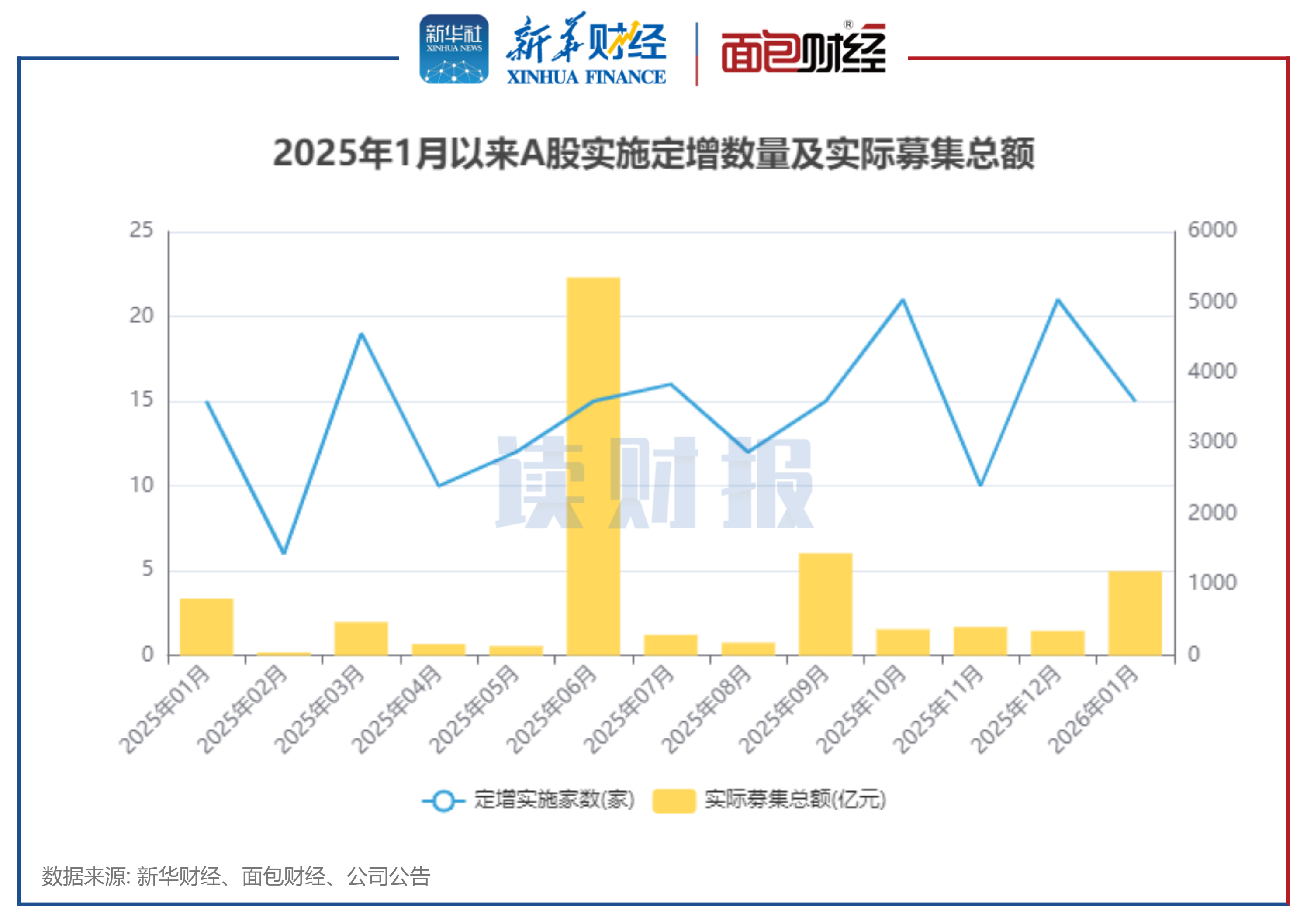
【读财报】1月上市公司定增动态:实际募资总额1194亿元 宏桥控股、电投产融募资额居前
Zhong Guo Jin Rong Xin Xi Wang· 2026-02-02 23:21
Summary of Key Points Core Viewpoint - In January 2026, A-share listed companies in China executed 15 private placements, raising a total of approximately 119.4 billion yuan, which represents a year-on-year increase of 48% [2][6]. Group 1: Fundraising Activities - The actual fundraising amount in January 2026 was about 1194.03 billion yuan, showing a year-on-year increase of 48% and a month-on-month increase of 242% [2][6]. - Among the companies, Hongqiao Holdings raised the most, with a total of 635.18 billion yuan from issuing 11.895 billion shares at a price of 5.34 yuan per share [6][9]. - Electric Power Investment raised 402.85 billion yuan by issuing approximately 11.99 billion shares at a price of 3.36 yuan per share [6][9]. Group 2: Planned Fundraising - In January 2026, 48 private placement plans were disclosed by A-share listed companies, with a total planned fundraising amount of approximately 43.92 billion yuan, which is a year-on-year decrease of 51% but a month-on-month increase of 20% [10][12]. - The largest planned fundraising was by *ST Songfa, aiming to raise up to 7 billion yuan for various projects related to shipbuilding [12][13]. - Tongfu Microelectronics planned to raise up to 4.4 billion yuan for enhancing production capacity in semiconductor packaging [12][13]. Group 3: Industry Distribution - The materials and industrial sectors each had 5 private placements, with the materials sector raising a total of approximately 673.85 billion yuan, the highest among all sectors [9][10]. - The industrial sector led in the number of planned placements with 16, followed by the information technology sector with 13, and the consumer discretionary sector with 7 [18].


2026年1月PMI数据点评
Ping An Securities· 2026-02-02 03:34
Group 1: PMI Overview - The comprehensive PMI index for January 2026 is 49.8%, a decrease of 0.9 percentage points from the previous month[3] - The manufacturing PMI is at 49.3%, down 0.8 percentage points, indicating a contraction in the sector[3] - The service sector PMI is 49.5%, reflecting a slight decline of 0.2 percentage points[3] Group 2: Price Trends - The manufacturing raw material purchase price index increased by 3.0 percentage points to 56.1%, indicating accelerated expansion[3] - The factory price index rose by 1.7 percentage points to 50.6%, marking the first time in 20 months it has exceeded the critical point[3] - The service sector sales price index improved by 0.8 percentage points to 48.9%[3] Group 3: Sector Performance - High-tech and equipment manufacturing PMIs are at 52.0% and 50.1%, respectively, remaining above the expansion threshold[3] - The construction sector PMI fell to 48.8%, a decrease of 4 percentage points, influenced by low temperatures and the upcoming Spring Festival[3] - The construction sector's new orders and business activity expectation indices dropped by 7.3 and 7.6 percentage points, respectively[3]
键邦股份首次覆盖报告赛克产品行业领先,开发高分子助剂产品发挥协同效应
GUOTAI HAITONG SECURITIES· 2026-01-30 00:25
Investment Rating - The report initiates coverage with a "Buy" rating for the company, with a target price of 42.70 yuan [5][18]. Core Insights - The company focuses on developing polymer materials additives, leveraging its leading product, Saike, to create a synergistic effect. The rise of emerging industries is expected to stabilize and increase product prices [2][12]. - The company has established a strong market position with its Saike product, which has maintained a market share of approximately 80% from 2021 to 2023 [12][20]. - The company is projected to see a recovery in revenue and net profit by Q3 2025, with a notable increase in Q3 2025 compared to previous quarters [22][12]. Financial Summary - Total revenue is forecasted to decline from 674 million yuan in 2023 to 655 million yuan in 2025, before rebounding to 1.12 billion yuan by 2027, reflecting a compound annual growth rate of 31.7% from 2025 to 2027 [4][12]. - Net profit attributable to shareholders is expected to decrease from 190 million yuan in 2023 to 132 million yuan in 2025, with a recovery to 282 million yuan by 2027 [4][12]. - Earnings per share (EPS) are projected to be 0.83 yuan in 2025, 1.22 yuan in 2026, and 1.76 yuan in 2027 [18][12]. Industry Position and Product Development - The company has developed a comprehensive product system centered around Saike, titanium esters, DBM/SBM, and acetylacetone salts, which are widely used in insulation coatings, PVC plastics, and lithium battery materials [20][21]. - The company benefits from strong demand in emerging applications such as industrial robotics and smart grid construction, which are driving the need for high-quality electromagnetic wires and coatings [35][39]. - The company has established long-term partnerships with major clients, including the Allen-Tas Group, which is expanding its production capacity for high-performance insulation coatings [39][12]. Price Trends and Market Dynamics - The price of Saike products has seen fluctuations, with a peak of 17,700 yuan per ton in 2022, dropping to 10,700 yuan per ton by Q3 2025. This decline is attributed to market demand and raw material price changes [40][41]. - The report anticipates that as demand recovers, product prices are likely to stabilize and potentially increase [12][40].
键邦股份(603285):键邦股份首次覆盖报告:赛克产品行业领先,开发高分子助剂产品发挥协同效应
GUOTAI HAITONG SECURITIES· 2026-01-29 14:38
Investment Rating - The report assigns an "Accumulate" rating to the company with a target price of 42.70 CNY, based on a 35x PE for 2026 [5][18]. Core Insights - The company focuses on high molecular environmental additives, leveraging its leading product, Saike, to develop a range of polymer materials such as titanate esters, DBM/SBM, and acetylacetone salts, which exhibit significant synergy [12][20]. - The company is expected to benefit from the recovery of product prices as emerging industries drive demand [2][34]. Financial Summary - The company's total revenue is projected to decline from 674 million CNY in 2023 to 655 million CNY in 2025, before rebounding to 1,120 million CNY by 2027, reflecting a compound annual growth rate (CAGR) of 31.7% from 2025 to 2027 [4][17]. - Net profit attributable to the parent company is expected to decrease from 190 million CNY in 2023 to 132 million CNY in 2025, with a significant recovery to 282 million CNY by 2027 [4][17]. - Earnings per share (EPS) are forecasted to be 0.83 CNY in 2025, 1.22 CNY in 2026, and 1.76 CNY in 2027 [18]. Business Development - The company has established a robust product system centered around Saike, titanate esters, DBM, SBM, and acetylacetone salts, which are widely used in insulation coatings, PVC plastics, and lithium battery materials [20][21]. - The company has maintained a strong market position, with Saike products holding approximately 80% market share in recent years [12][20]. Demand Growth - The rise of new applications in industrial automation and smart grid construction is expected to drive demand for high-quality electromagnetic wires and coatings [34][35]. - The company has established a stable partnership with Allen-Tas Group, which is expanding its production capacity for high-performance insulation coatings [39][40]. Price Stabilization - Saike product prices have recently hit a low, with a decline from 17,700 CNY per ton in 2022 to 10,700 CNY per ton in Q3 2025, but are anticipated to stabilize as demand recovers [12][40].
外资公募绩优产品持仓曝光!制造业为底盘,科技与资源品双线布局
证券时报· 2026-01-29 08:55
Core Viewpoint - In 2025, several foreign public funds achieved significant excess returns, with clear positioning in technology growth and resource sectors, reflecting strong stock selection and allocation capabilities [1][3]. Group 1: Performance of Foreign Public Funds - Multiple foreign public funds recorded impressive gains in 2025, with standout performances from products like BlackRock Advanced Manufacturing A, which rose 63.34%, and Robeco Resource Select A, which surged 97.28%, indicating strong grasp of structural market trends [3]. - The overall portfolio structure of these funds remains centered on manufacturing, while maintaining high attention to technology growth and resource opportunities [3]. Group 2: Specific Holdings and Strategies - BlackRock Advanced Manufacturing A focused heavily on manufacturing, with key technology stock positions in Q4 including Zhongji Xuchuang and Lixun Precision, leaning towards high-end manufacturing [3]. - Fidelity Low Carbon Growth A also prioritized manufacturing, with significant holdings in companies like Xinyi Solar and Shanghai Fudan, balancing low-carbon transition and technology growth [3]. - Robeco Resource Select A displayed a more diversified portfolio, investing in materials and mining sectors, with major positions in Zijin Mining and China Aluminum, highlighting a clear focus on commodities and related industries [3][4]. Group 3: Market Outlook and Strategic Adjustments - Foreign institutions are optimistic about the medium to long-term opportunities in resource sectors while making structural adjustments in technology investments, believing in the ongoing value reassessment of Chinese stocks amid economic transformation [6]. - Robeco Resource Select's manager expressed confidence in the resource sector, anticipating further market expansion in 2026, which will provide more options for portfolio allocation [6]. - Schroders China Power's managers indicated a strategy shift from high-expectation technology sectors to undervalued non-bank financials and chemicals, reflecting a rebalancing of their investment approach [6]. Group 4: Focus on Technology and Future Expectations - The AI sector's profit expectations have been revised upward, but stock performance remains subdued, leading to a cautious approach towards further investments in AI hardware while increasing exposure to application sectors and related supply chains [7]. - Allianz China Select's manager highlighted a sustained high equity position, focusing on quality technology assets as key drivers of value reassessment in Chinese stocks, with expectations for continued excess returns in 2026 [7].

中信证券港股2月展望:春季行情延续 关注三大主线
Zhi Tong Cai Jing· 2026-01-29 01:21
Core Viewpoint - The report from CITIC Securities indicates that the Hong Kong stock market is expected to continue its spring rally from late December 2025, with a focus on large-cap stocks before the Lunar New Year and better performance in growth sectors supported by policy directions [1] Group 1: Market Performance and Trends - The performance expectations for Hong Kong stocks have significantly adjusted, with a slowdown in the downward revision of earnings forecasts since late December 2025 [1] - The average return of the Hang Seng Index during the spring rally over the past eleven years is 2.4%, with a weekly win rate of 70.8%, particularly strong in 2019, 2021, and 2023, averaging a 10.6% increase [2] - The upcoming earnings reports for Hong Kong stocks are expected to be concentrated from late March to early April, indicating a period of performance vacuum [1][2] Group 2: Investment Focus Areas - Short-term investment focus should be on three main lines: 1) "14th Five-Year Plan" policy directions including biomanufacturing, embodied intelligence, and 6G; 2) food delivery platforms and real estate benefiting from policy-driven expectations; 3) non-bank financials benefiting from the spring rally [1] - The "15th Five-Year Plan" is expected to guide long-term investment opportunities, with strategic emerging industries like new energy, new materials, and quantum technology likely to receive policy support [3] Group 3: Liquidity and Market Dynamics - The liquidity outlook for Hong Kong stocks is expected to improve as the market approaches the next peak of stock unlocks, with significant reductions in unlock amounts in January and February 2026 [1] - Historical data shows that net inflows from southbound trading in January and February account for an average of 19.3% and 27.9% of the annual total, respectively [2]

2025年12月工业企业利润点评:环比也在改善
Changjiang Securities· 2026-01-28 07:01
1. Report Industry Investment Rating - Not mentioned in the provided content 2. Core Viewpoints of the Report - In 2025, the profit growth rate of industrial enterprises above designated size increased, with improved single - month profitability in December, accelerated inventory destocking, and increased production - sales ratio. The operating pressure may have marginally eased, and the enterprise profit repair trend is initially evident. However, the performance of revenue and profit margin is still divergent, the profit quality is somewhat restricted, and there are also differences among industries, with the mid - upstream performing well and the downstream under pressure. The "anti - involution" measures may have some effects, but the sustainability of profit repair depends on whether policies can stimulate the improvement of terminal demand and drive price stabilization and recovery. The bond market's reaction to the fundamentals may still show the characteristic of "being insensitive to positive news and sensitive to negative news", and the structural highlights of the economic fundamentals may limit the downward space of interest rates. The view of short - term long - bond oscillation is maintained [3][9] 3. Summary by Related Catalogs 3.1 Event Description - In 2025, the cumulative operating revenue of industrial enterprises above designated size was 139.2 trillion yuan, a year - on - year increase of 1.1%; the cumulative operating cost was 118.75 trillion yuan, a year - on - year increase of 1.3%; the cumulative total profit was 7.4 trillion yuan, a year - on - year increase of 0.6%; the operating profit margin increased by 0.02 pct to 5.31% compared with the first 11 months. In December, the year - on - year growth rate of industrial enterprise profits increased by 18.4 pct to 5.3% compared with November [6] 3.2 Event Comments - **Profit growth rate recovery and strong seasonality in the month - on - month aspect**: From January to December 2025, the profits of industrial enterprises above designated size in China increased by 0.6% year - on - year, and the cumulative growth rate increased by 0.5 pct compared with November. The low - base effect contributed, and the month - on - month growth rate was also at a relatively high level in the same period over the years, indicating the improvement of enterprise profitability. The reasons for the recovery of the profit growth rate of industrial enterprises above designated size in December are: active production (the year - on - year growth rate of industrial added value rebounded and the capacity utilization rate improved), weakened drag on the price side (the year - on - year decline of PPI narrowed and the production - sales ratio also improved slightly), and the year - on - year growth rate of the operating profit margin turned from negative to positive (an 8.6% year - on - year increase in December, a 22 pct increase compared with the previous month) [9] - **Marginal pressure on revenue and improved profit margin**: In December, the year - on - year revenue of industrial enterprises above designated size was - 3.2%, and the decline increased by 3 pct compared with November. In terms of cost and expenses, the cost per 100 yuan of operating revenue of industrial enterprises above designated size for the whole year was 85.31 yuan, and the expenses were 8.62 yuan. The total amount, cumulative year - on - year, and month - on - month growth rates all increased compared with January - November. In terms of profit efficiency, the cumulative value of the operating profit margin from January to December increased from the previous 5.29% to 5.31%, but the profit quality needs to be improved due to the year - on - year increase in cost and expenses and the impact of investment income [9] - **Differentiated profit performance**: In December, the non - ferrous and high - tech manufacturing industries performed well, while the downstream was still under pressure. Throughout the year, the black metal industry improved significantly, and the equipment manufacturing industry had a stable growth rate. By industry, the profits of the mid - stream non - ferrous, railway and shipbuilding, and downstream furniture manufacturing industries improved significantly in December. From the perspective of the two - year average growth rate, the profit growth rates of the mining, raw material, and equipment manufacturing industries all rebounded. Among them, the ferrous metal smelting and rolling processing industry recorded a profit of 109.83 billion yuan, a three - fold increase compared with the previous year; the mid - stream equipment manufacturing industry provided strong support, driving the profit growth of industrial enterprises above designated size by 2.8 pct throughout the year; the high - tech manufacturing industry had a remarkable growth rate, with the profit of high - tech manufacturing industries above designated size increasing by 13.3% compared with the previous year, 12.7 pct higher than the profit growth rate of all industrial enterprises above designated size. By business entity, the profit growth rates of small and medium - sized enterprises, foreign - invested and Hong Kong, Macao, and Taiwan - invested enterprises turned from negative to positive, and the profits of joint - stock and state - owned holding enterprises improved significantly [9] - **Both nominal and real inventories decreased, and inventory destocking accelerated**: In December, the year - on - year growth rate of finished product inventories of industrial enterprises was 3.9%, a decrease of 0.7 pct compared with the previous month. After excluding price factors, the real inventory was 5.9% year - on - year, a decrease of 1 pct compared with the previous month. The turnover days of finished products were 19.9 days, slightly lower than the previous month, and inventory turnover accelerated seasonally. By industry, some mid - stream manufacturing and downstream consumer goods industries were still in the process of inventory replenishment, while industries such as black metal and textile were actively destocking, and nearly 20% of industries destocked in December. The inventory - to - sales ratio decreased compared with the previous month. Notably, the production - sales ratio of industrial enterprises rebounded to near the median of the same period in history, and the asset - liability ratio continued to reach a new high in the same period over the years, which may reflect the marginal improvement of enterprise operating pressure [9]
海利得:“纤”动未来,“聚”力变革-20260128
GUOTAI HAITONG SECURITIES· 2026-01-28 00:25
Investment Rating - The report maintains a "Buy" rating for the company [6] Core Insights - The company is actively expanding into new materials, and the price gap for polyester industrial yarn has significantly improved year-on-year [2] - The target price has been raised to 10.40 yuan based on the company's growth potential and comparable company valuations [12] Financial Summary - Total revenue is projected to grow from 5,622 million yuan in 2023 to 6,328 million yuan in 2027, reflecting a compound annual growth rate (CAGR) of approximately 3.7% [4] - Net profit attributable to the parent company is expected to increase from 349 million yuan in 2023 to 675 million yuan in 2027, with a notable growth rate of 17.6% in 2024 and 27.0% in 2025 [4] - Earnings per share (EPS) is forecasted to rise from 0.30 yuan in 2023 to 0.58 yuan in 2027 [4] - The return on equity (ROE) is anticipated to improve from 9.5% in 2023 to 14.6% in 2027 [4] Business Development - The company plans to establish a subsidiary to implement industrialization projects for spinning oil agents and LCP resins, with an annual production capacity of 6,000 tons of LCP and 10,000 tons of chemical fiber oil agents [12] - The company has successfully developed key preparation technologies for high-end LCP resins and has completed the full process development from small-scale to pilot testing [12] - The polyester industrial yarn price gap has shown significant recovery, with an average price of 8,900 yuan per ton as of January 26, reflecting a month-on-month increase of 2.30% and a year-on-year increase of 2718.49% [12] International Expansion - The company's Vietnam base is progressing well, with a project to produce 18,000 tons of high-performance tire cord fabric [12] - The company is also implementing a second phase of spinning yarn and supporting polyester chip projects in Vietnam, aiming for a total production scale of 100,000 tons of differentiated polyester fiber industrial yarn and 25,000 tons of polyester chips [12]
