外卖与即时零售

Search documents
美团更希望战争停下来
Hu Xiu· 2025-08-09 23:39
Core Insights - The ongoing competition in the food delivery market has intensified, with Meituan facing challenges from JD and Alibaba, leading to a shift in market dynamics [1][3][4] - The battle for market share is not just about order volume but also about user engagement within apps, indicating a deeper ecosystem competition [2][10] - Meituan's market share has decreased from approximately 70% to a more fragmented landscape, with estimates suggesting a potential shift to a 5:3:2 ratio among Meituan, JD, and Alibaba [3][4] Market Dynamics - The food delivery market has seen a significant increase in daily orders, rising from 100 million to 250 million from January to early August [5] - Meituan's stock price has declined from around 140 HKD in January to 122.4 HKD by August 7, indicating market pressures [5] - The entry of JD and Alibaba has led to a more competitive environment, with Meituan's previously stable market position now under threat [3][4][6] Strategic Responses - Meituan is perceived to be in a "passive combat" state, focusing on maintaining its market share while facing aggressive competition from JD and Alibaba [8][9] - The company is exploring AI and drone technology as future growth areas, but the current focus on subsidies and competition may hinder these initiatives [8][9] - JD's strategy appears to be more proactive, viewing the food delivery market as a long-term investment rather than a short-term battle [9] Consumer Behavior - The competition has led to changes in consumer habits, with a notable increase in online ordering among younger demographics [12] - Restaurant owners express concerns about sustaining growth without platform subsidies, indicating a reliance on promotional strategies [11][12] - The long-term impact of these changes on consumer loyalty and behavior remains uncertain, particularly if subsidy levels decrease [11][12] Future Outlook - The ongoing battle is expected to evolve into a prolonged conflict, with the ability to sustain competitive advantages becoming crucial for success [14] - Meituan's internal focus may shift back to core business areas if the subsidy wars subside, allowing for a more strategic approach to growth [8][10] - The competitive landscape will continue to be shaped by the actions of JD and Alibaba, as they seek to expand their influence in the food delivery sector [9][10]



美团启动中小商户发展扶持计划,机构表示关注其长期格局
Mei Ri Jing Ji Xin Wen· 2025-08-06 02:51
Group 1 - The Hong Kong stock market opened lower on August 6, with technology stocks generally declining while innovative drug concepts opened higher. Chip stocks saw multiple gains, and the paper industry performed actively [1] - Meituan announced a support plan for small and medium-sized merchants starting August 5, aiming to provide financial assistance to over 100,000 restaurants by the end of the year, with individual support up to 50,000 yuan [1] - Citic Securities noted that competition in the domestic food delivery and instant retail sectors has intensified since Q2 2025, leading to increased user penetration but a significant decline in profitability due to substantial subsidies from various platforms [1] Group 2 - Recent expectations for a Federal Reserve interest rate cut have increased significantly, with over 90% probability for a 25 basis point cut in the September meeting, which is expected to benefit the Hong Kong stock market, particularly the technology sector [2] - The Hang Seng Technology Index is currently in a historically undervalued range and is highly sensitive to changes in the US-China interest rate differential, making it likely to benefit from a loosening of overseas liquidity [2] - The Hang Seng Technology Index is characterized by high elasticity and growth potential, suggesting that it will have stronger upward momentum once market conditions improve [2]
美团、淘宝、京东共同宣布,外卖0元购结束
3 6 Ke· 2025-08-01 11:19
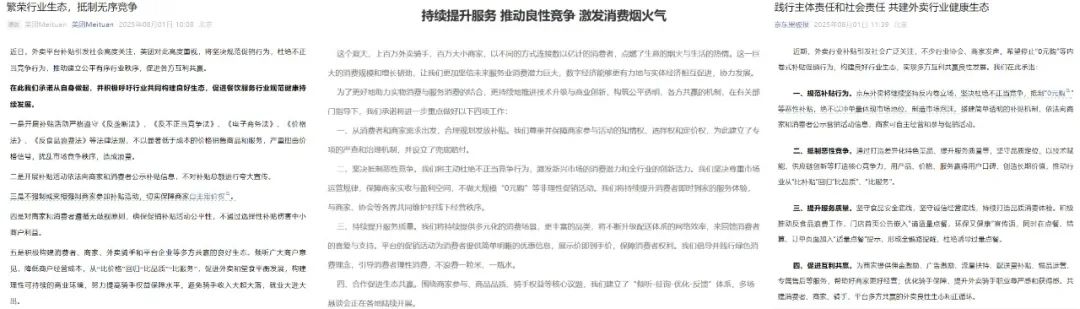
Core Viewpoint - Major food delivery platforms, including Meituan, Taobao Flash Sale, and JD Delivery, have collectively emphasized the importance of not selling goods and services at prices significantly below cost, aiming to resist malicious competition in the market [1][2][20]. Group 1: Market Response and Regulatory Actions - The recent actions by these platforms are seen as a response to the State Administration for Market Regulation's previous actions, which included discussions with major players like Ele.me, Meituan, and JD to ensure compliance with laws and regulations [2][20]. - The ongoing "takeout war" that began earlier this year is showing signs of resolution, as platforms are now focusing on sustainable competition rather than aggressive price wars [3][20]. Group 2: Competitive Landscape - The "takeout war" escalated in February 2023, with JD launching its delivery service and offering substantial subsidies, prompting Meituan and Alibaba to respond with their own initiatives [4][20]. - By mid-July, the total daily order volume in the food delivery market surged from an average of 100 million orders at the beginning of the year to approximately 250 million orders, with Meituan accounting for 150 million, Ele.me for 80 million, and JD for over 10 million [7][20]. Group 3: Financial Implications of Subsidies - Despite the apparent benefits of subsidies for platforms and merchants, the actual financial impact reveals that many merchants are struggling with profitability due to high costs associated with materials, subsidies, and platform fees [19][20]. - A detailed cost analysis indicated that while JD offers the most favorable conditions for consumers, Meituan provides the highest actual income for merchants, with JD's merchant income sometimes exceeding consumer payment prices due to strong subsidies [11][12][20]. Group 4: Industry Challenges and Future Outlook - The intense competition and reliance on extreme subsidies are leading to unsustainable business practices, with many merchants reporting declining profit margins and increased operational challenges [19][20]. - The collective commitment from major platforms to resist irrational competition reflects a growing consensus within the industry about the need for a more sustainable approach to growth, moving away from high subsidy strategies [20].

“小券”撬动“大市场”?| 基于外卖闪购优惠券的消费提振、经营拉动与行业启示
Sou Hu Cai Jing· 2025-07-30 16:05
Core Insights - The article discusses the significant impact of large-scale subsidies initiated by instant retail and food delivery platforms like Meituan, Taobao Flash Purchase, and JD.com on consumer spending and market competition since 2025 [1][3][9]. Group 1: Subsidy Impact on Consumer Spending - Taobao Flash Purchase coupons have shown a notable effect on increasing food delivery consumption on the Ele.me platform, with every 1 yuan of effective subsidy generating approximately 1.65 yuan in additional spending [3][15]. - The study indicates that the spillover effect of these coupons is substantial, with each 1 yuan of effective subsidy leading to an additional 6.76 yuan in total consumer spending through Alipay, including 3.11 yuan in e-commerce purchases [3][25]. - The penetration rate of Flash Purchase is positively correlated with the average weekly revenue of offline restaurants, indicating no evidence of cannibalization of dine-in services [3][39]. Group 2: Market Dynamics and Competition - The competition among platforms has intensified, with daily subsidies exceeding 2 billion yuan, resulting in a surge in daily orders from 100 million to 250 million [9][49]. - Regulatory bodies have intervened to ensure fair competition and prevent improper practices, emphasizing the need for platforms to adhere to legal standards and maintain a healthy market environment [9][49]. - The article highlights the importance of self-regulation within the industry to avoid issues such as food waste and labor rights violations [4][49]. Group 3: Merchant Revenue and Market Structure - Participating merchants in the Flash Purchase program experienced an average weekly revenue increase of 1,744.69 yuan, representing a growth rate of approximately 101.5% [34][35]. - The study found that the online coupons did not negatively impact offline restaurant revenues, with some small merchants even seeing slight increases in their offline earnings [36][39]. - The positive impact of Flash Purchase coupons is more pronounced for small merchants, with a revenue increase of 44.5% for those with lower pre-launch earnings [41][46]. Group 4: Future Research Directions - The article suggests further research is needed to assess the long-term effects of these subsidy programs, including their impact on consumer behavior, merchant profitability, and market equilibrium [48][53]. - Future studies will focus on various dimensions such as the sustainability of rider income, the real profit picture for merchants, and the external costs associated with increased delivery activity [54][55][56].

中国新就业形态研究中心、北京市总工会、北京市朝阳区总工会联合饿了么举办骑手与商家恳谈会
Xin Lang Ke Ji· 2025-07-30 07:55
Group 1 - The core viewpoint of the article highlights the positive cycle created by the competition among multiple platforms, leading to increased orders, merchant profits, rider income, and consumer benefits, forming a "consumption-driven - merchant growth - rider income increase - employment expansion" loop [1] - The number of riders has increased significantly, with a 78% year-on-year growth since the launch of Taobao Flash Purchase, and a 120% increase in crowd-sourced riders. Active and stable crowd-sourced riders have an average monthly income exceeding 12,500 yuan [1] - The industry is experiencing robust employment growth, with a surge in recruitment for riders and operational roles, indicating a thriving job market [1] Group 2 - The instant retail industry is projected to reach 500 million orders per day, reflecting its promising future [2] - Empirical research indicates that the opening of food delivery services has a significant positive impact on restaurants' total sales and delivery sales, as well as a slight increase in dine-in sales [2] - The total daily order volume for food delivery and flash purchase has surpassed 250 million, showcasing the strong recovery of the consumer market and the critical role of algorithm scheduling in large-scale instant delivery [2]
去掉0元购水分 ,美团1.5亿订单还剩多少?
3 6 Ke· 2025-07-14 09:29
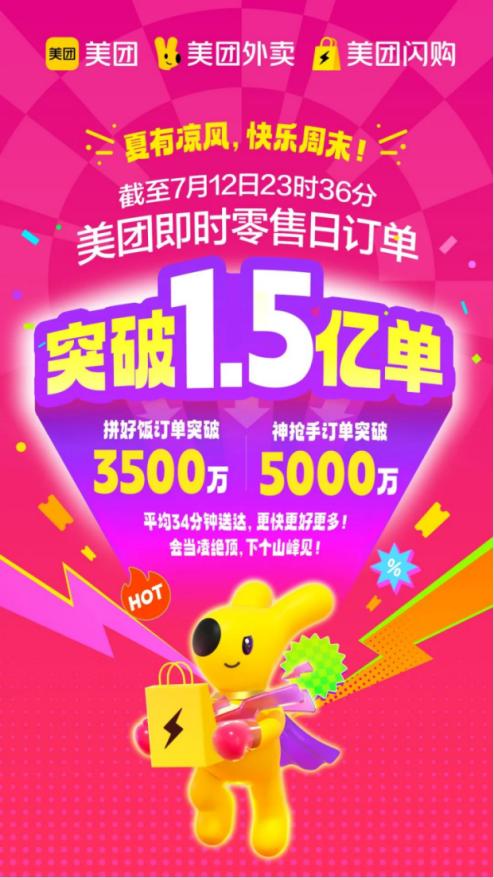
Core Insights - The competition between Meituan and Taobao Flash has intensified, with Meituan reporting a daily order volume of 150 million, a significant increase from 120 million, while Taobao Flash stabilized at 80 million orders, emphasizing that its figures do not include self-pickup or zero-cost purchases [4][11][21] - The analysis suggests that both platforms have reached a similar operational level, as the quality and structure of the order data must be considered alongside the raw numbers [4][11] Group 1: Meituan's Order Volume - Meituan's reported 150 million daily orders include a significant portion of self-pickup and zero-cost orders, which may not reflect true consumer demand [11][12] - The structure of Meituan's orders shows that 50 million came from promotional activities, with a substantial number likely being self-pickup orders [11][15] - The average monthly income for Meituan's delivery riders is reported at 9,793 yuan, which is lower than Taobao Flash's 12,500 yuan, indicating a potential discrepancy in effective order volume between the two platforms [15] Group 2: Taobao Flash's Strategies - Taobao Flash has employed various strategic maneuvers, such as "surrounding the enemy" and "taking advantage of the fire," to capture market share from Meituan [17][18] - The platform's initial launch included significant subsidies that diverted 15% of Meituan's daily orders, showcasing its effective market penetration strategy [17] - Recent tactics include creating a facade of aggressive competition while maintaining a steady approach to subsidies, leading competitors to overextend their resources [18][19] Group 3: Market Dynamics - The current market dynamics suggest a 1:1 competitive stance between Meituan and Taobao Flash, with both platforms vying for consumer attention through aggressive promotional strategies [16][20] - The long-term sustainability of these strategies is uncertain, as Meituan's established market presence poses a significant challenge for Taobao Flash [20] - The focus on short-term order volume through aggressive subsidies may detract from the overall consumer experience, raising concerns about the long-term viability of such strategies [21]

专家解读“外卖大战”
2025-07-07 16:32
Summary of Conference Call Records Industry Overview - The records primarily discuss the **food delivery and instant retail industry** in China, focusing on major players like **Alibaba's Taobao Flash Sale** and **Ele.me** [1][4][24]. Key Points and Arguments Market Dynamics - **Taobao Flash Sale** has significantly increased its Daily Active Users (DAU) from approximately 100 million to nearly 200 million within two months, leading to a substantial rise in order volume and Gross Merchandise Volume (GMV) [1][3][21]. - **Ele.me** holds a market share of over 50% in Shanghai and around 45% in Hangzhou, with a focus on expanding in lower-tier cities where market penetration is currently between 20% to 30% [1][13]. Financial Strategies - The platform plans to invest **500 billion yuan** in subsidies over the next 12 months, with the majority allocated to user incentives (400 billion yuan) to stabilize daily order volumes [1][8]. - As of July 2025, Ele.me's average loss per order increased from **4.6 yuan** to **6 yuan** due to heightened subsidy efforts, with a target to reduce losses to just over **2 yuan** by the end of the year [1][22][18]. Competitive Landscape - The total daily order volume for Taobao Flash Sale and Ele.me has surpassed **80 million**, with food orders accounting for **64.25 million** and non-food orders for **15.85 million** [2]. - **Meituan** has a peak order volume of **120 million**, but many are promotional orders, indicating a need for improved effective order growth [4][28]. Product Categories and Trends - The fastest-growing categories on Taobao Flash Sale include **milk tea, coffee, and fast food**, with significant growth also seen in supermarkets, fresh fruits, and apparel [1][15]. - The average commission for food orders on Ele.me is **25.7 yuan**, while non-food orders average **51.4 yuan** [6]. User Engagement and Retention - The introduction of Taobao Flash Sale has led to a **1.1 billion increase** in DAU and a **5-minute increase** in average user engagement time [1][21]. - The platform aims to maintain a daily order volume of at least **7.5 million** while managing subsidy costs effectively [18][19]. Future Outlook - The industry is expected to stabilize by **September to October 2025**, with market shares projected at **45% for Meituan**, **40% for Ele.me**, and **10% for JD.com** [35]. - The competitive landscape remains intense, with companies needing to balance subsidy strategies while ensuring sustainable growth [36][37]. Additional Important Insights - The internal restructuring of Alibaba aims to create a super app model centered around Taobao, integrating various services to enhance user experience and operational efficiency [24]. - The sensitivity of users to subsidy changes, particularly in the milk tea and coffee segments, poses a risk for user retention if subsidies are reduced [19]. - The records highlight the importance of strategic partnerships and user incentives in driving growth and maintaining market share in a competitive environment [4][24].
史诗级外卖大战,刚刚打响!
华尔街见闻· 2025-07-06 12:16
Core Viewpoint - The article discusses the intense competition in the instant retail and food delivery market among Alibaba, Meituan, and JD.com, highlighting significant financial investments and strategic maneuvers by these companies to capture market share and user engagement [6][10][14]. Group 1: Competitive Landscape - On July 5, Alibaba and Meituan engaged in a fierce price war, offering substantial discounts and coupons to attract users, leading to a surge in orders on both platforms [1][3]. - Meituan reported over 1.2 billion orders on July 5, with more than 1 billion being food delivery orders, indicating the high demand generated by the promotions [3]. - Alibaba announced a 500 billion yuan subsidy for its Taobao Flash Purchase service, aiming to disrupt Meituan's dominance in the food delivery sector [4][10]. Group 2: Financial Implications - Goldman Sachs predicts that the competition will pressure short-term profitability, estimating losses of 410 billion yuan for Alibaba's food delivery business and 260 billion yuan for JD.com, while Meituan's EBIT profit may decline by 250 billion yuan [12][14]. - The three companies are expected to invest a total of over 1 trillion yuan in this competitive landscape, with the goal of reshaping market dynamics and expanding into instant retail [14][32]. Group 3: Strategic Moves - Meituan has shifted its focus to instant retail, announcing a strategic adjustment to enhance its "Little Elephant Supermarket" initiative while scaling back on community group buying [21][23]. - Alibaba's integration of Ele.me into the Taotian Group signifies a broader strategy that extends beyond food delivery to encompass instant retail [19][17]. - JD.com is preparing to launch a new business model in the food delivery sector, aiming to differentiate itself from Meituan [27]. Group 4: Market Dynamics - The competition is characterized as a long-term war, with the potential for significant shifts in market share among the three giants [26][29]. - The article emphasizes the importance of user engagement and the battle for daily active users (DAU) as critical factors in determining the outcome of this competition [31][32]. - The potential outcomes of the competition include scenarios where Meituan maintains its market share, Alibaba gains significant ground, or JD.com captures a notable portion of the market [33][34][35].