家政服务等

Search documents
常德市落雪电器有限公司成立 注册资本30万人民币
Sou Hu Cai Jing· 2025-09-06 04:14
Core Insights - Changde Luoxue Electric Appliance Co., Ltd. has been established with a registered capital of 300,000 RMB [1] - The company is engaged in a wide range of retail and wholesale activities, including daily household appliances, office supplies, and medical equipment [1] Company Overview - The legal representative of the company is Luo Xuezhi [1] - The business scope includes retail and wholesale of daily necessities, kitchenware, stationery, hardware products, and various electrical equipment [1] Industry Activities - The company is involved in the sale of health food (pre-packaged), food (only pre-packaged), and home audio-visual equipment [1] - It also provides services such as professional cleaning, disinfection, and domestic services [1]
山东服务业“新政”3大方向帮企业找机遇得实惠
Da Zhong Ri Bao· 2025-09-06 00:46
Core Viewpoint - The service industry is a key driver for Shandong's economy, with its value-added expected to account for 53.1% of the province's GDP in 2024, and a growth rate of 5.8% in the first half of this year, surpassing overall GDP growth [1] Group 1: Measures to Support Service Industry - Shandong has introduced 42 measures to support the service industry, focusing on solving problems for enterprises and expanding market opportunities [1] - Key sectors such as wholesale and retail, transportation, finance, and real estate, which account for 54.7% of service industry value-added, are prioritized for support to stabilize operations and enhance growth [2] - The government will streamline support for large enterprises in key sectors, allowing them to directly connect with provincial authorities for assistance [2] Group 2: High-End Productive Services Development - The focus is on enhancing the quality of service development, particularly in high-end productive services like AI, industrial internet, and technology services [4] - Financial support includes a new budget of 100 million yuan for high-growth enterprises, with individual project subsidies up to 200,000 yuan [4] - The initiative aims to attract international consulting firms and enhance competitiveness in sectors like AI and big data [5] Group 3: Consumer Market Activation - The measures aim to boost consumer confidence and demand, enhancing service quality and profitability for businesses [6] - In the cultural tourism sector, Shandong has seen significant growth, with 410 million visitors and tourism revenue exceeding 500 billion yuan, both achieving nearly 10% growth [7] - Upcoming initiatives will focus on expanding tourism offerings and enhancing consumer experiences through various events and activities [7] Group 4: Improving Quality of Life - The measures include initiatives to enhance elderly care and childcare services, tapping into the potential of these sectors [8] - The government aims to increase the number of registered home service companies to over 850 by the end of the year, promoting a credit system for the industry [8] - Seasonal activities will be organized to stimulate demand in health and home service sectors, contributing to overall service consumption growth [8]
经济日报:培育服务消费新增长点丨做好下半年经济工作
Jing Ji Ri Bao· 2025-08-18 08:07
Core Viewpoint - The recent Central Political Bureau meeting emphasized the importance of implementing special actions to boost consumption, particularly focusing on cultivating new growth points in service consumption, which is seen as a key driver for expanding domestic demand [1] Group 1: Service Consumption Growth - Service retail sales in the first half of the year increased by 5.3% year-on-year, outpacing the growth rate of goods retail sales by 0.2 percentage points [2] - Per capita service consumption expenditure rose by 4.9% year-on-year, accounting for 45.5% of total per capita consumption expenditure [2] - The service sector's value added accounted for 59.1% of GDP, contributing over 60% to GDP growth, indicating strong support for high-quality economic development [2] Group 2: Policy and Market Environment - The government is focusing on service consumption as a primary tool for expanding domestic demand, with measures to enrich supply, expand consumption scenarios, and optimize the consumption environment [2][3] - Continuous policy optimization is creating a favorable market atmosphere for service consumption, with various differentiated consumption stimulation plans being implemented [3] Group 3: Integration of Consumption Scenarios - The Ministry of Commerce has launched the "Service Consumption Season" initiative for 2025, promoting the integration of travel, culture, sports, and health [4] - Experts suggest that integrating consumption scenarios is crucial for cultivating new growth points in service consumption, emphasizing the need for diverse, personalized, and interactive service offerings [4] Group 4: Digital Empowerment and Financial Support - The use of modern information technologies like the internet and big data is enhancing service production efficiency and upgrading service consumption [5] - The People's Bank of China and other departments have issued guidelines to increase credit support for key areas of service consumption, promoting personalized financial products [5] Group 5: Quality Supply and Market Competition - Despite the vast market for service consumption, challenges such as insufficient quality supply and a non-optimally competitive environment exist [7][8] - Experts advocate for policies that enhance market access for private and foreign enterprises, stimulate competition, and support the development of high-standard service providers [8]
68.8%!内需扛鼎中国经济“半年报”,消费潜力持续释放
Sou Hu Cai Jing· 2025-07-20 12:28
Group 1 - Domestic demand, especially consumption, is the main driver of GDP growth, contributing 68.8% to GDP growth in the first half of 2025, with final consumption expenditure contributing 52% [1] - The contribution of final consumption expenditure to economic growth in Q2 was 52.3%, showing a slight increase from Q1 [1] - Policies aimed at boosting consumption have been frequently introduced this year, leading to a sustained increase in the consumption market's activity [1][10] Group 2 - Cultural and tourism consumption has shown significant growth, with service retail sales increasing by 5.3% year-on-year in the first half of the year [2][4] - The "Special Action Plan for Boosting Consumption" emphasizes the importance of enhancing service consumption quality and promoting various integrated consumption scenarios [4] - The "old-for-new" policy for consumer goods has significantly boosted sales, with a reported 1.1 trillion yuan in sales driven by this initiative by May 31, 2025 [5] Group 3 - The government plans to continue supporting consumption, with 50% of the annual budget for "old-for-new" subsidies already utilized, and additional funds to be released in the second half of the year [6] - The average disposable income per capita in China reached 21,840 yuan in the first half of 2025, with a nominal growth of 5.3% [7] - The focus on increasing residents' income and improving the consumption environment is crucial for sustainable consumption growth [7][8] Group 4 - The second half of 2025 is expected to see continued support for consumption growth, driven by effective policies and the release of service consumption potential [10][12] - Recent local government initiatives have targeted service consumption, aiming to enhance cultural, tourism, and sports consumption [12] - Financial support for consumption is being strengthened, with new guidelines aimed at enhancing residents' consumption capacity and expanding financial supply [14] Group 5 - International financial institutions have raised their economic growth forecasts for China, citing the positive effects of recent policies and the significant growth potential in technology and consumption sectors [15]


广东筹划举办内贸版“广交会”
Guang Zhou Ri Bao· 2025-06-25 02:17
Core Viewpoint - The article discusses the "Guangdong Province Economic Promotion Plan" aimed at enhancing domestic circulation and stabilizing the economy through various measures and initiatives [4]. Group 1: Economic Measures - The plan includes hosting a domestic version of the "Canton Fair" using a market-oriented exhibition model and supporting e-commerce companies to establish export-to-domestic sales zones [2][5]. - It emphasizes the importance of stabilizing employment, supporting enterprises, and maintaining market expectations to promote continuous economic improvement [4][6]. Group 2: Employment Initiatives - The plan aims to provide no less than 10,000 research assistant positions by 2025, focusing on stabilizing existing jobs and expanding employment opportunities [3][6]. - Specific measures include social insurance subsidies and one-time expansion subsidies for businesses hiring recent graduates and unemployed youth [6]. Group 3: Consumer Promotion - The plan proposes actions to boost consumption, including promoting trade-in programs for automobiles and home appliances, and optimizing vehicle purchase regulations in Guangzhou and Shenzhen [8]. - It also aims to enhance inbound consumption through improved customs and payment services, alongside the construction of duty-free shops in major cities by the third quarter of 2025 [8]. Group 4: Innovation and Investment - The plan encourages private investment and the implementation of major technology projects, aiming to integrate technological and industrial innovation [9]. - It includes establishing mechanisms for sharing major scientific infrastructure with enterprises and promoting the development of the nuclear medical industry [9].
黑龙江:加力岗位挖潜扩容支持重点群体就业创业
Zhong Guo Chan Ye Jing Ji Xin Xi Wang· 2025-05-21 06:32
Core Viewpoint - The Heilongjiang Provincial Employment Promotion and Labor Protection Working Group has issued a plan to enhance employment support, focusing on key groups such as college graduates, impoverished populations, migrant workers, veterans, and people with disabilities, through three main initiatives: employment support, stabilization and expansion of job positions, and entrepreneurship promotion [1]. Group 1: Employment Support Plan - The plan aims to tap into the employment potential of advanced manufacturing and other new productive forces by implementing a new round of ten key industry growth strategies [2]. - It seeks to transform new consumption hotspots into new employment channels, promoting the development of the ice and snow industry and related tourism [2]. - The plan emphasizes the importance of major engineering projects to increase employment opportunities, leveraging national policies for infrastructure development [2]. - It focuses on enhancing essential public services to promote employment, including the development of elderly care services and healthcare infrastructure [2]. - The plan aims to expand service opportunities for laborers in urban and rural areas by creating community-based job positions and supporting legal aid volunteer services [2]. Group 2: Stabilizing Job Positions for Enterprises - The plan encourages state-owned enterprises to lead in job absorption and stabilize recruitment scales while providing support for private enterprises [4]. - It includes measures to reduce burdens on businesses, such as lowering unemployment insurance rates and improving access to financial support for small and medium-sized enterprises [4]. - The plan promotes timely implementation of tax incentives and employment subsidies to encourage employers to hire more workers [4]. - It emphasizes improving employment services by enhancing job posting systems and establishing local employment service stations [4]. - The plan advocates for large-scale vocational skills training to align with industry needs and promote a comprehensive training model [4]. Group 3: Entrepreneurship Promotion Plan - The plan promotes the "Chuangxiang Longjiang" initiative, which aims to create a supportive ecosystem for entrepreneurship through training, services, and incubation [7]. - It seeks to streamline the entrepreneurial process by enhancing inter-departmental collaboration and providing integrated services for entrepreneurs [7]. - The plan focuses on improving the quality of incubation services and ensuring that local governments provide support for key groups in entrepreneurship [7]. - It aims to facilitate entrepreneurship financing by implementing favorable policies and optimizing loan processes for startups [7].

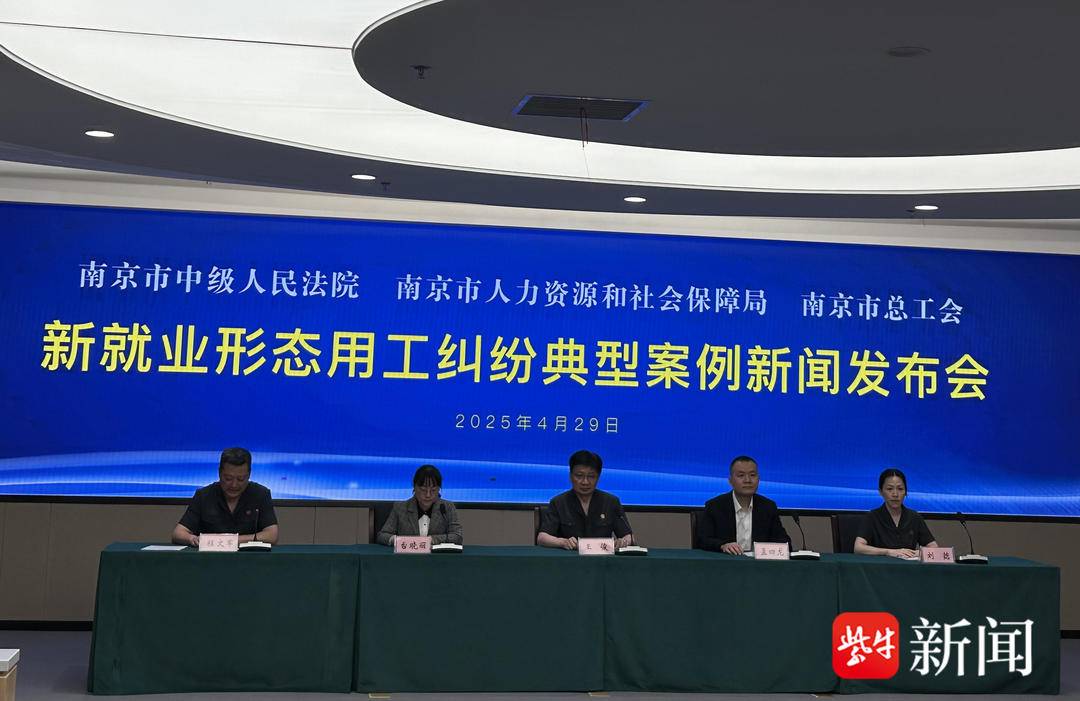
网约车、外卖、主播、快递占新业态用工纠纷七成,南京“三部门”协作促健康发展
Yang Zi Wan Bao Wang· 2025-04-29 10:42
Core Viewpoint - The Nanjing Intermediate People's Court, along with the Human Resources and Social Security Bureau and the Federation of Trade Unions, has reported on the increasing number of labor disputes in the new employment sector, aiming to promote healthy and sustainable development in this industry [1][3]. Group 1: Overview of Labor Disputes - From 2021 to 2024, the number of labor disputes in Nanjing's new employment sector has shown a year-on-year increase, with significant involvement from industries such as ride-hailing, food delivery, express delivery, online streaming, logistics, housekeeping, automotive services, and agricultural sales [3]. - The ride-hailing, food delivery, online streaming, and express delivery sectors account for over 70% of the total disputes, indicating a concentration of issues within these industries [3]. - The trend of "de-labor relationship" is evident, with a separation between recruitment and employment, as well as between work management and salary payment, complicating the legal landscape for workers [3]. Group 2: Typical Cases - **Case 1**: A group of 48 ride-hailing drivers successfully claimed over 340,000 yuan in compensation after their labor contracts were terminated due to a new performance evaluation system that aimed to change their employment status [4]. - **Case 2**: A housekeeper's claim for labor relationship recognition was upheld despite signing an "information service agreement," as the court found that the company exercised significant control over her work [5]. - **Case 3**: A network anchor was awarded overtime pay after the court recognized the fragmented nature of her work hours, emphasizing the need to consider work patterns in such cases [6]. - **Case 4**: A delivery worker's salary deductions were deemed illegal as the company failed to provide evidence justifying the penalties, reinforcing the requirement for employers to substantiate any wage deductions [7][8]. - **Case 5**: A network anchor was ordered to pay over 34,000 yuan in damages for breaching a contract with an MCN agency, highlighting the legal implications of contractual agreements in the absence of a labor relationship [9].