海洋船舶

Search documents
今年前三季度我国海洋经济同比增长5.6%
Zhong Guo Zi Ran Zi Yuan Bao· 2025-11-04 01:25
Group 1: Overall Performance - The marine economy in China showed a stable and progressive trend in the first three quarters of the year, with a marine GDP of 7.9 trillion yuan, representing a year-on-year growth of 5.6% [1] Group 2: Resource Supply and Traditional Industries - The supply level of marine resources has steadily improved, with a total approved marine and island area of 262,000 hectares, an increase of 19.2% year-on-year, involving an investment of 641.9 billion yuan [1] - Marine oil and natural gas production increased by 3.0% and 17.7% year-on-year, respectively, while offshore wind power added grid capacity grew by 42.1% [1] - The marine traditional industries are developing positively, with new shipbuilding orders, completed orders, and hand-held orders maintaining a global leading position [1] - The marine transportation industry is steadily developing, with marine freight volume and cargo turnover increasing by 5.7% and 6.2% year-on-year, respectively, and total marine import and export volume growing by 1.7%, with exports up by 6.5% [1] - The marine tourism industry is recovering, with added value increasing by 7.0% year-on-year, and passenger volume and turnover increasing by 3.0% and 3.8%, respectively; cruise tourism saw a significant rise, with 2.05 million passengers received at national cruise ports, a year-on-year increase of 28% [1] Group 3: Emerging Industries - Emerging marine industries are accelerating development, with marine engineering equipment deliveries and hand-held order amounts increasing by 13.6% and 7.0% year-on-year, respectively [2] - Marine pharmaceutical research is progressing, with the clinical trial approval of LY104 injection, which has independent intellectual property rights [2] - The marine information service industry is being rapidly cultivated, with the launch of the first trusted data space in the marine field in Zhejiang and the release of "AI + Marine" application scenarios in Shenzhen [2] - The marine financial market is showing positive signals, with 18 marine-related companies completing IPOs, raising a total of 26 billion yuan, accounting for 33.7% of the total IPO financing scale [2]
城市24小时 | 中部非省会第一城之争 洛阳“扳回一城”
Mei Ri Jing Ji Xin Wen· 2025-11-03 15:59
Economic Performance - Xiangyang's GDP for the first three quarters reached 435.546 billion yuan, with a year-on-year growth of 4.0%, which is 1.2 percentage points lower than the national average [1][2] - In comparison, Luoyang's GDP was 445.49 billion yuan, growing by 5.8%, and Yichang's GDP was 455.328 billion yuan, with a growth rate of 7.0%, both surpassing Xiangyang [1][2] Industry Structure and Competition - The industrial structure of Xiangyang is 9.2:41.4:49.4, indicating a significant reliance on the secondary and tertiary sectors [1] - The competition for the title of "first non-provincial city" in Central China has intensified, with Yichang and Xiangyang vying for the top position after surpassing Luoyang [1] Future Projections - By 2024, both Yichang and Xiangyang are expected to exceed 600 billion yuan in GDP, with Yichang projected to lead at 619.112 billion yuan, followed by Xiangyang at 610.241 billion yuan [1] - Experts suggest that Xiangyang's automotive industry, which has historically driven its economy, may hinder growth unless it successfully transitions to new industries [2] Industrial Growth in Luoyang - Luoyang's industrial output value for the first nine months increased by 8.9%, with high-tech manufacturing growing by 75.7% [3] - The establishment of CATL's new energy technology company in Luoyang is expected to significantly boost the local economy, with an anticipated annual output value exceeding 200 billion yuan [3]
前三季度海洋生产总值同比增5.6%,海洋原油、天然气产量双增
2 1 Shi Ji Jing Ji Bao Dao· 2025-11-03 14:22
Core Insights - The marine economy in China achieved a production value of 7.9 trillion yuan in the first three quarters, growing by 5.6% year-on-year, which is 0.4 percentage points higher than the GDP growth rate [1] Marine Resource Supply - The approved marine and island area reached 262,000 hectares, a year-on-year increase of 19.2%, with investments exceeding 641.9 billion yuan [1] - Significant breakthroughs in oil and gas exploration were reported, including a 211-meter oil and gas layer in the Weizhou 10-5 South oil field and high-yield oil and gas wells in the Bohai Bay Basin [1] - Marine oil and gas production saw increases of 3.0% for crude oil and 17.7% for natural gas in the first three quarters [1] Marine Renewable Energy - Offshore wind power generation increased by 3.7%, with new grid-connected capacity rising by 42.1% [2] - Major offshore wind projects, such as the Jiangsu Dafeng (800 MW) and the Jinshan Offshore Wind Farm (306 MW), achieved significant milestones in grid connection [2] Traditional Marine Industries - The shipbuilding industry showed stable growth, with completed ship volumes and hand-held orders increasing by 6.7% and 25.7% respectively [2] - The marine transportation sector experienced growth in cargo volume (5.7%) and cargo turnover (6.2%), with total maritime import and export value rising by 1.7% [2] Marine Tourism - The marine tourism sector saw a value-added increase of 7.0%, with passenger transport volume and turnover rising by 3.0% and 3.8% respectively [2] - Cruise tourism gained popularity, with a 17% increase in cruise ship arrivals and a 28% increase in total passengers [2] Emerging Marine Industries - The marine engineering equipment manufacturing sector maintained a strong position, with new orders, delivered orders, and hand-held orders accounting for 60.0%, 50.8%, and 61.9% of the international market share respectively [3] - Progress was made in marine pharmaceuticals, with the approval of LY104 injection for clinical trials, marking a significant development in marine small molecule drugs [3] - The resilience of marine foreign trade was evident, with a 1.7% increase in maritime import and export value, and notable growth in exports of wind turbine generators and ships by 23.9% and 22.4% respectively [3]
前三季度中国海洋生产总值7.9万亿元 同比增长5.6%
Zhong Guo Xin Wen Wang· 2025-11-03 11:20
Core Insights - China's marine economy showed a stable and progressive trend in the first three quarters of the year, with a marine GDP of 7.9 trillion yuan, reflecting a year-on-year growth of 5.6% [1][2] Group 1: Economic Performance - The marine GDP reached 7.9 trillion yuan, marking a 5.6% increase compared to the previous year [1] - Coastal regions and marine-related sectors effectively implemented macro policies, fostering a positive development atmosphere in the marine industry [1] - The supply of marine resources has steadily improved, with the approved area for marine and island use increasing by 19.2% to 262,000 hectares, involving an investment of 641.9 billion yuan [1] Group 2: Industry Development - New offshore wind power capacity increased by 42.1% year-on-year [1] - The production of marine aquatic products rose by 4.8% [1] - Emerging marine industries, such as marine pharmaceuticals and marine information services, are accelerating their development [1] Group 3: Traditional Industries and Trade - Traditional marine industries are performing well, with shipbuilding orders and completion rates maintaining a global lead [1] - The marine tourism sector is experiencing a sustained recovery [1] Group 4: Future Outlook - The Ministry of Natural Resources highlighted the need for accelerated marine technological innovation and industrial upgrades to achieve high-quality development in the marine economy [2]
前三季度海洋生产总值7.9万亿元,同比增长5.6%
Ren Min Ri Bao· 2025-11-03 07:07
Group 1 - The marine economy showed a steady and positive trend in the first three quarters, with a marine GDP of 7.9 trillion yuan, a year-on-year increase of 5.6% [1] - The supply level of marine resources has steadily increased, with a total approved marine and island area of 262,000 hectares, a year-on-year growth of 19.2%, involving an investment of 641.9 billion yuan [1] - The production of marine crude oil and natural gas increased by 3.0% and 17.7% year-on-year, respectively, while the new installed capacity of offshore wind power grew by 42.1% [1] - The output of marine aquatic products increased by 4.8% year-on-year [1] Group 2 - Traditional marine industries are developing positively, with marine shipping orders, completed orders, and hand-held orders continuing to lead globally [1] - The marine transportation industry is steadily developing, with marine freight volume and cargo turnover increasing by 5.7% and 6.2% year-on-year, respectively [1] - The total import and export volume of marine shipping increased by 1.7% year-on-year, with export volume rising by 6.5% [1] - The marine tourism industry is recovering, with an increase in value added of 7.0% year-on-year, and marine passenger volume and turnover increasing by 3.0% and 3.8%, respectively [1] - The number of passengers received at national cruise ports reached 2.05 million, a year-on-year increase of 28% [1] Group 3 - Emerging marine industries are accelerating development, with marine engineering equipment delivery and hand-held order amounts increasing by 13.6% and 7.0% year-on-year, respectively [2] - The research and development of marine pharmaceuticals is progressing, with the clinical trial approval of LY104 injection, which has independent intellectual property rights [2] - The marine information service industry is being cultivated, with the first trusted data space in the marine field launched in Zhejiang [2] - The "AI + Marine" industry application scenarios were released in Shenzhen, and a self-developed intelligent welding robot for marine engineering completed integration and testing in Tianjin [2] - The marine financial market is showing positive signals, with 18 marine-related companies completing IPOs, raising a total of 26 billion yuan, accounting for 33.7% of the total IPO financing scale [2]
青岛海洋装备创新发展联盟成立
Zhong Guo Zi Ran Zi Yuan Bao· 2025-09-04 02:37
Core Insights - The establishment of the Qingdao Marine Equipment Innovation Development Alliance aims to promote high-quality development in the marine equipment industry through collaboration among enterprises, universities, research institutions, and financial organizations [1][3] - The Qingdao Marine Science and Technology Innovation Center was inaugurated during the conference, focusing on technology docking, project incubation, investment fund operations, and marine technology research and development [2] Group 1: Alliance Formation and Objectives - The alliance consists of 151 initial member units, including marine shipbuilding, offshore engineering equipment, research institutions, and financial services [1] - The alliance seeks to create an open, collaborative, and efficient innovation cooperation platform, integrating innovation chains, industrial chains, financial chains, and talent chains [1] Group 2: Conference Activities and Outcomes - The conference featured a multi-dimensional docking mechanism with a main venue, parallel closed-door meetings, and project roadshows, focusing on marine vessels, offshore engineering equipment, and deep-sea aquaculture equipment [2] - Eight quality projects were showcased during the technology achievement roadshow, attracting interest from over 30 enterprises and investment institutions, resulting in more than ten cooperation intentions [2]
国泰海通|宏观:前瞻“十五五”:预期目标与产业机遇
国泰海通证券研究· 2025-08-24 13:35
Core Insights - The "14th Five-Year Plan" focuses on expanding consumption, new productive forces, common prosperity, deepening reforms, and green transformation, with an emphasis on emerging future industries, services, marine and green low-carbon sectors, and potential beneficiaries such as private tech firms and state-owned enterprises in emerging industries [1] Summary by Sections Economic Growth and Innovation - The GDP annual growth target for the "14th Five-Year Plan" period is expected to be set between 4.5% and 5.0%, with a bottom line of over 4.5% to ensure the successful completion of the 2035 long-term goals [2] - The innovation-driven target for the "14th Five-Year Plan" is anticipated to be significantly higher than that of the "13th Five-Year Plan," emphasizing the national innovation system and the vitality of various innovation entities and talent support [2] Common Prosperity and Reforms - The plan aims to enhance the well-being of citizens by adding new targets related to housing, healthcare, elderly care, and childcare, with a focus on investing more resources in human capital and public services [3] - Over 300 reform measures from the 20th National Congress are expected to be key focuses of the "14th Five-Year Plan," targeting the reduction of logistics costs and promoting a unified national market [4] Green Transformation - The green low-carbon goals may include a primary focus on controlling carbon emission intensity, with supplementary total control measures, aiming to reduce carbon emissions per unit of GDP [5] - The plan aims to achieve carbon peak by 2030, with clear frameworks for the development goals of energy-saving and environmental protection industries, new energy, and low-carbon transportation [9] Industry Opportunities - Emerging and future industries such as electronic information manufacturing, humanoid robots, and brain-computer interfaces are expected to see rapid market penetration and technological breakthroughs [6] - There is significant potential for growth in service consumption sectors like retail, healthcare, elderly care, telecommunications, and internet services, as well as in productive service industries like science and technology, finance, and information services [7] - The marine industry, particularly in marine tourism, transportation, shipbuilding, electricity, and biomedicine, is projected to accelerate due to favorable policies and market conditions [8]


前瞻“十五五”:预期目标与产业机遇
Haitong Securities International· 2025-08-24 09:13
Economic Growth and Policy Goals - The GDP annual growth target for the "15th Five-Year Plan" is set between 4.5% and 5.0%, with a minimum of 4.5% to ensure the 2035 vision is achieved[2]. - The focus on developing new productive forces will see a significant increase in innovation-driven targets compared to the "14th Five-Year Plan"[2]. - The plan aims to enhance living standards with new targets in housing, healthcare, and elderly care, emphasizing investment in human resources[2]. Reform and Green Transition - Over 300 reform measures from the 20th Central Committee will be prioritized in the "15th Five-Year Plan," focusing on comprehensive reforms[2]. - The green transition will shift from energy consumption control to carbon emission control, aiming for a 65% reduction in carbon intensity by 2030 compared to 2005 levels[19]. Industry Opportunities - Emerging industries such as electronic information manufacturing and humanoid robots are expected to see rapid market penetration and technological breakthroughs[3]. - The service sector, including retail, healthcare, and telecommunications, has significant growth potential, driven by rising consumer demand[3]. - The marine economy, particularly in tourism and transportation, is projected to grow rapidly, with a focus on policy support[3]. Risks and Challenges - There are risks related to misinterpretation of policies and unexpected changes in domestic and international macroeconomic conditions[39].
中国海洋经济十万亿时代,广东2万亿领跑
2 1 Shi Ji Jing Ji Bao Dao· 2025-08-20 14:13
Core Insights - The National Development and Reform Commission of China is working on the "14th Five-Year" marine economic development plan, aiming to break through key core technologies in the marine sector, marking a new chapter in building a marine power [3] - In 2024, China's marine GDP is expected to exceed 10 trillion yuan, growing at a rate 0.9 percentage points higher than the overall GDP, with international shipping accounting for about one-third of the global total [3][7] - Guangdong province is projected to be the first in the country to surpass 2 trillion yuan in marine GDP, followed by Shandong, Fujian, Zhejiang, Shanghai, and Jiangsu, which are also significant marine economies [7][8] Marine Economic Development - Guangdong has established a Marine Strong Province Committee, aiming for innovation in mechanisms and systems to enhance marine economic growth [4] - The marine economy in Guangdong has maintained its position as the largest in the country for 30 consecutive years, with a marine GDP share of 14.1% in 2024 [6][8] - The marine economy's scale in the top three provinces accounts for half of the national total, showcasing distinct development characteristics and advantages [8] Key Statistics - In 2024, the marine GDP of China is projected to reach 10.54 trillion yuan, with Guangdong contributing significantly [5][7] - Guangdong's marine industry added value is expected to be 739.51 billion yuan in 2024, with a nominal growth rate of 7.4% [10] - The marine tourism sector is projected to see a decline of 110.01% in 2024, while other sectors like marine engineering and marine power are expected to grow [10][11] Emerging Industries - Guangdong has over 80,000 marine-related enterprises, with a stable growth of high-tech marine enterprises, contributing to the province's new productive forces in the marine economy [13] - The offshore wind power capacity in Guangdong is expected to exceed 12 million kilowatts in 2024, leading to double-digit growth in the marine power sector [14] - Significant advancements in deep-sea technology include the launch of the "Dream" deep-sea drilling vessel and the construction of the world's first deep-sea ecological system research facility [15][17]

城市24小时 | 发力下半年 湖北再提这条“黄金水道”
Mei Ri Jing Ji Xin Wen· 2025-08-05 15:54
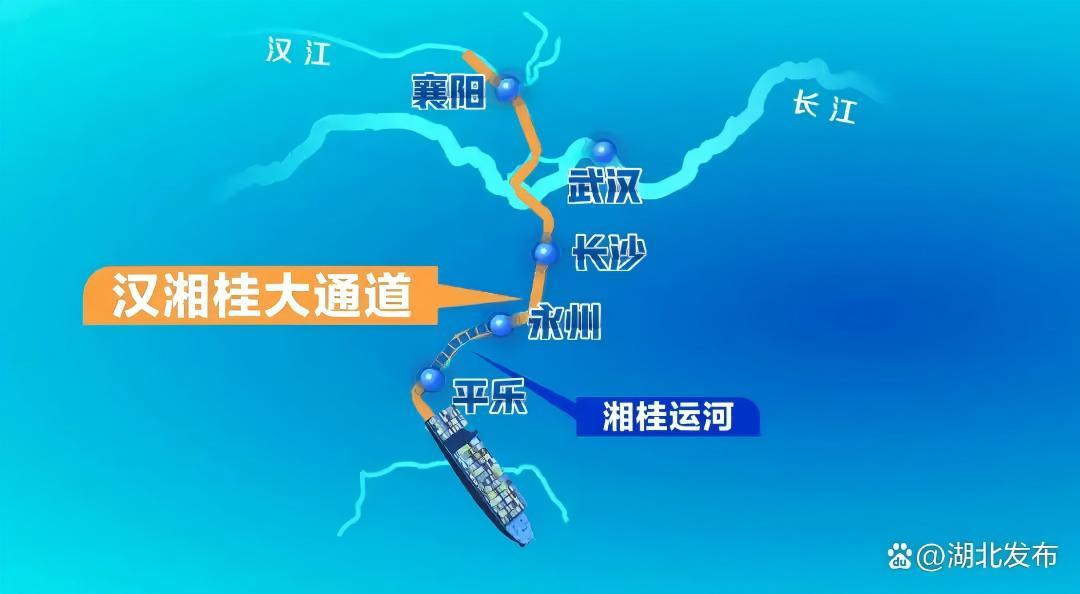
Core Insights - Hubei Province has completed a transportation investment of 104.16 billion yuan in the first half of the year, achieving 51.9% of its annual target, with a year-on-year growth of 1.8% [1] - The province aims for a total transportation investment of 200 billion yuan, striving for 220 billion yuan by the end of the year, focusing on major transportation projects [1][2] - The Han-Xiang-Gui inland waterway corridor, approximately 3,200 kilometers long, is a key project that will enhance connectivity between major river systems in China [2][3] Investment and Development Goals - Hubei's transportation investment in the first half of the year ranks third nationally and first in Central China [1] - The province plans to enhance its logistics efficiency through multi-modal transport and digital transformation, aiming to reduce costs and improve quality [1][2] - The Han-Xiang-Gui corridor will facilitate low-cost water transport to coastal ports, benefiting the central and western regions [2] Project Progress and Future Plans - The feasibility study for the Hanjiang Qianpan Mountain to Xinglong section of the waterway has been approved, marking progress in the Han-Xiang-Gui corridor project [3] - Hubei plans to start construction on key projects this year, targeting a fixed asset investment of 10 billion yuan and increasing port throughput capacity by 20 million tons [3]