渔业等

Search documents
投资结构持续优化,稳投资政策密集加力|数读“十四五”
Di Yi Cai Jing· 2026-01-22 12:17
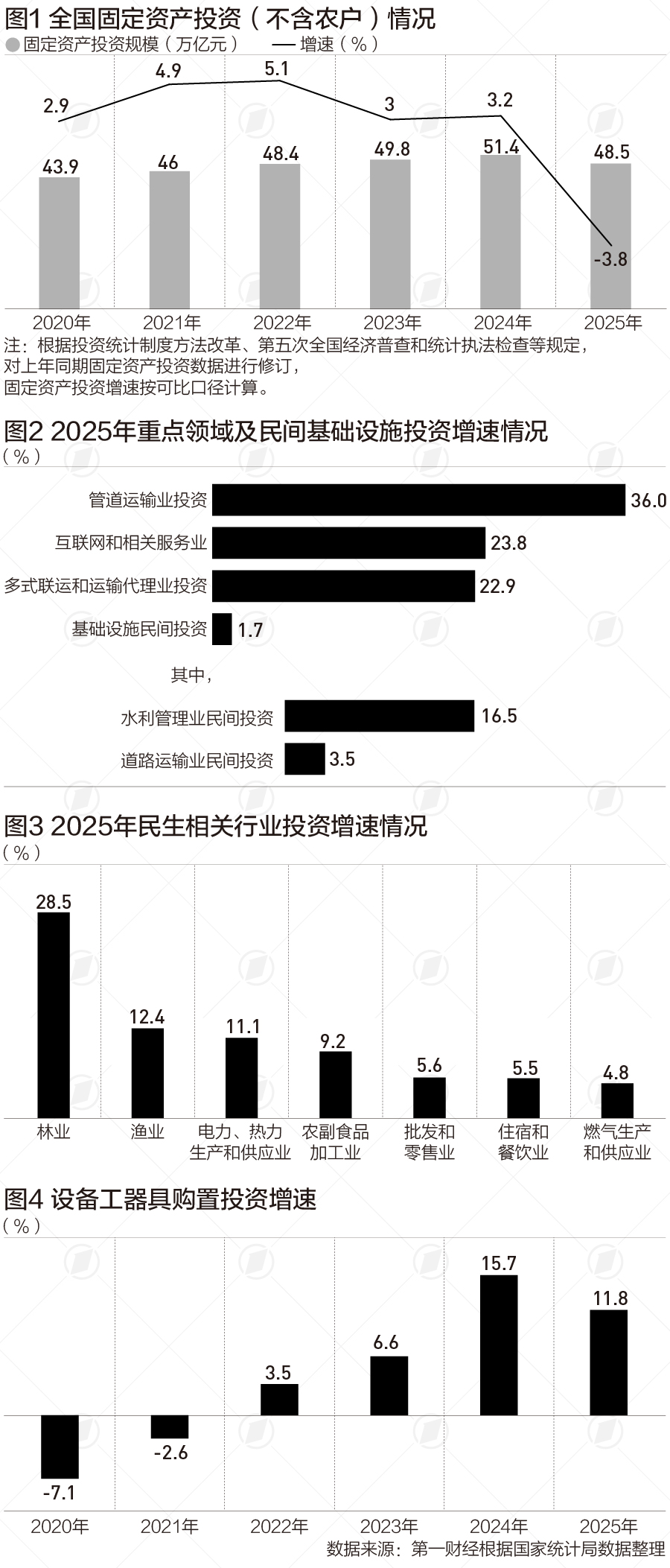
Core Viewpoint - The Chinese government is intensifying efforts to stabilize investment and promote growth through various policies and financial tools, particularly focusing on supporting private investment and optimizing investment structures [1][2][17]. Investment Policy and Measures - The State Council has implemented a package of policies to stimulate domestic demand, including interest subsidies for small and micro enterprises and special guarantee plans for private investment [1][17]. - A total of 936 billion yuan in special long-term bonds has been allocated to support approximately 4,500 projects in industrial and energy sectors, leading to a total investment exceeding 4.6 trillion yuan [1]. Investment Scale and Structure - During the 14th Five-Year Plan period, the government has effectively guided investment, with nearly 3.4 trillion yuan allocated for public projects and approximately 16 trillion yuan in local government special bonds issued for investment [3]. - Fixed asset investment (excluding rural households) reached 48.5 trillion yuan in 2025, showing a slight decrease of 3.8% from the previous year, with notable growth in the primary and secondary industries [12]. Private Investment Initiatives - Over 13,000 projects have been promoted to private capital, involving a total investment of over 11 trillion yuan, with significant participation in major projects in nuclear power, hydropower, and water supply [4]. - The infrastructure sector's REITs market has entered a normalization phase, with 83 projects across 10 industries expected to drive new investments exceeding 1 trillion yuan [4]. Investment Optimization - The investment structure is continuously improving, with industrial investment growing by 2.6% in 2025, contributing to overall investment growth [12]. - In the civil sector, investments in forestry, fisheries, and energy production have shown strong growth, indicating a positive trend in public welfare-related investments [13]. Challenges and Future Outlook - Despite the challenges posed by local government debt and investment cycles, China's economic foundation remains strong, with significant potential for effective investment growth [2][16]. - The government aims to enhance investment efficiency and promote both material and human capital, focusing on projects that directly benefit people [18].

A股冰火两重天!当宽基指数估值超过100倍,该如何选择?
Xin Lang Cai Jing· 2026-01-17 23:35
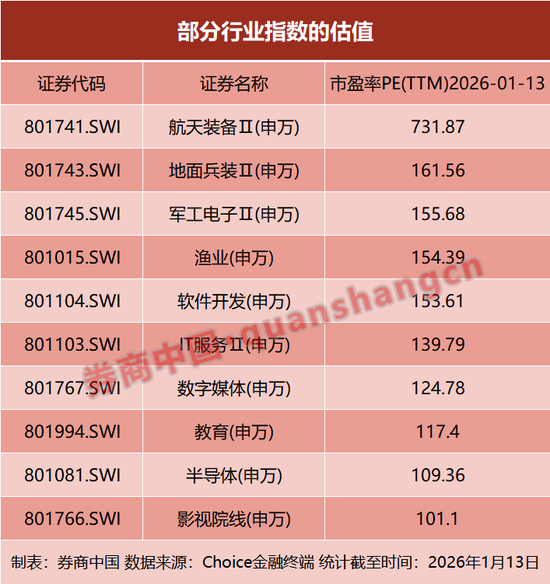
Core Viewpoint - The current market shows a significant disparity in valuations, with certain indices exceeding 100 times earnings, indicating potential risks for investors as historical patterns suggest that such high valuations are unsustainable [1][10]. Group 1: Market Valuation Insights - The valuations of the Sci-Tech 100, Sci-Tech 50, and CSI 2000 indices have surpassed 150 times earnings, with the Sci-Tech 100 and Sci-Tech 50 at 217 times and 172 times respectively, and the CSI 2000 at 164 times as of January 13, 2026 [3][10][16]. - Historical data indicates that when broad market indices exceed 100 times earnings, it often leads to significant market corrections, as seen with the Nikkei 225 and Nasdaq indices in previous decades [10][12]. - The current A-share market presents a dichotomy, with large-cap value and dividend indices showing earnings multiples below 10 times, suggesting that these stocks are undervalued compared to the high-flying indices [10][11]. Group 2: Investment Strategy and Market Behavior - Investors are advised to adopt a cautious approach when market valuations exceed 100 times, as this is a signal to be wary of potential downturns [2][10]. - The phenomenon of irrational market behavior is noted, where undervalued stocks may decline further while overvalued stocks can continue to rise temporarily, but such conditions are not sustainable in the long run [12][5]. - The concept of a valuation anchor is emphasized, suggesting that most stocks should ideally be valued around 20 times earnings, which can help investors gauge market temperature [4][11]. Group 3: Sector-Specific Valuations - Certain sectors are experiencing extreme valuations, with some industry indices showing earnings multiples exceeding 100 times, such as aerospace equipment at 731.87 times and military electronics at 155.68 times [8][14]. - The micro-cap stock index has seen substantial growth, with a rise of 3.1 times since February 2024, despite a significant portion of its constituents being loss-making [11][16].
南农晨读 | 粉了
Nan Fang Nong Cun Bao· 2026-01-07 01:31
Group 1 - The article discusses the rise of grassroots football in China, highlighting the achievements of a local team in Yongzhou, which emphasizes that the true rewards are friendship and passion rather than material gains [3][4][5] - The article reflects on the importance of community and emotional connections in sports, suggesting that these elements are more valuable than resources or calculations [4][5] Group 2 - The Guangdong Seed Industry Expo is set to take place, focusing on high-value cherry tomato varieties and aiming to boost the local agricultural sector [8][10][12] - The event will feature a competition for cherry tomatoes, aligning with market demands and promoting sustainable agricultural practices in the region [11][12] Group 3 - The Chinese pet industry is projected to reach a market size of 811.4 billion yuan by 2025, with a year-on-year growth of 15.7%, indicating a significant shift towards high-quality development [15][30] - The report highlights advancements in policy, capital investment, and technology that are driving the pet industry towards a more robust growth trajectory [16][30] Group 4 - The "Chao Tian Jiao 6" pepper variety has been recognized as a key recommended variety at the Guangdong Seed Industry Expo, showcasing the collaborative innovation in agricultural research [34][36][37] - This recognition underscores the strength of the "industry-university-research" collaboration in advancing agricultural breeding in the region [36][37] Group 5 - The article mentions the successful inclusion of "Xingning Green Tea" in the national list of quality agricultural products, marking a significant milestone for the brand and its market expansion [50][52][53] - This achievement reflects the growing recognition of local agricultural products and their potential in broader markets [52][53]

【省农业农村厅】陕西组织农业产业链企业赴广州考察招商
Shan Xi Ri Bao· 2025-12-22 22:42
Core Insights - The event organized by the Provincial Department of Agriculture and Rural Affairs in Guangzhou aimed to foster cooperation in key agricultural industry chains, resulting in 9 signed projects with an intended investment exceeding 300 million yuan [1] Group 1: Event Overview - The event took place from December 18 to 19, featuring a delegation of 40 representatives from Shaanxi agricultural enterprises [1] - The focus was on 8 key modern agricultural industry chains, including apples, vegetables, livestock meat, and dairy products [1] Group 2: Objectives and Goals - The primary goal was to connect with advanced regions for funding, technology, market access, and innovative ideas, addressing weaknesses in high-end processing, brand marketing, and distribution networks [1] - The initiative aims to enhance, extend, and strengthen the agricultural industry chain [1] Group 3: Investment and Projects - Prior to the event, Shaanxi identified 292 investment demand projects related to grain and oil, modern agricultural industry chains, and other specialty industry chains, with a total planned investment of 29.7 billion yuan [1] - The projects span various sectors, including grain, fruit, vegetables, livestock, tea, traditional Chinese medicine, fisheries, and leisure agriculture [1] Group 4: Future Plans - The Provincial Department of Agriculture and Rural Affairs indicated that Shaanxi has developed several industry chains exceeding 10 billion yuan at the municipal and county levels [1] - Future efforts will focus on cultivating "chain master" enterprises and specialized innovative companies, guiding resources like technology, talent, and capital towards the industry chain to promote the development of modern agricultural clusters [1]
"三农"成绩单传递中国稳定性和确定性
Ren Min Ri Bao· 2025-12-08 02:41
Core Viewpoint - The modernization of agriculture and rural areas is essential for China's overall modernization, emphasizing that a strong nation must first have a strong agricultural sector [1]. Group 1: Agricultural Modernization Goals - The "15th Five-Year Plan" emphasizes accelerating agricultural modernization and promoting comprehensive rural revitalization as a top priority for the Party [1][2]. - The plan aims to enhance agricultural production capacity and quality efficiency, focusing on improving the supply guarantee for important agricultural products [3]. Group 2: Enhancing Agricultural Production Capacity - Agricultural production capacity is defined as the stable output achievable under existing infrastructure, technology, and policy support, with a goal of achieving breakthroughs in grain production capacity during the "15th Five-Year Plan" [4]. - Over 1 billion acres of high-standard farmland have been established, with agricultural technology contributing 63.2% to production capacity [4]. Group 3: Addressing Shortcomings in Agriculture - The plan identifies the need to strengthen the agricultural foundation, improve infrastructure, and enhance resilience against natural disasters as critical areas for development [5]. - Strategies include implementing the "store grain in the land and technology" approach and accelerating self-reliance in high-level agricultural technology [5]. Group 4: Quality and Efficiency Improvement - The focus is on not only quantity but also quality, with initiatives to develop high-quality rice and wheat varieties, and to promote diversified food supply systems [7]. - The plan aims to integrate technology, green practices, quality agriculture, and branding to build a modern agricultural industry [7]. Group 5: Rural Living Environment Improvement - The modernization of agriculture is linked to the well-being of millions of farmers, with plans to create quality living spaces in rural areas [8]. - The approach emphasizes local conditions and orderly, categorized development to enhance rural living standards [11]. Group 6: Policy Effectiveness and Financial Support - The "15th Five-Year Plan" proposes enhancing the effectiveness of agricultural support policies to meet farmers' needs and ensure stable grain production [15][16]. - Financial commitments include increasing the proportion of land transfer income for agricultural use and ensuring that agricultural loans are prioritized [17]. Group 7: Precision in Policy Implementation - The plan stresses the importance of precise policy measures to prevent poverty and support low-income populations in rural areas [18]. - It aims to establish a regular mechanism to prevent the return to poverty, focusing on targeted assistance for vulnerable groups [18].
两部门通报:部分地方仍存在违法占地破坏耕地问题
Di Yi Cai Jing· 2025-11-05 04:57
Core Viewpoint - The Ministry of Natural Resources and the National Forestry and Grassland Administration reported on November 5, 2025, highlighting 14 typical illegal activities discovered during inspections and law enforcement supervision in the third quarter of 2025, including illegal land occupation, illegal mining, and ecological destruction, with some cases involving fraudulent rectification efforts [2][6]. Group 1: Illegal Land Occupation - Hebei Province's Xuanhua Huasheng Steel Co., Ltd. illegally occupied 118.24 acres of forest land for mining without obtaining necessary permits since June 2020 [2]. - In Liaoning Province, the New Da (Liaoning) Tourism Development Co., Ltd. unlawfully occupied 44.44 acres of land, including 30.54 acres of black soil farmland, for a leisure tourism project [2]. - In Henan Province, illegal sand extraction activities damaged 68.82 acres of permanent basic farmland from April 2020 to March 2025 [3]. - Guizhou Province's Zunyi City illegally occupied 273.61 acres of land for the construction of a scenic area without proper approvals [3]. Group 2: Illegal Mining Activities - Shanxi Province's Qiangsheng Sand and Stone Co., Ltd. illegally changed its mining operations from sand to iron ore without proper authorization [4]. - Chongqing's Fengdu County government allowed the illegal mining of 33.59 million tons of building sand by a local company under the guise of agricultural construction [4]. Group 3: Ecological Destruction - In Inner Mongolia, an individual illegally cleared 129.19 acres of forest land for cultivation [5]. - A company in Guangxi illegally occupied 915.23 acres of forest land for mining and construction activities without approval [6]. - Hainan Province's Chengmai Changfeng Energy-saving Building Materials Co., Ltd. was found to have engaged in fraudulent rectification regarding illegal land occupation, misleading authorities about compliance [6]. Group 4: Regulatory Response - The Ministry of Natural Resources and the National Forestry and Grassland Administration emphasized the need for local governments to rectify and address these issues in accordance with laws and regulations, avoiding simplistic or one-size-fits-all solutions [6][7].
粮食产量创新高 农村发展有活力(权威发布·高质量完成“十四五”规划)
Ren Min Ri Bao· 2025-09-16 22:29
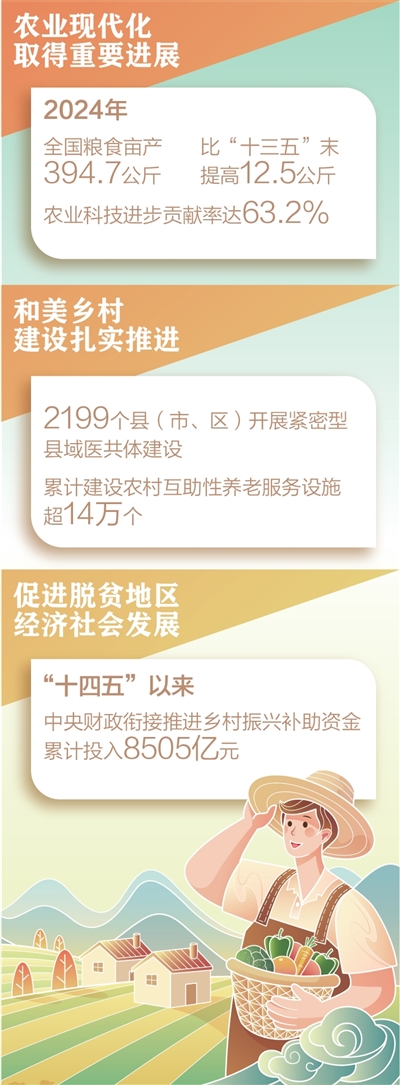
Core Insights - The article highlights significant progress in agricultural modernization and rural development during the "14th Five-Year Plan" period, emphasizing the goal of building a strong agricultural nation and promoting comprehensive rural revitalization [3][10]. Agricultural Production - In 2024, China's grain production is expected to exceed 1.4 trillion jin (approximately 700 million tons), with a per capita grain availability of 500 kg, ensuring basic self-sufficiency in grains and absolute safety in staple food [4][9]. - The average grain yield reached 394.7 kg per mu (approximately 0.067 hectares) in 2023, an increase of 12.5 kg compared to the end of the "13th Five-Year Plan," with yield improvements contributing over 80% to the growth in grain production [5][4]. Agricultural Structure and Safety - The agricultural production structure is being optimized to adapt to market demand, with soybean production reaching 20.65 million tons in 2024, and the self-sufficiency rate increasing by 4 percentage points since 2020 [5]. - The quality and safety of agricultural products are being prioritized, with a monitoring compliance rate of 97.5% for agricultural product quality during the "14th Five-Year Plan" period [5]. Rural Infrastructure and Support Policies - A comprehensive policy framework to support farmers has been established, including subsidies, price supports, and insurance, aimed at stabilizing farmers' income from grain production [6][8]. - Significant investments have been made in rural infrastructure, with over 4.64 million kilometers of rural roads and a 94% coverage rate for tap water, enhancing public services in rural areas [6][8]. Poverty Alleviation and Economic Development - The government has implemented various support measures to consolidate and expand the achievements of poverty alleviation, with over 600 million monitoring subjects identified for assistance to prevent the risk of returning to poverty [8]. - Since the beginning of the "14th Five-Year Plan," a total of 850.5 billion yuan has been allocated to support rural revitalization, improving infrastructure and public services in poverty-stricken areas [8]. Employment and Income Growth - The income of farmers has seen rapid growth, with the urban-rural income ratio decreasing from 2.56:1 in 2020 to 2.34:1 in 2024, reflecting the effectiveness of policies aimed at supporting agricultural and rural development [9].