玩具潮玩

Search documents
为什么“中国式消费”这么像投资?
吴晓波频道· 2025-06-10 16:40
Core Viewpoint - The article emphasizes the shift in consumer behavior in China, where spending is increasingly viewed as a form of investment rather than mere consumption, reflecting a desire for value retention and appreciation in purchases [5][15][48]. Group 1: Consumer Behavior Trends - In Shanghai, large-scale consumption vouchers have led to significant increases in sales, particularly in gold jewelry, indicating a strong consumer interest in both consumption and investment [2][3]. - The Consumer Price Index (CPI) data shows a stark contrast between the rising prices of gold (up 40.1%) and the overall CPI, which decreased by 0.1%, highlighting a trend where consumers are prioritizing investment-like purchases [3][5]. - The concept of "investment-style consumption" is becoming prevalent, where consumers are not just buying goods but are also considering their potential for value retention and appreciation [6][17][24]. Group 2: Policy and Economic Context - The Chinese government has implemented various policies to stimulate consumption, including subsidies for replacing old goods, which have significantly boosted sales across multiple categories [7][8]. - Despite the push for increased consumer spending, the actual contribution of consumption to GDP has remained relatively stable, indicating that the growth in consumer loans has not translated into proportional increases in retail sales [18][20]. - Recent trends show a surge in consumer loans, with banks aggressively promoting these products, but much of this borrowing is being redirected towards investments rather than direct consumption [21][22]. Group 3: Service Consumption - There is a notable shift towards service consumption, which includes spending on experiences rather than physical goods, yet this segment remains underreported in official statistics [30][32]. - Current data indicates that while product consumption has returned to historical levels, service consumption lags behind at only 87.7% of historical trends, suggesting untapped potential in this area [34][38]. - The quality and quantity of service supply are critical to meeting consumer demand, and enhancing service offerings could be a key strategy for stimulating further consumption growth [35][41].


年轻人情绪消费强势崛起 “谷子店”国产IP释放市场增长动能丨新消费观察
Sou Hu Cai Jing· 2025-05-27 08:50
Core Insights - Emotional consumption is emerging as a core growth driver for many brands, with a focus on younger consumers [1] - The "China Online Consumption Brand Index" (CBI) and the "Global Brand China Online 500 Strong List" (CBI500) highlight the rise of new brands that resonate with youth [1][3] Brand Performance - The CBI500 list features brands like Diao Zhi Xin Yi, MiHoYo, Light and Night of Love, and Card Game, which are recognized for their strong emotional appeal and connection with young consumers [1][3] - These brands have low average transaction prices, rapid product launches, and are centered around IP content, fostering high customer loyalty and repeat purchases [3] Market Trends - The introduction of the "newness" metric in the CBI500 evaluation emphasizes sales growth speed, particularly among young consumers, and innovation in products [2] - During the 618 shopping festival, over 2,000 IPs are expected to launch more than 200,000 new products on platforms like Taobao, indicating a significant trend in the toy and collectible market [3] Industry Implications - The success of domestic IP brands like MiHoYo and Diao Zhi Xin Yi demonstrates the potential to break the dominance of foreign IPs in the market [4] - The rise of these brands signifies a shift in the Chinese toy industry from manufacturing to creative development, highlighting the commercial potential of local cultural content and derivative products [4]
情绪消费成品牌增长核心动力!叠纸心意等4家“谷子店”跻身中外大牌
Huan Qiu Wang Zi Xun· 2025-05-27 04:20
Core Insights - Emotional consumption is experiencing significant growth, with new brands like "谷子经济" leading the way in capturing the youth market [1][4] - The "China Online Consumption Brand Index" (CBI) and "Global Brand China Online 500" (CBI500) highlight the performance of brands based on real consumer data, focusing on high-quality development [1][2] Brand Performance - Four brands, namely 叠纸心意, 米哈游, 光与夜之恋, and 卡游, have emerged as strong representatives of emotional consumption among young consumers, characterized by low average transaction prices and rapid product updates [2][4] - 卡游 has a customer price index of 1.34, below 85% of brands on the list, yet its transaction amount growth index is 0.56, surpassing well-known international brands like LEGO [2] Youth Engagement - The four brands show exceptional performance in the 18-24 age group, with transaction growth rates exceeding those of established toy brands like 万代 and 迪士尼 [2] - 光与夜之恋's transaction amount growth index can reach over four times that of other brands, indicating strong market traction among younger consumers [2] Market Trends - During last year's Double 11 shopping festival, 米哈游 and 叠纸心意 both surpassed 100 million RMB in sales, marking their entry into the "billion club" [3] - The total transaction volume for derivative products on the Taobao platform exceeded 10 billion RMB, with over 30% of transactions coming from consumers aged 18-24 [3] Industry Implications - The success of these domestic IP brands serves as a strong reference for similar brands, demonstrating the potential of original IP content to disrupt the dominance of foreign IPs [4] - The rise of emotional consumption is becoming a core driver of growth for many brands, indicating a shift from manufacturing to creative development in the Chinese toy market [4]
北大报告:线上消费品牌指数稳定上升,品牌消费持续增长
Guan Cha Zhe Wang· 2025-05-22 04:14
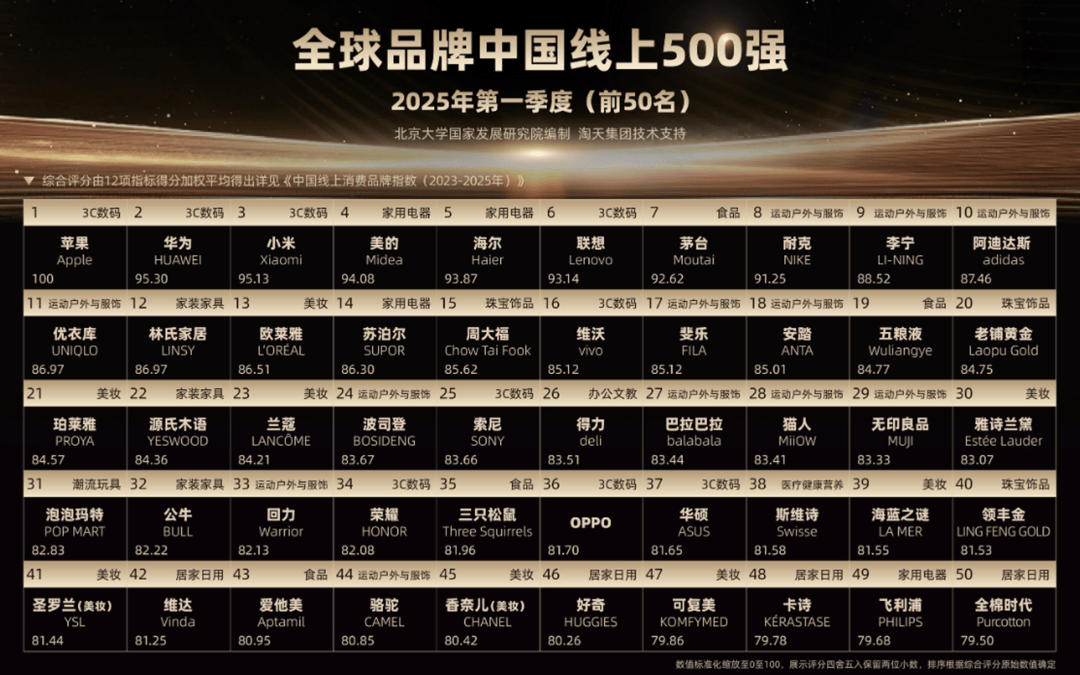
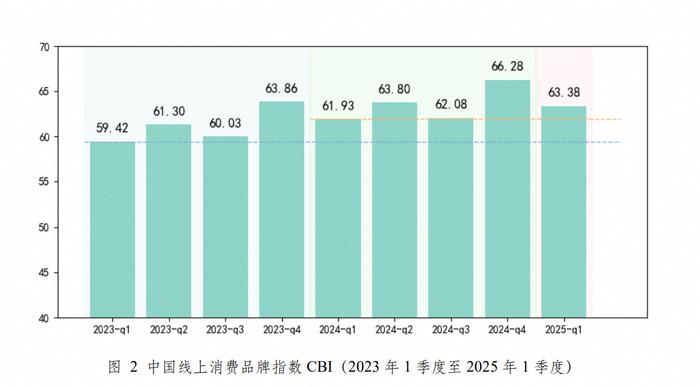
Core Insights - The report from Peking University's National School of Development presents the first online consumption brand index based on real consumer data, indicating a stable growth trend in consumption quality in China from 2023 to 2025 [1][2] Group 1: Consumption Quality Trends - The Chinese online consumption brand index is projected to increase from 59.42 in Q1 2023 to 63.38 in Q1 2025, reflecting an average brand score increase of nearly 4 points [1] - The jewelry brand consumption index is expected to rise by nearly 8 points over two years, with emerging brands like Laopu Gold achieving significant sales growth [4][5] Group 2: Brand Performance - The top brands in the online consumption index include Huawei, Xiaomi, and Apple, with scores ranging from 95.30 to 87.46 for the top ten brands [4] - New toy brands such as Blokus and Light and Night have entered the top 500 brand list, indicating a shift in consumer preferences towards emotional and healing experiences [5] Group 3: Policy and Regional Insights - National subsidies have significantly boosted the consumption quality, particularly in home improvement and appliance sectors, with indices showing growth of around 5 points [7] - The report highlights a rapid growth in the consumption brand index in western regions, attributed to e-commerce initiatives like the "Xinjiang Free Shipping" campaign [7]
指数显示中国消费品质呈现稳定增长趋势
Xin Hua Cai Jing· 2025-05-21 13:38
Core Insights - The "China Online Consumption Brand Index" (CBI) indicates a stable growth trend in consumer quality in China, reflecting a significant recovery in consumption quality from Q1 2023 to Q1 2025 [1][2] Group 1: Index Overview - The CBI increased from 59.42 to 63.38 between Q1 2023 and Q1 2025, with an average brand score rising by 4 points over two years [1] - The index showed a notable increase of 11.5 percentage points in Q4 2024 compared to the baseline, and a 6.7 percentage point increase in Q1 2025, indicating a significant recovery in consumer quality [1] Group 2: Industry Insights - The 3C digital industry has the highest consumer brand index, scoring between 75-85, indicating a strong preference for leading brands among consumers [2] - The pet supplies industry shows significant growth in its consumer brand index, reflecting an increasing brand awareness among consumers [2] - The toy and trendy toy industry has a consumer brand index below 50, despite dominant brands like LEGO and Pop Mart, suggesting a rise of new brands gaining consumer recognition [2] Group 3: Research Support and Methodology - The CBI was developed by Peking University and supported by data from Taotian Group, marking a significant collaboration between academic institutions and e-commerce platforms for consumer quality research [2]
去年淘宝上衍生周边成交量超百亿元 潮玩行业可能出现下一个泡泡玛特吗?
Mei Ri Jing Ji Xin Wen· 2025-04-19 13:03
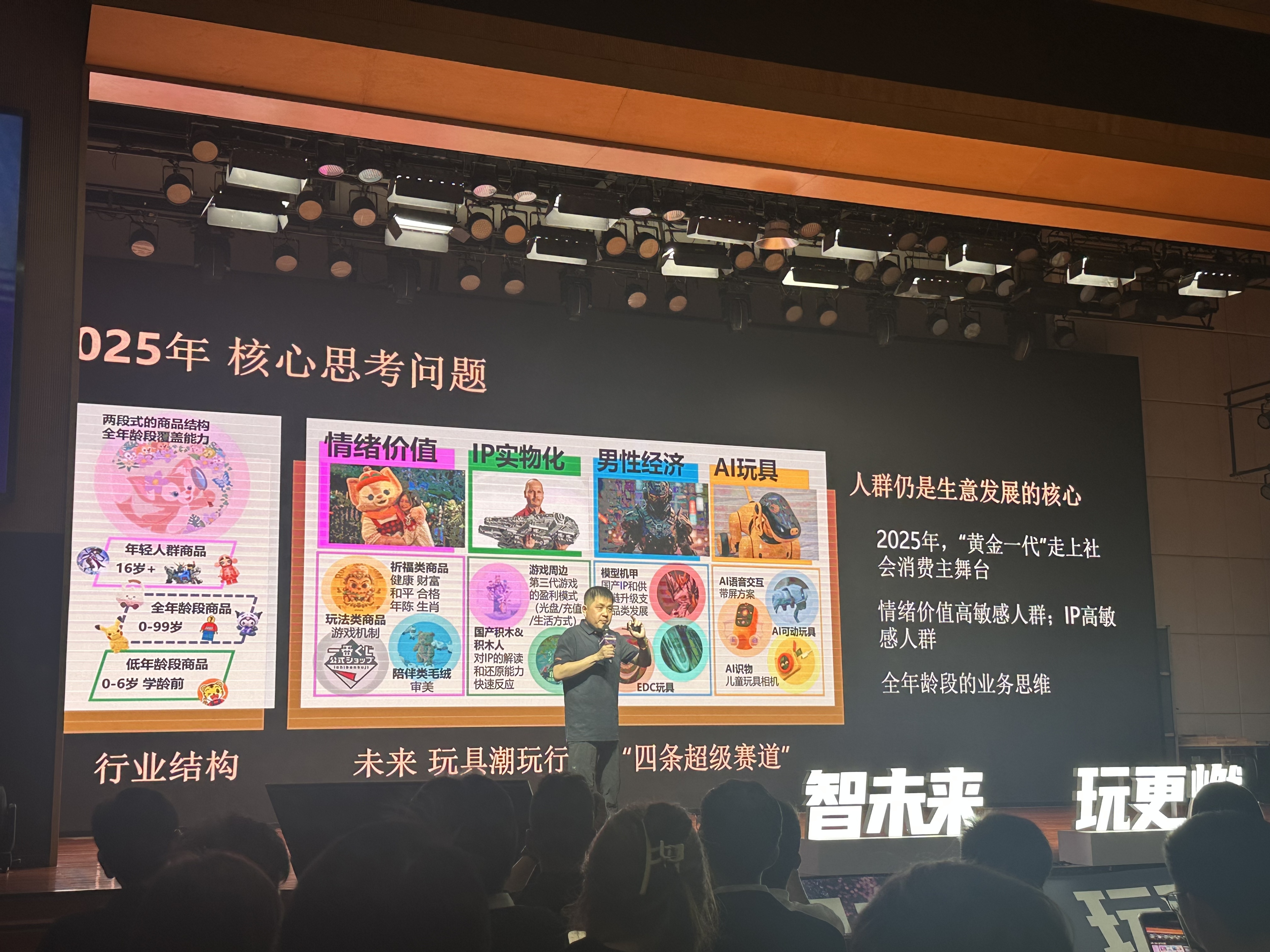
Core Insights - The toy industry is predicted to evolve towards four major trends in the next five years: emotional value, IP (Intellectual Property) materialization, male economy, and AI (Artificial Intelligence) toys [1] - The market size of China's toy and trendy toy industry is approximately 153.6 billion yuan, indicating significant growth potential [1] - The rise of derivative products related to popular IPs is creating a substantial market, with the example of "Nezha 2" generating over 300 million yuan in sales within a month [5] Group 1: Industry Trends - The toy industry is transitioning from niche to mainstream, with significant sales figures reported on platforms like Taobao, including over 1 billion yuan in derivative product sales in 2024 [1] - The focus of Taobao's toy offerings has shifted over the years, from maternal and infant toys to blind boxes, and now to plush toys, which have become the leading category [4] - The EDC (Every Day Carry) toy segment has seen a remarkable increase, with search volume up 532% and transaction volume up 345% year-on-year in 2024 [4] Group 2: Brand Development - The toy industry is moving towards brand-oriented development, with many manufacturers transitioning from OEM to brand marketing strategies [5][6] - The success of brands like Bubble Mart has demonstrated that high-value toys can be marketed effectively, influencing the industry's approach to pricing and value [10] - The concept of "brand equals category" is emphasized, suggesting that successful brands can dominate their respective markets, as seen with Lego and Bubble Mart [9] Group 3: Market Opportunities - The potential for new companies to emerge in the toy industry is significant, with the possibility of 3 to 10 new publicly listed companies in the future [13] - The industry's evolution from practicality to emotional value reflects changing consumer preferences for personalized and high-value toys [13] - The success of Bubble Mart has shown that Chinese toy companies can achieve substantial market valuations, although replicating its success may be challenging [13]