环卫装备

Search documents
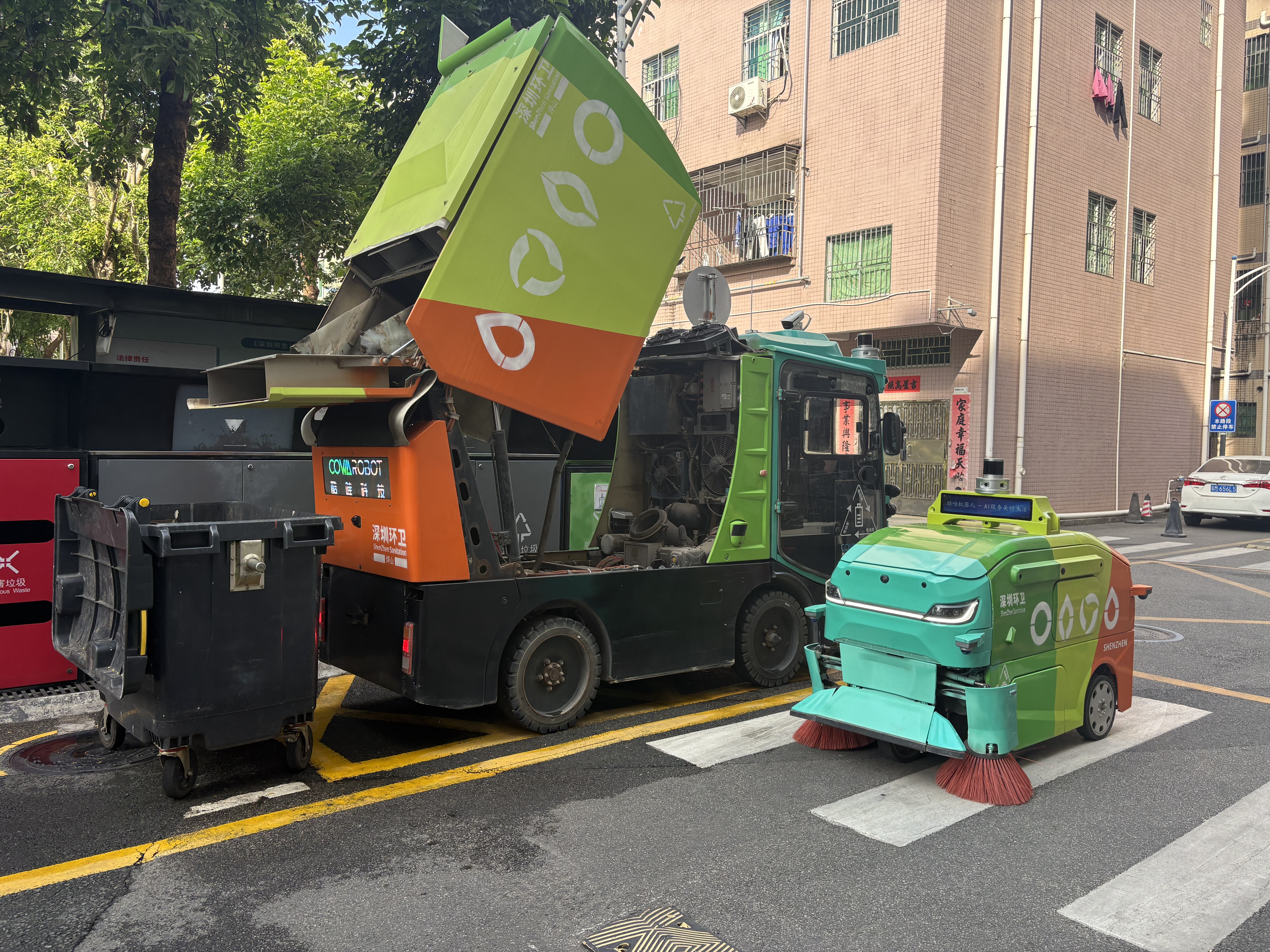
扫垃圾也得上高科技,机器人怎么算成本账
Di Yi Cai Jing· 2025-12-03 10:37
Core Insights - The article discusses the implementation and challenges of sanitation robots in urban environments, particularly in Shenzhen, highlighting their transition from technology demonstrations to practical applications in city management [1][5][8]. Group 1: Technology and Operations - Sanitation robots are now actively cleaning sidewalks and urban areas, with 36 units covering an area of 2.7 million square meters in Shenzhen [5]. - The complexity of identifying various types of waste, such as cigarette butts and plastic bags, poses significant challenges for the robots, requiring advanced algorithms and real-time adjustments based on environmental conditions [5][6][7]. - The operational efficiency of these robots is enhanced through human-robot collaboration, where human workers transition from repetitive tasks to oversight and inspection roles [12][13]. Group 2: Economic Viability - The economic model for deploying sanitation robots hinges on reducing human labor costs, with each robot expected to replace 3-5 workers, thereby justifying the investment [8][12]. - The cost structure of sanitation projects is shifting from a labor-intensive model (50% labor costs) to a more equipment-centric approach (40% mechanical costs) as robots are integrated [12][13]. - The financial feasibility of these projects is validated as long as the total costs of equipment depreciation, energy, and maintenance remain below the cost of human labor [12]. Group 3: Regulatory and Market Expansion - The regulatory framework is evolving, with real-time data monitoring replacing traditional manual inspections, enhancing accountability and performance assessment [14][15]. - Companies are exploring international markets, with successful implementations in regions like Singapore and plans for expansion into Abu Dhabi, driven by favorable conditions for automation [15][16]. - The competitive landscape is shifting, focusing on operational scalability, experience, and the ability to deliver consistent results rather than just technological advancements [16].


企业碳配额与产出挂钩不设总量上限,紫金赋能龙净逻辑不变且持续深化 | 投研报告
Zhong Guo Neng Yuan Wang· 2025-12-02 03:04
Industry Overview - The carbon quota allocation mechanism is linked to production output without a total carbon emission cap, focusing on intensity-based dynamic adjustments [1][2] - The allocation mechanism is based on the experience of the power generation industry, implementing free quota distribution based on carbon emission intensity control, with total quotas dynamically associated with industry production levels [2] - New key emission units in the steel, cement, and aluminum smelting industries must complete the first quota clearance for 2024 by 2025 [1][2] Company Tracking - Longking Environmental has seen significant shareholding increases from Zijin Mining, with stable leadership transitions expected to enhance Longking's business [3] - China Water Affairs reported a revenue of HKD 5.183 billion for FY26H1, a decrease of 12.9% year-on-year, with a net profit of HKD 571 million, down 24.4% year-on-year, primarily due to a decline in connection and construction activities [3] - The company has reduced capital expenditures by 31.8% to HKD 1.243 billion in FY26H1, while maintaining a dividend of HKD 0.13 per share, resulting in a dividend yield of 4.8% [3] Solid Waste Sector Insights - The solid waste sector has shown strong fundamentals in Q3 2025, with a 12% increase in net profit and a 2.7 percentage point increase in gross margin [3] - Free cash flow in the solid waste sector reached RMB 13.3 billion in Q1-Q3 2025, a year-on-year increase of 28%, with capital expenditures down 12% [3] - The average waste incineration companies' output per ton increased by 1.8% year-on-year in H1 2025, indicating operational efficiency improvements [3] Water Sector Insights - The water sector is expected to experience a cash flow turnaround, with significant increases in free cash flow anticipated starting in 2026 [4] - Recent water price reforms in major cities like Guangzhou and Shenzhen are expected to enhance revenue and profitability for water companies [5] - Recommended companies in the water sector include Yuehai Investment and Xingrong Environment, with a focus on improving cash flow and dividend payouts [5] Industry Tracking - The sales of new energy sanitation vehicles increased by 61.32% year-on-year in the first ten months of 2025, with a penetration rate of 18.02% [6] - The average price of biodiesel remained stable, while net profits per ton have declined [6] - Lithium carbonate prices have risen, improving profitability in lithium battery recycling [6]




钢铁水泥电解铝配额方案落地,高能布局金矿强化资源化协同,龙净国资增持价值 | 投研报告
Zhong Guo Neng Yuan Wang· 2025-11-25 02:02
Core Viewpoint - The report highlights significant growth in the environmental protection industry, particularly in the sanitation equipment and lithium battery recycling sectors, driven by increasing demand for new energy vehicles and rising lithium prices [1][3][7]. Industry Overview - Sanitation Equipment: In the first ten months of 2025, sales of new energy sanitation vehicles increased by 61.32%, with a penetration rate rising by 6.33 percentage points to 18.02%. Total sanitation vehicle sales reached 60,675 units, a year-on-year increase of 4.61%, with 10,931 units being new energy vehicles, marking a 63.32% increase [1][7]. - Lithium Battery Recycling: The price of lithium carbonate has risen, improving profitability. As of November 21, 2025, the weekly price of lithium carbonate was 92,400 (up 8.4% week-on-week), with cobalt and nickel prices at 405,000 and 116,700 respectively [1][7]. Investment Recommendations - Key Recommendations: Companies such as Hanlan Environment, High Energy Environment, Green Power Environmental Protection, and others are highlighted as key investment opportunities [2][4][5]. - Suggested Focus: Attention is drawn to companies involved in carbon monitoring and CCER asset appreciation, as well as those engaged in plastic recycling and energy-saving projects [3][4]. Financial Performance - Solid Waste Sector: The sector showed a 12% increase in net profit for the first three quarters of 2025, with a gross margin improvement of 2.7 percentage points. Free cash flow reached 13.3 billion, up 28% year-on-year [5][6]. - Water Sector: The water sector is expected to see a significant improvement in free cash flow, with a projected increase in dividend payout ratios as cash flow stabilizes [6]. Market Trends - Carbon Emission Quotas: The Ministry of Ecology and Environment has implemented a carbon emission quota scheme for the steel, cement, and aluminum industries for 2024 and 2025, which is expected to enhance the demand for carbon monitoring equipment [3][4]. - Price Adjustments: Recent price adjustments in water services in major cities are anticipated to support revenue growth and improve investment returns [6].
江苏塑造更高水平开放新优势
Ren Min Ri Bao· 2025-11-22 03:17
Core Insights - The article highlights the transformation of foreign investment in Jiangsu, moving from single-point investments to industrial clusters and from manufacturing to R&D headquarters, indicating a shift from "foreign R&D, Chinese manufacturing" to "Chinese innovation, global sales" [1][4]. Group 1: Foreign Investment Landscape - Jiangsu has attracted over 560 German enterprises with a cumulative investment exceeding $60 billion, with about 70% focusing on the automotive industry [2]. - The province has established 26 international cooperation parks, with manufacturing foreign investment accounting for $37.58 billion from 2021 to 2024, representing 36.2% of the total foreign investment in the province [3]. - Jiangsu's actual foreign investment usage accounts for approximately one-sixth of the national total, with 43,000 foreign enterprises currently operating in the province [4]. Group 2: R&D and Headquarters Development - Jiangsu has recognized 423 regional headquarters and functional institutions of multinational companies, with 128 new additions since the start of the 14th Five-Year Plan, ranking among the top in the country [4][5]. - The province has implemented a three-year action plan to encourage reinvestment of profits by foreign enterprises, creating a comprehensive support scheme [4]. Group 3: Innovation and Technology Transfer - Foreign enterprises are increasingly establishing R&D centers in Jiangsu, with companies like Mettler Toledo and Schaeffler leveraging local talent and resources to innovate and serve global markets [6][7]. - The shift in foreign enterprises' roles in China is evident, as they transition from merely producing to developing innovative solutions that are exported globally [6][7]. Group 4: Policy and Strategic Goals - Jiangsu's government emphasizes the dual approach of stabilizing and improving foreign trade and investment, aiming to contribute more significantly to national economic growth [8].
活力中国调研行丨江苏塑造更高水平开放新优势
Ren Min Ri Bao· 2025-11-22 01:49
Core Insights - The article highlights the transformation of foreign investment in Jiangsu, China, from single-point investments to industrial clusters, emphasizing the shift from "foreign R&D, Chinese manufacturing" to "Chinese R&D, global sales" [1][4]. Group 1: Foreign Investment Landscape - Jiangsu has attracted over 560 German-funded enterprises with a cumulative investment exceeding $60 billion, particularly in the automotive industry, where about 70% of these enterprises focus on the automotive supply chain [2][3]. - The province has established 26 international cooperation parks, with foreign investment in the manufacturing sector reaching $37.58 billion from 2021 to 2024, accounting for 36.2% of the total foreign investment in the province [3]. Group 2: Innovation and R&D Focus - Foreign enterprises are increasingly establishing R&D centers and regional headquarters in Jiangsu, with 423 multinational company regional headquarters recognized, and 128 new ones added since the start of the 14th Five-Year Plan [4][5]. - Companies like Hawe Mechanical and Mettler Toledo have shifted from merely manufacturing to R&D, with Mettler Toledo investing 7% of its revenue in R&D and achieving global sales with its high-precision equipment [6][7]. Group 3: Economic Policies and Support - Jiangsu has implemented a three-year action plan to encourage foreign enterprises to reinvest their profits, creating a comprehensive support scheme that includes policy guidance and tax services [5]. - The province has recognized three foreign headquarters economic clusters, with foreign headquarters contributing an average tax of 160 million yuan, surpassing the average level of foreign enterprises [5]. Group 4: Global Integration and Market Position - Foreign companies are redefining their roles in the Chinese market, with many transferring core R&D functions to Jiangsu, viewing China not just as a market but as a source of innovation [6][7]. - Jiangsu is evolving from a "cost sink" for foreign investment to an "innovation highland," with foreign enterprises becoming "innovation partners" and "global nodes" in the supply chain [7][8].
实际使用外资约占全国1/6 现有外资企业4.3万家——江苏塑造更高水平开放新优势(活力中国调研行)
Ren Min Ri Bao· 2025-11-21 22:57
Core Insights - The article highlights the transformation of foreign investment in Jiangsu, China, from single-point investments to industrial clusters, emphasizing a shift from "foreign R&D, Chinese manufacturing" to "Chinese R&D, global sales" [1][4][6] Group 1: Foreign Investment Landscape - Jiangsu has attracted over 560 German enterprises with a cumulative investment exceeding 60 billion USD, particularly in the automotive industry, where about 70% of foreign companies focus on the supply chain [2][3] - The province has established 26 international cooperation parks, with manufacturing foreign investment accounting for 375.8 billion USD from 2021 to 2024, representing 36.2% of the total foreign investment in the province [3][4] Group 2: Innovation and R&D Focus - Foreign companies are increasingly establishing R&D centers and regional headquarters in Jiangsu, with 423 multinational company regional headquarters recognized, and 128 added since the start of the 14th Five-Year Plan [4][5] - The shift towards R&D is exemplified by companies like Mettler Toledo, which has developed high-precision equipment in China, showcasing a transition from "foreign R&D, Chinese manufacturing" to "Chinese R&D, global sales" [6][7] Group 3: Economic Contribution and Policy Support - Foreign headquarters in Jiangsu contribute an average tax of 160 million CNY, higher than the average for foreign enterprises, indicating a robust economic impact [5] - Jiangsu's government has implemented a three-year action plan to encourage reinvestment of profits by foreign enterprises, enhancing the investment environment [4][5] Group 4: Global Integration and Market Role - The article emphasizes that Jiangsu is no longer just a cost-effective location for foreign investment but has evolved into an "innovation highland," with foreign enterprises acting as "innovation partners" and "global nodes" [7][8] - Companies are leveraging local supply chains and talent to enhance their global service capabilities, as seen in the case of Jabil and Finisar, which have established comprehensive bases in Jiangsu [7][8]
江苏塑造更高水平开放新优势(活力中国调研行)
Ren Min Ri Bao· 2025-11-21 22:12
Core Insights - The article highlights the transformation of foreign investment in Jiangsu, China, from single-point investments to industrial clusters, emphasizing the shift from "foreign R&D, Chinese manufacturing" to "Chinese R&D, global sales" [1][4]. Group 1: Foreign Investment Trends - Jiangsu has attracted over 560 German enterprises with a cumulative investment exceeding 60 billion USD, with about 70% focusing on the automotive industry [2]. - The province has established 26 international cooperation parks, with manufacturing foreign investment accounting for 375.8 billion USD from 2021 to 2024, representing 36.2% of the total foreign investment in the province [3]. - Jiangsu's actual foreign investment usage accounts for approximately one-sixth of the national total, with 43,000 foreign enterprises currently operating in the region [4]. Group 2: R&D and Headquarters Development - Jiangsu has recognized 423 regional headquarters and functional institutions of multinational companies, with 128 new additions since the 14th Five-Year Plan, ranking among the top in the country [4][5]. - The establishment of R&D centers and regional headquarters signifies a shift from merely manufacturing to innovation and development, with companies like Hawe and Mettler Toledo leading in their respective fields [4][6]. Group 3: Innovation and Global Integration - Foreign enterprises are increasingly redefining their roles in the Chinese market, with companies like Schaeffler and Jabil Electronics establishing R&D and service centers in Jiangsu to cater to global demands [6][7]. - The article emphasizes that Jiangsu is evolving from a "cost haven" for foreign investment to an "innovation hub," with foreign companies becoming "innovation partners" and "global nodes" in the supply chain [7].
福龙马11月20日获融资买入2.81亿元,融资余额7.84亿元
Xin Lang Cai Jing· 2025-11-21 01:31
Group 1 - The core point of the news is that Fulongma's stock price increased by 4.47% on November 20, with a trading volume of 3.009 billion yuan, indicating positive market sentiment towards the company [1] - On the same day, Fulongma had a financing buy-in amount of 281 million yuan, with a net financing buy of 54.73 million yuan, reflecting strong investor interest [2] - As of November 20, the total balance of margin trading for Fulongma was 784 million yuan, which accounts for 6.79% of its circulating market value [2] Group 2 - Fulongma's main business involves the research, production, and sales of environmental sanitation equipment, with revenue composition being 77.01% from environmental industry ecological operations, 20.70% from intelligent equipment, and 1.30% from other sources [2] - For the period from January to September 2025, Fulongma reported a revenue of 3.599 billion yuan, a year-on-year decrease of 5.07%, and a net profit attributable to shareholders of 113 million yuan, down 1.83% year-on-year [2] - Since its A-share listing, Fulongma has distributed a total of 933 million yuan in dividends, with 273 million yuan distributed over the past three years [3]

零排放+自动驾驶!全运会启用新能源环卫车
Nan Fang Du Shi Bao· 2025-11-13 13:51
Core Viewpoint - The 15th National Games, held from November 9 to 21, marks the first joint hosting by Guangdong, Hong Kong, and Macau, and introduces a "carbon neutrality" goal for the event [1] Group 1: Event Overview - The event emphasizes a "green, shared, open, and clean" philosophy, integrating the concept of "waste-free" throughout the organization process [1] - Urban sanitation serves as the "first window" of the event's image, focusing on efficient cleaning while achieving low carbon emissions and noise control [1] Group 2: Technology and Equipment - Various types of new energy sanitation vehicles, including 18-ton pure electric sweepers and L4 autonomous driving vehicles, are deployed for road cleaning and maintenance during the event [1][2] - The 18-ton pure electric sweeper features a new generation high-energy battery and efficient electric drive, saving over 16% energy compared to similar products, with a single charge supporting 8 hours of continuous operation and covering 80-100 kilometers [1] Group 3: Automation and Management - L4 autonomous sanitation vehicles utilize a multi-sensor fusion perception system for 360-degree environmental recognition, automatic obstacle avoidance, and precise path planning [2] - An integrated management system connects all event support vehicles to a smart network cloud control platform, allowing real-time monitoring of vehicle status, energy consumption, and operational progress [2]
环保行业跟踪周报:印尼启动56亿美元垃圾焚烧计划,固废出海市场广阔-20251110
Soochow Securities· 2025-11-10 07:51
Investment Rating - The report maintains an "Overweight" rating for the environmental protection industry [1]. Core Views - Indonesia has launched a $5.6 billion waste-to-energy project, indicating a vast market opportunity for solid waste management companies to expand internationally [11][12]. - The solid waste sector is experiencing strong fundamentals, with a notable increase in free cash flow and improved return on equity (ROE) due to operational efficiencies and reduced capital expenditures [14][15]. - The water services sector is poised for growth, with expectations of increased cash flow and dividend payouts as capital expenditures decline [18][19]. Summary by Sections Industry News - Indonesia's sovereign fund has initiated the first waste-to-energy project tender, with plans for 33 plants and a total investment of approximately 56 billion USD [11]. - The solid waste industry is transitioning to a mature phase, focusing on efficiency improvements and cash flow generation [14]. - The environmental sanitation vehicle market saw a 63.18% increase in new energy vehicle sales, with a penetration rate of 17.40% [20]. Key Recommendations - Recommended stocks include: - **Waiming Environmental**: Selected as a supplier for Indonesia's waste-to-energy projects, with significant operational capacity [13]. - **Green Power**: Strong performance driven by increased heating capacity and cost savings [14]. - **Yongxing Co.**: Notable growth in revenue and profit due to improved operational efficiency [14]. - Companies to watch include **Dayu Water Saving**, **Lian Tai Environmental**, and **Wang Neng Environment** [1]. Financial Performance - The solid waste sector reported a 12% increase in net profit and a 2.7 percentage point rise in gross margin for the first three quarters of 2025 [14]. - Free cash flow for the sector reached 13.3 billion CNY, marking a 28% increase year-on-year [14]. - Dividend payouts are expected to rise, with several companies maintaining high payout ratios [15][18]. Market Trends - The water services sector is expected to see a cash flow turnaround, similar to the solid waste sector, with anticipated increases in dividend payouts as capital expenditures decrease [18][19]. - Price reforms in water services are expected to enhance growth and valuation, with cities like Guangzhou and Shenzhen implementing price increases [18]. Equipment and Technology - The report highlights the growth in the environmental sanitation vehicle market, particularly in new energy vehicles, which are becoming increasingly prevalent [20]. - The report also notes improvements in the profitability of lithium battery recycling, with a slight decrease in metal prices leading to better margins [34][35].