
稀土材料

Search documents
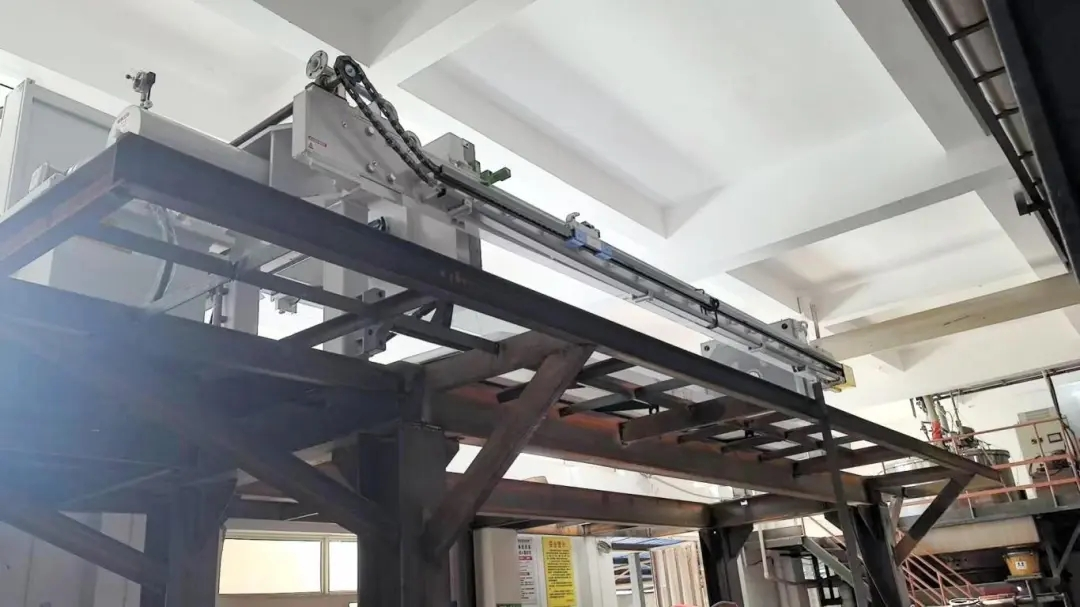
倒计时!兰石中科纳米稀土材料生产线冲刺带料调试
Jing Ji Wang· 2025-08-11 08:23
Group 1 - The project for the production line of nano rare earth materials, constructed by Qian Dong Rare Earth Group and featuring the multi-phase interface reactor developed by Lanshi Zhongke, is nearing completion and is in the final stages of commissioning with materials [1][3] - The core component, the 80L multi-phase interface reactor, along with other key units, has been successfully installed, and the critical processes of material preparation and synthesis have passed initial water tests, confirming the system's operational stability [3][5] - The collaboration between Lanshi Zhongke and Qian Dong Rare Earth demonstrates strong technical capabilities and efficient teamwork, ensuring the project progresses steadily and contributes to technological breakthroughs in the nano rare earth materials sector in Jiangxi Province and the country [5]

科恒股份:公司稀土功能材料业务体系主要涵盖稀土发光材料和稀土储氧材料两大核心板块
Zheng Quan Ri Bao Wang· 2025-08-05 12:42
Core Viewpoint - The company, Keheng Co., Ltd. (300340), has a robust rare earth functional materials business that focuses on rare earth luminescent materials and rare earth oxygen storage materials, primarily applied in lighting and exhaust gas treatment sectors [1] Group 1 - The company's rare earth functional materials business includes two main segments: rare earth luminescent materials and rare earth oxygen storage materials [1] - The applications of these materials are primarily in the lighting industry and in the treatment of exhaust and waste gases [1] - The company has established a strong brand image and reputation in the industry through continuous R&D investment and technological innovation [1] Group 2 - The company has participated in the formulation of multiple national standards, showcasing its commitment to industry development [1] - The ongoing enhancement of product performance is aimed at meeting diverse customer needs [1]

有研新材股价下跌1.47% 子公司完成硫化锂业务资产转让
Jin Rong Jie· 2025-07-31 19:14
Group 1 - The stock price of Youyan New Materials closed at 18.77 yuan on July 31, 2025, down 1.47% from the previous trading day, with a trading volume of 742 million yuan [1] - Youyan New Materials is primarily engaged in the research and production of rare earth materials, optoelectronic materials, and biomedical materials, covering sectors such as new energy and new materials [1] - The company announced that its subsidiary, Youyan Rare Earth, has completed the transfer of lithium sulfide business-related assets to Shanghai Xiba Technology Co., Ltd., with a total transaction value of approximately 110 million yuan, involving proprietary technology, patents, and equipment [1] Group 2 - On July 31, Youyan New Materials experienced a net outflow of main funds amounting to 102 million yuan [2]

21社论丨巩固经济优势,持续增强中国资产吸引力
21世纪经济报道· 2025-07-24 03:53
Group 1 - The core viewpoint of the article highlights the increasing confidence of global investors in Chinese assets, driven by the resilience of the Chinese economy and significant progress in economic transformation and upgrading [1][2][3] - Foreign investment in domestic RMB bonds has exceeded 600 billion USD, indicating a historical high level of foreign capital interest in China [1] - In the first half of the year, foreign net purchases of domestic stocks and funds reached 10.1 billion USD, with a notable increase in May and June to 18.8 billion USD, reflecting a growing willingness to allocate capital to RMB assets [1] Group 2 - The article emphasizes that China's economic resilience and high growth potential are based on long-term stable growth, requiring a balance between maintaining growth, structural adjustment, risk prevention, and reform [3] - It is crucial to expand domestic demand to ensure the economy remains resilient against external shocks, thereby boosting market confidence [4] - The narrative of "American exceptionalism" is fading, with global investors increasingly viewing China as a reliable choice amid global uncertainties, particularly in undervalued technology sectors [2]

巩固经济优势,持续增强中国资产吸引力
2 1 Shi Ji Jing Ji Bao Dao· 2025-07-23 21:59
Group 1 - The stock of foreign investment in domestic RMB bonds has exceeded $600 billion, indicating a historically high level of foreign interest in Chinese assets [1] - In the first half of the year, foreign net purchases of domestic stocks and funds reached $10.1 billion, with significant increases in May and June, totaling $18.8 billion, reflecting a growing willingness to allocate capital to RMB assets [1] - International capital recognizes the resilience of the Chinese economy, which has shown the ability to withstand external shocks and maintain export growth despite U.S. tariffs [1] Group 2 - Global investors are optimistic about China's economic transformation and upgrades, moving beyond low-end manufacturing to sectors like new energy vehicles, innovative pharmaceuticals, advanced manufacturing, artificial intelligence, semiconductors, rare earth materials, robotics, and drones [2] - The narrative of "American exceptionalism" is fading, with U.S. government policies creating uncertainty and risks, while China's economic independence and competitive potential are seen as reliable choices amid global turmoil [2] - According to Invesco's report, about 60% of Middle Eastern sovereign wealth funds plan to increase allocations to Chinese assets over the next five years, with 88% of Asia-Pacific and 80% of African sovereign funds also indicating similar intentions [2] Group 3 - China's economic resilience and high growth are built on a foundation of stable long-term growth, requiring a balance between stabilizing growth, structural adjustments, risk prevention, and reform [3] - Ensuring sufficient total demand is crucial for the smooth transition between old and new growth drivers, thereby consolidating economic resilience and fostering new momentum [3] Group 4 - In the face of unfavorable external conditions, expanding domestic demand is essential to shield the economy from external shocks and boost market confidence [4] - Promoting "anti-involution" while actively expanding domestic demand is vital for maintaining stable economic growth and enhancing investor confidence in China's economy amid global instability [4]
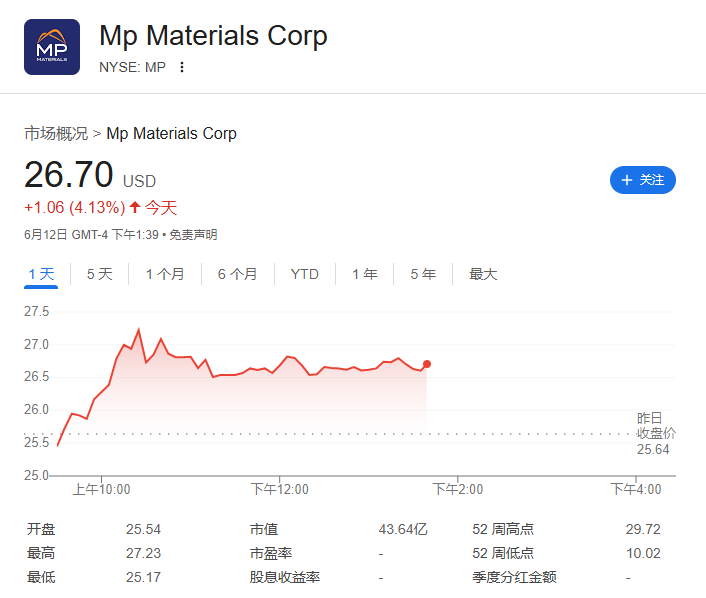
稀土材料公司MP Materials Corp.(MP)涨4.1%。美国国务卿卢比奥与哈萨克斯坦副总理讨论稀有矿物的(合作)前景,并讨论了科技问题。
news flash· 2025-06-12 17:45
Core Viewpoint - MP Materials Corp. (MP) experienced a 4.1% increase in stock price following discussions between U.S. Secretary of State Rubio and Kazakhstan's Deputy Prime Minister regarding cooperation prospects in rare minerals and technology issues [1] Company Summary - MP Materials Corp. is a key player in the rare earth materials sector, benefiting from geopolitical discussions that may enhance its operational landscape [1] Industry Summary - The discussions between U.S. and Kazakhstan officials highlight the growing importance of rare minerals in technology and industry, indicating potential for increased collaboration and investment in this sector [1]

纳指高开0.3% 特斯拉涨超2%
news flash· 2025-06-11 13:33
Group 1 - The U.S. stock market opened higher with the Nasdaq up by 0.33% and the S&P 500 increasing by 0.17% following a lower-than-expected CPI for May [1] - Tesla's stock rose over 2% after Elon Musk expressed regret over recent comments related to Trump [1] - Quantum computing stocks surged, with Quantum Computing increasing by over 13%, as Jensen Huang indicated a critical turning point for the industry [1] Group 2 - The rare earth sector experienced a decline, with MP Materials falling by more than 6% [1]

日美谈判仍然毫无进展,关税成“死结”,日本大臣:双方“尚未找到共识”
Huan Qiu Shi Bao· 2025-06-08 22:42
Group 1 - The fifth round of Japan-U.S. tariff negotiations has made no progress, with both sides failing to reach a consensus [1] - Japan is strongly urging the U.S. to reconsider high tariff measures, focusing on expanding trade, reviewing non-tariff measures, and enhancing economic security cooperation [1] - U.S. officials, including the Treasury Secretary and Commerce Secretary, reportedly had internal disagreements during the negotiations, indicating a disconnect at various levels of the U.S. administration [1] Group 2 - Japan's stance remains unchanged, asserting that tariffs are unacceptable, with current tariffs on automobiles, auto parts, steel, and aluminum causing significant economic losses [1] - Japan is proposing to expand imports of U.S. agricultural products and re-discuss non-tariff barriers on automobile imports as part of the negotiations [1] - The upcoming G7 summit may serve as a critical deadline for reaching an agreement, with Japan's Prime Minister indicating a willingness to meet with President Trump during the summit [2]