
算力中心

Search documents
52个园区入选首批国家级零碳园区建设名单
Xin Lang Cai Jing· 2025-12-27 17:39
Core Insights - The first batch of national-level zero-carbon parks has been announced, including 52 parks across 31 provinces and regions, ensuring at least one park in each area [1][2] - The parks focus on low-energy, low-pollution, and high-value-added industries, primarily in renewable energy sectors, emphasizing a "green production" approach [1][2] - The expected output value of these zero-carbon parks is projected to reach 3.54 trillion yuan [1] Group 1 - The first batch of zero-carbon parks includes Beijing Economic-Technological Development Area and Tianjin Economic-Technological Development Area among others [1] - The parks will utilize local wind and solar resources, with a green electricity supply ratio of at least 50% of the parks' total electricity consumption [1][2] - The initiative is part of a broader strategy to promote green transformation and explore new low-carbon development paths [2] Group 2 - The central economic work conference in 2024 emphasized the establishment of zero-carbon parks, with clear directives in the government work report [3] - A systematic deployment for zero-carbon park construction has been outlined, including a core indicator for carbon emissions per unit of energy consumption and five guiding indicators [3] - The guiding indicators focus on clean energy consumption ratio, energy consumption per unit of product output, comprehensive utilization of industrial solid waste, and reuse rates of industrial water [3]
首批国家级零碳园区建设名单正式公布
Yang Shi Wang· 2025-12-27 03:39
Core Viewpoint - The National Development and Reform Commission of China has released the first batch of national-level zero-carbon park construction lists, including 52 parks, achieving full coverage across 31 provinces (regions, municipalities) and the Xinjiang Production and Construction Corps [1] Group 1: Overview of Zero-Carbon Parks - A total of 52 parks have been selected for the zero-carbon initiative, covering all provinces and regions in China [1] - The selected parks primarily focus on low-energy consumption, low pollution, and high value-added industries, including new energy equipment manufacturing, advanced equipment manufacturing, and computing power centers [1] Group 2: Expected Economic Impact - The anticipated output value of the first batch of national-level zero-carbon parks is projected to reach 3.54 trillion yuan [1]
首批国家级零碳园区名单公布,建成后预计产值3.54万亿元
Xin Lang Cai Jing· 2025-12-27 03:17
Core Insights - The National Development and Reform Commission (NDRC) has released the first batch of national-level zero-carbon park construction lists, including 52 parks, achieving full coverage across 31 provinces and regions, as well as the Xinjiang Production and Construction Corps [1] Group 1: Zero-Carbon Parks Overview - Zero-carbon parks are critical for China's economic activities, energy consumption, and carbon emissions, serving as a breakthrough for green transformation and low-carbon development [2][4] - Existing national and provincial parks exceed 3,000, hosting over 80% of industrial enterprises, consuming about 60% of national energy, and accounting for over 30% of direct carbon emissions [2] Group 2: Expected Outcomes and Industry Focus - The 52 selected parks primarily focus on low-energy, low-pollution, and high-value-added industries, including new energy equipment manufacturing and advanced equipment manufacturing, with an expected output value of 3.54 trillion yuan [5][13] - Upon completion, these parks are projected to have a combined annual energy consumption exceeding 60 million tons of standard coal and carbon emissions below 15 million tons [13] Group 3: Innovation and Development - The construction of zero-carbon parks is seen as a testing ground for accelerating the establishment of a new energy system, enhancing the local consumption of renewable energy [13][16] - Emphasis is placed on technological innovation, institutional innovation, and business model innovation to achieve carbon reduction while also lowering costs and increasing efficiency [16]

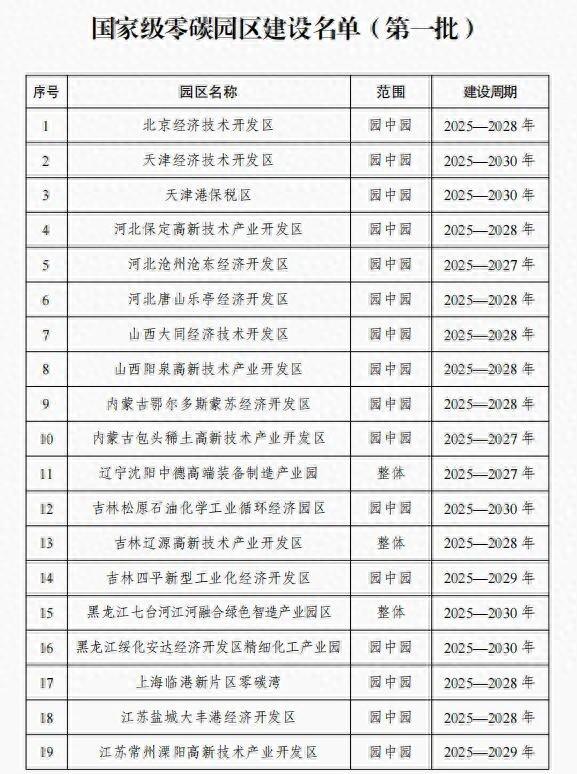
首批国家级名单公布!安徽2个入选
Xin Lang Cai Jing· 2025-12-27 01:14
| 序号 | 园区名称 | 范围 | 建设周期 | | --- | --- | --- | --- | | I | 北京经济技术开发区 | 园中园 | 2025-2028 年 | | 2 | 天津经济技术开发区 | 园中园 | 2025-2030年 | | 3 | 天津港保税区 | 园中园 | 2025-2030 年 | | র্ব | 河北保定高新技术产业开发区 | 园中园 | 2025-2028年 | | 5 | 河北沧州沧东经济开发区 | 园中园 | 2025-2027年 | | 6 | 河北唐山乐亭经济开发区 | 园中园 | 2025-2028 年 | | r- | 山西大同经济技术开发区 | 园中园 | 2025-2028 年 | | 8 | 山西阳泉高新技术产业开发区 | 园中园 | 2025-2028 年 | | 9 | 内蒙古鄂尔多斯蒙苏经济开发区 | 园中圆 | 2025-2028 年 | | HD | 内蒙古包头稀土高新技术产业开发区 | 图中圆 | 2025-2027 年 | | 11 | 辽宁沈阳中德高端装备制造产业园 | 整体 | 2025-2027 年 | | 12 | 吉林松原石 ...
百余个数字经济领域项目在浙江乌镇签约,金额逾千亿元
Sou Hu Cai Jing· 2025-11-08 14:38
Core Insights - The Digital Economy Industry Cooperation Conference was held in Wuzhen, Zhejiang, on November 8, where over 100 projects in the digital economy sector were signed, amounting to over 100 billion RMB [1] Group 1: Event Overview - The conference featured discussions among global experts in artificial intelligence and other fields, focusing on industrial upgrading paths and technological innovation breakthroughs [1] - A new signing segment for high-level talent "dual employment" between schools and enterprises was introduced to enhance collaboration between academia and industry in talent cultivation and resource sharing [1] Group 2: Financial Impact - The total value of signed projects exceeded 100 billion RMB, indicating significant investment and interest in areas such as digital technology, smart manufacturing, artificial intelligence, and computing power centers [1]
百余个数字经济领域项目在浙江乌镇签约 金额逾千亿元
Zhong Guo Xin Wen Wang· 2025-11-08 13:59
Core Insights - The Digital Economy Industry Cooperation Conference was held in Wuzhen, Zhejiang, resulting in over 100 projects signed with a total value exceeding 100 billion RMB [1] - The conference serves as a significant platform for global cooperation in the digital economy, focusing on cutting-edge technologies like AI [1] - A new "dual appointment" signing session for high-level talent was introduced to enhance collaboration between academia and industry [1] Summary by Categories Event Overview - The conference took place on November 8 in Wuzhen, Zhejiang, and is part of the World Internet Conference's ongoing activities [1] - The theme of this year's conference was "Digital Leap: AI-Driven New Ecology of the Digital Economy" [1] Financial Highlights - More than 100 projects were signed, with a total investment amounting to over 100 billion RMB, covering various sectors including digital technology, smart manufacturing, AI, and computing power centers [1] Industry Collaboration - The event featured discussions among global experts in AI and related fields, focusing on industrial upgrading and technological innovation breakthroughs [1] - The introduction of the "dual appointment" signing session aims to foster collaboration in talent development and resource sharing between academic institutions and industries [1]
普洛斯携手ADIA:15亿美元战投落槌,新经济赛道的“资管机遇”
第一财经· 2025-09-05 03:24
Core Viewpoint - The strategic investment of $1.5 billion by Abu Dhabi Investment Authority (ADIA) in GLP reflects the growing recognition of China's new economic infrastructure by international capital, driven by supportive policies and industry upgrades [1][5][6]. Group 1: Investment and Market Dynamics - ADIA's investment in GLP is seen as a significant endorsement of China's new economy, indicating strong market confidence and the long-term potential of the Chinese market [2][3]. - The collaboration between ADIA and GLP has evolved from previous fund-level partnerships to a strategic alliance, highlighting the recognition of GLP's comprehensive capabilities in project planning, development, and operational enhancement [2][3]. - The investment signifies a shift in international capital's focus towards China's new economic infrastructure as a stable investment anchor, particularly in logistics, data centers, and renewable energy [3][5]. Group 2: Economic and Policy Environment - China's economic resilience and supportive macroeconomic policies are crucial factors driving investment in new economic infrastructure, with GDP growth of 5.3% and retail sales growth of 5% in the first half of 2025 [5][6]. - The rapid rise of new productive forces, including renewable energy and artificial intelligence, is propelling industry upgrades and creating sustained market demand for new infrastructure [5][6]. - Recent policies from the National Development and Reform Commission and the Ministry of Finance have encouraged public REITs to invest in new infrastructure projects, enhancing investor confidence [6][9]. Group 3: GLP's Strategic Positioning - GLP has established a comprehensive professional capability system covering investment, development, operation, and management, successfully transitioning from a logistics real estate developer to a diversified infrastructure operator [7][9]. - The company has demonstrated strong asset management capabilities, with over 20 private real estate funds and public REIT products, achieving high dividend payouts and leading in its category [7][9]. - GLP's partnerships with local governments and state-owned enterprises are expanding, as seen in its recent collaboration with Zhejiang's state capital for a $3.5 billion investment in a data center [8][9]. Group 4: Future Outlook and Strategic Alignment - The alignment of GLP's operational model with national policy goals positions it as a key player in the new productive forces era, facilitating the interaction between capital, industry, and policy [9]. - The company's experience in asset fund management and REIT operations aligns with the government's objectives of revitalizing existing assets and supporting new infrastructure development [9]. - GLP's role extends beyond infrastructure construction and operation, potentially serving as a bridge among capital, industry, and policy in the context of China's high-quality economic development [9].


15亿美元注资!普洛斯何以获得全球资本垂青?
2 1 Shi Ji Jing Ji Bao Dao· 2025-09-03 12:54
Core Insights - The core viewpoint of the news is that GLP Pte Ltd (Prologis) has secured a strategic investment of $1.5 billion from the Abu Dhabi Investment Authority (ADIA), marking a significant step in its expansion into the new economy sector [1][2]. Investment Details - The investment consists of an initial deployment of $500 million, which will enhance Prologis's financial strength and accelerate its business development [2]. - ADIA has a long-standing partnership with Prologis, having previously invested in multiple flagship logistics funds in China, showcasing a history of successful collaboration [2][3]. Strategic Implications - The investment from ADIA is seen as an upgrade in their partnership, providing Prologis with enhanced capital structure and credibility, which will help in attracting more clients and partners [3][4]. - ADIA's focus on long-term, stable capital growth aligns with Prologis's asset management-centric business model, which aims to create sustained value for investors [4]. Business Performance - Prologis reported a revenue of 4.224 billion yuan in the first half of the year, a 10% increase year-on-year, driven by strong performance in logistics, big data, and new energy sectors [5]. - The company has established a significant operational footprint, with over 30 million square meters of operational area, serving nearly 3,000 clients [5]. Market Trends - The collaboration between Prologis and ADIA is driven by the potential of the new economy, particularly in China, where economic growth is projected to remain robust, with a GDP growth of 5.3% year-on-year [7]. - The infrastructure sector supporting the new economy is regaining vitality, making it an attractive investment opportunity for long-term investors [7]. Future Prospects - Prologis is expected to leverage this investment to further its business incubation and potential IPO plans, indicating a mature business logic in asset securitization and platform development [9][11]. - The company is also focusing on expanding its capabilities in data centers and AI infrastructure, with predictions of significant market growth in these areas [8].
上半年营收总额同比增长10% 普洛斯中国财务表现强健
Xin Hua Cai Jing· 2025-09-01 08:49
Financial Performance - Prologis China reported strong financial performance for the first half of 2025, with revenue reaching 4.224 billion yuan, a 10% increase year-on-year [1] - The core operating profit, measured by EBITDA, was 2.027 billion yuan, showing an increase of over 20% compared to the same period last year [1] - The public REIT, CICC Prologis REIT, generated approximately 216 million yuan in revenue, with a distributable amount of about 167 million yuan, maintaining robust operations [1] Expansion and Development - Prologis is expanding its computing power center, with a significant revenue increase of over 48% year-on-year in the second quarter [2] - The company efficiently delivered multiple intelligent computing projects, including upgrades to data centers in Dongguan and Beijing, enhancing service capabilities for major internet clients [2] - Prologis is actively promoting the standardization of liquid cooling technology and participating in industry standards development [2] Strategic Focus - The company emphasizes efficient, smart, and green operations, focusing on industrial upgrades and zero-carbon transformation to enhance service capabilities [3] - Prologis aims to solidify its delivery and service capabilities, leveraging leading infrastructure to empower clients' high-quality growth and create long-term value for investors [3]
衢州国资,豪掷200亿
3 6 Ke· 2025-08-29 01:44
Group 1 - The core point of the article is that Quzhou Development, under the control of Quzhou State-owned Assets, is making significant moves in mergers and acquisitions, including a major acquisition of 95.4559% of the shares of Xian Dao Electric Technology for a valuation not exceeding 12 billion yuan [1][6] - Quzhou State-owned Assets has signed a strategic cooperation agreement with Prologis China, investing 2.5 billion yuan in a computing power center, marking the largest investment in the AI sector for the city [2][5] - The acquisition of Xian Dao Electric Technology is part of a broader strategy by Quzhou to strengthen its industrial chain, particularly in the new materials sector, which is a key focus for the local economy [6][7] Group 2 - The computing power center is a key focus of the collaboration between Quzhou and Prologis, aiming to establish an international logistics hub and service the local industrial ecosystem [2][3] - Quzhou's investment strategy aligns with Zhejiang Province's goal to develop a leading AI industry, targeting over 1 trillion yuan in revenue from the core AI industry by 2027 [3][4] - The article highlights that Quzhou's recent acquisitions, including a stake in the photovoltaic company Yida New Energy, are strategically aligned with the region's industrial development goals [8][9]
