
跨境电商等

Search documents
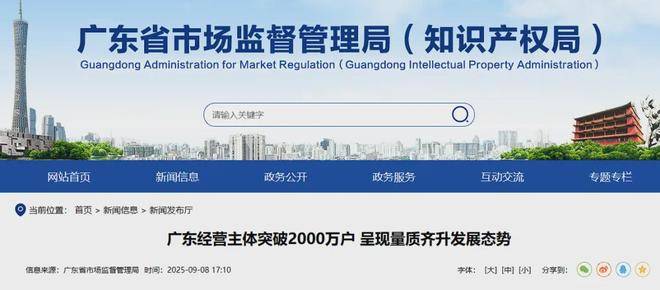
广东经营主体突破2000万,每6个人就有一个老板!
Sou Hu Cai Jing· 2025-09-12 11:46
Core Insights - The number of registered business entities in Guangdong Province has surpassed 20 million, marking a net increase of 953,100 entities, or 5%, compared to the end of 2024, maintaining its position as the highest in the country [1][5] - The entrepreneurial environment in Guangdong is thriving, with a significant increase in the number of companies compared to individual businesses, indicating a shift towards larger-scale operations [2][5] Business Composition - Among the 20 million registered entities, there are 9 million enterprises and 11 million individual businesses, with the proportion of enterprises increasing, reflecting a trend towards more organized business structures [2] - The private economy is a major driver of Guangdong's economy, with 19.25 million private economic organizations, representing 96.45% of total business entities, and a year-on-year growth of 6.47% [2][5] - Private enterprises have reached 8.35 million, showing a year-on-year increase of 10.6%, while individual businesses have grown by 3.52% to 10.91 million [2] New Economic Trends - Approximately 37.92% of newly established companies in Guangdong are engaged in "new quality productivity," with 414,600 new "four new economy" enterprises [3][4] - The digital economy sector has seen a significant year-on-year growth of 25.41%, with 167,600 new digital economy enterprises established [3][4] Investment Climate - Foreign investment confidence in Guangdong is increasing, with 230,000 registered foreign-invested enterprises, a net increase of 15,000, or 6.97%, since the end of 2024 [4] - The Guangdong-Hong Kong-Macao Greater Bay Area has become a preferred destination for foreign investment, with 18,500 new foreign-invested enterprises established in the nine cities of the Greater Bay Area, accounting for 97.73% of the total new foreign enterprises in the province [4] Economic Vitality - Guangdong's business entity growth from 19.04 million to 20 million in just nine months highlights the province's remarkable entrepreneurial density, with one business for every six residents [5] - The scale of registered enterprises in Guangdong is significantly higher than that of leading U.S. states, showcasing its robust market vitality [5][6] - The growth of 20 million business entities reflects Guangdong's strong economic foundation, successful transformation and upgrading, and favorable business environment [6]

勇担国家中心城市使命 谱写人民城市郑州新篇
Zheng Zhou Ri Bao· 2025-09-12 00:39
Core Viewpoint - Zhengzhou aims to implement the spirit of the Central Urban Work Conference by enhancing urban resilience, improving citizen happiness, promoting historical and cultural heritage, stimulating innovation and entrepreneurship, increasing openness, and refining smart governance systems, contributing to China's modernization efforts [1][2]. Group 1: Urban Resilience - Zhengzhou is committed to enhancing urban safety by learning from past disasters, such as the "7·20" heavy rain, and is advancing infrastructure projects to improve disaster response capabilities [3]. - The city is focusing on a comprehensive public safety network and strict law enforcement to maintain social stability and safety [3]. Group 2: Citizen Happiness - The city prioritizes public services in education, healthcare, and elderly care, aiming for equitable distribution and improved service quality [4]. - Initiatives include the establishment of a 100 billion yuan youth innovation and entrepreneurship fund and a plan to retain one million university graduates over five years [5]. Group 3: Cultural Heritage - Zhengzhou, as one of China's ancient capitals, is enhancing its cultural heritage through the development of a comprehensive museum and archaeological park system [6]. - The city aims to creatively transform and develop traditional culture, ensuring historical resources are preserved and integrated into modern life [6]. Group 4: Innovation and Entrepreneurship - The city is focusing on innovation-driven development, with significant growth in high-tech industries and a robust research and development ecosystem [7]. - Zhengzhou plans to deepen the integration of education, technology, and talent to foster a conducive environment for innovation [7]. Group 5: Openness - Zhengzhou is positioned as a major transportation hub, with significant achievements in international trade and logistics, including a high ranking in cargo throughput at its airport [8]. - The city is enhancing its cross-border e-commerce capabilities and aims to become a national innovation demonstration zone [8]. Group 6: Smart Governance - The city is implementing a "党建+网格+大数据" governance model to improve efficiency and responsiveness in public service delivery [9][10]. - Since the introduction of a unified platform for governance, over 7.2 million events have been processed, enhancing public satisfaction and trust in local governance [10]. Group 7: Regional Development - Zhengzhou is leveraging its role as a central city to drive regional development through integrated urban planning and collaboration with surrounding areas [11].
上市公司半年报出炉,A股全市场近六成公司营收正增长
Sou Hu Cai Jing· 2025-09-02 01:51
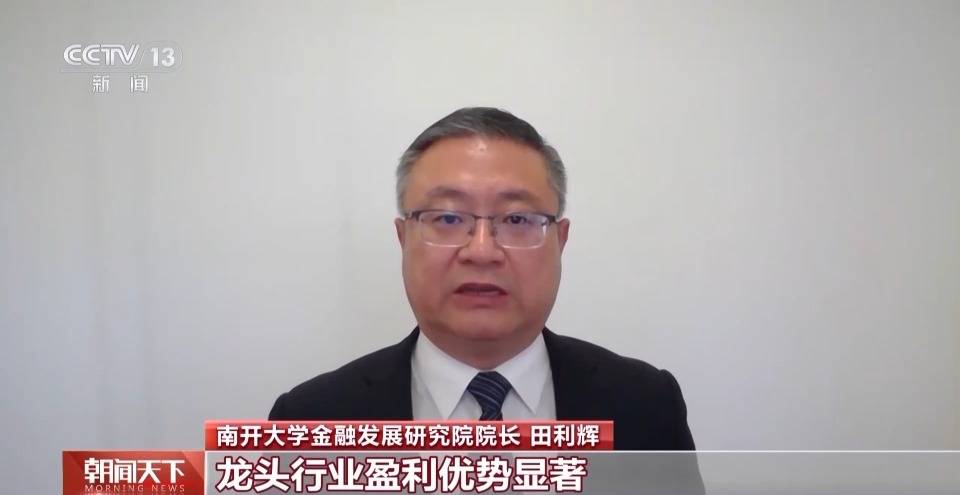
Group 1 - As of August 31, 2025, a total of 5,432 listed companies in A-shares disclosed their semi-annual reports, showing continuous optimization of industrial structure and steady strengthening of endogenous momentum [1] - In the first half of 2025, the total operating revenue of listed companies reached 35.01 trillion yuan, a year-on-year increase of 0.16%, while net profit was 3 trillion yuan, up 2.54% year-on-year, with an acceleration of 4.76 percentage points compared to the previous year's full-year growth [1] - Nearly 60% of companies reported revenue growth, over three-quarters achieved profitability, with 2,475 companies showing positive net profit growth and 1,943 companies experiencing both revenue and net profit growth [1] Group 2 - Leading industries are showing significant profitability advantages, with accelerated industry concentration driven by policies and funding, particularly in AI, chips, and optical modules, which are driving growth across the entire industrial chain [3] - The performance of small and medium-sized enterprises is notable, with revenue growth in the ChiNext, Sci-Tech Innovation Board, and Beijing Stock Exchange reaching 9.03%, 4.90%, and 6.08% respectively, significantly surpassing the overall market level [3] Group 3 - The advanced manufacturing sector is leading in performance, with industries such as military, new energy, and medical devices showing strong results [7] - The "old-for-new" subsidy policy has led to sustained high growth in the production and sales of new energy vehicles, with related companies seeing net profit growth exceeding 30% [7] - The home appliance replacement trend has resulted in industry revenue and net profit growth exceeding 9% [7] Group 4 - Despite facing tariff pressures from the U.S., listed companies demonstrated resilience, achieving overseas revenue of 4.90 trillion yuan, a year-on-year increase of 4.50%, with the proportion of overseas income rising for three consecutive years [9] - Shipbuilding has led globally, with export delivery value increasing by 38.6%, and listed companies in this sector reporting revenue growth of 23.42% and net profit growth of 135.33% [9] - Emerging markets have become a core growth driver, with domestic internet giants accelerating overseas warehouse layouts, leading to significant investment growth in cross-border e-commerce, exceeding 15% [9]
多方紧密部署 服务贸易系列政策加快“落子
Shang Hai Zheng Quan Bao· 2025-08-28 12:16
Core Viewpoint - The Chinese government is accelerating the implementation of policies to support service trade, indicating a positive growth trend in this sector [1][2]. Group 1: Policy Initiatives - The State Council's recent study emphasizes the need to enhance the international competitiveness of service exports, focusing on areas such as research, consulting, e-commerce, and digital service trade [2]. - The Ministry of Commerce plans to introduce a series of measures to promote service exports, including optimizing zero tax rate declaration procedures and increasing export credit insurance support [2][5]. - The government aims to leverage the effects of visa-free policies to attract more foreign tourists, thereby boosting travel service exports [2][3]. Group 2: Service Trade Growth - The global service export is projected to grow by 4% by 2025, with major economies showing robust growth in service trade during the first half of the year [1]. - In the first half of the year, transportation service exports reached 418.5 billion yuan, growing by 23.9%, while travel service exports surged to 174.87 billion yuan, marking a 68.7% increase [2][5]. Group 3: Digital Service Trade - The development of digital service trade is prioritized, with a focus on cross-border e-commerce and the digital transformation of trade processes [3]. - The Ministry of Commerce is set to promote and regulate cross-border data flow, which is crucial for many multinational companies [3]. Group 4: Negative List Management - The reduction of the negative list for cross-border service trade is a key strategy for expanding service imports [3][4]. - The government is actively monitoring the implementation of the negative list and addressing any challenges that arise [4]. Group 5: Future Outlook - The next phase is expected to see increased support from fiscal, tax, financial, and regulatory measures for service trade, particularly service exports [5]. - Overall, service trade is anticipated to maintain growth throughout the year, with an ongoing optimization of trade structure [5].
【环球财经】卢拉政府推多项增税措施以增加财政收入
Xin Hua Cai Jing· 2025-07-21 09:43
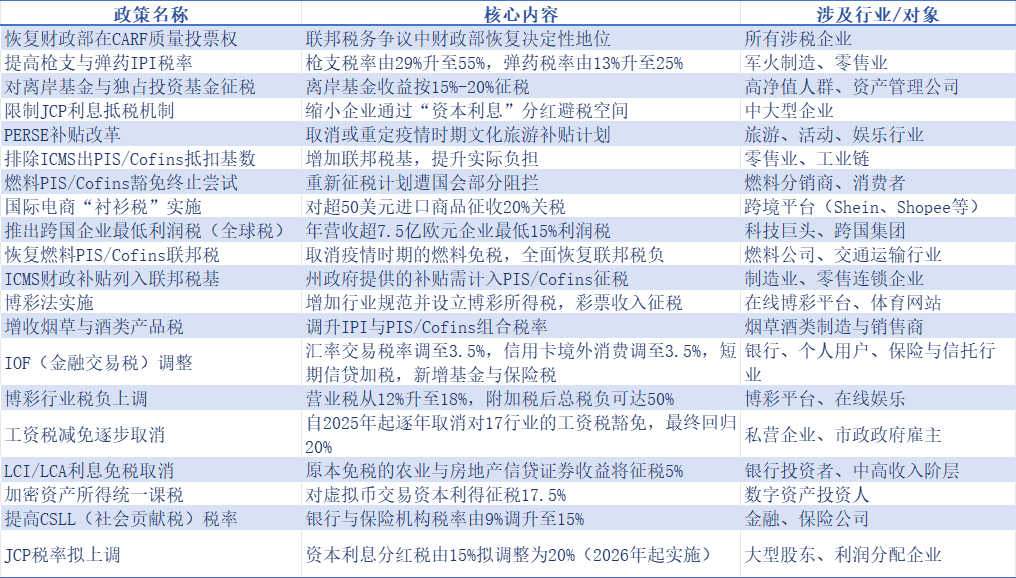
Core Viewpoint - The Brazilian government has implemented approximately 25 tax adjustments since January 2023 under President Lula's administration, aiming to achieve fiscal balance and strengthen public finances [1][2]. Tax Policy Adjustments - The government has increased existing tax rates, eliminated certain tax exemptions, introduced new taxes, and raised taxes on specific goods and services [1]. - Notable measures include a special tax on the sports betting industry, the "shirt tax" on international shopping, and the financial transaction tax (IOF) [1]. Specific Tax Changes - The IPI tax rate on firearms has increased from 29% to 55%, and the tax on ammunition has risen from 13% to 25% [2]. - Offshore funds will be taxed on earnings at rates between 15% and 20% [2]. - The "shirt tax" imposes a 20% tariff on imported goods valued over $50 [2]. - A minimum profit tax for multinational corporations with annual revenues exceeding €750 million will be set at 15% [2]. - The gambling sector will see an increase in operational taxes from 12% to 18%, with total tax burdens potentially reaching 50% [2]. - The tax rate on capital interest dividends (JCP) is proposed to rise from 15% to 20% starting in 2026 [2]. Economic Implications - The continuous optimization of tax policies is expected to modernize Brazil's tax system, enhancing fairness and efficiency, which is crucial for long-term sustainable development [3]. - While these tax increases may initially pressure businesses and consumers, they are deemed essential for consolidating national finances and promoting economic stability [3]. - The Brazilian Central Bank and Ministry of Finance will closely monitor the effects of these policies to balance fiscal goals with economic growth [3].
《广州市2025年优化营商环境重点任务及措施清单》发布
Guang Zhou Ri Bao· 2025-07-18 01:57
Group 1: Core Initiatives - Guangzhou has introduced a comprehensive "big gift package" consisting of 105 specific measures aimed at optimizing the business environment by 2025 [2][3] - The initiatives focus on four main areas: market environment, legal environment, investment and trade environment, and government service environment [2][3] Group 2: Market Environment Enhancements - The plan includes 34 measures to enhance market vitality, such as maintaining fair competition, reducing overall business costs, and improving financing services for small and micro enterprises [3] - Specific actions include the establishment of a complaint channel for fair competition and the promotion of decentralized evaluation in bidding processes [3] Group 3: Legal Environment Improvements - The legal environment will be enhanced through 18 measures aimed at standardizing administrative inspections and optimizing legal services [4][5] - Key actions include the implementation of a "no disturbance" list for administrative enforcement and the establishment of a special action to inspect illegal enterprise charges [4][5] Group 4: Investment and Trade Environment - The investment and trade environment will be improved with 20 measures, focusing on attracting foreign investment and enhancing cross-border trade efficiency [6] - Initiatives include supporting foreign investment in R&D centers and promoting pilot programs for qualified foreign limited partners (QFLP) [6] Group 5: Government Service Environment - The government service environment will be streamlined with 33 measures aimed at improving efficiency in business registration, project approval, and tax processes [7] - Innovations such as "AI-guided" services and a one-stop service platform for enterprises are part of the plan [8][9] Group 6: Financial Support for Enterprises - The plan proposes the establishment of a 100 billion yuan future industry technology innovation fund and a 200 billion yuan industry development fund to support technological innovation [10] - Measures to facilitate financing for small and micro enterprises include enhancing the financing application process and providing free incubation space [10] Group 7: Reform and Pilot Initiatives - The plan includes over 10 pilot measures to address challenges in the business environment, focusing on both attracting foreign investment and supporting domestic enterprises in going global [11] - Specific actions involve the establishment of a comprehensive service base for Chinese enterprises going abroad and the expansion of foreign investment in key sectors [11]