量子技术

Search documents
【投融资动态】中科酷原D轮融资,融资额近亿人民币,投资方为中国移动
Sou Hu Cai Jing· 2026-01-14 11:35
Core Insights - Zhongke Kuyuan Technology (Wuhan) Co., Ltd. has completed a Series D financing round, raising nearly 100 million RMB, with China Mobile among the participating investors [1] - The company is the first in China to possess both atomic quantum computing and quantum precision measurement research and industrialization capabilities [1] - Zhongke Kuyuan is recognized as a "chain leader" in the quantum technology industry chain in Hubei Province, with a core team originating from the Chinese Academy of Sciences Precision Measurement Research Institute [1] - The team has over 20 years of experience in neutral atom quantum technology research, accumulating systematic technical capabilities in quantum computing and precision measurement applications [1]



杨德龙:2026年市场行情开局良好
Xin Lang Cai Jing· 2026-01-13 09:32
Core Viewpoint - The market in 2026 is expected to continue the trends of 2025, with a more diversified performance across various sectors, moving away from the "barbell" strategy observed in 2025, where low-valuation, high-dividend sectors like banks and high-performing tech stocks dominated [1][10]. Group 1: Market Trends and Investor Behavior - In 2025, the market exhibited a "barbell" characteristic, with significant gains in low-valuation sectors and standout performance in tech stocks, while traditional sectors showed lackluster performance [1][10]. - Many investors did not achieve satisfactory returns in 2025 due to inadequate allocation towards the two main investment themes, leading to lower overall returns and even losses [1][10]. - The strong performance of the market in 2026 is anticipated to enhance investor confidence and improve the overall market sentiment [1][8]. Group 2: Capital Market Dynamics - A significant shift in resident savings is expected, with a large influx of funds into the capital market, driven by declining savings rates and limited investment opportunities in traditional sectors [2][11]. - In 2025, new fund issuance exceeded 1 trillion yuan, primarily in equity funds, marking a notable shift where equity fund sales surpassed fixed-income products for the first time [2][11]. - The number of new stock accounts opened in 2025 reached over 27 million, indicating strong investor interest and engagement in the capital market [2][11]. Group 3: Economic Impact and Consumer Behavior - The capital market's recovery is seen as a crucial mechanism for boosting consumer spending, as families recover from significant wealth losses due to declining real estate values [3][12]. - The market's performance is expected to help stabilize the real estate sector, particularly in core areas of first-tier cities, while many regions still face oversupply issues [3][12]. - The ongoing bull market is viewed as a vital tool for enhancing household financial health and increasing disposable income, thereby stimulating consumption [3][12]. Group 4: Technological Innovation and Investment Opportunities - The strengthening of the stock market is projected to facilitate a resurgence in IPOs, allowing more tech innovation companies to access capital [4][13]. - The focus of the "14th Five-Year Plan" aligns with sectors that performed well in 2025, such as semiconductors and quantum technology, indicating significant opportunities for growth in these areas [4][13]. - The AI technology sector is still in its early stages, with substantial potential for growth as it moves towards large-scale commercialization [5][14]. Group 5: Investment Strategy and Sector Differentiation - Investment in tech stocks in 2026 will require a more differentiated approach, focusing on companies with core technologies and real application potential, as opposed to those that are merely conceptual [6][15]. - The human-robotics sector is expected to shift from a phase of expectation to one of actual order fulfillment, with companies securing contracts from leading manufacturers likely to see greater growth [6][15]. - Other tech sectors are anticipated to follow a similar trajectory, with software companies and data-related enterprises poised for growth as the industry evolves [7][15]. Group 6: Overall Market Sentiment - The market is expected to see an increase in profitability and investor satisfaction, contributing to a sustained recovery in market confidence [8][16].
济南:不凡的2025·1.4万亿里的含金量
Feng Huang Wang Cai Jing· 2026-01-13 07:22
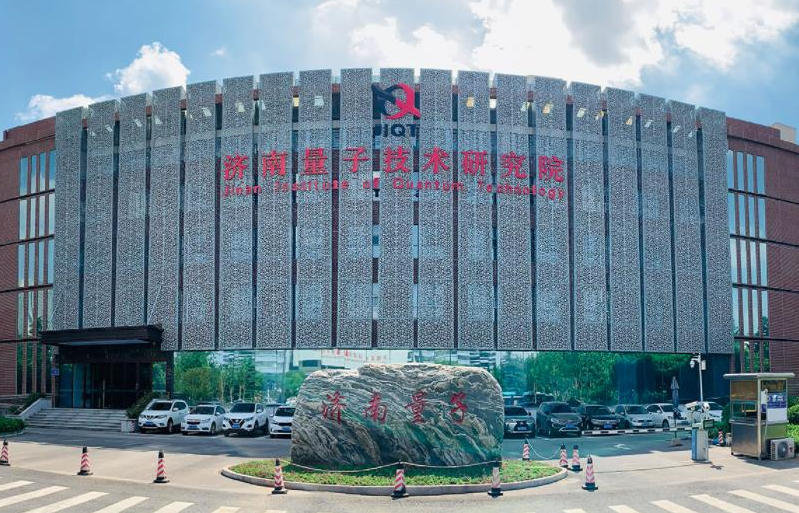
Economic Growth - Jinan's GDP reached 10,434 billion yuan in the first three quarters, with a year-on-year growth of 5.4%, indicating a strong economic performance as it aims to surpass 14 trillion yuan by 2025 [1][3] - The achievement of crossing four 1 trillion yuan milestones in five years reflects not just numerical growth but also a comprehensive enhancement in development quality [1] Technological Innovation - The establishment of the Jinan Quantum Technology Research Institute and the successful launch of significant technological innovations, such as the world's largest diameter intelligent shield tunneling machine, highlight the city's advancements in technology [3] - Jinan's ranking in the global research city index improved from 57th in 2021 to 27th in 2025, showcasing a significant enhancement in its scientific research capabilities [3] Industrial Development - The city is building a complete industrial ecosystem in the aerospace and low-altitude economy sectors, with the artificial intelligence core industry expected to reach a scale of 60 billion yuan [5] - Jinan is home to the largest production bases for hyaluronic acid, cephalosporins, heavy-duty vehicles, and new energy vehicles in northern China, indicating a robust industrial structure [5] Sustainable Development - Jinan has completely transitioned from coal heating, with a cumulative reduction of 23.5% in energy consumption per unit of GDP from 2021 to 2024, and maintains a 100% rate of good water quality in surface water [7] - The city is committed to ecological and industrial symbiosis, aligning with national strategies for ecological protection and high-quality development [7] Social Development - Jinan is focused on enhancing the "happiness index" of its residents, with significant investments in urban renewal and infrastructure, including the renovation of 2,381 old urban communities and the expansion of public transportation [9] - The city has achieved a 100% enrollment rate in nine-year compulsory education and is accelerating the construction of national regional medical centers, improving public health services [9]
研报掘金丨东北证券:首予国盾量子“买入”评级,看好其长期发展趋势
Ge Long Hui A P P· 2026-01-09 09:03
Group 1 - The core viewpoint of the article highlights that GuoDun Quantum is positioned as a leader in the quantum computing industry, marking a new chapter in quantum computing [1] - The company has a comprehensive layout in quantum communication, quantum computing, and quantum measurement, demonstrating scalable industrialization capabilities [1] - The Ministry of Industry and Information Technology plans to focus on quantum technology applications in key sectors such as healthcare, finance, energy, and transportation by 2025, which is expected to open market opportunities for the industry [1] Group 2 - The quantum computing industry is recognized as a crucial sector for future national and global development, transitioning from laboratory research to industrial application [1] - As a core leader in domestic quantum computing, GuoDun Quantum is viewed positively for its long-term growth prospects, with an initial coverage rating of "Buy" [1]

杨德龙:新年牛市氛围愈来愈浓 市场赚钱效应明显提高
Xin Lang Cai Jing· 2026-01-08 03:22
Core Viewpoint - The A-share and Hong Kong stock markets are experiencing a continuous upward trend, with the Shanghai Composite Index achieving a historic "14 consecutive days of gains," confirming the ongoing "policy bull" market since September 24, 2024 [1][7]. Policy and Economic Environment - Economic growth stabilization policies are gradually taking effect, expected to improve economic data in 2026 and boost demand through moderate price recovery [1][7]. - The new "National Nine Articles" has significantly changed the A-share market ecosystem, with companies increasing cash dividends and stock buybacks to reward investors [1][7]. - The central bank has introduced policy tools to support the capital market and attract incremental capital [1][7]. Market Dynamics - In 2025, the Shanghai Composite Index broke the 4000-point mark for the third time, with concerns that it might be a market peak; however, it is viewed as the starting point for a new market phase [1][7]. - The market is expected to transition from a structural bull to a comprehensive bull market in 2026, driven by the increasing participation of retail investors [2][8]. Investor Behavior - The public fund sales in 2025 exceeded 1 trillion units, with equity funds accounting for over half [2][8]. - In December 2025, 2.6 million new stock accounts were opened, marking a 30.54% year-on-year increase, indicating a strong trend of household savings moving into the capital market [2][8]. - By the end of 2025, the total number of A-share accounts approached 400 million, with individual investors making up over 99% of the market, highlighting its retail-driven nature [2][8]. Market Performance - The A-share market saw an overall increase in 2025, with the Shanghai Composite Index rising by 18.41% and the ChiNext Index increasing by over 50%, reflecting a broadening market profit effect [3][9]. - The current bull market is characterized by a slow and steady increase, potentially lasting 3-10 years, marking a significant shift in A-share market dynamics [3][9]. Future Outlook - The 2026 market is expected to continue the trends of 2025, with technology stocks remaining a key investment focus, alongside sectors like consumption, new energy, and military industry [4][10]. - The bull market is seen as a once-in-a-decade opportunity, with the potential to set historical records in duration [4][10]. Economic Impact - The bull market aims to boost consumption by enhancing household balance sheets and consumer confidence, thereby stimulating domestic demand [5][11]. - It is also expected to stabilize the real estate market as investors may redirect profits from the stock market into property purchases [5][11]. - The market's prosperity will support the development of innovative technology companies, fostering economic transformation and new growth drivers [6][11].
科大国盾量子技术股份有限公司 第四届董事会第二十次会议决议公告
Zhong Guo Zheng Quan Bao - Zhong Zheng Wang· 2025-12-20 06:25
Group 1 - The company held its 20th meeting of the 4th Board of Directors on December 19, 2025, where all 10 directors were present, and the meeting was conducted in accordance with relevant laws and regulations [2][3][4] - The board unanimously approved the proposal to appoint director Ying Yong as the acting chairman and legal representative until a new chairman is elected [3][10] - The board also approved two related party transactions, including a procurement service contract with Ququan Technology for an estimated amount of 8.7 million yuan and a sales contract with Client C for an estimated amount of 4.28 million yuan [5][7][13] Group 2 - The total amount of procurement contracts with related parties over the past 12 months, including the new contract with Ququan Technology, is 10.6975 million yuan [5][13] - The total amount of sales contracts with related parties over the past 12 months, including the new contract with Client C, is 4.9584 million yuan [7][13] - The transactions do not constitute a major asset reorganization and are part of the company's normal business operations [14][27]
国仪量子IPO状态变更为已问询
Xin Lang Cai Jing· 2025-12-19 12:36
根据上交所最新披露的信息,2025年12月19日,国仪量子技术(合肥)股份有限公司IPO的状态从已受 理变更为已问询。 根据上交所最新披露的信息,2025年12月19日,国仪量子技术(合肥)股份有限公司IPO的状态从已受 理变更为已问询。 ...
知名公司董事长突然去世,警方通报
Sou Hu Cai Jing· 2025-12-19 05:15
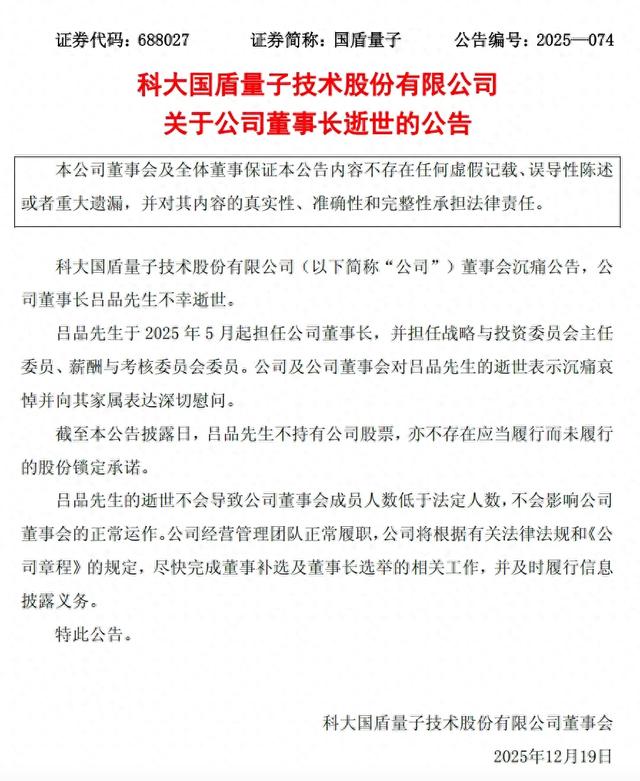
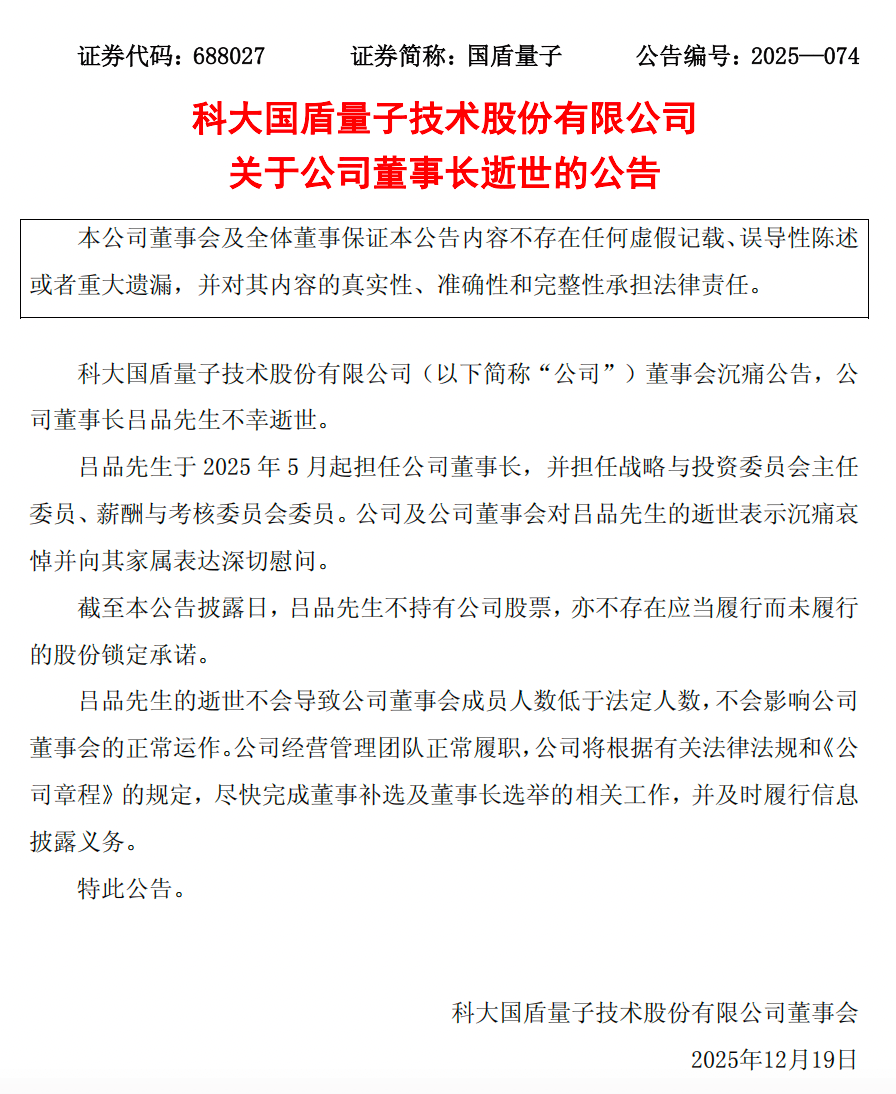
12月18日晚间,科大国盾量子技术股份有限公司公告,公司董事长吕品不幸逝世,具体内容如下: 吕品先生于 2025年5月起担任公司董事长,并担任战略与投资委员会主任委员、薪酬与考核委员会委员。公司及公司董事会对吕品先生的逝世表 示沉痛哀悼并向其家属表达深切慰问。 截至本公告披露日,吕品先生不持有公司股票,亦不存在应当履行而未履行的股份锁定承诺。 吕品先生的逝世不会导致公司董事会成员人数低于法定人数,不会影响公司董事会的正常运作。公司经营管理团队正常履职,公司将根据有关法 律法规和《公司章程》的规定,尽快完成董事补选及董事长选举的相关工作,并及时履行信息披露义务。 12月18日晚间,合肥高新公安分局发布警情通报。通报称:2025年12月18日13时许,我局接报警称,吕某(男,46岁)在望江西路与孔雀台路交 口某公司一办公室内失去意识,接警后,民警立即到场处置。经120现场确认,吕某已无生命体征。经公安机关勘查调查,已排除案件。 警 情 通 报 2025年12月18日13时许,我局接报警称,吕 某(男,46岁)在望江西路与孔雀台路交口某公 司一办公室内失去意识。接警后,民警立即到场 处置。经120现场确认,吕某已无 ...
摩根士丹利邢自强:未来五年中国前沿行业将“再拔头筹”
Zhong Guo Xin Wen Wang· 2025-12-18 17:38
Core Viewpoint - The next five years will see China leading in advanced industries such as 6G networks, quantum technology, brain-computer integration, nuclear fusion, and next-generation biomanufacturing, driven by significant advantages in industrial capabilities, talent, and domestic market utilization [1][2] Group 1: Industrial Advantages - China has a first-mover advantage in electric vehicles, lithium batteries, next-generation smart cars, and future nuclear fusion technologies, attributed to three main advantages [1] - The first advantage is the industrial chain clustering capability, where regions like the Yangtze River Delta and Pearl River Delta can quickly access various components and engineers within a few dozen kilometers, a unique advantage not replicable by any other economy [1] - The second advantage is the talent reserve, with China producing a large number of graduates in artificial intelligence each year, providing a foundational talent pool for industrial and innovative development [1] Group 2: Market Utilization - The third advantage is the effective use of the domestic market, where most Chinese companies start locally, leveraging strong domestic demand to enhance product competitiveness before expanding internationally [1] - These three advantages are expected to continue to evolve and be leveraged during the 14th Five-Year Plan period [2]
46岁国盾量子董事长意外去世
Xin Lang Cai Jing· 2025-12-18 16:10
截至本公告披露日,吕品先生不持有公司股票,亦不存在应当履行而未履行的股份锁定承诺。 吕品先生的逝世不会导致公司董事会成员人数低于法定人数,不会影响公司董事会的正常运作。公司经 营管理团队正常履职,公司将根据有关法律法规和《公司章程》的规定,尽快完成董事补选及董事长选 举的相关工作,并及时履行信息披露义务。 登录新浪财经APP 搜索【信披】查看更多考评等级 智通财经记者 秦盛 12月18日晚间,科大国盾量子技术股份有限公司(688027)公告,公司董事长吕品不幸逝世,具体内容 如下: 吕品先生于 2025 年 5 月起担任公司董事长,并担任战略与投资委员会主任委员、薪酬与考核委员会委 员。公司及公司董事会对吕品先生的逝世表示沉痛哀悼并向其家属表达深切慰问。 12月18日晚间,合肥高新公安分局发布警情通报。通报称:2025年12月18日13时许,我局接报警称,吕 某(男,46岁)在望江西路与孔雀台路交口某公司一办公室内失去意识,接警后,民警立即到场处置。 经120现场确认,吕某已无生命体征。经公安机关勘查调查,已排除案件。(此前报道:) 对此,国盾量子办公楼所在园区中安创谷科技园的工作人员对智通财经记者确认,当天 ...