
风能

Search documents
泰胜风能:股票交易异常波动
2 1 Shi Ji Jing Ji Bao Dao· 2026-01-08 10:35
Core Viewpoint - The stock of Taisheng Wind Power has experienced an abnormal trading fluctuation, with a cumulative price increase of over 30% during three consecutive trading days from January 6 to January 8, 2026 [1] Summary by Relevant Sections - **Stock Trading Fluctuation** The company announced that its stock price had deviated significantly, exceeding a 30% increase over three consecutive trading days, which is classified as an abnormal trading situation according to Shenzhen Stock Exchange regulations [1] - **Verification of Information** The company confirmed that there are no corrections or supplements needed for previously disclosed information, and no significant undisclosed information has been found that could impact the stock price [1] - **Operational Status** The company stated that there have been no major changes in its operational situation or external business environment recently. Additionally, the controlling shareholder has not engaged in any stock trading during the abnormal fluctuation period [1] - **Business Development** The company is in the early stages of business layout in the commercial aerospace sector, focusing on production line transformation and market expansion [1] - **Investor Advisory** The company reminded investors to make rational investment decisions and to be aware of trading risks associated with the stock [1]

泰胜风能:公司在商业航天领域相关规划处于业务布局起步阶段
Xin Lang Cai Jing· 2026-01-08 10:33
Core Viewpoint - The stock of the company (stock code: 300129) has experienced a cumulative price increase of over 30% during three consecutive trading days (January 6, 2026, January 7, 2026, and January 8, 2026) [1] Group 1 - The company has confirmed that there are no corrections or supplements needed for previously disclosed information [1] - No undisclosed significant information has been found that could impact the company's stock trading price [1] - The company's operational situation and external business environment have not undergone significant changes [1] Group 2 - The company and its controlling shareholders do not have any significant matters that should have been disclosed but were not [1] - The company's stock has been included in the commercial aerospace sector by some websites [1] - The company's planning in the commercial aerospace field is currently in the initial stage of business layout [1]
泰胜风能:向特定对象募资11.76亿,签订三方监管协议
Xin Lang Cai Jing· 2025-12-31 07:55
Group 1 - The company announced the issuance of 173,954,013 shares to Guangzhou Kaide Investment Holding Co., Ltd. at a price of 6.76 yuan per share, raising a total of 1.176 billion yuan, with a net amount of 1.169 billion yuan [1] - The company's board approved the establishment of a special account at Industrial Bank's Guangzhou Science City branch for fund storage and usage, with a balance of 1.173 billion yuan as of 2025 [1] - A tripartite supervision agreement was signed among the company, Industrial Bank's Guangzhou Science City branch, and other parties, clarifying the rights and obligations of each party until the funds in the special account are fully utilized and the supervision period ends [1]
信义储电(08328.HK)披露关连交易出售金寨信义风能股权,12月24日股价下跌4.92%
Sou Hu Cai Jing· 2025-12-24 10:07
《联合公告 - 关连交易 - 出售及购买金寨信义风能之股权》 以上内容为证券之星据公开信息整理,由AI算法生成(网信算备310104345710301240019号),不构成 投资建议。 截至2025年12月24日收盘,信义储电(08328)报收于0.58元,较前一交易日下跌4.92%,该股当日开盘 0.58元,最高0.59元,最低0.58元,成交额达40.29万元。近52周最高1.08元,最低0.53元。 根据近日发布的联合公告,于2025年12月23日,信义玻璃(芜湖)与安徽信义电源作为卖方,与买方信 义能源(繁昌)订立股权转让协议,有条件同意出售金寨信义风能的全部股权,总代价为人民币6200万 元(可调整),其中信义玻璃(芜湖)获人民币5080万元,安徽信义电源获人民币1120万元。代价分两 期支付,90%于完成时支付,10%作为担保付款于满足条件后支付。交易完成后,金寨信义风能将成为 信义能源的全资附属公司。此次交易构成信义玻璃、信义能源、信义光能及信义储电的关连交易,因相 关百分比率高于0.1%但低于5%,须遵守申报及公告规定,豁免通函及独立股东批准。信义玻璃及信义 储电预计将分别确认收益3360万 ...
港股异动 金风科技(02208)涨超3% 花旗认为明年国内风能和太阳能装机产量指引预测可能过低
Jin Rong Jie· 2025-12-18 04:11
Core Viewpoint - The article highlights the recent performance of Goldwind Technology (02208), which saw a stock increase of over 3% following the 2026 National Energy Work Conference, emphasizing the push for higher energy security and a green low-carbon transition in China's energy sector [1]. Group 1: Company Performance - Goldwind Technology's stock rose by 3.31%, reaching HKD 13.75, with a trading volume of HKD 148 million [1]. Group 2: Industry Developments - The 2026 National Energy Work Conference in Beijing emphasized the need for enhanced energy security and a transition to green low-carbon energy, aiming for over 200 million kilowatts of new wind and solar power installations in the year [1]. - Citigroup's report indicated a decline in several mainland public utility stocks, attributing this to conservative guidance from the National Energy Administration regarding next year's targets for new wind and solar installations, as well as a cautious stance on hydropower and nuclear development [1]. - The report suggests that the forecast of exceeding 200 GW for wind and solar installations next year may be underestimated, and anticipates increased capital expenditure on hydropower and nuclear projects during the 14th Five-Year Plan to meet emission reduction goals [1]. - There is an expectation for accelerated growth in global energy storage system (ESS) demand [1].

业内人士热议中国企业出海:出海方式更多元 增长结构更均衡
Zhong Zheng Wang· 2025-12-17 08:44
Core Insights - Chinese enterprises have achieved significant success in international markets but face challenges such as insufficient brand recognition and the need for improved localization [1][2] - China's merchandise trade export value exceeded that of the same period in 2024, contributing positively to economic growth [1] - China is positioned as a key player in global green transformation, leading in sectors like photovoltaics, wind energy, electric vehicles, and energy storage [1] Industry Trends - The "2025 China Brand Going Global Top Ten Industry Research Report" indicates a steady growth trend for Chinese brands abroad, with manufacturing, technology, and consumer sectors collaborating effectively [1] - New generation brands are enhancing their product capabilities, technological levels, and global operational experience, leading to more diversified and balanced growth structures [1] - The shift in export strategies is moving from merely selling products to building systems and creating brands [1] Challenges and Recommendations - Companies face challenges related to regional and cultural differences, as well as policy variations when expanding internationally [2] - It is recommended that enterprises deepen their understanding of local cultures and customs to advance localization strategies [2] - Establishing infrastructure such as logistics and warehousing is essential for successful international operations [2] - A dual focus on technology and compliance is crucial for long-term stability, necessitating the development of a trustworthy and secure global service network [2]
8.3亿千瓦!中国能源装机超美欧总和,日本要铤而走险
Sou Hu Cai Jing· 2025-12-17 02:49
Group 1 - The current confrontation between Japan and China has escalated beyond mere diplomatic protests, with Japan's government under Prime Minister Kishi's leadership taking aggressive actions [1][3] - Japan is pursuing a Visiting Forces Agreement with the Philippines, granting its Self-Defense Forces near-unrestricted deployment rights in the region, indicating a significant military presence [5][9] - Japan's military strategy is not limited to the Asia-Pacific region; it is also attempting to involve European military alliances, which has raised concerns from Russia about the formation of an "Asian version of NATO" [9][10] Group 2 - China's rapid advancements in energy and military capabilities have left Japan feeling increasingly threatened, as evidenced by China's solar and wind energy installations surpassing those of the US and EU combined [13][15] - Japan's elite are aware that they have lost competitive advantages, with a projected trade surplus of over $1 trillion by 2025 signaling Japan's diminishing position in the global market [17][19] - The US's shifting strategic focus away from East Asia has exacerbated Japan's feelings of marginalization, prompting aggressive posturing from Japan's government as a means to regain attention from the US [19][20] Group 3 - The US is currently facing significant financial constraints, making it unlikely to engage in direct confrontation with China on Japan's behalf, which Japan's government seems to underestimate [25][26] - Japan's attempts to leverage economic measures against China, such as restricting exports of critical materials, may backfire and worsen its own economic situation [31][33] - Japan's reliance on the US for security while simultaneously trying to assert its own military presence is a precarious balancing act that may lead to unfavorable outcomes [35][39]


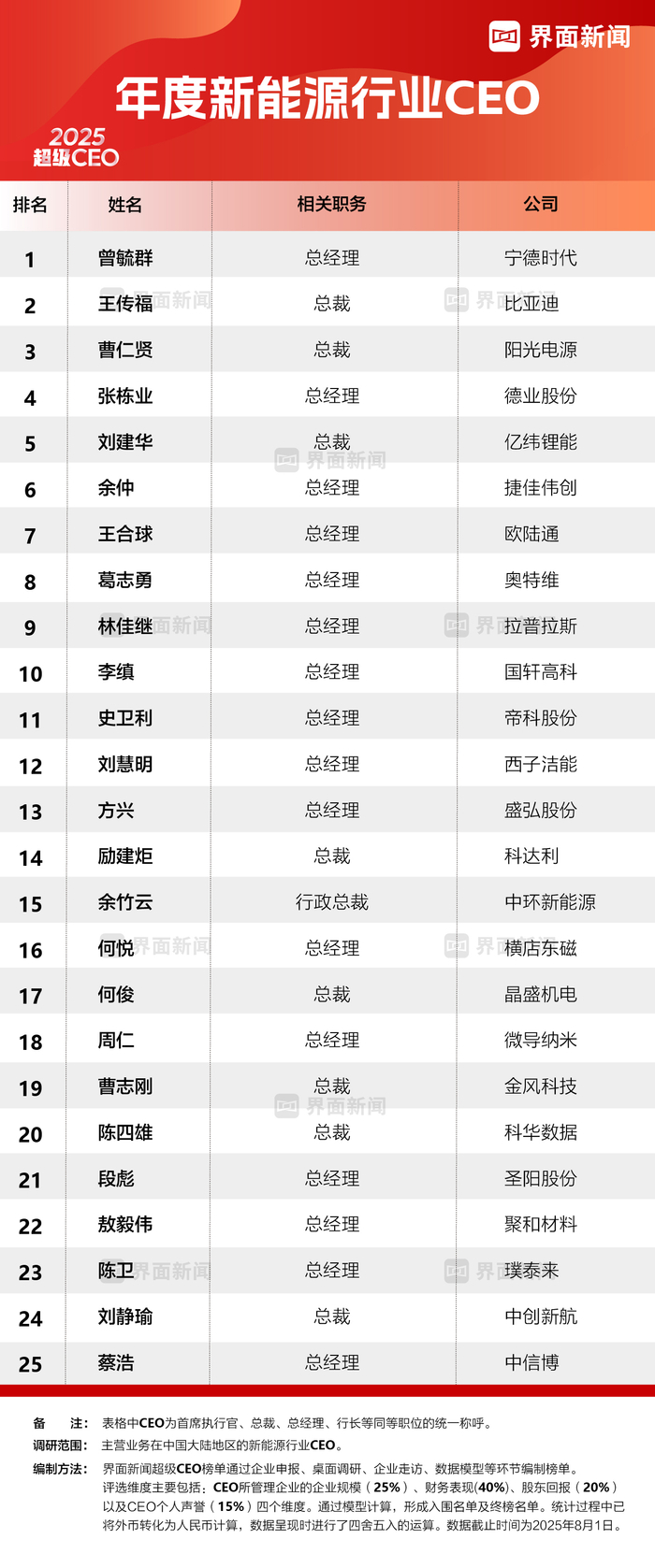
界面新闻2025年度新能源行业CEO榜单发布:宁德时代曾毓群蝉联榜首
Xin Lang Cai Jing· 2025-12-16 08:09
Core Insights - The article highlights the continuous growth and development of the renewable energy sector in China, emphasizing the significant contributions of various energy sources such as solar, wind, and lithium batteries to the country's carbon neutrality goals [1][6]. Renewable Energy Growth - China's renewable energy sector is on track to meet its carbon peak and carbon neutrality goals, with renewable energy accounting for nearly 60% of the total installed capacity as of June 2023 [1]. - In the first half of 2023, the newly installed renewable energy capacity reached 268 million kilowatts, a year-on-year increase of 99.3%, representing 91.5% of the total new installations [1]. - Renewable energy generation accounted for approximately 39.7% of the total electricity generation in the first half of 2023, with a total generation of 1,799.3 billion kilowatt-hours, marking a 15.6% increase year-on-year [2]. Policy and Market Trends - By 2025, the renewable energy sector is expected to undergo a policy shift focusing on quality and efficiency rather than just expansion, aiming to enhance energy security and promote a green transition [2]. - The solar industry is set to see a significant increase in new installations, with an expected 27.8 million kilowatts added in 2024, a 28% year-on-year growth [3]. Wind Energy Development - Wind energy is crucial for optimizing China's energy structure, with plans to accelerate the construction of large wind power bases and promote offshore wind development [4]. - In 2024, the newly installed wind power capacity is projected to reach 79.82 million kilowatts, a 6% increase, with total installed capacity expected to reach 521 million kilowatts by the end of the year [4]. Lithium Battery Industry - The lithium-ion battery industry is experiencing rapid growth, with a total output expected to exceed 1.2 trillion yuan in 2024, and production reaching 1,170 GWh, a year-on-year increase of over 24% [5]. - The export volume of lithium batteries is projected to reach 3.91 billion units in 2024, setting a new historical record [5]. CEO Performance and Company Insights - The article presents the 2024 Super CEO list, highlighting the performance of CEOs in the renewable energy sector, with a median revenue growth of 14.44% and a net profit growth of 18.25% among the listed companies [9]. - Notable CEOs include Zeng Yuqun from CATL, who led the company to achieve a revenue of 362.01 billion yuan in 2024, despite a 9.7% year-on-year decline, while net profit increased by 15.01% [15]. - The CEO of Sungrow, Cao Renxian, reported a revenue of 77.86 billion yuan in 2024, with a net profit increase of 16.92% [16]. - Jin Feng Technology's CEO, Cao Zhigang, achieved a revenue of approximately 56.70 billion yuan in 2024, with a net profit growth of 39.78% [17].




2025-2030年全球风能劳动力展望报告(英文版)
Sou Hu Cai Jing· 2025-12-11 08:51
Core Insights - The report highlights the urgent need for workforce development in the global wind energy sector, projecting a significant increase in labor demand due to the expansion of wind capacity from 2025 to 2030 [1][12][41] - By 2030, the global wind industry will require approximately 628,000 skilled technicians, driven by the need for both construction and maintenance of an expanding fleet [12][55][58] - The offshore wind sector, while only expected to account for 10% of total installed capacity, will represent about 25% of workforce demand, necessitating specialized skills and safety competencies [2][71] Labor Demand Characteristics - Onshore wind remains the primary source of installations, but offshore wind is growing rapidly, requiring a workforce with advanced technical skills [2][13] - The demand for labor is concentrated in construction and installation (C&I) and operations and maintenance (O&M), with O&M needs expected to increase significantly as the turbine fleet ages [20][21][42] - The industry faces challenges such as a shortage of skilled technicians, limited training capacity, and competition for talent across sectors [22][47][48] Strategic Solutions - The report suggests a collaborative approach involving public and private sectors to enhance workforce planning, training, and knowledge transfer [3][14] - Countries are taking action by establishing training institutions, promoting certification standards, and fostering partnerships between educational institutions and industry [3][16] - A focus on standardized training and international cooperation is essential to address the workforce shortage and support the industry's growth [3][16][36] Economic and Social Impact - Workforce development in the wind sector is crucial not only for achieving energy transition goals but also for creating high-quality jobs and supporting regional economic growth [3][23][50] - Ensuring equitable access to training and supporting workers transitioning from fossil fuel sectors are vital for a just energy transition [24][50] - The wind energy sector is positioned as a significant job creation engine, contributing to broader economic and social benefits [56][57]

共话中国经济新机遇|专访:德中经济合作深度与广度持续升级——访上海德国中心董事长兼首席执行官夏建安
Xin Hua Wang· 2025-12-09 03:14
Core Insights - The economic cooperation between Germany and China is continuously upgrading in depth and breadth, with significant potential for further enhancement [1] Group 1: Investment Trends - German companies are increasingly upgrading their investment models in China due to strong market demand, robust supply chains, low industrial electricity costs, stable energy supply, and a rich pool of skilled labor [1] - The need for German companies to enhance competitiveness in the Chinese and Asia-Pacific markets is driving additional investment [1] - Many German firms are shifting from solely relying on exports to local production and operations to meet cost-effectiveness and rapid local service demands [1] Group 2: Local Operations and R&D - German companies are recognizing that local teams have a better understanding of the supply chain and consumer market compared to their headquarters in Germany, leading to strategic upgrades in local operations [2] - Some companies are transferring part of their R&D from Germany to China or allowing their Chinese subsidiaries to conduct independent research and development [2] Group 3: Green Development - Green development practices are seen as a crucial breakthrough for long-term cooperation between Germany and China, with China making significant progress in green low-carbon development over the past decade [2] - German representatives visiting China are often impressed by the rapid advancements in green technologies, such as solar energy, wind energy, and sustainable transportation [3] Group 4: Collaboration and Understanding - There is a call for German business leaders to visit China to gain a more accurate understanding of the local market and environment [3] - The importance of mutual understanding and respect for differences is emphasized as a foundation for successful cooperation between Germany and China [3]