
网约车

Search documents
@新就业形态劳动者,这些保障实招请收好
Xin Lang Cai Jing· 2026-01-18 19:30
Core Insights - The new employment model in the province is rapidly developing, with 3.8 million workers requiring urgent social security and labor compensation needs [1] - The provincial human resources department has implemented a series of policies to protect the rights of new employment model workers, focusing on labor compensation, rest, and labor safety [2][3] Group 1: Policy Implementation - The provincial government has clarified the responsibilities of platform companies to address issues such as irregular labor compensation calculations and ambiguous labor relationships [2] - A labor rights protection implementation plan has been established for delivery workers, couriers, and ride-hailing drivers, with a labor rights maintenance working group formed by eight provincial departments [2] - The signing rate of labor contracts and participation in work injury insurance among new employment model workers has significantly increased, with platform commission rates becoming more transparent [2] Group 2: Social Security Innovations - The province has prioritized work injury insurance for new employment model workers, allowing for flexible participation in social insurance regardless of household registration [3] - Local innovations include pilot programs for pension insurance subsidies for delivery riders and a comprehensive risk protection system combining social insurance, occupational injury protection, and medical mutual assistance [3] Group 3: Dispute Resolution - A one-stop dispute resolution platform has been established to efficiently handle labor disputes, exemplified by a case where a network anchor received compensation after intervention [4] - The province has created a diversified dispute resolution system, with 87 one-stop labor dispute resolution organizations established, handling over 1,200 cases [4] - A "green channel" for arbitration has been implemented to assist unemployed workers, providing employment guidance and skills training [4] Group 4: Collaborative Efforts - The provincial government, trade unions, and social organizations are collaborating to protect the rights of new employment model workers, launching a care service action plan [5] - Over 5,056 "union stations" and 93 comprehensive service "driver homes" have been established to address basic needs such as food, water, rest, and sanitation for workers [5] - A special protection plan for new employment model workers is set to be piloted in 2025, focusing on logistics, freight driving, and food delivery sectors [5]
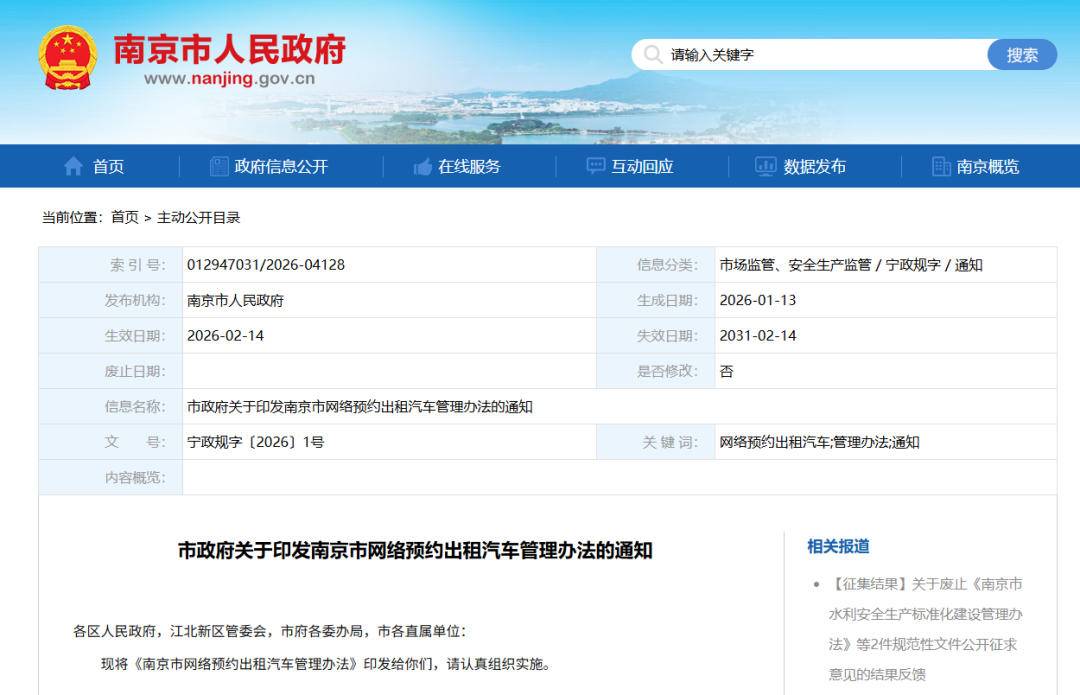
2月14日起南京网约车新规实施:取消驾驶员户籍要求,平台须公开抽成比例
Yang Zi Wan Bao Wang· 2026-01-18 08:02
Core Viewpoint - The Nanjing Municipal Government has officially released the "Nanjing Online Ride-Hailing Taxi Management Measures," which will take effect on February 14, 2026, and remain valid until February 13, 2031. This marks the first systematic revision of the policy since the initial implementation in 2017, aimed at adapting to new industry developments, further regulating market order, and protecting the legal rights of all parties involved. Group 1: Admission Criteria - The new policy relaxes vehicle age restrictions to within 2 years from the initial registration date, allowing eligible second-hand cars to enter the ride-hailing market [1] - The requirement for drivers to have local household registration or residence permits has been removed, enabling any driver under the legal retirement age with at least 3 years of driving experience and no serious criminal or legal violations to apply for ride-hailing services in Nanjing [1] Group 2: Platform Transparency - The new measures mandate that ride-hailing platforms must transparently disclose their commission rates, requiring them to publish the maximum commission percentage and provide detailed breakdowns of passenger payments, driver earnings, and platform commissions after each ride [2] - Drivers are granted the right to report any discrepancies if the actual commission exceeds the publicly announced limit [2] Group 3: Driver Rights Protection - The regulations prohibit platforms from forcing drivers to accept "discounted" or "fixed-price" orders, addressing issues of low-price competition and ensuring fair earnings for drivers [3] - The new rules enhance driver labor rights by requiring platforms to sign labor contracts and contribute to social insurance for drivers in qualifying situations, as well as establishing complaint handling mechanisms without retaliation against drivers [3] Group 4: Aggregator Platform Responsibilities - The revised measures explicitly define the responsibilities of "ride-hailing aggregator platforms," which must verify the legitimacy of the ride-hailing services they connect to and cannot allow unlicensed platforms [4] - Aggregator platforms are required to publicly display platform information and complaint channels, and they will be held accountable for passenger losses due to negligence in verification [4] - The regulations allow for joint supervision of platforms that engage in serious violations, such as operating unlicensed vehicles or infringing on driver rights, with relevant authorities empowered to take action [4]

无人驾驶崛起,网约车司机忧心!广州市政协委员建议互补发展
Nan Fang Du Shi Bao· 2026-01-17 11:55
Core Viewpoint - The proposal submitted by Fang Ou emphasizes the need for a balanced development of the autonomous ride-hailing industry while safeguarding the rights and transition pathways of traditional ride-hailing drivers as autonomous technology rapidly expands [2]. Group 1: Industry Development - The autonomous driving technology is experiencing explosive growth, with services already covering major cities like Beijing, Guangzhou, and Shenzhen, and some companies achieving over 10 million kilometers in total autonomous driving mileage [2]. - The cost of vehicle acquisition for autonomous ride-hailing has significantly decreased, accelerating the commercialization process [2]. Group 2: Impact on Traditional Drivers - Traditional ride-hailing drivers are facing income pressure and job insecurity due to the rise of autonomous vehicles, with over 80% of drivers expressing concerns about being replaced by technology [2]. - The existing industry protection systems and transition mechanisms for traditional drivers are inadequate [2]. Group 3: Recommendations for Transition - Fang Ou suggests that the transportation department should establish an evaluation mechanism for the capacity of autonomous ride-hailing services, approving deployment in phases based on market demand and road capacity [2]. - It is recommended to clarify the service scope and business boundaries of autonomous ride-hailing to ensure it complements rather than competes directly with traditional ride-hailing services [2]. Group 4: New Job Creation and Training - The autonomous driving industry is creating new job roles such as safety operators, maintenance personnel, and data annotators, but there is a lack of unified professional standards and skill certification systems for these positions [3]. - Fang Ou advocates for the establishment of a new occupational system and the expansion of employment channels, including collaboration between vocational schools and companies to provide targeted training for traditional ride-hailing drivers [3]. - The human resources department should lead the development of new occupational standards in the autonomous driving field, creating a one-stop service platform for training, certification, and employment [3].

经济日报:新就业形态劳动保障不应有盲区
Xin Lang Cai Jing· 2026-01-17 00:13
Core Viewpoint - The rapid development of the digital economy and platform economy has led to the expansion of new employment forms such as delivery riders, ride-hailing drivers, and freelancers, which often lack traditional employment relationships and social security protections [1][2]. Group 1: Current Challenges - New employment form workers have low participation rates in social insurance, not solely due to unwillingness but also due to low income levels, insufficient job stability, and short-term livelihood pressures [1]. - Many new employment form workers prioritize immediate income over long-term social security benefits [1]. Group 2: Government Initiatives - Since 2020, the inclusion of new employment form protections in the "14th Five-Year Plan" has been a focus, with pilot programs for occupational injury insurance launched in various regions [1]. - Cities like Beijing and Shenzhen have introduced "new occupational injury insurance," allowing workers in sectors like delivery and express services to receive benefits without formal labor contracts, with premiums primarily covered by platforms [1]. Group 3: Corporate Responses - Under policy guidance, platform companies like Meituan are initiating pension insurance subsidy plans for delivery riders, aiming for nationwide implementation by 2025, marking it as the "year of social insurance for riders" [2]. - The model emphasizes inclusivity and public welfare, with a mechanism of "corporate subsidies + voluntary participation" to encourage riders to join the social security system [2]. Group 4: Technological Support - Digital technology plays a crucial role in supporting the implementation of social insurance for riders, with local social security departments optimizing payment methods and platforms integrating big data with social security systems [2]. - Platforms utilize income comparisons to identify eligible riders for subsidies, facilitating efficient distribution [2]. Group 5: Broader Implications - The initiative to provide social insurance for riders serves as a starting point for addressing similar issues faced by other flexible employment groups, such as ride-hailing drivers and domestic workers [3]. - The exploration of rider social insurance enhances protection levels without compromising employment flexibility, promoting efficiency and fairness [3]. - Future efforts should focus on collaboration among government, enterprises, and society to innovate mechanisms and technologies that alleviate social security concerns for more flexible workers [3].
全国共有395家网约车平台公司取得经营许可
Qi Lu Wan Bao· 2026-01-16 11:05
Group 1 - As of December 31, 2025, a total of 395 ride-hailing platform companies have obtained operating licenses in China [1] - In December, the ride-hailing regulatory information exchange system recorded a total of 9.63 billion orders [1] - The top 10 platforms by order compliance rate (the proportion of orders where both drivers and vehicles are licensed) are ranked as follows: Ruqi Mobility, Fengyun Mobility, Jishi Mobility, Xixing Ride-hailing, T3 Mobility, Xiangdao Mobility, Sunshine Mobility, Caocao Mobility, Didi Mobility, and Huaxiaozhu Mobility [1]
Singapore tries to give its flagging stock market a kickstart with a link to the NASDAQ, allowing firms to easily list in both places
Yahoo Finance· 2026-01-16 09:00
Firms will soon get the opportunity to list in both the U.S. and Singapore in a first-of-its kind partnership. The SGX-NASDAQ dual listing bridge, which will commence later this year, is part of Singapore’s drive to revitalize its stock exchange, which has persistently lagged other regional bourses like the Hong Kong Stock Exchange in attracting IPOs and other deals. The bridge will likely appeal to Southeast Asian companies who want to draw on the U.S.’s deep capital market, yet still tap “strong brand ...
国泰海通证券:首予曹操出行“增持”评级 定制化驱动增长 智驾化定义未来
Zhi Tong Cai Jing· 2026-01-16 02:52
Core Viewpoint - Cathay Securities initiates coverage on Cao Cao Mobility (02643) with a "Buy" rating, highlighting its profitability through Total Cost of Ownership (TCO) optimization and potential for valuation increase due to its autonomous driving strategy backed by Geely [1] Group 1: Market Position and Financial Performance - Cao Cao Mobility holds the second-largest market share in China's ride-hailing market, with shares of 8.8% and 8.5% in core first and second-tier cities respectively [1] - The company is projected to achieve revenues of 14.657 billion RMB in 2024, with a year-on-year growth rate exceeding 35% for the past two years [1] - The gross margin has seen a "three-year consecutive jump," with profitability expected to reach 809 million RMB in 2024, and the company is anticipated to enter a phase of synchronized expansion in profitability and business scale by 2026 [1] Group 2: Cost Reduction and Differentiated Growth - The company has established a commercial moat centered around a "customized vehicle strategy," reducing TCO to approximately 0.5 RMB per kilometer [2] - As a part of Geely's ecosystem, the company benefits from stable low-cost production capacity and a high-density battery swap network, while also leveraging vast real-world data to enhance smart driving algorithms [2] - This "manufacturing + platform + data" internal closed-loop model provides significant advantages in operational efficiency, vehicle durability, and compliance risk management compared to traditional light-asset models [2] Group 3: Strategic Upgrades and Future Goals - The company is transitioning from the "N-cube" to the "F-cube" strategy, focusing on fully intelligent customized vehicles, autonomous driving, and automated operational systems [3] - With the technological support from Geely's "Thousand-Mile Smart Driving," the company plans to launch L4-level Robotaxi customized models by 2026 [3] - The company has set a global strategic goal of "Ten Years, Hundred Cities, Thousand Billion," indicating its ambition to reshape the industry's profitability ceiling through Robotaxi [3]

国泰海通证券:首予曹操出行(02643)“增持”评级 定制化驱动增长 智驾化定义未来
智通财经网· 2026-01-16 02:48
Core Viewpoint - Cathay Securities initiates coverage on Cao Cao Mobility (02643) with a "Buy" rating, highlighting its strong market position and growth potential driven by customized vehicle strategies and cost optimization [1] Group 1: Market Position and Financial Performance - Cao Cao Mobility holds the second-largest market share in China's ride-hailing sector, with shares of 8.8% and 8.5% in core first- and second-tier cities respectively [1] - The company is projected to achieve revenues of 14.657 billion RMB in 2024, with a year-on-year growth rate exceeding 35% for the past two years [1] - The gross margin has improved significantly, achieving a three-year consecutive increase, with profitability expected to reach 809 million RMB in 2024 [1] Group 2: Cost Optimization and Business Model - The company has established a competitive moat centered around a "customized vehicle strategy," reducing total cost of ownership (TCO) to approximately 0.5 RMB per kilometer [2] - As part of the Geely ecosystem, the company benefits from stable low-cost production capacity and a high-density battery swap network, enhancing operational efficiency and risk resilience [2] Group 3: Strategic Upgrades and Future Plans - The company is transitioning from the "N-cube" to the "F-cube" strategy, focusing on fully intelligent customized vehicles, autonomous driving, and automated operations [3] - Plans are in place to launch L4-level Robotaxi customized models by 2026, with a global strategic goal of "100 cities in 10 years, 100 billion" [3]
中山领行智享科技有限公司成立
Zheng Quan Ri Bao Wang· 2026-01-15 06:13
Group 1 - A new company, Zhongshan Lingxing Zhixiang Technology Co., Ltd., has been established with a registered capital of 10 million yuan [1] - The company's business scope includes network reservation taxi services, cruising taxi services, and internet information services [1] - The company is wholly owned by Nanjing Lingxing Automobile Service Co., Ltd., which is a subsidiary of T3 Mobility [1]
截至2025年底全国共有395家网约车平台公司取得经营许可
Zhong Guo Xin Wen Wang· 2026-01-15 06:02
Core Insights - As of December 31, 2025, a total of 395 ride-hailing platform companies have obtained operating licenses in China, with an increase of one company from the previous month [1] Group 1: Order Volume and Compliance Rates - In December, the ride-hailing regulatory information system recorded a total of 9.63 billion orders [1] - The top 10 platforms by order compliance rate (the percentage of orders where both drivers and vehicles are licensed) are ranked as follows: Ruqi Travel, Fengyun Travel, Jishi Car, Xixing Car, T3 Travel, Xiangdao Travel, Sunshine Travel, Cao Cao Travel, Didi Travel, and Huaxiaozhu Travel [1] - The platforms with the highest growth in order compliance rates are Ruqi Travel, Cao Cao Travel, and T3 Travel, while Didi Travel (0.1%), Xiangdao Travel (-1.0%), and Huaxiaozhu Travel (-1.9%) saw the lowest growth [1] - Aggregator platforms, which provide services to passengers in collaboration with ride-hailing companies, completed 292 million orders, representing a month-on-month growth of 5.6% [1] - The compliance rates for aggregator platforms are ranked as follows: Huaxiaozhu Travel, Didi Travel, Gaode Dache, Baidu Dache, Tencent Travel, Ctrip Car, and Meituan Dache [1] Group 2: Compliance Rates in Major Cities - Among major cities, the order compliance rates are ranked from highest to lowest as follows: Xiamen, Guangzhou, Shenzhen, Chengdu, Hangzhou, Jinan, Chongqing, Nanjing, Qingdao, Ningbo, Fuzhou, Hefei, Nanchang, Nanning, Guiyang, Changchun, Tianjin, Changsha, Zhengzhou, Xining, Kunming, Shijiazhuang, Taiyuan, Dalian, Lhasa, Haikou, Hohhot, Wuhan, Urumqi, Lanzhou, Yinchuan, Shanghai, Xi'an, Harbin, Shenyang, and Beijing [2] - 26 cities, including Xiamen, Guangzhou, Shenzhen, Chengdu, Hangzhou, Jinan, Chongqing, Nanjing, Qingdao, Ningbo, Fuzhou, Hefei, Nanchang, Nanning, Guiyang, Changchun, Tianjin, Changsha, Zhengzhou, Xining, Kunming, Shijiazhuang, Taiyuan, Dalian, Lhasa, Haikou, and Hohhot, have compliance rates above 80% [2] - The cities with the highest growth in order compliance rates are Kunming, Jinan, and Hangzhou, while the cities with the lowest growth are Yinchuan (-2.7%), Hohhot (-4.0%), and Urumqi (-5.6%) [2]