
金融衍生品

Search documents
李家超:继续与内地相关机构商讨落实在港推出离岸国债期货
Zheng Quan Shi Bao Wang· 2025-09-17 04:09
Core Viewpoint - Hong Kong will continue discussions with mainland institutions to implement offshore government bond futures and expand the variety of interest rate derivatives under the swap connect, while promoting the development of over-the-counter derivatives and cross-border RMB repurchase business with the mainland [1] Group 1 - The Hong Kong government aims to encourage more companies to issue bonds in Hong Kong, increasing market engagement from the Hong Kong Securities and Futures Commission, the Monetary Authority, and the Stock Exchange [1]
广发早知道:汇总版-20250917
Guang Fa Qi Huo· 2025-09-17 00:54
Report Industry Investment Rating There is no information provided in the report regarding the industry investment rating. Core Viewpoints of the Report The report comprehensively analyzes various sectors in the financial and commodity futures markets, including financial derivatives (such as stock index futures and treasury bond futures), precious metals, and multiple commodity futures (like non - ferrous metals, black metals, and agricultural products). It assesses market conditions, influencing factors, and provides corresponding investment suggestions for each sector. For example, in the stock index futures market, the technology sector has regained strength, and there is sector rotation of funds; in the precious metals market, the expectation of monetary easing is rising before the Fed's decision, driving up the prices of gold and silver; in the commodity futures market, different metals and agricultural products have different supply - demand situations and price trends [2][8][10]. Summary by Directory Financial Derivatives Financial Futures - **Stock Index Futures**: On Tuesday, the major indices opened higher and then retreated. The stock market showed a pattern of sector rotation. The technology sector was strong, and the financial sector adjusted. The four major stock index futures contracts had mixed performance. The main contracts IF2509 and IH2509 fell, while IC2509 and IM2509 rose. The market is influenced by domestic and overseas news, such as Sino - US economic and trade talks and the appointment of a new Fed governor. The current basis of the main contracts has been rapidly repaired. It is recommended to consider a double - buy strategy if the volatility decreases [2][3][4]. - **Treasury Bond Futures**: Treasury bond futures mostly rose. The yield of major interest - rate bonds in the inter - bank market generally declined. The central bank increased liquidity injection, and the money market was in a state of convergence. Although the money market was tight during the tax period, the bond market showed a recovery due to the increased allocation value and the expectation of the central bank restarting bond purchases. It is recommended that investors wait and see in the short term and pay attention to the money market and the central bank's operations [5][6]. Precious Metals - **Gold and Silver**: Before the Fed's decision, the expectation of monetary easing continued to rise, and the US dollar index fell to a new low for the year. Gold prices reached a new high and then retreated, while silver prices fell due to the correction in the non - ferrous metal sector. The Fed is likely to cut interest rates by 25 basis points, and it is recommended to wait and see and then buy on dips. For silver, it is recommended to sell out - of - the - money put options on rallies [7][8][9]. Commodity Futures Non - Ferrous Metals - **Copper**: The copper market is focused on the FOMC meeting. The spot price has increased, but the high price has suppressed downstream demand. The supply of copper concentrate is tight, and the output of refined copper is expected to decline in September. The inventory shows a pattern of de - stocking in LME and stocking in the domestic market. It is expected that the copper price will be range - bound in the short term, and the main contract is expected to trade between 80,000 - 82,000 yuan/ton [10][12][13]. - **Alumina**: The spot price has declined, and the supply is increasing. Although the futures price has rebounded, the market is still in a situation of high supply, high inventory, and weak demand. It is expected that the main contract will oscillate between 2900 - 3200 yuan/ton in the short term, and it is advisable to consider shorting on rallies in the medium term [13][15][16]. - **Aluminum**: The spot price is stable. The output of electrolytic aluminum is increasing, and the downstream demand is in the process of recovery. The inventory shows a pattern of repeated changes. It is expected that the aluminum price will be strongly range - bound in the short term, and the main contract is expected to trade between 20,600 - 21,400 yuan/ton [17][18][19]. - **Aluminum Alloy**: The spot price is stable. The output of recycled aluminum alloy is expected to increase in September. The demand is gradually recovering. The inventory is in the process of accumulation. It is expected that the price will be strongly range - bound in the short term, and the main contract is expected to trade between 20,200 - 20,800 yuan/ton [21][22]. - **Zinc**: The zinc price shows a pattern of strong overseas and weak domestic. The supply is expected to be loose, and the demand is in the process of recovery. The domestic inventory is accumulating, while the LME inventory is decreasing. It is expected that the zinc price will be range - bound in the short term, and the main contract is expected to trade between 21,800 - 22,800 yuan/ton [25][26]. - **Tin**: The supply of tin is tight, and the price is at a high level. The spot price is high, and the trading is light. The import of tin ore has decreased, and the demand has not improved significantly. It is expected that the tin price will be range - bound at a high level, and the main contract is expected to trade between 265,000 - 285,000 yuan/ton [26][27][28]. - **Nickel**: The macro - environment is improving, and the price is strongly range - bound. The output of refined nickel is at a high level, and the demand is stable. The overseas inventory is high, and the domestic inventory is increasing. It is expected that the price will be strongly range - bound in the short term, and the main contract is expected to trade between 120,000 - 125,000 yuan/ton [29][30][32]. - **Stainless Steel**: The price is range - bound and slightly weak. The cost is supported, but the demand has not fully recovered. The inventory is decreasing slowly. It is expected that the price will be range - bound in the short term, and the main contract is expected to trade between 12,800 - 13,400 yuan/ton [33][34][35]. - **Lithium Carbonate**: The macro - environment is positive, and the price is strongly range - bound. The supply is increasing, and the demand is optimistic. The inventory is decreasing. It is expected that the price will be strongly range - bound in the short term, and the main contract is expected to trade between 70,000 - 75,000 yuan/ton [37][38][39]. Black Metals - **Steel**: The price of steel rose due to the expected contraction in the coal supply. The spot price of rebar increased more than that of hot - rolled coil, and the spread between them narrowed. The supply of steel is at a high level, and the demand is expected to recover seasonally. The inventory is expected to rise. It is recommended to try short - term long positions, with the upper resistance level of rebar at 3350 yuan and that of hot - rolled coil at 3500 yuan [40][42][43]. - **Iron Ore**: The price of iron ore is strongly range - bound. The global shipment of iron ore has increased, and the arrival volume at 45 ports has decreased. The demand for iron ore is supported by the increase in steel production and the need for replenishment. The inventory is at a low level. It is recommended to go long on the 2601 contract on dips and consider the strategy of long iron ore and short hot - rolled coil [44][45][46]. - **Coking Coal**: The price of coking coal is expected to rebound. The supply of coking coal is gradually recovering, and the demand is increasing due to the increase in steel production. The inventory is at a medium level. It is recommended to go long on the 2601 contract on dips and consider the strategy of long coking coal and short coke [47][48][49]. - **Coke**: The price of coke is expected to rebound. The second - round price cut of coke has been implemented, and the third - round cut is difficult. The supply of coke is increasing, and the demand is supported by the increase in steel production. The inventory is at a medium level. It is recommended to go long on the 2601 contract on dips and consider the strategy of long coking coal and short coke [51][55][56]. Agricultural Products - **Meal**: The price of soybean meal has stabilized. The US soybean export inspection volume has increased, and the Brazilian new soybean planting has started. The domestic soybean meal inventory is at a high level, and the demand is weak. It is expected that the 01 contract will trade between 3000 - 3100 yuan/ton [57][58][59]. - **Live Pigs**: The price of live pigs is oscillating weakly. The supply of live pigs is increasing, and the demand is slowly recovering. The profit of pig farming has decreased. It is expected that the price will continue to bottom - out [60][61]. - **Corn**: The price of corn is under pressure. The new - season corn in the Northeast is slow to be listed, and the supply in the North China region has increased. The demand is mainly for replenishment. It is expected that the price will be range - bound and weak in the short and medium terms [62][63]. - **Sugar**: The price of raw sugar has rebounded from an oversold level, and the domestic sugar price is oscillating. The supply of raw sugar is in surplus, and the domestic sugar inventory is at a high level. It is recommended to short on rallies [64].
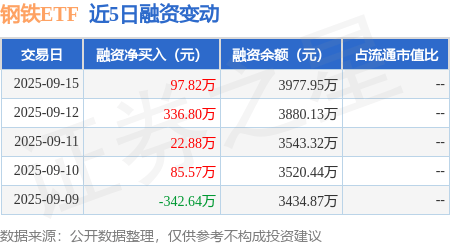
钢铁ETF:9月15日融资净买入97.82万元,连续3日累计净买入457.5万元
Sou Hu Cai Jing· 2025-09-16 02:55
Core Viewpoint - The Steel ETF (515210) has shown a net inflow in financing activities, indicating increased investor interest in the steel sector, with a total net inflow of 97.82 million yuan on September 15, 2025, and a cumulative net inflow of 457.5 million yuan over the past three trading days [1]. Financing Activities - On September 15, 2025, the financing buy-in amounted to 10.4269 million yuan, while the financing repayment was 9.4487 million yuan, resulting in a net financing buy of 0.9782 million yuan [1]. - The financing balance reached 39.7795 million yuan on the same day, with 11 out of the last 20 trading days showing net financing inflows [1][2]. Margin Trading Activities - On September 15, 2025, there were 20,000 shares sold short, with 33,300 shares repaid, leading to a net short sale of 13,300 shares and a remaining short balance of 100,070 shares [2][3]. - In the last 20 trading days, there were 11 days with net short sales, indicating a trend of increased short selling activity [2][3]. Overall Margin Balance - The total margin balance reached 41.1995 million yuan on September 15, 2025, reflecting an increase of 2.36% from the previous day [4]. - The margin balance has shown fluctuations, with a notable increase of 9.19% on September 12, 2025, following a decrease of 8.71% on September 9, 2025 [4]. Regulatory Information - Individual investors participating in margin trading must meet two conditions: having at least six months of trading experience and maintaining an average account asset of 500,000 yuan over the last 20 trading days [5]. - The number of margin trading stocks on the Shanghai Stock Exchange is set to increase from 800 to 1,000, while the Shenzhen Stock Exchange will expand its eligible stocks from 800 to 1,200 [5].

"Higher Highs, Higher Lows" Trend Hold, Health Care Bull Run Potential
Youtube· 2025-09-12 14:21
Market Overview - The S&P 500 is experiencing a weak start with around 20% of its stocks in the green, indicating mixed market sentiment [1] - Information technology remains a leading sector, contributing positively to the market cap weighted index [2] - Key resistance level is identified at 6,000, with support levels at 6,570 and 6,540 [3] Options and Volatility - Next week marks the quarterly options expiration, expected to generate significant volume across indices and equities [4] - The VIX expiration is also on the radar, with the last trading day on Tuesday, potentially leading to increased market activity [5][16] - Current VIX is at 14.64, indicating low volatility, but an uptick is anticipated as the expiration approaches [15][16] Crude Oil Market - Developments in the crude oil market include Ukraine targeting a major Russian export facility, which may impact global supply [7][8] - Oil is currently in a technical triangle formation, with significant support around $61, and the market is observing for potential breakout or breakdown [8][9] - Ongoing geopolitical tensions, particularly involving Russia and Venezuela, could exert upward pressure on oil prices [9][10] Healthcare Sector - The healthcare sector is showing strength, with the XLV ETF attempting to break through the 200-day moving average, a key resistance level since November of the previous year [11][12] - There is a rotation trade benefiting healthcare, despite previous negative sentiment surrounding GLP-1 drugs [14] - The sector's performance could provide significant runway for the S&P 500 if it successfully transitions the 200-day moving average from resistance to support [13][14]
股票股指期权:震荡降波,指数高位可考虑构建看跌期权保护
Guo Tai Jun An Qi Huo· 2025-09-12 13:19
Report Industry Investment Rating - Not provided in the content Core Viewpoint - In the stock index options market, there is a trend of volatility decline. When the index is at a high level, investors can consider constructing put options for protection [1] Summary by Related Catalogs Option Market Data Statistics - **Underlying Market Statistics**: The closing prices of the Shanghai Composite 50 Index, CSI 300 Index, and other underlying assets showed different changes. For example, the Shanghai Composite 50 Index closed at 2968.54, down 14.54 points; the CSI 300 Index closed at 4522.00, down 26.04 points; the CSI 1000 Index closed at 7422.88, up 23.00 points. The trading volumes of these underlying assets also had corresponding changes [1] - **Option Market Statistics**: The trading volumes and open interests of various option products changed. For example, the trading volume of Shanghai Composite 50 Index options was 57,617, down 5,024; the open interest was 93,475, up 266. The VL - PCR and OI - PCR of different options also showed different values [1] Option Volatility Statistics - **Near - month Options**: The ATM - IV of various options decreased to different extents. For example, the ATM - IV of Shanghai Composite 50 Index options was 15.99%, down 0.77%; the ATM - IV of CSI 300 Index options was 16.14%, down 1.05%. The HV and Skew of different options also had corresponding changes [4] - **Next - month Options**: Similar to the near - month options, the ATM - IV of next - month options also showed a downward trend in most cases. For example, the ATM - IV of Shanghai Composite 50 Index options was 19.56%, down 1.01%; the ATM - IV of CSI 300 Index options was 20.65%, down 0.24% [4] Option Index Data Statistics - For each type of option (such as Shanghai Composite 50 Index options, CSI 300 Index options, etc.), there are corresponding full - contract PCR charts, main - contract skewness trend charts, volatility cone charts, and volatility term structure charts, which visually display the relevant data changes of these options [8][12][17]
什么是期权的波动率策略?
Sou Hu Cai Jing· 2025-09-12 04:24
Group 1 - The core concept of options volatility strategy emphasizes the importance of analyzing volatility over the option price itself, as volatility is a critical indicator for investors when trading options [1] - Volatility can be categorized into implied volatility and historical volatility, with implied volatility reflecting market expectations of future price fluctuations [6][7] - The article outlines various volatility strategies, including long volatility strategies such as buying straddles and strangles, which are used when significant price movements are anticipated without a clear direction [3][4][6] Group 2 - A long straddle strategy involves purchasing both a call and a put option with the same strike price and expiration date, allowing for profit if the underlying asset's price moves significantly in either direction [3] - A long strangle strategy entails buying a call option with a higher strike price and a put option with a lower strike price, which is generally less expensive than a straddle and can yield high returns during significant price movements [4] - Directly purchasing volatility index futures, such as VIX futures, is another strategy employed when investors expect an increase in market volatility, allowing them to profit from rising volatility [4] Group 3 - The article also discusses short volatility strategies, where investors can profit from a decrease in volatility by selling options when volatility is expected to revert to its mean [7] - Historical volatility is calculated using past data, while implied volatility is derived from option pricing models, indicating market sentiment regarding future volatility [7] - The strategies discussed can be particularly effective during events that cause significant market fluctuations, such as geopolitical tensions or economic announcements [6][7]

股票股指期权:上行升波,看涨情绪上升,可考虑牛市看涨价差策略
Guo Tai Jun An Qi Huo· 2025-09-11 12:57
Report Industry Investment Rating - The report suggests considering a bull call spread strategy for stock index options as there is an upward volatility trend and increasing bullish sentiment [1]. Core Viewpoints - The upward volatility in stock index options indicates a rise in bullish sentiment, and a bull call spread strategy can be considered [1]. Summary According to Related Catalogs 1. Option Market Data Statistics - **Underlying Market Statistics**: The closing prices of various indices and ETFs showed increases, with significant trading volume changes. For example, the Shanghai - Shenzhen 300 Index closed at 4548.03, up 102.67, and its trading volume was 253.26 billion hands, an increase of 49.67 billion hands [2]. - **Option Market Statistics**: Trading volumes of most options increased significantly, while open interest decreased in some cases. The VL - PCR and OI - PCR values varied among different options, reflecting different market sentiment. For instance, the trading volume of CSI 1000 index options was 429644, an increase of 128507, and its OI - PCR was 108.41% [2]. 2. Option Volatility Statistics - **Near - Month Volatility**: ATM - IV and IV changes were positive for most options, indicating an increase in implied volatility. For example, the ATM - IV of Huaxia Kechuang 50 ETF options was 43.60%, with an IV change of 7.74% [5]. - **Next - Month Volatility**: Similar to the near - month situation, most options showed an increase in ATM - IV, but the change magnitudes were relatively smaller [5]. 3. Option Indicator Data Statistics (Graphs) - **Index Option Graphs**: For each type of index option (e.g., SSE 50 index option, CSI 300 index option, etc.), there are graphs showing the full - contract PCR, main - contract skewness, volatility cone, and volatility term structure, which help analyze the market situation and sentiment [9][13][17]. - **ETF Option Graphs**: Similar to index options, ETF options (e.g., SSE 50ETF option, Huatai - Baorui 300ETF option) also have corresponding graphs for analysis [20][22].
年底4000点,梦想应该有,现实也要认
对冲研投· 2025-09-11 12:06
Core Viewpoint - The article discusses the current state of the A-share market, particularly focusing on the Shanghai Composite Index, and presents a bullish outlook based on macroeconomic factors and the performance of various indices [5][6]. Group 1: Market Overview - The A-share indices, including the 50, 300, 500, and 1000, have experienced significant gains this year, reflecting both domestic support policies and international dovish expectations [6]. - The 50 and 300 indices have lagged behind in terms of cumulative growth, especially the 50 index, which has shown relative stability in recent weeks as funds shift from high-risk to lower-risk assets [6][8]. Group 2: Investor Sentiment and Strategy - Despite concerns about potential pullbacks, there are no clear negative macroeconomic drivers, allowing investors to maintain a bullish stance while being cautious about the depth of any corrections [8]. - Options are highlighted as a valuable tool for bullish investors, providing a strategy that allows for both offensive and defensive positioning [8][10]. Group 3: Options Strategy - The implied volatility of index options has decreased recently, with the 50 ETF options showing a volatility level that is neither too low nor too high, indicating a market sentiment leaning towards bullishness [10]. - A recommended strategy for bullish investors is the "bull call spread," which allows for maintaining a long position while managing the risk of a downturn [12]. - The bull call spread can be adjusted based on market movements, allowing investors to maintain exposure while capitalizing on volatility during price fluctuations [13][14]. Group 4: Future Outlook - The article concludes with an optimistic expectation for the Shanghai Composite Index to exceed 4000 points by the end of the year, reflecting confidence in the market's recovery and growth potential [15].

股指期权日报-20250911
Hua Tai Qi Huo· 2025-09-11 09:24
Report Summary 1. Report Industry Investment Rating No information provided. 2. Core Viewpoint No information provided. 3. Summary by Directory I. Option Trading Volume - On September 10, 2025, the trading volumes of various index options were as follows: 1.0867 million contracts for SSE 50 ETF options, 1.2034 million contracts for SSE CSI 300 ETF options, 1.6179 million contracts for SSE CSI 500 ETF options, 0.1152 million contracts for Shenzhen 100 ETF options, 2.2872 million contracts for ChiNext ETF options, 0.034 million contracts for SSE 50 index options, 0.1289 million contracts for CSI 300 index options, and 0.3011 million contracts for CSI 1000 index options [1]. - The detailed trading volumes including call and put options are presented in Table 1. For example, the call and put trading volumes of SSE 50 ETF options were 0.4827 million and 0.4762 million contracts respectively, with a total of 0.9589 million contracts [21]. II. Option PCR - The PCR values of various index options and their环比 changes are as follows: For SSE 50 ETF options, the turnover PCR was 0.68 (环比 change -0.11), and the open - interest PCR was 0.85 (环比 change +0.02); for SSE CSI 300 ETF options, the turnover PCR was 0.67 (环比 change -0.02), and the open - interest PCR was 1.12 (环比 change +0.03); etc. [2][36]. III. Option VIX - The VIX values of various index options and their环比 changes are as follows: The VIX of SSE 50 ETF options was 17.49% (环比 change -0.98%); the VIX of SSE CSI 300 ETF options was 18.06% (环比 change -0.79%); etc. [3][51].
利率衍生品市场和交易策略
2025-09-10 14:35
Summary of Key Points from Conference Call Industry Overview - The conference call discusses the **government bond futures market** and its trading strategies, highlighting its role in risk management and investment opportunities [1][2][3]. Core Insights and Arguments - **Characteristics of Government Bond Futures**: - Features include short-selling mechanisms, margin trading, standardized contracts, and daily mark-to-market settlement, which help mitigate interest rate risks, lower transaction costs, enhance liquidity, and reduce credit risks [1][2]. - **Functions of Government Bond Futures**: - Key functions include hedging against interest rate fluctuations, price discovery, linkage between primary and secondary markets, and optimizing asset allocation [1][2][3]. - **Types of Government Bond Futures in China**: - China has introduced futures for 2-year, 5-year, 10-year, and 30-year government bonds, covering critical maturities. Each contract corresponds to different remaining maturity ranges, with longer maturities having wider price fluctuation limits and higher minimum margin requirements [1][4]. - **Basis and Net Basis**: - Basis is the difference between the cash bond price and the futures price adjusted for the conversion factor, serving as an important indicator for analyzing arbitrage opportunities. Net basis considers holding income, which is crucial for selecting the cheapest deliverable bond (CTD) [1][7][10]. - **Market Participants**: - Main participants in the government bond futures market include brokerage firms, asset management products (like public funds and private equity), individual investors, and some banks and insurance companies. The market has seen steady growth in trading volume and open interest since 2023 [5][6]. Additional Important Content - **Hedging Strategies**: - Hedging strategies include short and long hedges to manage interest rate risks. The process involves selecting contracts, calculating hedge ratios, dynamically adjusting positions, and managing rollovers [2][12][13]. - **Risks in Hedging**: - Risks faced during hedging include basis risk, financing spread volatility, and term mismatch risk. These risks arise from the imperfect correlation between the swap contract indicators and actual yields [17][27]. - **Interest Rate Swaps**: - Interest rate swaps are over-the-counter financial contracts that help manage interest rate risk by exchanging fixed and floating interest payments. They can also be used for speculation and cost reduction [21][22]. - **Arbitrage Opportunities**: - Arbitrage strategies in the futures market include directional trading and relative value strategies, such as term arbitrage and cross-asset strategies [19][28][29]. - **Risks in OTC Contracts**: - OTC contracts carry additional risks compared to exchange-traded contracts, including credit, operational, and valuation risks. Market risk arises if actual market conditions deviate from expectations [30]. This summary encapsulates the essential aspects of the government bond futures market and its associated trading strategies, highlighting both opportunities and risks for market participants.