
公用事业

Search documents
报告:中国CEO信心全球最高,外商对华投资热情回升
第一财经· 2026-02-04 09:24
Core Insights - Chinese CEOs are optimistic about the global economic growth over the next three years, with 67% expecting a rebound in the next 12 months, surpassing the global average of 61% [2] - Despite facing short-term revenue pressures, Chinese entrepreneurs maintain strong confidence in long-term development due to a stable business environment and agile strategic adaptability [2] - CEOs globally recognize increased risks in the coming year, with Chinese CEOs identifying cyber risks as the primary threat, followed by macroeconomic fluctuations and technological disruptions [2] Group 1: Global Investment Trends - There is a growing trend among companies to actively pursue global layouts to mitigate geopolitical risks, with Chinese CEOs showing a more proactive and pragmatic approach [3] - The attractiveness of mainland China as an investment destination has increased, with the percentage of global CEOs listing it among their top three investment destinations rising from 9% to 11% [3] - In various sectors, 14% of respondents in industrial and service industries listed mainland China as a top investment destination, an increase from the previous year [3] Group 2: Innovation and AI Adoption - Innovation is a key focus for Chinese companies in response to global technological competition and the acceleration of AI transformation, with 18% of mainland and 22% of Hong Kong CEOs concerned about their innovation capabilities [4] - Chinese companies exhibit a higher tolerance for innovation risks and have established mature dynamic management mechanisms for R&D projects, allowing for agile resource allocation [4] - 52% of Chinese CEOs report increased revenue from AI applications, significantly higher than the global average of 29%, with 17% achieving both cost reduction and revenue increase through AI [6] Group 3: Resilience and Supply Chain - Chinese enterprises demonstrate strong resilience in the face of supply chain fluctuations, with over 40% exhibiting significant flexibility, compared to the global average of 28% [6] - The robustness of China's industrial chain and diversified supply chain layout are identified as core advantages for companies to withstand external shocks [6]


高股息策略配置性价比进一步提升,港股通红利ETF广发(520900)涨1.34%
Xin Lang Cai Jing· 2026-02-03 08:04
Group 1 - The core viewpoint of the articles emphasizes the increasing interest in high dividend yield stocks, particularly in the context of declining bond yields and the need for investors to seek higher returns in equity investments [1][2][3] - Long-term value in dividend investing is shifting from merely seeking high dividend rates to focusing on sustainable dividend capabilities, with a recommended expected return rate of over 3%-5% and a strong safety margin [1][2] - The performance of high dividend sectors has shown recovery, driven by strong demand for insurance funds and favorable pricing logic in cyclical high dividend sectors such as oil, steel, and coal [1][2] Group 2 - The market is experiencing challenges in restoring risk premiums, with significant volatility in cyclical products affecting market profitability, leading to a potential "small platform period" for investor risk appetite [2][3] - The insurance sector is seeing robust growth in new business, particularly in dividend insurance sales, which is increasing the allocation of investment funds towards long-duration assets [2][3] - The dividend strategy remains a key focus for equity investments, with pressures on cash investment returns expected to increase by 2026, reinforcing the importance of dividend strategies for companies [2][3] Group 3 - Looking ahead to 2026, dividend strategies are expected to continue serving as a stabilizing force in investment portfolios, with dividend assets showing lower valuation levels and volatility compared to other asset classes [3][9] - The Hong Kong Stock Connect Dividend ETF (520900) closely tracks the CSI National New Hong Kong Stock Connect Central Enterprise Dividend Index, which selects stable dividend-paying companies from the central state-owned enterprises [3][9] - The top five industries in the CSI National New Hong Kong Stock Connect Central Enterprise Dividend Index include oil and petrochemicals (28.63%), telecommunications (21.75%), coal (11.80%), transportation (10.47%), and public utilities (7.94%), indicating a strong value and defensive characteristic [4][10]



大和:长江基建集团(基本面不变但利好因素已反映 降级至“跑赢大市”
Zhi Tong Cai Jing· 2026-02-03 07:18
Group 1 - The core viewpoint of the report is that despite favorable factors such as regulatory resets and the sale of the UK railway business being reflected in the stock price of Cheung Kong (00001), the fundamental outlook remains unchanged, and further upside potential is limited [1] - The rating for Cheung Kong has been downgraded from "Buy" to "Outperform" with a target price adjustment from HKD 63.5 to HKD 66.3 [1] - The recent ruling by the Panama Supreme Court declaring Cheung Kong's port concession agreement unconstitutional has led to a decline in the stock prices of both Cheung Kong and CK Infrastructure Holdings (01038) [1] Group 2 - The report suggests that the court ruling may be influenced by the strategic tensions between the US and China regarding critical assets, potentially disrupting Cheung Kong's plans to sell its global port business to BlackRock [1] - For CK Infrastructure, the event poses sentiment pressure as it highlights the risk of political scrutiny, but it does not have a direct impact on the company's profit base since its operations are primarily focused on regulated utilities in the UK and Australia [1]


大和:长江基建集团((01038)基本面不变但利好因素已反映 降级至“跑赢大市”
智通财经网· 2026-02-03 07:16
Group 1 - The core viewpoint of the report is that despite favorable factors such as regulatory resets and the sale of UK railway operations being reflected in the stock price of Cheung Kong Holdings (00001), the company's fundamentals remain unchanged, and further upside potential is limited [1] - Daiwa has downgraded its rating on Cheung Kong from "Buy" to "Outperform" and raised the target price from HKD 63.5 to HKD 66.3 [1] - The recent ruling by the Panama Supreme Court declaring Cheung Kong's port concession agreement unconstitutional has led to a decline in the stock prices of both Cheung Kong and CK Infrastructure Holdings (01038) [1] Group 2 - The report suggests that the court ruling may be linked to the strategic tensions between China and the United States, which could disrupt Cheung Kong's plans to sell its global port business to BlackRock [1] - For CK Infrastructure, the event poses sentiment pressure as it highlights political scrutiny risks, but it does not have a direct impact on the company's profit base since its operations are primarily focused on regulated utilities in the UK and Australia [1]
港股市场估值周报-20260203
Zhe Shang Guo Ji Jin Rong Kong Gu· 2026-02-03 06:30
Valuation of Hong Kong Stock Market - The report analyzes the valuation of major indices in the Hong Kong stock market, including the Hang Seng Composite Index (HSCI), Hang Seng Index (HSI), and Hang Seng Tech Index (HSTECH) [8][9][13][17]. - The report highlights that there are no industries currently undervalued with a PE valuation percentile below 20% [24]. - Industries with PE valuation percentiles below 50% include Consumer Discretionary, Consumer Staples, and Utilities [24]. Industry Valuation Levels - The report indicates that industries with relatively high PE valuations (above 50%) include Energy, Materials, Industrials, Healthcare, Financials, Information Technology, and Telecommunications [24]. - For PB valuation, no industries are currently undervalued with a percentile below 20% [24]. - Industries with PB valuation percentiles below 50% are Consumer Staples, Utilities, and Real Estate [24]. AH Share Premium/Discount Levels - The report includes a trend analysis of the Hang Seng AH Share Premium Index, showing fluctuations over time [34]. - The average value and standard deviations of the AH Share Premium Index are provided, indicating market sentiment towards AH shares [34].
2026年2月小品种策略:中等期限票息品种还可继续挖掘
Orient Securities· 2026-02-03 04:15
Group 1 - The report indicates that the bond market experienced a recovery in January, with yields initially rising before declining throughout the month, driven by a lack of negative trading factors and improved market sentiment [5][10] - The focus for February is on medium-term credit bonds, particularly those with maturities of 2-3 years, as demand is expected to increase following the stabilization of fund liabilities [11][12] - The report highlights that the issuance of corporate perpetual bonds decreased significantly in January, with a total of 68 bonds issued, raising 55.6 billion yuan, a drop of approximately 68% from the previous month [18][19] Group 2 - In the secondary market, the yield spread for perpetual bonds narrowed slightly, with city investment bonds performing better than industrial bonds [29][31] - The report notes that the average yield of various grades of perpetual bonds decreased by about 4 basis points in January, with city investment bonds showing a more significant decline [30][34] - The analysis indicates that the issuance of Asset-Backed Securities (ABS) halved in January, with financing costs declining across the board, suggesting a stable outlook for future issuance [14][40]
大和:长江基建集团进一步上行空间有限 评级下调至“跑赢大市”
Xin Lang Cai Jing· 2026-02-03 03:25
Core Viewpoint - Daiwa downgraded the rating of Cheung Kong Infrastructure Group from "Buy" to "Outperform" while raising the target price from HKD 63.5 to HKD 66.3 [1] Group 1: Impact of Legal Ruling - The ruling by the Panama Supreme Court declaring the port concession agreement unconstitutional led to a decline in the stock prices of Cheung Kong and Cheung Kong Infrastructure [1] - This event primarily exerts emotional pressure on Cheung Kong Infrastructure, without directly impacting its profit base [1] Group 2: Business Fundamentals - Cheung Kong Infrastructure's operations are mainly focused on regulated utilities in the UK and Australia, which remain unaffected by the recent legal ruling [1] - Positive factors such as regulatory resets and the sale of the UK railway business have already been reflected in the stock price [1] Group 3: Market Position - The fundamental outlook for the company remains unchanged, but the potential for upward movement in stock price is limited [1] - The dividend yield of Cheung Kong Infrastructure is now comparable to that of its peers in the industry [1]
大行评级丨大和:长江基建集团进一步上行空间有限,评级下调至“跑赢大市”
Ge Long Hui· 2026-02-03 02:40
大和发表研报指,长和上周被巴拿马最高法院裁定其港口特许经营合约违宪,导致长和及长江基建集团 股价下跌。对于长建而言,该行认为事件构成情绪面压力,因其凸显了政治审查风险,但未有直接冲击 长建的利润基础,因公司业务主要集中于英国及澳洲受监管的公用事业。考虑到监管重置及英国铁路业 务出售等利好因素已反映于股价中,该行认为其基本面不变,但进一步上行空间有限,加上股息收益率 已与同业接近,将评级由"买入"下调至"跑赢大市",目标价由63.5港元上调至66.3港元。 ...
华泰证券:防御配置价值显现
Sou Hu Cai Jing· 2026-02-02 23:54
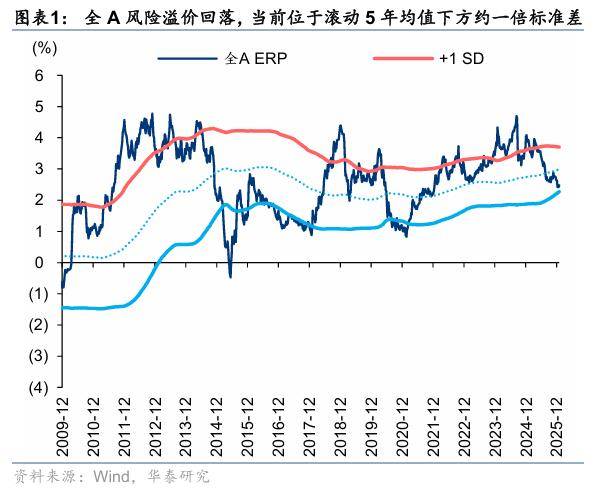
Core Viewpoint - The high dividend sector showed signs of recovery in January, driven by strong demand for dividend assets from insurance companies and the performance of cyclical high dividend stocks like oil, petrochemicals, and steel [2][4]. Market Overview - The overall market risk appetite continued to decline in January, with the full A ERP falling below one standard deviation of the past five-year average, indicating a challenging environment for market risk premium recovery [1][3]. - The volatility in cyclical stocks has impacted the market's profit-making ability, leading to a potential "small plateau" in investor risk appetite [3]. High Dividend Strategy - The configuration value of high dividend stocks has marginally increased compared to the previous month, suggesting a focus on stable high dividend stocks with defensive attributes and some potential high dividend varieties [1][3]. - The high dividend strategy's cost-effectiveness has improved, with the current full A ERP positioned at a historically significant level, requiring fundamental recovery or strong capital support for a breakthrough [3]. Sector Investment Opportunities - **Insurance**: The market sentiment remains strong, with expectations for continued positive performance in the insurance sector [5]. - **Oil and Petrochemicals**: Geopolitical tensions have raised concerns about global oil supply risks, leading to a rebound in oil prices. The Brent crude oil price forecast for 2026 has been raised to $65 per barrel [5]. - **Construction Materials**: The construction sector is expected to improve post-Spring Festival, with price increases in fiberglass, waterproof materials, and gypsum boards anticipated [5]. - **Utilities**: The electricity supply side is expected to stabilize, with coal prices remaining steady, indicating a bottoming out of electricity stock valuations [6]. - **Transportation**: The logistics sector is seeing a slight uptick in activity, particularly in road freight, as the Spring Festival travel season approaches [6]. - **Banking**: Banks are actively increasing lending, with profit margins expected to improve, particularly in light of a manageable impact from the real estate sector [7]. - **Real Estate**: The Hong Kong residential market has seen significant growth, with transaction volumes and prices rebounding, indicating a recovery trend [7]. - **Consumer Staples**: Leading companies in the consumer staples sector are expected to maintain stable cash flows and increase dividend payouts, benefiting from structural upgrades and international expansion opportunities [8].

12月工业企业利润数据点评:新旧分化显著,工业企业利润年增速结束连续三年负增长转正
Zhong Cheng Xin Guo Ji· 2026-02-02 13:04
Group 1: Industrial Profit Trends - In 2025, industrial enterprises' revenue grew by 1.1% year-on-year, a decline of 1 percentage point compared to 2024[2] - Industrial profits turned positive with a year-on-year increase of 0.6%, ending three consecutive years of negative growth[3] - December 2025 saw a monthly profit increase of 5.3%, a rebound of 18.4 percentage points from November[3] Group 2: Cost and Revenue Dynamics - The cost per 100 yuan of revenue for industrial enterprises was 85.31 yuan, an increase of 0.15 yuan year-on-year[6] - The profit margin for industrial enterprises was 5.31%, a slight increase of 0.02 percentage points from the previous month but a decrease of 0.08 percentage points year-on-year[3] - Accounts receivable grew by 4.7% year-on-year, marking the lowest growth rate since 2020[6] Group 3: Sector Performance Disparities - State-owned enterprises experienced a profit decline of 3.9%, while private enterprises' profits remained flat at 0%[7] - Foreign and Hong Kong-Macau-Taiwan invested enterprises saw a profit increase of 4.2%, contributing significantly to overall industrial profit growth[7] - High-tech manufacturing profits grew by 13.3% year-on-year, significantly outpacing overall industrial growth[13] Group 4: Future Outlook - Industrial profits are expected to continue recovering in 2026, supported by stable export demand and ongoing policy measures[18] - Challenges remain, including weak domestic demand and structural imbalances in supply and demand[18] - Continued focus on expanding domestic consumption and addressing external risks is necessary for sustained recovery[18]