
电池制造

Search documents
紫建电子:2025年全年净利润同比预减88.78%—92.52%
2 1 Shi Ji Jing Ji Bao Dao· 2026-01-27 10:01
Core Viewpoint - The company, ZhiJian Electronics, is forecasting a significant decline in net profit for the year 2025, with an expected profit range of 6 million to 9 million yuan, representing a year-on-year decrease of 88.78% to 92.52% [1] Financial Performance - The projected net profit attributable to shareholders for 2025 is expected to be between 6 million and 9 million yuan, indicating a substantial decline compared to the previous year [1] - The company anticipates a net loss of 12 million to 15 million yuan when excluding non-recurring gains and losses [1] Reasons for Performance Decline - The decline in performance is attributed to increased research and development investments aimed at accelerating product iteration and technological innovation [1] - The company is focusing on the development of key technologies and the investment in specialized talent [1] - The ongoing construction of the Vietnam factory and projects at the Wanzhou base for emerging consumer batteries, such as smart rings and smart glasses, has not yet fully released production capacity, leading to higher unit costs as fixed assets are transitioned [1] - A significant rise in the prices of key raw materials, such as lithium cobalt oxide, has contributed to increased operating costs, with a lag in the company's ability to pass these costs onto products [1]
国轩高科:0.2GWh全固态电池中试产线已于2025年上半年完成并投产
Zheng Quan Ri Bao Wang· 2026-01-27 08:43
Group 1 - The company Guoxuan High-Tech (002074) has completed the pilot production line for 0.2GWh all-solid-state batteries, which is set to be operational in the first half of 2025 [1] - The design work for the 2GWh mass production line is progressing as planned [1]

国轩高科:截至2025年12月31日公司股东户数为260470户
Zheng Quan Ri Bao Wang· 2026-01-27 08:43
Group 1 - The core point of the article is that Guoxuan High-Tech (002074) has reported its shareholder count as of December 31, 2025, which stands at 260,470 households [1]
比亚迪与越南金龙签约1.3亿美元投建电池工厂
Xin Lang Cai Jing· 2026-01-27 08:30
观点网讯:1月27日,越南政府网站披露,中国电池巨头比亚迪与越南金龙汽车(Kim Long)正式签 约,将在越南中部建设一座专注商用车配套的电动汽车电池工厂,项目总投资1.3亿美元。 根据协议,工程分两期实施:一期建设带顶厂房4.4公顷,形成年产3吉瓦时动力电池产能;二期再扩6 公顷,使总面积达10公顷,并新增乘用车电池产线,总产能提升至6吉瓦时,产品覆盖巴士、卡车及小 型客车电池需求。 免责声明:本文内容与数据由观点根据公开信息整理,不构成投资建议,使用前请核实。 ...

越南金龙汽车与比亚迪签约建设电动汽车电池工厂,总投资1.3亿美元
Xin Lang Cai Jing· 2026-01-27 08:12
1月27日,据越南政府网站,比亚迪日前与越南金龙汽车( Kim Long )签署协议,将在越南中部建设 一座商用电动汽车电池工厂。该工厂将生产巴士、卡车、小型客车等商用车配套电池。该项目两期总投 资额为1.3亿美元。一期建设带顶厂房面积达4.4公顷,年产能达3吉瓦时。二期计划扩建带顶厂房面积至 10公顷,新增乘用车电池产线,总产能提升至6吉瓦时。 ...

帮主郑重午评:3700股下跌却藏黄金坑!午后这样操作,精准踩中结构性机会
Sou Hu Cai Jing· 2026-01-27 04:23
朋友们中午好,我是帮主郑重,做20年财经记者专做中长线投资,早盘行情是不是看懵了?沪指微涨 0.03%,创业板指飘红0.44%,但全市场超3700只个股下跌,一半以上的朋友可能都在亏钱,可黄金、 半导体却涨疯了,湖南黄金、紫金矿业创历史新高,东芯股份直接20cm涨停,这就是典型的结构性行 情,资金全往有硬逻辑的赛道挤! 再分享个实操小技巧,也是我多年来坚守的原则:结构性行情里,别追着热点乱换股,要么抱紧有长期 逻辑的龙头,要么耐心等回调布局,频繁操作反而容易两边挨打。就像黄金板块,虽然强势,但短期涨 太快,有持仓的朋友可以把止盈位设在5日均线,没持仓的别盲目追高,等回调到10日均线附近再考 虑;半导体赛道则可以关注研发投入高的龙头,比如天孚通信、中际旭创,它们跟着AI算力需求走, 中长期逻辑很通顺。 聊到这里,肯定有朋友问,午后到底该咋操作?帮主给大家三个明确的行动指令,简单好执行。第一, 对于黄金、半导体这些强势板块,有持仓的继续持有,设好止盈不贪心,没持仓的坚决不追高,宁可错 过也别做错,中长线有的是机会;第二,对于电池、白酒等弱势板块,没持仓的千万别抄底,有持仓的 如果基本面没改善,不如趁反弹减仓,把资 ...


印尼投资局CEO答21:中国与印尼合作迈向产业链整合升级
2 1 Shi Ji Jing Ji Bao Dao· 2026-01-27 03:29
南方财经 21世纪经济报道记者张伟泽袁思杰香港报道 1月26日,印尼投资局首席执行官里达对21世纪经济报道记者表示,中印尼经济合作正从传统的资源互 补,迈向更高水平的产业链整合升级。双方的合作版图已从初期的主权财富基金合作,扩展至电动汽车 电池、医疗健康、稀土及先进材料等多个关键领域。 里达举例称,一家中国制造商与印尼方面成立的合资电池组件工厂,其规模已扩大至原来的四倍。他认 为,这既体现了强劲的市场需求,也证明了双方深度合作的成效。完整的电池产业链不仅需要宁德时代 (CATL)这样的龙头企业,也离不开正极、负极、隔膜等关键材料的配套生产。 里达表示,中印尼的经济合作基础牢固。印尼长期以来既是中国的重要市场,也是多种原材料的供应 国。这种多维度、多层次的合作模式,将为中国企业提供新的发展机遇,也为印尼的产业升级和经济增 长注入了新的动力。 (文章来源:21世纪经济报道) 里达指出,除了在科技领域持续发力,中国与印尼双方的合作版图正加速向医疗健康、稀土和先进材料 等新兴战略领域拓展。中国正计划将更多的技术和资本引入印尼,并将其作为全球市场布局的重要一 环,这为两国在供应链和价值链层面的深度整合提供了新的动力。 ...
微电新能源正式递表港交所,为中国最大无线耳机电池供应商
Ju Chao Zi Xun· 2026-01-27 03:07
Core Viewpoint - Guangdong Micro Battery New Energy Co., Ltd. (referred to as "Micro Battery New Energy") has officially submitted its application to the Hong Kong Stock Exchange, aiming to leverage its position as a leading provider of high-performance, high-safety micro lithium-ion battery solutions in the global market [2]. Group 1: Company Overview - Micro Battery New Energy is recognized as a top five global supplier in various micro lithium-ion battery sectors, with a focus on addressing core challenges in battery materials and design [2]. - The company has established a broad customer base, including world-renowned smart device and consumer electronics brands [2]. - In 2024, the company is projected to ship 103.2 million consumer-grade smart terminal micro lithium-ion batteries, ranking fourth globally and second among Chinese suppliers [2]. - For wireless earphones, the company expects to ship 86.9 million micro lithium-ion batteries, ranking second globally and first among Chinese suppliers [2]. Group 2: Manufacturing and Production - The manufacturing system of Micro Battery New Energy is built around three global production bases located in Huizhou, Guangdong Province, Ganzhou, Jiangxi Province, and Bac Ninh Province, Vietnam, each optimized for specific battery types [3]. - The company implements end-to-end traceability and automation processes from raw material procurement to final packaging, ensuring quality consistency and compliance with regional regulations [3]. - The production process includes three core stages: battery manufacturing, testing and inspection, and battery pack assembly, with customized production processes for each battery type [3]. Group 3: Market Trends and Financial Performance - The micro lithium-ion battery market is experiencing long-term growth driven by trends in IoT, 5G, cloud computing, and artificial intelligence, with the global market expected to reach 2,496.1 million units in 2024 and grow at a compound annual growth rate of 12.4% from 2025 to 2029 [3]. - Micro Battery New Energy has successfully capitalized on market opportunities, with revenue increasing by 51.7% from RMB 351.2 million in 2023 to RMB 532.9 million in 2024 [3]. - The company's net profit is projected to rise significantly from RMB 6.8 million in 2023 to RMB 57.8 million in 2024, achieving a net profit of RMB 42.8 million for the nine months ending September 30, 2025 [3]. Group 4: Industry Landscape - The global consumer-grade micro lithium-ion battery industry is relatively concentrated, with the top five suppliers accounting for 27.6% and 37.7% of the market for consumer-grade smart terminal batteries and wireless earphone batteries, respectively [4]. - Micro Battery New Energy believes it is well-positioned to capture growth trends in the global consumer-grade micro lithium-ion battery industry due to its comprehensive product portfolio, diverse customer base, mature R&D capabilities, and advanced manufacturing processes [4]. - Chinese policies are also promoting technological innovation and standard-setting in lithium-ion batteries, with key battery materials and automated manufacturing equipment classified as "encouraged industries" in the 2024 Industrial Structure Adjustment Guidance Catalog [4].
针对低温场景,宁德时代发布首款轻型商用车量产钠电池
Guan Cha Zhe Wang· 2026-01-27 02:41
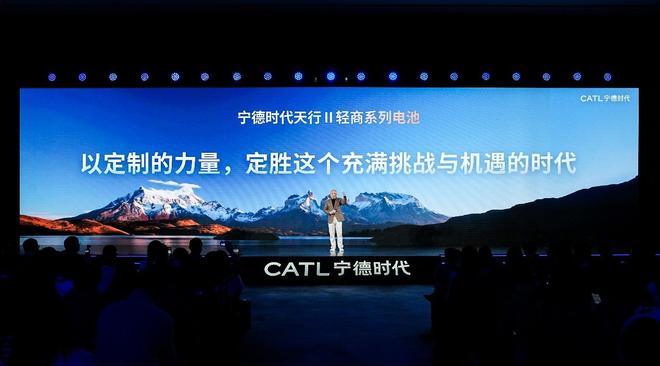
Core Insights - CATL has launched the Tianxing II light commercial series solutions, including the mass-produced sodium-ion battery for light commercial vehicles, marking a significant step in the industry [1][3] Group 1: Product Launch and Features - The Tianxing II light commercial low-temperature version is the first mass-produced sodium-ion battery in the light commercial vehicle sector, with a capacity of 45 kWh [3] - The battery retains over 92% usable capacity at -20°C and can still charge at -30°C, demonstrating superior cold resistance [3] - Safety tests show that the sodium-ion cells do not catch fire or explode under extreme conditions, maintaining functionality even after being cut [3] Group 2: Market Position and Future Plans - CATL is a pioneer in sodium-ion battery development, having introduced its first generation in July 2021, with a single cell energy density of 160 Wh/kg [5] - The company plans to expand sodium-ion battery applications into passenger vehicles, with the first model set to be produced in Q2 of this year [3][5] - The sodium-ion battery market is projected to exceed 100 GWh in shipments and reach a market size of 100 billion yuan within the next 3-5 years [6] Group 3: Comparison with Lithium-ion Batteries - Sodium-ion batteries have advantages in resource availability, cold resistance, and safety compared to lithium-ion batteries, which are currently dominant in the market [5] - However, sodium-ion batteries face challenges such as lower energy density (175 Wh/kg) and fewer charge cycles (2000-3000) compared to lithium batteries [6] - Despite these challenges, CATL aims to make sodium batteries more economically viable than lithium batteries within 2-3 years [6] Group 4: Additional Product Offerings - The Tianxing II light commercial series also includes long-range, supercharging, and high-temperature supercharging versions, with various features such as 800 km range and rapid charging capabilities [7] - CATL has introduced a battery management app called "Battery Manager" to help users monitor battery lifecycle usage [7]

宁德时代智能电芯设计项目获MINDS奖项
Zhong Guo Hua Gong Bao· 2026-01-27 02:24
有关负责人表示,未来宁德时代将持续技术创新,肩负起行业领军者的责任,持续引领AI从"赋 能"到"创造",携手全球伙伴共同塑造一个更智能、更绿色、更富韧性的可持续发展未来。 MINDS奖项由世界经济论坛旗下人工智能卓越中心设立,从战略、人才、数据、技术及治理五个核心 维度在全球范围内严格遴选能够以负责任方式推动AI转型的标杆组织,是全球范围内衡量组织智能化 转型领导力的重要标尺。 中化新网讯 1月19日,在瑞士达沃斯举行的世界经济论坛第56届年会上,宁德时代凭借"增强智能重塑 下一代锂电池设计"项目(简称"智能电芯设计"),获"AI驱动产业转型全球标杆"MINDS奖项。 获奖项目由宁德时代首席制造官与工程研发体系联席总裁倪军教授及晋文静博士团队牵头。通过深度学 习超10万个电池案例、600TB测试数据及海量新能源车后市场数据,宁德时代构建的智能电芯设计平 台,可根据用户自定义性能指标,在数秒内生成设计建议、数分钟交付虚拟电芯,性能预测准确率达 95%,设计人效较传统设计提升30%,实现了从"依赖实验试错"向"数据驱动正向设计"的研发范式跨 越。 ...