核能

Search documents
中国铀业(001280.SZ):已与华能核电签署协议约定由公司保障华能核电的天然铀供应
Ge Long Hui· 2025-12-12 01:17
格隆汇12月12日丨中国铀业(001280.SZ)在投资者互动平台表示,公司已与华能核电签署协议约定由公 司保障华能核电的天然铀供应。 ...
中国铀业:已同中国核电签署了长贸协议 ,约定向中国核电下属核电公司供应天然铀
Mei Ri Jing Ji Xin Wen· 2025-12-11 09:01
(记者 王瀚黎) 每经AI快讯,有投资者在投资者互动平台提问:贵公司有没有跟秦山核电站开展合作或者是业务? 中国铀业(001280.SZ)12月11日在投资者互动平台表示,中国铀业已同中国核电签署了长贸协议 ,约 定向中国核电下属核电公司供应天然铀。 ...

中国铀业(001280.SZ):为中核集团核电天然铀产品独家供应商及国内少数具有天然铀运营资质的企业之一
Ge Long Hui· 2025-12-11 08:57
格隆汇12月11日丨中国铀业(001280.SZ)在互动平台表示,公司背靠规模巨大的核电市场,产业发展空 间广阔。 我国在建核电反应堆数量及装机规模均远高于全球其他国家,具有全球最大的天然铀产业发 展市场基础。公司为中核集团核电天然铀产品独家供应商及国内少数具有天然铀运营资质的企业之一, 可以充分享有我国总量巨大且稳定增长的核电市场红利。 ...
12月11日主题复盘 | 指数调整,航天、核聚变逆势上涨,光通信上游持续活跃
Xuan Gu Bao· 2025-12-11 08:53
Market Overview - The Shanghai Composite Index experienced fluctuations throughout the day, while the ChiNext Index saw a rise before retreating. The North Star 50 index surged over 6% in the afternoon. The commercial aerospace sector remained active, with Zaiseng Technology achieving a fourth consecutive trading limit, and over ten stocks, including Aerospace Power, hitting the daily limit. Conversely, the Fujian sector faced significant declines, with nearly ten stocks, including Haixin Food and Sanmu Group, hitting the daily limit. Overall, nearly 4,400 stocks in the Shanghai and Shenzhen markets were in the red, with a total transaction volume of 1.89 trillion yuan [1]. Hot Topics Aerospace - The aerospace sector saw significant gains, with Zaiseng Technology achieving a fourth consecutive limit up, and Sichuan Jinding hitting the limit for the third time. Aerospace Power and Goldwind Technology also reached the daily limit. The catalyst for this surge was Elon Musk's indication that SpaceX might conduct an IPO next year, aiming to raise over $30 billion (approximately 212.3 billion yuan) with a target valuation of $1.5 trillion (approximately 10.62 trillion yuan). If successful, this IPO would break the previous record set by Saudi Aramco in 2019, which raised $29 billion [4][5]. Nuclear Fusion - The nuclear fusion sector performed well, with Yongding Co. hitting the daily limit and companies like Hahuan Huadong and Guangzhi Technology rising over 10%. A recent joint statement from China and France emphasized the importance of nuclear energy as a clean, low-carbon, and stable energy source for addressing global challenges such as climate change and energy security [7][9]. Optical Communication - The optical communication sector experienced a significant rise, with companies like Yueling Co. achieving a third consecutive limit up, and others like Farsen and Yongding Co. hitting the daily limit. Coherent announced plans to double the production capacity of indium phosphide lasers within the next 12 months, which is expected to significantly enhance production efficiency and reduce costs [10][11]. Additional Insights - The commercial aerospace market in China is growing annually, forming a complete ecosystem covering upstream manufacturing, midstream launch and operation, and downstream application services. Key breakthroughs in "cost reduction and efficiency enhancement" are essential for scaling, with reusable rocket technology being a revolutionary aspect that significantly lowers launch costs and shortens mission cycles [6].



目标价腰斩至18.50美元!花旗唱空NuScale Power(SMR.US):短期利好难掩合同与营收风险
智通财经网· 2025-12-11 06:52
Core Viewpoint - Citigroup has reiterated a "Sell/High Risk" rating for NuScale Power, significantly lowering its target price from $37.50 to $18.50 due to contract uncertainties and revenue pressures [1] Group 1: Company Analysis - NuScale Power is the only small modular reactor company with approval from the U.S. Nuclear Regulatory Commission, providing it with a significant regulatory and time advantage [1] - The company has gained a first-mover advantage in the context of increasing electricity demand driven by data centers and artificial intelligence [1] - Despite its advantages, NuScale faces substantial project execution risks, and its stock price appears to have already factored in a large portion of the expected installations before 2040, which does not align with the projected increase in global nuclear capacity [1] Group 2: Financial Outlook - Short-term factors may drive the company's stock price higher, but long-term revenue pressures are expected to persist [1] - Existing contract-related revenues are declining, and partner Fluor (FLR.US) is continuously reducing its stake, leading to potential liquidity issues for NuScale [1] - NuScale may need to issue additional equity to meet payment commitments, and the expected sales timeline for its first nuclear module has been pushed back by two years [1] - The likelihood of securing definitive contracts with the Tennessee Valley Authority in the near to medium term is considered low [1]

Rolls-Royce share price eyes a rebound as a bullish pattern forms
Invezz· 2025-12-10 10:23
Core Viewpoint - Rolls-Royce has transformed from a pandemic laggard to a top performer in the FTSE 100 Index, with significant stock price appreciation and strong demand across its business segments [2][3]. Group 1: Stock Performance - Rolls-Royce share price has increased from a low of 1,020p on November 24 to 1,110p, marking a rise of over 100% from its lowest level in January [1] - The stock has surged from 62.15p in 2022 to 1,112p, representing a 1,527% increase, elevating its market capitalization to over $126 billion [2] - The stock price has shown positive technical indicators, remaining above the 50-day and 100-day Exponential Moving Averages, suggesting bullish control [9] Group 2: Financial Outlook - The company expects full-year operating profit to be between £3.1 billion and £3.2 billion, with free cash flow projected between £3.0 billion and £3.1 billion [3] - Despite strong stock performance, Rolls-Royce maintains a trailing P/E ratio of 16.9, which is lower than the S&P 500 Index average of 22, indicating it is not overly expensive [6] Group 3: Business Growth Drivers - Rolls-Royce has received significant orders from airlines such as IndiGo and Malaysia Airlines, contributing to its recovery as active flying hours surpass pre-pandemic levels [4] - The company is benefiting from a boom in the defense industry, with potential large contracts, including a €50 billion spending package in Germany [4] - The Small Modular Reactors (SMR) business has gained traction, with orders from the UK government and expansion plans into the US market, supported by a recent $800 million investment announcement [5][6]

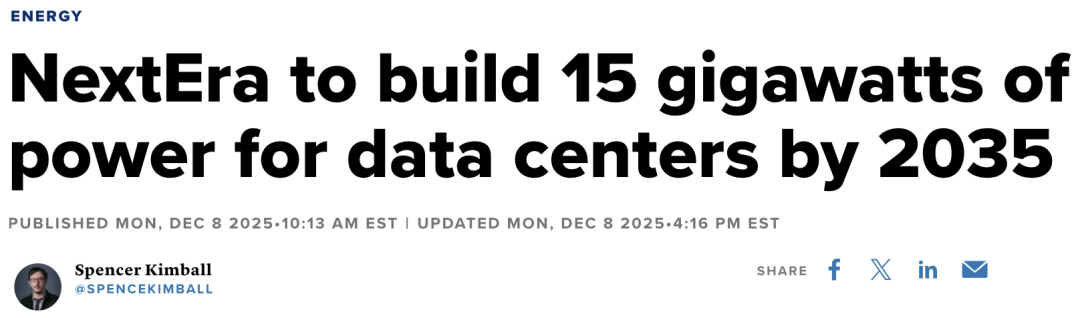
【动向】美国NextEra公司计划新建15吉瓦发电容量支持数据中心
Sou Hu Cai Jing· 2025-12-10 03:40
Core Insights - NextEra Energy plans to build 15 gigawatts (GW) of new generation capacity by 2035 to support data center hubs, as announced by CEO John Ketchum during an investor meeting [1][2] - The company has partnered with Alphabet, Google's parent company, to develop three gigawatt-scale data center campuses in the U.S., with plans for further expansion [2] - Despite these announcements, NextEra's stock closed down approximately 3% on Monday [2] Group 1 - The 15 GW target for data center power supply is considered a "fairly conservative" estimate by Ketchum, who expressed disappointment if the final construction capacity does not exceed this goal [2] - Ketchum indicated potential growth space for building up to 30 GW of generation capacity by 2035 [2] - The data center hubs will utilize a diversified energy structure, with a recent agreement to restart the Duane Arnold nuclear plant in Iowa through a power purchase agreement with Google [2] Group 2 - NextEra aims to achieve a target of 4-8 GW of new natural gas generation capacity by 2032, with significant expansion expected by 2035 [2] - The company is currently advancing a total of 20 GW in natural gas generation project reserves [2] - To address the rising electricity demand from AI data centers, Ketchum proposed that tech giants should build their own generation facilities to manage costs effectively [2]

受强震影响日本一核设施乏燃料池水发生外溢
Xin Hua Wang· 2025-12-10 03:27
Core Viewpoint - A strong earthquake with a magnitude of 7.5 struck the eastern waters of Aomori Prefecture, Japan, causing approximately 450 liters of water to overflow from a spent fuel pool at a nuclear fuel reprocessing plant, but no safety issues were reported [1]. Group 1: Earthquake Impact - The earthquake occurred on December 8 at 23:15 local time, initially recorded at a magnitude of 7.6, later revised to 7.5 [1]. - The Japan Atomic Energy Regulatory Commission reported that the overflow of water did not reach outside the building [1]. Group 2: Nuclear Facility Status - Other nuclear facilities in the northeastern region of Japan, including Fukushima Daiichi Nuclear Power Plant, Aomori's Ohma Nuclear Power Plant, and Miyagi's Onagawa Nuclear Power Plant, reported no abnormalities following the earthquake [1]. - The spent fuel pool's water level remained within normal ranges, indicating no safety concerns at the reprocessing plant [1].
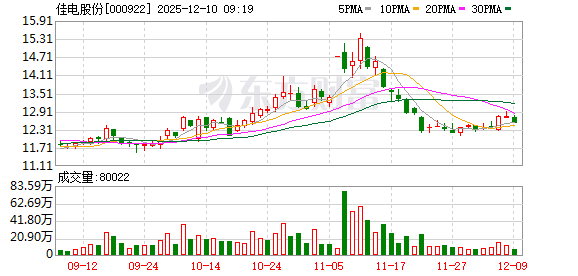
佳电股份(000922.SZ):佳电股份电动机及屏蔽泵已在中核小堆实现产品供货
Ge Long Hui· 2025-12-10 01:22
Core Viewpoint - The unique advantages of small modular reactors (SMRs) in terms of safety, deployment flexibility, and versatility are increasingly prominent in the new wave of nuclear technology transformation and international industrial competition [1] Group 1: Company Developments - Jiadian Co., Ltd. (佳电股份) announced that its subsidiary, Hadong Equipment, successfully developed and delivered all four nuclear main pumps for the "Linglong One," the world's first land-based commercial modular reactor [1] - The nuclear main pump is described as the "heart" of the reactor coolant system and is considered the most critical and challenging rotating equipment in the nuclear island [1] - The company has achieved full-chain independent research and development for the nuclear main pump, indicating a significant advancement in its technological capabilities [1] Group 2: Product Supply and Future Plans - Jiadian Co., Ltd. has supplied electric motors and shielded pumps for the China National Nuclear Corporation's small modular reactor, meeting the technical requirements [1] - The company plans to continue deepening the technological iteration of nuclear main pumps and promote the standardization and intelligent upgrade of its equipment [1] - Leveraging the demonstration experience from "Linglong One," the company aims to further consolidate its leading position in the core equipment field of small modular nuclear reactors, contributing to the high-quality development of China's nuclear technology [1]

佳电股份:电动机及屏蔽泵已在中核小堆实现产品供货 产品可满足技术需求
Mei Ri Jing Ji Xin Wen· 2025-12-10 01:19
Core Viewpoint - The unique advantages of small modular reactors (SMRs) in terms of safety, deployment flexibility, and multi-functionality are increasingly prominent in the new round of nuclear technology transformation and international industrial competition [2] Group 1: Company Developments - Jiadian Co., Ltd. announced that its subsidiary, Hadong Equipment, successfully developed and delivered all four nuclear main pumps for the world's first land-based commercial modular reactor, "Linglong No. 1" [2] - The nuclear main pump is described as the "heart" of the reactor cooling system and is considered the most critical and challenging rotating equipment in the nuclear island [2] - Jiadian Co., Ltd. has achieved full-chain independent research and development for the nuclear main pump, indicating a significant advancement in its manufacturing capabilities [2] Group 2: Future Plans and Industry Position - The company plans to continue deepening the technological iteration of nuclear main pumps and promote the standardization and intelligent upgrade of its equipment [2] - By leveraging the demonstration experience of "Linglong No. 1," the company aims to further consolidate its leading position in the core equipment field of small modular nuclear reactors [2] - The products supplied by Jiadian Co., Ltd., including electric motors and shielded pumps, have met the technical requirements for the small modular reactor [2]