
啤酒

Search documents
珠江啤酒业绩快报:2025年净利润9.03亿元 同比增长11.42%
Ge Long Hui· 2026-02-25 08:15
格隆汇2月25日丨珠江啤酒(002461.SZ)公布2025年度业绩快报,报告期内,公司产品结构优化升级,市 场开拓稳中有进,渠道建设创新发力,品牌声量持续放大,管理效能不断提升,持续推动企业高质量发 展走深走实。2025年,公司实现啤酒销量146.24万吨,同比增长1.58%;实现营业总收入58.78亿元,同 比增长2.56%;利润总额、归属于上市公司股东的净利润、扣除非经常性损益后的归属上市公司股东的 净利润分别为10.57亿元、9.03亿元和8.32亿元,分别同比增长10.98%、11.42%和9.25%,基本每股收益 同比增长10.81%。本报告期末资产总额、归属于上市公司股东的所有者权益分别为160.66亿元、110.36 亿元,分别比本报告期初增长1.00%、5.00%。 ...

珠江啤酒(002461.SZ)业绩快报:2025年净利润9.03亿元 同比增长11.42%
Ge Long Hui A P P· 2026-02-25 08:14
格隆汇2月25日丨珠江啤酒(002461.SZ)公布2025年度业绩快报,报告期内,公司产品结构优化升级,市 场开拓稳中有进,渠道建设创新发力,品牌声量持续放大,管理效能不断提升,持续推动企业高质量发 展走深走实。2025年,公司实现啤酒销量146.24万吨,同比增长1.58%;实现营业总收入58.78亿元,同 比增长2.56%;利润总额、归属于上市公司股东的净利润、扣除非经常性损益后的归属上市公司股东的 净利润分别为10.57亿元、9.03亿元和8.32亿元,分别同比增长10.98%、11.42%和9.25%,基本每股收益 同比增长10.81%。本报告期末资产总额、归属于上市公司股东的所有者权益分别为160.66亿元、110.36 亿元,分别比本报告期初增长1.00%、5.00%。 ...
年度啤酒销量146.24万吨,珠江啤酒2025年归母净利润9.03亿元
Zhi Tong Cai Jing· 2026-02-25 08:13
珠江啤酒(002461)(002461.SZ)披露2025年度业绩快报,公司实现啤酒销量146.24万吨,同比增长 1.58%;实现营业总收入58.78亿元,同比增长2.56%;利润总额、归属于上市公司股东的净利润、扣除非经 常性损益后的归属上市公司股东的净利润分别为10.57亿元、9.03亿元和8.32亿元,分别同比增长 10.98%、11.42%和9.25%,基本每股收益同比增长10.81%。 ...
年度啤酒销量146.24万吨,珠江啤酒(002461.SZ)2025年归母净利润9.03亿元
智通财经网· 2026-02-25 08:12
智通财经APP讯,珠江啤酒(002461.SZ)披露2025年度业绩快报,公司实现啤酒销量146.24万吨,同比增 长1.58%;实现营业总收入58.78亿元,同比增长2.56%;利润总额、归属于上市公司股东的净利润、扣除非 经常性损益后的归属上市公司股东的净利润分别为10.57亿元、9.03亿元和8.32亿元,分别同比增长 10.98%、11.42%和9.25%,基本每股收益同比增长10.81%。 ...
奉献最踏实的坚守
Zhong Guo Zhi Liang Xin Wen Wang· 2026-02-25 03:25
Core Insights - The article highlights the efforts of Shunyi District in Beijing to enhance quality management and support local enterprises in their quality upgrades, exemplified by the recognition of Yanjing Beer with a nomination for the Beijing Government Quality Management Award [2][3] Group 1: Quality Management Initiatives - Shunyi District has implemented a series of measures, including the establishment of a leading enterprise cultivation database and the promotion of a Chief Quality Officer system, to foster influential enterprises like Yanjing Beer [2] - The district's market supervision bureau emphasizes the importance of the quality cultivation process, believing that a well-executed process will naturally lead to positive results [2] Group 2: Impact on Enterprises - Yanjing Beer has experienced steady improvements in product quality, reduced production costs, and increased production efficiency since the implementation of an excellent management system, leading to enhanced brand reputation and consumer recognition [3] - The quality upgrade journey of Yanjing Beer serves as a vivid example of Shunyi District's commitment to advancing its quality strong district strategy [3] Group 3: Future Plans - The Shunyi District Market Supervision Bureau plans to deepen the "one-stop" quality infrastructure service system, aiming to create a more precise, efficient, and considerate quality service platform to ensure safety and promote industrial upgrades [4]



春节动销渠道观察
2026-02-24 14:16
Summary of Conference Call on Food and Beverage Industry Industry Overview - The conference focused on the food and beverage industry, particularly during the Chinese New Year period, with insights from experts in the field [1][2]. Key Points and Arguments Sales Performance by Category - Overall sales during the Chinese New Year period showed a growth of approximately 10% compared to the previous year, primarily driven by gift boxes [2]. - Specific categories reported varied growth rates: - **Dairy Products**: - Growth in ambient yogurt was around 3-4%, marking a positive shift from previous negative growth trends [3]. - Liquid milk showed a growth rate of about 7%, with Yili at approximately 8% and Mengniu around 5-6% [3]. - Infant formula experienced a negative growth due to inventory issues and recalls affecting brands like Nestlé and Feihe, while A2 and Junlebao performed well [4][5]. - **Frozen Foods**: - The leading brand, Anjing, reported an 18% growth, while the second tier brands averaged around 5-6% growth [6]. - **Condiments**: - Growth was lower than the previous year, with Hai Tian at 3% compared to 6% last year, attributed to a decline in restaurant sales [7][8]. - **Beverages**: - Notable growth in brands like Nongfu Spring and Dongpeng, with Nongfu Spring achieving a 15% growth [8][9]. Factors Influencing Sales - Seasonal factors played a significant role, with the timing of the Chinese New Year affecting sales cycles, resulting in fewer business days compared to previous years [12][13]. - Inventory management was crucial, with many products sold being produced in January, leading to a fresh stock perception among consumers [14][15]. - Consumer behavior shifted towards essential goods, with a focus on necessary items rather than premium or novelty products [16][17]. - Price stability was noted, with fewer discounts compared to previous years, indicating a healthier pricing environment [17]. Market Trends - Community and convenience stores contributed significantly to sales, while traditional supermarkets showed weaker performance [18][41]. - The growth of community group buying and snack retailing was highlighted as a key trend, especially in rural and suburban areas [18][41]. - The beverage market saw a rise in demand for sugar-free and health-oriented products, with unsweetened tea growing at around 18% [21]. Brand-Specific Insights - **Yili and Mengniu**: Both brands set ambitious growth targets of 5-8% and 10% respectively, with cautious optimism based on early performance [20][21]. - **Dongpeng**: Reported a 14% growth, driven by energy drinks and electrolyte water, although growth rates were expected to slow down due to market saturation [24][25]. - **Hai Tian**: Aiming for a 5% growth target, with challenges in the restaurant sector impacting overall performance [43][51]. Challenges and Risks - The industry faces challenges from fluctuating consumer preferences and potential economic downturns affecting discretionary spending [12][13]. - Brands like Three Squirrels and others reported lower-than-expected growth, indicating potential market saturation and changing consumer tastes [29][32]. Additional Important Content - The conference highlighted the importance of adapting marketing strategies to current consumer trends, emphasizing the need for brands to focus on essential products and maintain competitive pricing [16][17]. - The discussion also touched on the impact of seasonal employment patterns on restaurant sales, which could affect future growth in the condiment sector [44][50]. This summary encapsulates the key insights and trends discussed during the conference call, providing a comprehensive overview of the food and beverage industry's performance during the Chinese New Year period.



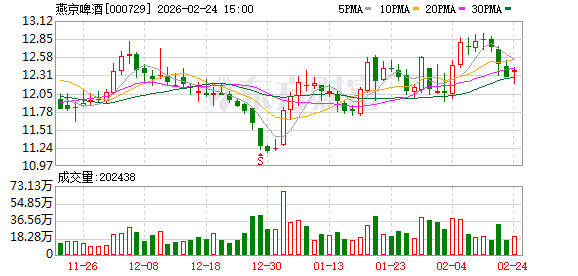
燕京啤酒:截至2026年2月13日公司股东总户数为43538户
Zheng Quan Ri Bao· 2026-02-24 10:15
Group 1 - The core point of the article is that Yanjing Beer reported its total number of shareholders as 43,538 as of February 13, 2026 [2]
港股收盘(02.24) | 恒指收跌1.82% AI模型“双雄”逆市上涨 存储概念、油气股走强
智通财经网· 2026-02-24 08:43
Market Overview - On the first trading day after the resumption of Northbound trading, Hong Kong's three major indices collectively declined, with the Hang Seng Index falling below the 27,000 mark, closing down 1.82% or 491.59 points at 26,590.32 points, with a total turnover of HKD 250.99 billion [1] - The Hang Seng China Enterprises Index dropped 2.06% to 9,007.86 points, while the Hang Seng Tech Index fell 2.13% to 5,270.70 points [1] Sector Performance - The technology sector remains a long-term investment focus, with valuation pressure easing after recent pullbacks, and potential for rebound driven by accelerated AI model updates and applications [1] - The energy and precious metals sectors are expected to rise amid heightened geopolitical risks in the Middle East and adjustments in U.S. tariff policies [1] - The consumer sector, currently undervalued, is anticipated to have upward potential as consumption policies are strengthened [1] Blue-Chip Stocks - WH Group (00288) led blue-chip gains, rising 4.42% to HKD 10.39, contributing 5.87 points to the Hang Seng Index [2] - Other notable blue-chip performers included Henderson Land (00012) up 2.08% and China Resources Beer (00291) up 2.02% [2] - China Biologic Products (01177) fell 6.58%, negatively impacting the index by 7.48 points [2] Hot Sectors - Major tech stocks faced pressure, with Tencent down over 3% and Alibaba down over 2% [3] - Storage concepts saw significant gains, with Zhaoyi Innovation (03986) up 11.91% and Longsys Technology (06809) up 4.92% [3] - Oil and gas stocks rose amid concerns over escalating tensions in Iran, with Shandong Molong (00568) up 11.41% [4] AI and Technology - The AI sector continues to show promise, with significant growth in token usage, particularly in Chinese models, which account for 61% of the total token volume [5] - The market anticipates ongoing rapid growth in AI applications and commercial viability [5] Film Sector - The film sector faced challenges, with the 2026 Spring Festival box office down approximately 40% year-on-year, indicating a need for improved content quality [6] - Major film stocks like Maoyan Entertainment (01896) and Huayi Brothers (01003) saw declines of 8.18% and 5.26%, respectively [6] Notable Stock Movements - Kwan Hung Holdings (01888) surged 12.37% following a profit forecast indicating a 165% increase in net profit for the fiscal year ending December 2025 [7] - Weichai Power (02338) rose 7.29% after a report highlighted its emergency generator's use in a major data center [8] - China Shipbuilding Defense (00317) reached a new high, up 5.37%, following a significant shipbuilding contract announcement [9] - Standard Chartered (02888) saw a 3.07% increase after reporting a 6% rise in operating income for the fiscal year 2025 [10] - China Duty Free Group (01880) faced a 10.51% drop due to losing some operating rights at major airports [11]



海通国际:维持百威亚太“中性”评级 目标价7.9港元
Zhi Tong Cai Jing· 2026-02-24 02:09
Core Viewpoint - Budweiser APAC (01876) is undergoing a deep adjustment period in the Chinese market, facing short-term performance pressure due to reform pains and external shocks, but positive signals are emerging from channel transformation, with preliminary improvements in market share observed in Q4 [1] Group 1: Financial Performance - For the full year 2025, the company's revenue and EBITDA were $5.76 billion and $1.59 billion, respectively, representing a year-on-year decline of 6.1% and 9.8%; Q4 revenue and EBITDA were $1.07 billion and $170 million, down 4.2% and 24.7% year-on-year [2] - The Chinese market significantly dragged down performance, with Q4 revenue and EBITDA declining by 11.4% and 42.3% year-on-year, and full-year revenue and EBITDA down 11.3% and 15.7% [2] - The net profit attributable to shareholders for the full year was $489 million, a decrease of 32.1% year-on-year, while cash flow remained robust with a dividend payout ratio increased to 153% [2] Group 2: Market Dynamics and Strategy - The industry in China is experiencing stable volume but declining prices, with Budweiser APAC actively transforming its channels; the decline in sales volume in Q4 narrowed from 11% in Q3 to 3.9% [3] - The company is focusing on high-end product positioning and expanding into new channels like instant retail and O2O, with expectations for ASP improvement in 2026 supported by various factors including policy changes and increased consumer confidence [3] - Management's outlook for 2026 includes organic growth, inorganic expansion, and shareholder returns, with a focus on high-end channels in China and maintaining a strong position in the Korean market [3] Group 3: Valuation and Target Price - The estimated EPS for the company for 2026-2028 is projected at $0.04, $0.05, and $0.05, respectively, with the valuation multiple for 2026 adjusted from 20x PE to 25x PE, maintaining a target price of HKD 7.9 [1][2]

海通国际:维持百威亚太(01876)“中性”评级 目标价7.9港元
智通财经网· 2026-02-24 02:05
Core Viewpoint - Budweiser APAC is undergoing a deep adjustment period in the Chinese market, facing short-term performance pressure due to reform pains and external shocks, but positive signals are emerging from channel transformation, with preliminary improvements in Q4 market share [1] Group 1: Financial Performance - For the full year 2025, revenue and EBITDA were $5.76 billion and $1.59 billion, down 6.1% and 9.8% year-on-year; Q4 revenue and EBITDA were $1.07 billion and $170 million, down 4.2% and 24.7% year-on-year [2] - The Chinese market significantly dragged down performance, with Q4 revenue and EBITDA declining 11.4% and 42.3% year-on-year, and full-year revenue and EBITDA down 11.3% and 15.7% year-on-year [2] - The net profit attributable to shareholders for the full year was $489 million, a decrease of 32.1% year-on-year, while cash flow remained robust with a dividend payout ratio increasing to 153% [2] Group 2: Market Dynamics - The industry saw stable volume but declining prices in Q4 2025, with leading companies maintaining stable operations; however, the average selling price (ASP) has been under pressure, hindering premiumization [3] - Budweiser APAC, as a leader in high-end beer, is increasing investments in emerging channels like instant retail and O2O, with early signs of improvement as the decline in sales volume narrowed from 11% in Q3 to 3.9% in Q4 [3] - The company is expected to benefit from multiple factors supporting ASP improvement in 2026, including effective policies to boost consumer confidence and demand, alongside the release of benefits from high-end positioning and channel transformation [3] Group 3: Strategic Outlook - The management has outlined three core outlooks for 2026: organic growth, inorganic expansion, and shareholder returns, with a focus on high-end home channels and O2O expansion in China [4] - The company plans to explore M&A and collaboration opportunities in the Asia-Pacific region, supported by strong cash flow for external growth [4] - A high dividend policy continues, with a dividend yield of 5.6% providing a solid safety net for the stock price; the depreciation of the US dollar is also expected to positively impact financial statements [4]