快餐

Search documents
斩获 “非凡雇主”!鱼你在一起以人才生态解码万店扩张密码
Cai Fu Zai Xian· 2025-12-09 03:38
Core Insights - The Chinese rice fast-food brand "Fish You Together" has won the "2025 Beijing Extraordinary Employer" award at the "2025 Extraordinary Employer" selection hosted by Liepin, highlighting its strong employer brand and commitment to talent management [1][3]. Group 1: Talent Strategy - The company aims to become the global leader in Chinese fast food with a vision of opening 10,000 stores, emphasizing that its team is the most important asset in achieving this goal [5]. - To build a globally-minded core team, the company recruits top experts from the chain restaurant and supply chain management sectors and focuses on hiring international students with cross-cultural communication skills [5]. - The establishment of corporate universities and various specialized academies reflects the company's commitment to providing opportunities for motivated individuals and rewarding high performers with equity [5]. Group 2: Talent Development Programs - The "Three Dragons and One Seedling" talent cultivation plan includes the Potential Dragon Plan, Flying Dragon Plan, Azure Dragon Plan, and Fish Seedling Plan, creating a comprehensive talent growth pathway across all levels [6]. - The Flying Dragon Plan targets senior management, focusing on loyalty, self-drive, and innovation through experiential learning and mentorship from industry experts [6]. - The Azure Dragon and Fish Seedling Plans are designed for new graduates, incorporating a mixed training mechanism to enhance organizational integration and business collaboration skills [6]. Group 3: Globalization and Localization - The company adheres to a "localization first, domestic expatriation second" principle in its overseas expansion, emphasizing the importance of local talent integration [7]. - By fostering cultural empathy and inclusivity, the company enhances team cohesion and operational efficiency in diverse markets, particularly in Southeast Asia [8]. - The localization strategy has led to improved operational metrics, such as increased table turnover rates in Thailand, demonstrating the effectiveness of cross-departmental collaboration and innovation [8]. Group 4: Future Aspirations - The recognition as an "Extraordinary Employer" marks a significant milestone in the company's talent strategy, aligning with its mission to promote Chinese cuisine globally [10]. - The company plans to deepen its talent system construction to support its global expansion and solidify its foundation for achieving the goal of becoming the top global Chinese fast-food brand [10].


孔东梅:共筑社会价值创新生态
Xin Lang Cai Jing· 2025-12-09 02:13
Core Viewpoint - The conference emphasizes the importance of cultural confidence and the concept of "business for good" as guiding principles for modern enterprises in China [3][14]. Group 1: Cultural Confidence - The essence of a company lies in its culture, which is the deepest layer beyond tangible assets and capabilities [5][17]. - The direction of modern Chinese enterprise management is to creatively integrate traditional Chinese culture with modern corporate spirit, transitioning from "efficiency competition" to "value competition" [6][18]. - Companies must consider the coexistence of growth and social responsibility as a critical issue of the times [15][21]. Group 2: Business for Good - "Business for good" is defined as leveraging commercial power to address social and environmental issues while creating economic value [20][21]. - The concept is rooted in both Western and Chinese traditions, highlighting the importance of social responsibility over mere profit maximization [20][21]. - Companies are encouraged to find intersections between public welfare and business, adopting a "benefit through righteousness" approach to create shared value [21][22]. Group 3: Sustainable Social Value - The idea of "sustainable social value innovation" transcends traditional corporate social responsibility, making social progress a core mission of enterprises [23][24]. - Building an open and collaborative ecosystem is essential for addressing social issues through shared resources and technology [23][24]. - The integration of cultural confidence and social responsibility is seen as vital for Chinese companies to become world-class enterprises with both commercial value and social commitment [24].

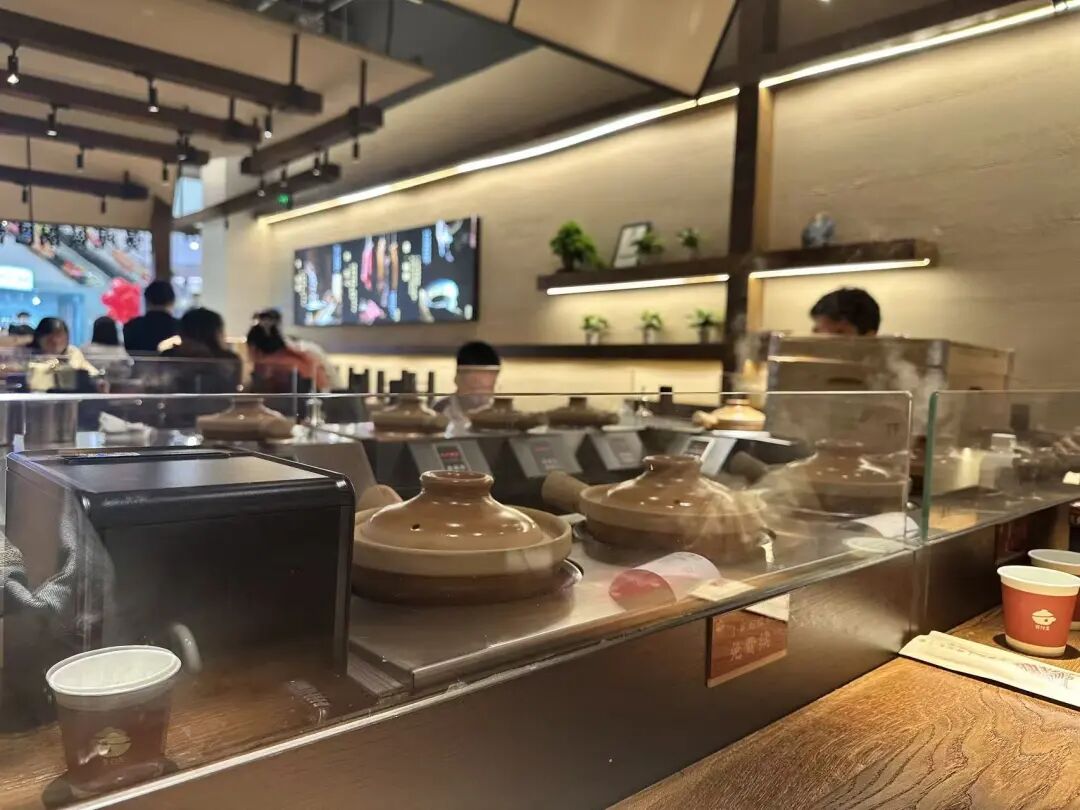
人均10+元,“板前快餐”席卷全国
3 6 Ke· 2025-12-08 12:13
Core Insights - The article discusses the rising popularity of the "板前" (front-of-counter) dining model in Chinese fast food, which is inspired by Japanese culinary practices and aims to enhance customer experience and operational efficiency [1][8]. Group 1: Market Trends - The "板前" model has been widely adopted across various fast food categories, with brands like "煲仔皇" and "捏捏虎" successfully implementing this approach to attract customers [2][4]. - In 2022, a surge in brands utilizing open kitchen concepts for items like hamburgers led to increased consumer interest and long queues in cities such as Shanghai and Guangzhou [2][4]. - "煲仔皇" plans to convert over 200 locations to the "板前" model within the next 18 months, highlighting the trend's potential for growth [4]. Group 2: Consumer Demand - The "板前" model addresses consumer desires for fresh ingredients and transparency in food preparation, allowing customers to witness the cooking process firsthand [9][11]. - The dining experience is enhanced by the visibility of food preparation, which builds trust and satisfaction among consumers [9][11]. - The model caters to the growing trend of solo dining, providing a comfortable environment for individuals without the need for shared tables [12][15]. Group 3: Operational Efficiency - The "板前" model improves table turnover rates by optimizing seating arrangements, allowing for higher customer throughput [12][15]. - By eliminating the need for waitstaff to deliver food from the kitchen, the model streamlines operations and enhances service speed [12][15]. - The design of the "板前" setup allows for better space utilization and a more efficient service process, which can lead to increased revenue [12][15]. Group 4: Challenges and Considerations - The shift to a "板前" model requires higher standards for hygiene and operational transparency, as kitchen practices are now visible to customers [17]. - The focus should remain on food quality and taste, rather than merely the novelty of the dining experience, to ensure customer retention and satisfaction [18][20]. - Brands must balance the appeal of the "板前" experience with consistent food quality and service efficiency to avoid potential pitfalls [20].
握紧“密钥”,掘金东南亚!江苏出海的跨境新策
Sou Hu Cai Jing· 2025-12-07 13:38
Core Insights - The recent "Silk Road E-commerce" event highlighted the potential of the Southeast Asian market for Jiangsu enterprises, emphasizing the need for deep localization to capitalize on this opportunity [1][4]. Group 1: Market Trends - Southeast Asia's e-commerce market is transitioning from a "traffic dividend" phase to a "brand cultivation" phase, necessitating a shift from simple sales strategies to refined brand management [3]. - Local consumers are becoming more sophisticated, and competition is intensifying, making traditional sales methods less effective [3]. - Jiangsu enterprises must focus on brand building, user engagement, and localized experiences to achieve sustainable growth and premium pricing [3][4]. Group 2: Data-Driven Localization - The use of AI tools, such as Adqlo, can help companies analyze social media data across platforms to gain consumer insights and market trends, facilitating effective localization strategies [5][6]. - Successful case studies, like the introduction of "Iron Goddess Coconut Tea" by a tea brand in Malaysia, demonstrate the effectiveness of data-driven approaches in product development and marketing [6]. Group 3: Local Team and Compliance - Building and managing an efficient local team is a common challenge for Chinese companies entering Southeast Asia, where the job market is competitive and local talent is selective [7][8]. - Companies need to adapt to local employment expectations and may require support in recruitment, compliance, and establishing local operations [7][8]. - The shift towards localized production and supply chain strategies is essential for Jiangsu manufacturers to meet international trade requirements and enhance their global brand presence [8].
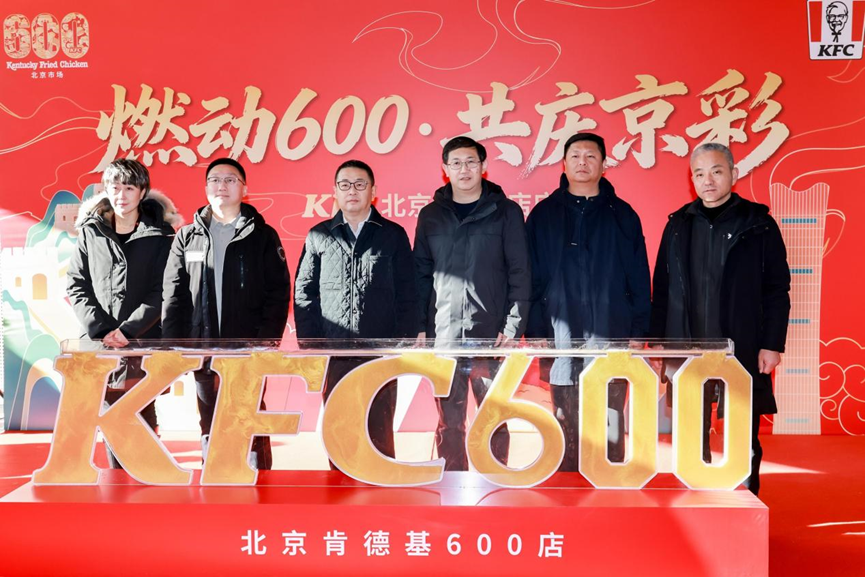
肯德基食物驿站实现北京十六区全覆盖
Bei Jing Shang Bao· 2025-12-05 13:29
Group 1 - The core point of the article highlights the opening of KFC's 600th store in Beijing, which features a "three-in-one" model including KFC, K COFFEE, and KPRO, showcasing the brand's innovative development in collaboration with the city over the past year [1] - The newly opened store also marks the launch of KFC's 60th food station in Beijing, achieving complete coverage across all 16 districts in the city [1] - KFC's food station initiative, started in 2020, aims to reduce food waste by providing surplus food to those in need, specifically targeting food that is past its best before date but still safe to consume [1] Group 2 - The food stations collect surplus food generated daily, package it, and distribute it with consumption guidelines to individuals in need [1] - KFC has expanded its food station initiative to over 1,000 locations across 180 cities in China, reflecting its commitment to social responsibility and community support [1]

北京肯德基第600家门店开业 “食物驿站”覆盖北京16区
Xin Jing Bao· 2025-12-05 12:28
Core Insights - KFC opened its 600th store in Beijing on December 5, marking a significant milestone in its expansion in the region [2] - The new store also includes K COFFEE and KPRO, showcasing KFC's strategy of integrating multiple dining concepts under one roof [2] - KFC's food station initiative has expanded to 60 locations in Beijing, contributing to a nationwide total of over 1,000 food stations across 180 cities [2] Expansion and Development - KFC's first store in mainland China was opened in 1987 in Beijing, and the brand has rapidly expanded to reach 600 stores in the city within a year [2] - The upcoming 500th restaurant, set to open in January 2025, will feature a unique cultural theme that combines dining with tourism and innovative consumer experiences [2] - The company plans to continue enhancing the integration of culture, commerce, and tourism in its future developments [2] Social Responsibility - The food station initiative, launched in 2020, aims to donate surplus food to those in need, reflecting KFC's commitment to social responsibility [2] - The expansion of food stations demonstrates KFC's proactive approach to addressing food waste and supporting local communities [2]

北京肯德基第600家门店启幕 肯德基食物驿站实现北京十六区全覆盖
Bei Jing Wan Bao· 2025-12-05 08:07
Core Insights - KFC has opened its 600th store in Beijing, marking a significant milestone in its expansion and the complete coverage of its food station initiative across all 16 districts of the city [1][10] - The brand has been deeply rooted in Beijing for over 30 years, focusing on local culture and quality, which has contributed to its growth alongside the city [3][12] - KFC's food station program has seen a tenfold increase in three years, reflecting its commitment to reducing food waste and supporting local communities [8][10] Expansion and Growth - KFC's first store in Beijing opened in 1987, and since then, the brand has integrated itself into the local culture and consumer experience [3] - The rapid expansion includes the opening of the 500th restaurant in Haidian in January 2025, featuring a unique cultural and tourism theme [3][5] - The company has adopted a multi-brand strategy with the introduction of K COFFEE and KPRO, enhancing its offerings and consumer experience [5][7] Community Engagement and Social Responsibility - The food station initiative, launched in 2020, aims to reduce food waste by distributing surplus food to those in need, showcasing KFC's commitment to social sustainability [8][10] - The program has expanded to over 1,000 locations across 180 cities in China, demonstrating its effectiveness and reach [8] - The recent opening of the 60th food station in Beijing highlights the brand's ongoing efforts to support outdoor workers and promote community welfare [10][12]
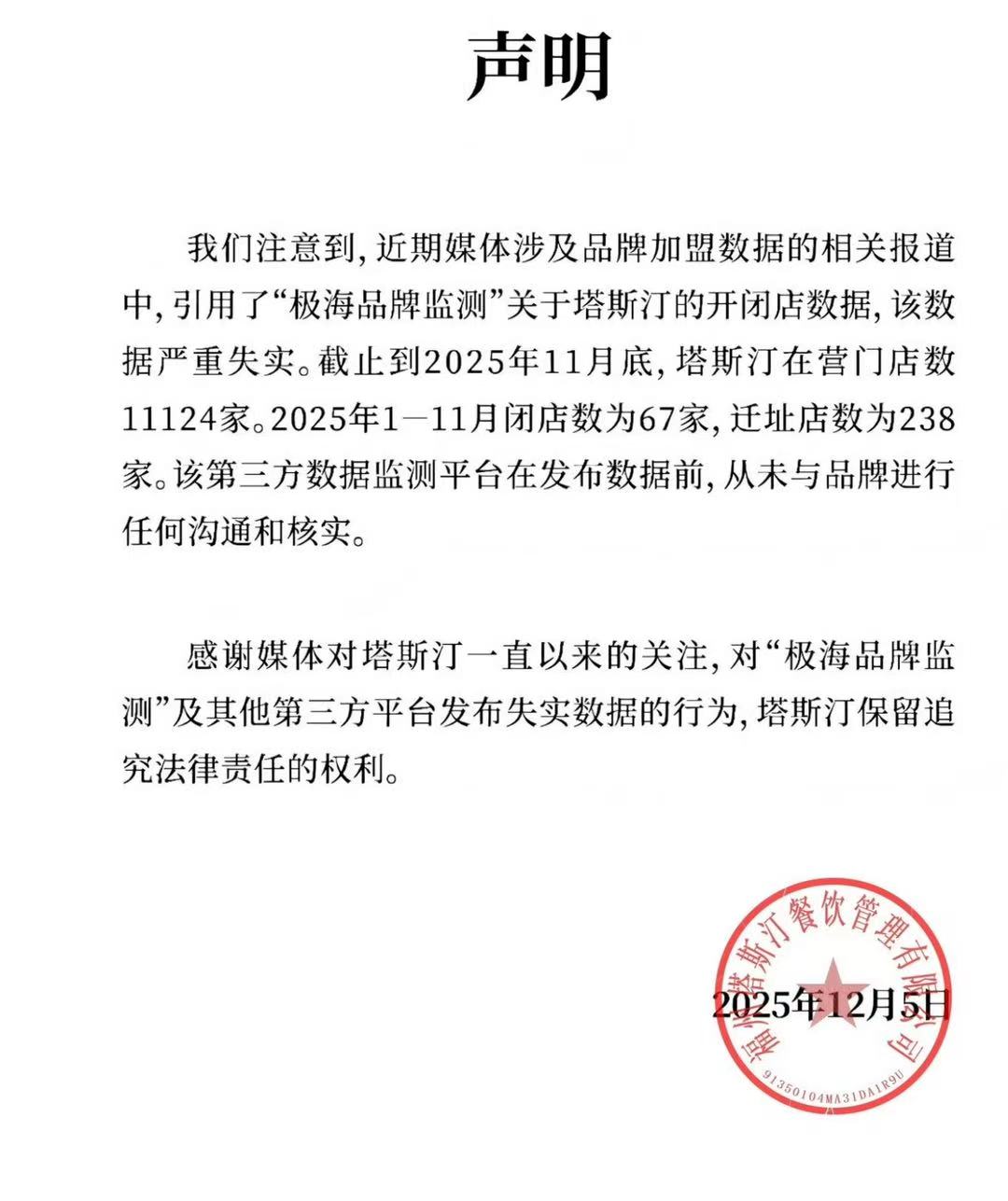
被指90天关闭超九百家店,塔斯汀发声明否认:数据严重失实
Nan Fang Du Shi Bao· 2025-12-05 06:00
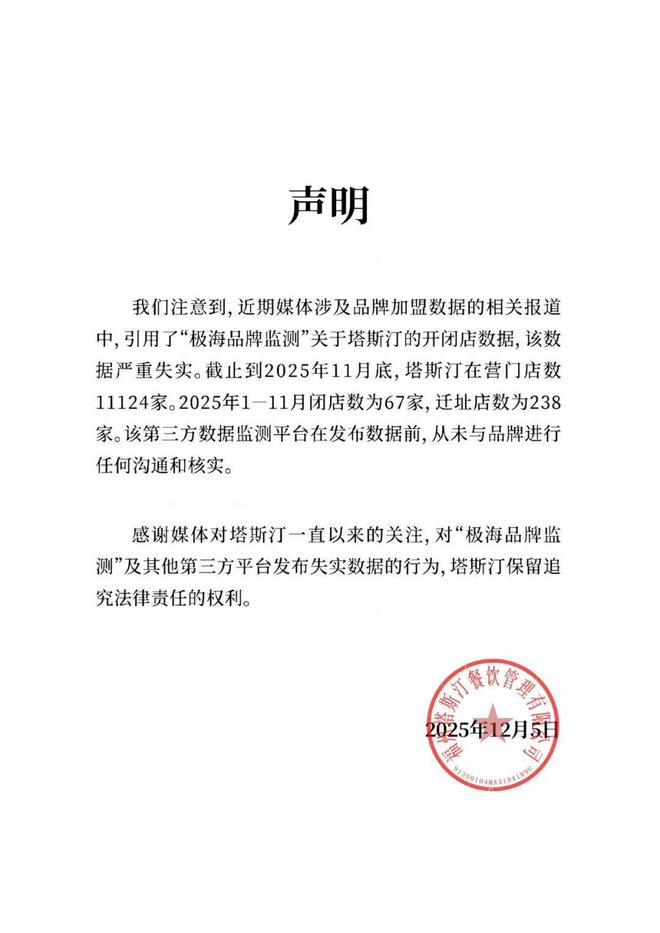
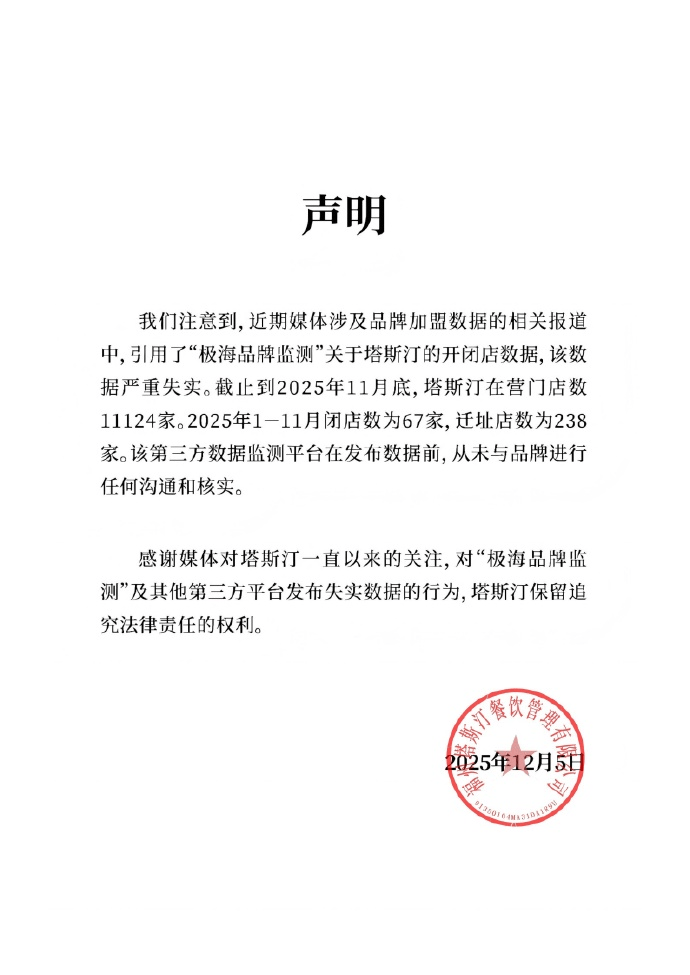
Core Viewpoint - The fast-food chain Tasting has issued a statement disputing recent media reports regarding its store opening and closing data, claiming that the data from the third-party monitoring platform, Extreme Sea Brand Monitoring, is significantly inaccurate [1][3]. Group 1: Store Data Discrepancies - As of December 2, according to Extreme Sea Brand Monitoring, Tasting opened 968 new stores and closed 907 in the past 90 days, which Tasting refutes [1]. - Tasting clarified that from January to November 2025, it closed 67 stores and relocated 238, with a total of 11,124 operating stores by the end of November 2025 [1]. - Tasting stated that the third-party monitoring platform did not communicate or verify the data with the brand before publication [1]. Group 2: Recent Developments and Growth Strategy - Tasting has been accelerating its store openings since 2022, becoming the third hamburger brand to exceed 10,000 stores, following Wallace and KFC [7]. - In 2023, Tasting's pace of new store openings has noticeably slowed, with 3,775 new stores opened in 2023, dropping to 2,355 in 2024, and 2,215 as of November 13, 2023 [7]. - Tasting is exploring new growth avenues, having opened two Tasting China Pizza stores in Quanzhou, featuring local flavors in their pizza offerings, with prices starting at 18 yuan [7]. Group 3: Company Background - Tasting was founded in Fuzhou in 2012, with its first store opening in Nanchang the same year [5]. - The brand introduced a dual-category offering of "hamburger + pizza" in 2017 and launched its signature "Chinese hamburger" in 2019, focusing on the "Chinese hamburger" market [5]. - Tasting's pricing strategy is aimed at being more affordable than competitors like KFC and McDonald's, targeting county-level cities and rural areas [5].
塔斯汀否认“大规模开关店”,今年前11月闭店67家,创始人曾为华莱士加盟商
Sou Hu Cai Jing· 2025-12-05 05:36
Core Viewpoint - Tasting, a Chinese hamburger brand, is facing challenges amid rapid expansion, including a recent controversy over store openings and closures, as well as ongoing food safety issues that have raised consumer concerns [1][5][6]. Group 1: Store Operations - As of December 2, Tasting opened 968 new stores in the past 90 days but also closed 907 stores [1] - Tasting's official statement claims that the reported data from "Extreme Sea Brand Monitoring" is severely inaccurate, asserting that as of November 2025, the total number of operating stores is 11,124, with only 67 closures and 238 relocations from January to November 2025 [1] - The company reserves the right to pursue legal action against third-party platforms that publish false data [1] Group 2: Business Model and Financials - Tasting was founded in 2012, initially focusing on pizza, but shifted to hamburgers in 2019, aiming to create a Chinese hamburger brand [3] - The franchise fee for Tasting is 38,800 yuan, with total costs to open a store estimated at 452,300 yuan [4] - The average gross margin for a single product is between 65% and 70%, with online package activities estimated at 50% to 55%, and delivery platform margins at 45% to 50% [4] - Tasting received 120 million yuan in financing from Source Code Capital and Uncertain Investment in November 2021 [4] - By the third quarter of 2025, Tasting is expected to surpass 10,000 stores, becoming the second Chinese hamburger brand to enter the "10,000-store club" after Wallace [4] Group 3: Food Safety Issues - Tasting has faced multiple food safety scandals, including a significant incident during the 2022 "3.15" event where undercover investigations revealed serious food safety violations [4] - Despite previous admissions of management failures by Tasting's founder, food safety issues have continued to surface, with reports of undercooked products in 2023 [5][6] - The ongoing food safety problems highlight the need for improvements in Tasting's supply chain capabilities and store management [6]
90天关了907家店?塔斯汀发声明否认
Xin Lang Cai Jing· 2025-12-05 04:25
Core Insights - Tasiting has opened 968 new stores in the past 90 days but has also closed 907 stores, resulting in approximately 10,296 operational stores as of December 2 [3] - Founded in 2012 by three individuals in their 30s, Tasiting initially focused on Western fast food, particularly "burgers + pizza," before pivoting to a differentiated product positioning of "Chinese burgers" in 2019 [3] - The company aims to expand its presence significantly, with plans to open over 2,300 new stores annually from 2022 to 2025, targeting first-tier cities and aiming to become a "10,000-store brand" by the second half of 2025 [6] Product Offering - Tasiting specializes in "handmade and freshly baked" products, offering a variety of Chinese-style burgers such as spicy chicken leg burgers and Beijing roast duck burgers, along with snacks, roasted chicken, and beverages [4] - The average transaction value is around 19 yuan, which is lower than that of Western fast food chains like KFC and McDonald's [4] Company Background and Valuation - Tasiting Restaurant Management Co., Ltd. was established in December 2017, with a registered capital of approximately 120 million yuan, focusing on restaurant management and consulting services [6] - The company is currently valued at 7 billion yuan, with significant funding rounds including a 120 million yuan Series A in November 2021 and a recent investment from Sequoia China in November 2023, although specific amounts were not disclosed [6]