
数码

Search documents
625亿元!2026年第一批“国补”资金来了 补哪些、怎么补?
Mei Ri Jing Ji Xin Wen· 2025-12-31 08:47
12月31日,国家发展改革委召开12月份新闻发布会。 国家发展改革委政策研究室副主任、委新闻发言人李超介绍,12月29日,国家发展改革委牵头印发《关于2026年实施大 规模设备更新和消费品以旧换新政策的通知》。2026年的"两新"政策进一步优化了制度设计和实施方式。 中央经济工作会议明确提出,要优化"两新"政策实施。按照党中央和国务院决策部署,在制定2026年"两新"政策过程中, 相关部门系统总结前期政策实施情况,广泛听取各方意见,充分评估发掘"两新"政策在扩大内需、带动就业、改善民生 等方面的潜力,将投资于物和投资于人紧密结合,重点在设备更新政策惠及面、支持绿色低碳智能产品推广应用、资金 使用监管等方面进行了优化。 继续实施汽车报废更新和汽车置换更新补贴 李超介绍,对于2026年"两新"政策,一是优化支持范围。设备更新方面,在总体延续今年支持范围的基础上,主要增加 了三个方面的更新补贴。民生领域增加老旧小区加装电梯、养老机构设备更新。安全领域增加消防救援、检验检测设备 更新。消费基础设施方面,增加商业综合体、购物中心、百货店、大型超市等线下消费商业设施的设备更新。 消费品以旧换新方面,进一步集中资源,着力提 ...

定了,明年以旧换新有这些补贴
Zhong Guo Zheng Quan Bao· 2025-12-31 08:31
Core Viewpoint - The Chinese government has announced a subsidy program for the replacement of old home appliances and the purchase of new digital and smart products starting January 1, 2026, aimed at boosting consumer spending and supporting the economy [1][5]. Group 1: Subsidy Details - The subsidy program includes six categories of home appliances: refrigerators, washing machines, televisions, air conditioners, water heaters, and computers, as well as four categories of digital and smart products: smartphones, tablets, smartwatches (bands), and smart glasses, with a maximum subsidy of 1,500 yuan for home appliances and 500 yuan for digital products [2]. - Consumers can receive a subsidy of 15% off the final sales price after discounts, with each person eligible for one subsidy per category [2]. Group 2: Implementation and Support - Local governments are required to effectively implement the subsidy program, utilizing both online and offline sales channels, and enhancing support for participating businesses [2]. - The program encourages the development of diverse consumption scenarios in physical stores and aims to boost the potential of brand specialty stores and professional retail [2]. Group 3: Rural Consumer Access - The notification emphasizes the importance of ensuring that rural residents, especially those in remote areas, can access the subsidy program through increased offline business presence and online channel guidance [3]. - It supports the participation of various commercial entities in county-level markets and encourages large supermarkets and specialty stores to reach rural markets through mobile sales and local exhibitions [3]. Group 4: Waste Recycling System - The notification calls for strengthening logistics management and improving the waste recycling system for old appliances, ensuring that businesses involved in the subsidy program can handle both the sale of new products and the collection of old ones [4]. - It encourages promotional activities that offer discounts for consumers who purchase new products while trading in their old appliances, and suggests developing innovative recycling models [4]. Group 5: Policy Coordination and Efficiency - A national meeting emphasized the need for coordination among various departments and local governments to effectively implement the subsidy policy, focusing on enhancing the efficiency of subsidy approval and disbursement [5]. - The meeting also highlighted the importance of combating fraudulent claims and ensuring that subsidy funds are utilized effectively [5].
跨年消费多元化:宅家体验“微醺”,在洗浴中心“猫冬”
Nan Fang Du Shi Bao· 2025-12-31 07:55
Core Insights - The New Year's consumption trend is shifting towards a more diversified and decentralized approach, with young consumers opting for home celebrations and experiences rather than traditional large gatherings [1][11] Group 1: Consumption Trends - Home-based celebrations are becoming popular among young consumers, with significant increases in sales of alcoholic beverages and digital products. For instance, craft beer and white wine sales have both seen over 100% year-on-year growth, while brandy sales surged by over 230%. Smartwatches and tablets also emerged as popular self-gifting items, with smartwatch sales increasing by 610% [3][5] - The search volume for unique and low-alcohol beverages has risen, indicating a shift in consumer preferences towards emotional value and participation rather than excessive drinking [5][11] Group 2: Service Consumption - Service consumption is trending towards collective relaxation, with significant increases in searches for beauty services such as haircuts, manicures, and eyelash extensions, which have doubled year-on-year. The popularity of KTV and bathing centers has also surged, with KTV transactions increasing by nearly 30% in the weeks leading up to New Year's [8][10][11] - The bathing industry is expected to experience significant growth by 2025, with a notable increase in transaction volumes during the winter season, particularly in cities like Harbin, where transaction growth exceeded 211% [10][11]
最新部署!关于2026年家电以旧换新、数码和智能产品购新补贴
Zheng Quan Ri Bao Wang· 2025-12-31 07:28
Core Viewpoint - The Ministry of Commerce and other departments have issued a notification regarding the implementation of subsidies for the replacement of old home appliances and the purchase of new digital and smart products starting January 1, 2026, aimed at promoting consumer spending and supporting the retail sector [1][2]. Group 1: Subsidy Details - The subsidy applies to six categories of home appliances (refrigerators, washing machines, televisions, air conditioners, water heaters, and computers) and four categories of digital and smart products (mobile phones, tablets, smartwatches, and smart glasses) [1]. - The subsidy standard is set at 15% of the final sales price after discounts, with a maximum subsidy of 1,500 yuan for home appliances and 500 yuan for digital and smart products, limited to one item per category per person [1]. Group 2: Implementation and Funding - Local authorities are required to develop a scientific plan for the use and disbursement of subsidy funds, ensuring a balanced monthly usage and smooth transitions between weeks and months [2]. - The notification encourages the use of pre-allocated and rolling disbursement methods to simplify the funding approval process and alleviate the financial burden on participating businesses [2]. Group 3: Supervision and Compliance - Strengthened supervision and management measures are mandated, including the establishment of a monitoring mechanism for the use of subsidy funds [3]. - Non-compliance with subsidy requirements will lead to immediate corrective actions, including the suspension of participation qualifications and potential legal consequences for violations [3]. - The notification emphasizes the need for a healthy competitive environment and the prevention of price wars among brands in the home appliance and mobile phone sectors [3].
2026年首批625亿元“国补”下达,汽车家电换新补贴比例明确
Sou Hu Cai Jing· 2025-12-31 07:25
数码产品购新补贴拓展为数码和智能产品购新补贴,支持范围在手机、平板、智能手表(手环)基础上,新增了智能眼镜。此外,通知支持地方结合实际自 主制定智能家居产品(含适老化家居产品)的购新补贴具体品类与标准。 国家发展改革委会同财政部近日已向地方提前下达2026年第一批625亿元超长期特别国债支持消费品以旧换新资金计划。根据两部门发布的《关于2026年实 施大规模设备更新和消费品以旧换新政策的通知》,2026年"国补"资金将按季度分批次下达地方。 根据通知规定,直接向地方安排的消费品以旧换新资金总体按照9:1的原则实行央地共担,具体承担比例根据地区划分:东部地区中央承担85%,中部地区 90%,西部地区95%。各省级财政需根据中央资金分配情况按比例安排配套资金,省以下经费分担办法由省级财政确定。 值得注意的是,通知明确,若某地区用完中央下达的消费品以旧换新资金额度,超出部分将由该地区通过地方资金支持,中央不再负担。2026年第一批"国 补"资金规模为625亿元,低于2025年同期的810亿元。 汽车补贴方式由定额调整为按新车售价比例进行,报废更新购买新能源乘用车补贴车价的12%(最高2万元),购买2.0升及以下排量 ...

品类、范围和标准明确!2026年这些家电享受补贴
Sou Hu Cai Jing· 2025-12-31 07:23
Group 1 - The Ministry of Commerce and other departments issued a notice on December 31 regarding the implementation of a subsidy program for replacing old home appliances and purchasing new digital and smart products in 2026 [1] - The notice emphasizes the need for participating businesses to provide a one-stop service for both selling new appliances and collecting old ones, while encouraging promotional activities that offer discounts to consumers who trade in their old products [1] - The policy aims to enhance the participation of rural residents, especially in remote areas, by ensuring that online platforms meet their subsidy consumption needs and encouraging various commercial entities to extend services to these regions [1] Group 2 - Starting from January 1, 2026, consumers will receive subsidies for purchasing specific energy-efficient home appliances and digital products, with a subsidy rate of 15% of the final sales price after discounts, capped at 1500 yuan for home appliances and 500 yuan for digital products [2] - Eligible products include six categories of home appliances such as refrigerators, washing machines, televisions, air conditioners, water heaters, and computers, as well as four categories of digital products like smartphones and smartwatches, with a price limit of 6000 yuan per item [2]
2026年家电最高只补贴1500元,数码类新增智能眼镜
Sou Hu Cai Jing· 2025-12-31 07:13
根据国家发改委以及财政部最新的通知,2026年国补将会从1月1日启动,个人消费者购买冰箱、洗衣机、 电视、空调、电脑以及热水器这6类产品,如果你是1级能效或者水效的产品,那么就可以享受最高15%的 补贴,补贴的额度最高不超过1500元,相比较2025年的政策,2026年的国补降低了家电类补贴的额度以及 幅度,如果购买高端产品就要多花500元的价格。 对于2025年的消费者来说,国补能够节省一大笔的预算,从而也能促进消费者。随着时间来到了年末,大 家纷纷担心2026年国补是否会取消,现在有个好消息就是2026年国补仍将继续,当然相比较2025年,2026 年的国补政策在部分领域有所调整,例如家电类产品的国补幅度为15%,而不是2025年的20%,最高额度 也降低到了1500元,不过这一次智能眼镜算是加入到了国补的行列中来。 不过针对数码产品,国补的范围有所增加,个人消费者在购买手机、平板、智能手表以及智能眼镜这四类 产品,最高可以享受15%的补贴幅度,最高补贴额度为500元,相比较2025年增加了智能眼镜的品类,此外 像是智能家居类产品的补贴项目,则是地方结合实际进行对应的补贴。 相比较2025年,2026年的 ...
刚刚,利好来了!国家最新发布
中国基金报· 2025-12-31 07:13
一、明确享受补贴品类、范围和标准 2026年1月1日起,按照全国统一的品类和标准,对个人消费者购买1级能效或水效标准的冰 箱、洗衣机、电视、空调、热水器、电脑6类家电产品,以及单件销售价格不超过6000元的 手机、平板、智能手表(手环)、智能眼镜4类数码和智能产品给予补贴。补贴标准为上述产 品扣除各环节优惠后最终销售价格的15%,每人每类可补贴1件,其中,家电产品每件补贴不 超过1500元,数码和智能产品每件补贴不超过500元。 来源:商务部网站、央视新闻客户端 商务部等部门12月31日发布关于做好2026年家电以旧换新、数码和智能产品购新补贴工作的 通知。 通知明确,2026年1月1日起,按照全国统一的品类和标准,对个人消费者购买1级能效或水 效标准的 冰箱、洗衣机、电视、空调、热水器、电脑 6类家电产品,以及单件销售价格不超 过6000元的 手机、平板、智能手表(手环)、智能眼镜 4类数码和智能产品给予补贴。 补 贴标准为上述产品扣除各环节优惠后 最终销售价格的15% ,每人每类可补贴1件,其中,家 电产品每件补贴 不超过1500元 ,数码和智能产品每件补贴 不超过500元 。 全文如下: 商务部等5部门 ...

“国补”新变化!这些产品也能享受补贴→
Jin Rong Shi Bao· 2025-12-31 06:47
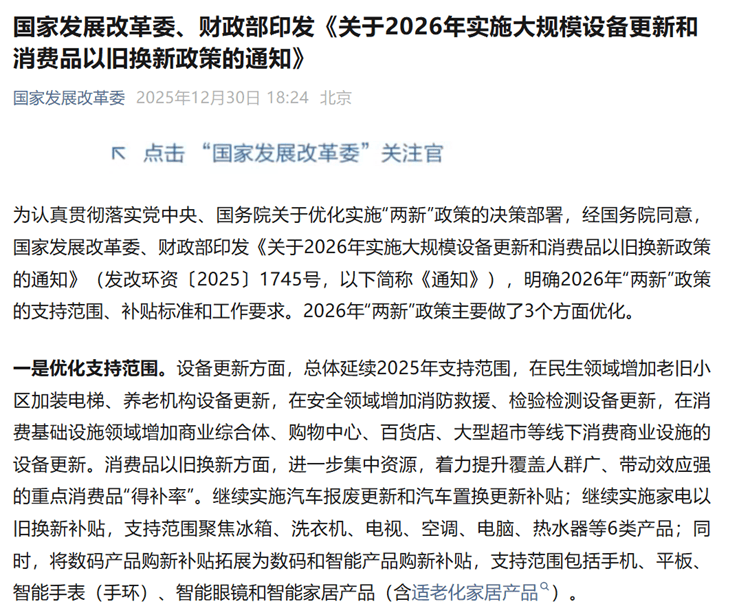
12月30日,国家发展改革委、财政部发布了《关于2026年实施大规模设备更新和消费品以旧换新政策的 通知》,明确了明年"两新"政策的支持范围和补贴标准。 其中,消费品以旧换新(以下简称"'国补'")政策方面,进一步集中资源,着力提升覆盖人群广、带动效 应强的重点消费品"得补率"。 "国补"政策都有哪些变化?哪些产品可以享受"国补"?个人能享受多少"国补"?记者进行了梳理: 支持汽车报废更新 个人消费者报废登记在本人名下的乘用车,并购买纳入《减免车辆购置税的新能源汽车车型目录》的新 能源乘用车或2.0升及以下排量燃油乘用车的,给予汽车报废更新补贴支持。 ——购买新能源乘用车补贴车价的12%(最高不超过2万元)。 ——购买新能源乘用车补贴车价的8%(最高不超过1.5万元)。 ——购买2.0升及以下排量燃油乘用车补贴车价的6%(最高不超过1.3万元)。 支持家电以旧换新 个人消费者购买冰箱、洗衣机、电视、空调、电脑、热水器等6类家电中1级能效或水效标准的产品,按 产品销售价格的15%给予补贴,每位消费者每类产品可补贴1件,每件补贴不超过1500元。 支持数码和智能产品购新 相较于2025年,2026年将数码产品购新 ...
扩大支持范围、细化补贴标准、完善实施机制—— “两新”政策优化升级促内需
Zhong Guo Jing Ji Wang· 2025-12-31 06:46
国家发展改革委、财政部日前印发《关于2026年实施大规模设备更新和消费品以旧换新政策的通知》 (以下简称《通知》),进一步优化"两新"政策支持范围、补贴标准以及实施机制。同时,为做好政策 平稳有序衔接,满足元旦、春节等旺季消费需求,2026年第一批625亿元超长期特别国债支持消费品以 旧换新资金计划已提前下达。 推动大规模设备更新和消费品以旧换新,在稳投资、扩消费、促转型、惠民生等方面发挥了有力作 用。"2026年'两新'政策聚焦社会普遍关切和民生现实需要展开系统部署,具有精准发力、提质增效的 鲜明特征。"国家节能中心主任刘琼说。 《通知》明确,设备更新方面,在总体延续2025年支持范围的基础上,2026年将新增老旧小区加装电 梯、养老机构、消防救援、检验检测、线下消费商业设施领域设备更新。消费品以旧换新方面,继续支 持汽车以旧换新,家电以旧换新聚焦冰箱、洗衣机、电视、空调、电脑、热水器6类产品;数码产品购 新补贴拓展为数码和智能产品购新补贴,支持范围包括手机、平板、智能手表(手环)、智能眼镜和智 能家居产品(含适老化家居产品)。 在国家信息中心经济预测部副研究员袁剑琴看来,设备更新中的消防救援设施直接关系到 ...