
智能手表(手环)

Search documents
政策协同配合 激发消费市场新活力
Jin Rong Shi Bao· 2026-02-25 02:02
Group 1 - In 2025, China's total retail sales of consumer goods exceeded 50 trillion yuan for the first time, reaching 50.1 trillion yuan, with a year-on-year growth of 3.7% and a contribution rate of consumption to economic growth at 52%, an increase of 5 percentage points [1] - The central economic work conference emphasized the importance of domestic demand and building a strong domestic market as a key task for economic work in 2026, with various policies being implemented to boost consumption [1] - Experts suggest enhancing the coordination between monetary and fiscal policies to amplify policy effectiveness and guide social capital in supporting consumption and investment [1] Group 2 - The implementation of the old-for-new policy since 2025 has significantly boosted sales in related categories, with sales reaching 2.61 trillion yuan and benefiting 366 million people [2] - Retail sales of home appliances, communication equipment, and furniture saw increases of 11%, 20.9%, and 14.6% respectively, while passenger vehicle retail volume grew by 3.8% in 2025 [2] - A new notification for 2026 aims to enhance the effectiveness of the old-for-new policy by focusing on key consumer goods and expanding the scope of subsidies [2] Group 3 - The integration of consumer credit products with the old-for-new policy is expected to enhance the actual effects of the policy, with financial institutions collaborating with merchants to improve consumer convenience [3] - The focus on automotive, home appliance, and digital products in the old-for-new scenarios will promote the development of financial services in these areas [3] Group 4 - By the end of 2025, the balance of loans in key service consumption sectors reached 2.8 trillion yuan, with a year-on-year growth of 6%, indicating a steady recovery in consumer willingness and capacity [4] - The People's Bank of China established a 500 billion yuan re-loan facility for service consumption and elderly care, with a re-loan rate of 1.5%, to encourage financial support for key service sectors [4] Group 5 - In August 2025, the Ministry of Finance introduced a loan interest subsidy policy for service industry operators, providing a 1% subsidy for loans in various service sectors [5] - In January 2026, the People's Bank of China announced an expansion of the re-loan support areas and reduced the re-loan rate to 1.25%, while the Ministry of Finance optimized the subsidy policy to include digital, green, and retail sectors [5] - The combination of re-loan and interest subsidy policies reflects a deep integration of monetary and fiscal policies, aimed at reducing financing costs in the consumption sector [5]
换家电、购数码产品可享15%政府补贴
Xin Lang Cai Jing· 2026-02-13 22:45
Group 1 - The core initiative involves a government subsidy of 15% for consumers purchasing new home appliances and digital products, aimed at upgrading consumption in Hebei province [1] - The subsidy applies to six categories of home appliances, including refrigerators, washing machines, televisions, air conditioners, water heaters, and computers, as well as four categories of digital products, such as smartphones, tablets, smartwatches, and smart glasses, with specific price limits for each category [1] - The maximum subsidy per home appliance is capped at 1,500 yuan, while for digital products, it is capped at 500 yuan, with each consumer eligible for one subsidy per category [1] Group 2 - A collaborative mechanism involving provincial, municipal, and county levels will be established to ensure effective implementation, data sharing, and fund security [2] - The program will include a price filing and public announcement system for subsidized products, prohibiting temporary price increases or misleading discounts by participating vendors [2] - Efforts will be made to enhance convenience for rural residents by increasing offline service providers and promoting online channels to facilitate access to the subsidy program [2]
400场活动!南京端出春节消费大餐
Sou Hu Cai Jing· 2026-02-11 00:31
Core Viewpoint - Nanjing is launching a series of consumer promotion activities titled "Revitalizing Consumption, Enjoy Shopping in Nanjing" with over 400 events planned around the Spring Festival, focusing on enhancing consumer experience through technology and cultural integration [2][3]. Group 1: Consumer Promotion Activities - Nanjing will conduct more than 400 promotional activities across six dimensions: food, accommodation, transportation, tourism, shopping, and entertainment during the Spring Festival [2]. - The city is implementing a "Universal Consumption Incentive" program, offering a lottery for consumers who spend over 100 yuan in various sectors, with prizes up to 800 yuan [3]. Group 2: Automotive and Electronics Subsidies - For the automotive sector, Nanjing is providing subsidies of up to 20,000 yuan for vehicle scrappage and 15,000 yuan for vehicle replacement [3]. - In the electronics sector, consumers can receive up to 1,500 yuan for purchasing energy-efficient home appliances and up to 500 yuan for certain digital products [3]. Group 3: Cultural and Culinary Promotions - Nanjing is promoting local culinary culture through 136 signature dishes across 11 districts, encouraging restaurants to offer special New Year meals and gift boxes [5]. - The city aims to create a "food + culture + tourism" experience to attract more visitors, emphasizing the unique flavors of Nanjing [5]. Group 4: Digital Consumption Experience - Nanjing is collaborating with major e-commerce platforms to provide various discounts and promotions, with over 50 million yuan allocated for consumer incentives [6]. - Initiatives include instant discounts through payment apps and special live-streaming events to promote local products [6]. Group 5: Festive Atmosphere and Events - The city is organizing traditional and modern cultural activities in major shopping districts to enhance the festive atmosphere during the Spring Festival [7]. - Events include parades, exhibitions, and interactive experiences that integrate traditional crafts with contemporary commercial spaces [8]. Group 6: Integration of Culture, Commerce, and Tourism - Nanjing will host a series of themed events such as lantern festivals and cultural exhibitions to highlight the festive spirit and local heritage [9]. - The city is leveraging social media platforms to enhance cultural tourism appeal and create immersive consumer experiences during the holiday season [9].

北京市家电数码“以旧换新”补贴升级
Sou Hu Cai Jing· 2026-02-10 08:50
Core Viewpoint - The implementation of the "Beijing 2026 Home Appliance Trade-in and Digital Product Purchase Subsidy Implementation Details" aims to enhance the precision and efficiency of subsidy fund allocation, reflecting a shift from "heavy investment" to "performance-oriented" governance in fiscal fund usage [2][4][6]. Group 1: Subsidy Details - The subsidy applies to six categories of home appliances and four categories of digital and smart products, with a subsidy rate of 15% of the final sales price after discounts, capped at 1,500 yuan for home appliances and 500 yuan for digital products [3][4]. - Consumers must complete real-name authentication via the "Jing Tong" mobile app to claim subsidies, with specific limits on the number of qualifications that can be claimed and their validity periods [3][4]. Group 2: Policy Implementation and Management - The policy emphasizes a structured approach to subsidy qualification, requiring consistency among the applicant, payer, and recipient, and mandates that products must be unsealed and activated for verification [4][6]. - The new policy framework aims to prevent misuse of qualifications and ensure that subsidy funds reach genuine consumers, addressing previous issues of fund wastage and regulatory challenges [4][6]. Group 3: Broader Policy Context - The "Two New" policy has entered a quality enhancement phase, with local governments accelerating the implementation of related measures since its announcement [5][6]. - The central and local governments are collaborating to ensure the effective rollout of the policy, aligning with national goals to expand domestic demand and upgrade consumption [5][6].

政策加力,以旧换新激发市场潜能
Sou Hu Cai Jing· 2026-02-10 02:23
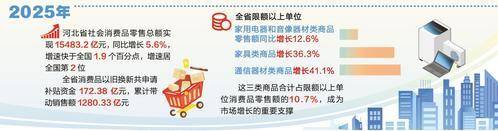
Core Viewpoint - The retail sales of consumer goods in Hebei Province reached 1,548.32 billion yuan in 2025, with a year-on-year growth of 5.6%, outpacing the national average by 1.9 percentage points, ranking second in the country [1] Group 1: Policy Impact - The "old-for-new" policy has significantly boosted consumer spending, with 172.38 billion yuan in subsidies leading to a sales increase of 1280.33 billion yuan [1] - The Hebei Province has expanded its "old-for-new" policy framework, enhancing its coverage and ensuring effective implementation through a combination of short-term and long-term strategies [2] - The introduction of subsidies for digital products such as smartphones, tablets, and smartwatches marks a significant expansion of the policy's scope, supporting consumers in adopting smart technologies [2] Group 2: Consumer Experience - The "Huanxin Life" app in Langfang has facilitated the purchase of electronic products, offering substantial subsidies and creating a new consumer service environment [4] - In Baoding, a streamlined online platform for electric bicycle exchanges has been established, allowing consumers to complete the entire process quickly and efficiently [4] - The "old-for-new" initiative not only stimulates consumption but also drives quality supply, creating a positive cycle of policy stimulation, industrial upgrading, and consumption expansion [4] Group 3: Sales Growth Data - In 2025, retail sales of household appliances and audio-visual equipment increased by 12.6%, furniture by 36.3%, and communication equipment by 41.1%, collectively accounting for 10.7% of retail sales in the province [5]
北京家电数码以旧换新补贴升级
Bei Jing Shang Bao· 2026-02-09 17:07
Core Viewpoint - The implementation of the "Beijing 2026 Home Appliance Trade-in and Digital Product Purchase Subsidy Implementation Details" aims to enhance the precision and efficiency of subsidy fund allocation for consumers in Beijing, reflecting a shift from "heavy investment" to "performance-oriented" governance in fiscal fund usage [2][6]. Group 1: Subsidy Details - The subsidy applies to six categories of home appliances and four categories of digital and smart products, with a subsidy standard of 15% of the final sales price after discounts, capped at 1,500 yuan for home appliances and 500 yuan for digital products [3][4]. - Consumers must complete real-name authentication via the "Jingtong" mobile app to claim subsidies, with restrictions on the number of qualifications that can be claimed for each category [3][4]. Group 2: Qualification and Usage Rules - The qualification for subsidies has a validity period, with online qualifications expiring at 24:00 on the same day and offline qualifications expiring at 24:00 on the following Sunday, with a limit of four unutilized qualifications leading to ineligibility for future claims in that category [3][4]. - The implementation emphasizes consistency among the applicant, payer, and recipient, requiring verification of product activation and alignment with sales orders [4][5]. Group 3: Policy Implementation and Evolution - The "Two New" policy has entered a quality enhancement phase, transitioning from initial implementation to a focus on precision and efficiency in subsidy distribution [6]. - The central and local governments are collaborating to ensure unified policy direction while adapting to local market conditions, enhancing the convenience of participation through digital platforms [5][6].
设领补时效、 4次逾期未用不能再领 北京市家电数码“以旧换新”补贴升级
Bei Jing Shang Bao· 2026-02-09 13:46
Core Viewpoint - The implementation of the "Beijing 2026 Home Appliance Trade-in and Digital Product Purchase Subsidy Implementation Details" aims to enhance the precision and efficiency of subsidy fund allocation, reflecting a shift from "heavy investment" to "performance-oriented" governance in fiscal fund usage [2][4][6]. Group 1: Subsidy Details - The subsidy applies to six categories of home appliances and four categories of digital and smart products, with a subsidy rate of 15% of the final sales price after discounts, capped at 1,500 yuan for home appliances and 500 yuan for digital products [3]. - Consumers must complete real-name authentication via the "Jing Tong" mobile app to claim subsidies, with specific limits on the number of qualifications that can be claimed for each product category [3][4]. Group 2: Policy Implementation - The policy emphasizes a principle of "total control, balanced use, first come first served, and while supplies last," ensuring that the claimant, payer, and recipient of the subsidy are the same [4]. - The new guidelines are seen as a refined upgrade to previous subsidy policies, addressing issues such as qualification abuse and fund wastage, thereby ensuring that subsidy funds reach genuine consumers [4][6]. Group 3: Broader Context - The "Two New" policy has entered a quality improvement phase, transitioning from initial implementation to a focus on the precision of execution, reflecting a summary optimization of prior execution experiences [6]. - The central and local government collaboration is crucial for the effective implementation of the "Two New" policy, ensuring uniformity and coordination across the country while adapting to local market conditions [5].
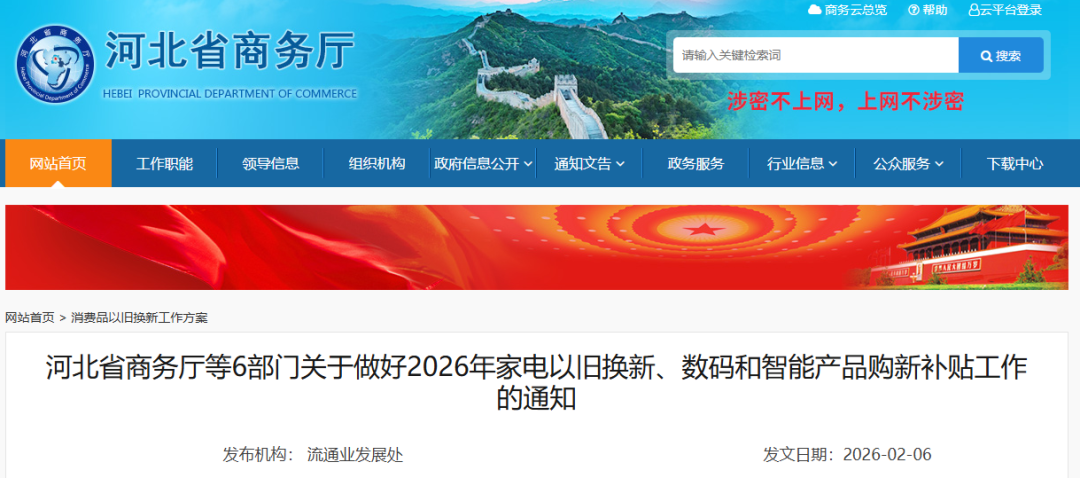
最高2万元!事关“国补”,河北最新通知
Xin Lang Cai Jing· 2026-02-08 12:21
Group 1 - The Hebei Provincial Department of Commerce and other departments have issued notifications regarding subsidies for the replacement of old home appliances and vehicles in 2026 [1][3][5] - For home appliances, consumers can receive a subsidy of 15% of the final sales price after discounts, with a maximum of 1,500 yuan for each appliance and 500 yuan for each digital and smart product [3] - The subsidy program for home appliances includes six categories: refrigerators, washing machines, televisions, air conditioners, water heaters, and computers, as well as four categories of digital products: smartphones, tablets, smartwatches, and smart glasses [3] Group 2 - The automotive replacement program will run from January 1, 2026, to December 31, 2026, supporting the scrapping and replacement of old vehicles [5] - Consumers who scrap eligible old vehicles and purchase new energy vehicles will receive a subsidy of 12% of the new vehicle's sales price, with a maximum subsidy of 20,000 yuan [5] - For consumers who scrap eligible fuel vehicles and purchase new fuel vehicles with an engine size of 2.0 liters or less, a subsidy of 10% of the new vehicle's sales price will be provided, with a maximum of 15,000 yuan [5]
每日10时领取资格,最高补贴1500元,北京2026年家电数码和智能产品以旧换新政策2月9日实施
Bei Jing Shang Bao· 2026-02-06 10:17
Group 1 - The core viewpoint of the article is the introduction of a new subsidy policy by Beijing's Commerce Bureau aimed at promoting the replacement of old home appliances and the purchase of new digital and smart products, effective from February 9, 2026 [1] - The subsidy policy covers two main areas: the replacement of old home appliances and the purchase of new digital and smart products, including six categories of home appliances and four categories of digital products [1] - The subsidy standard is set at 15% of the final sales price after discounts, with a maximum subsidy of 1,500 yuan for home appliances and 500 yuan for digital products per item [1] Group 2 - The 2026 policy adjusts the timing for subsidy qualification retrieval, standardizing it to start at 10 AM daily, with different validity periods for online and offline qualifications [2] - A dynamic adjustment mechanism is established to adapt to market demand and ensure efficient use of subsidies, particularly during peak consumption periods [2] - The policy extends the participation period for enterprises throughout the year, simplifies the entry process, and encourages offline retailers to offer exclusive promotions and activities to enhance the shopping experience [2]
上海家电数码购新补贴:新增“线下即时摇号”
Guo Ji Jin Rong Bao· 2026-02-05 14:07
Core Viewpoint - Shanghai's new subsidy policy for replacing old home appliances and purchasing new digital and smart products aims to enhance consumer participation through both online and offline channels, with the introduction of an "instant offline lottery" system starting February 5, 2026 [1][2] Group 1: Policy Implementation - The Shanghai Municipal Commission of Commerce released detailed implementation rules for the subsidy policy, which includes both online lottery and the new offline instant lottery method [1] - The offline instant lottery allows consumers to participate in real-time and receive immediate results, enhancing the shopping experience in physical stores [1][2] Group 2: Participation and Eligibility - Consumers can participate in the instant lottery through various online platforms, including major apps like Cloud Flash Payment, JD.com, and others, as well as banking apps from local banks [1][2] - The instant lottery is available daily from 08:00 to 22:00, and the subsidy qualification voucher is valid for 14 days after issuance [2] Group 3: Subsidy Details - The subsidy covers six categories of home appliances and four categories of digital and smart products, with specific eligibility criteria for each category [2] - The subsidy standard is set at 15% of the final price after discounts, with a maximum subsidy of 1,500 yuan for home appliances and 500 yuan for digital products per person per category [2]