油气开采

Search documents
环海南岛海上气田群年产量突破千万吨油气当量
Zhong Guo Zi Ran Zi Yuan Bao· 2026-01-08 06:17
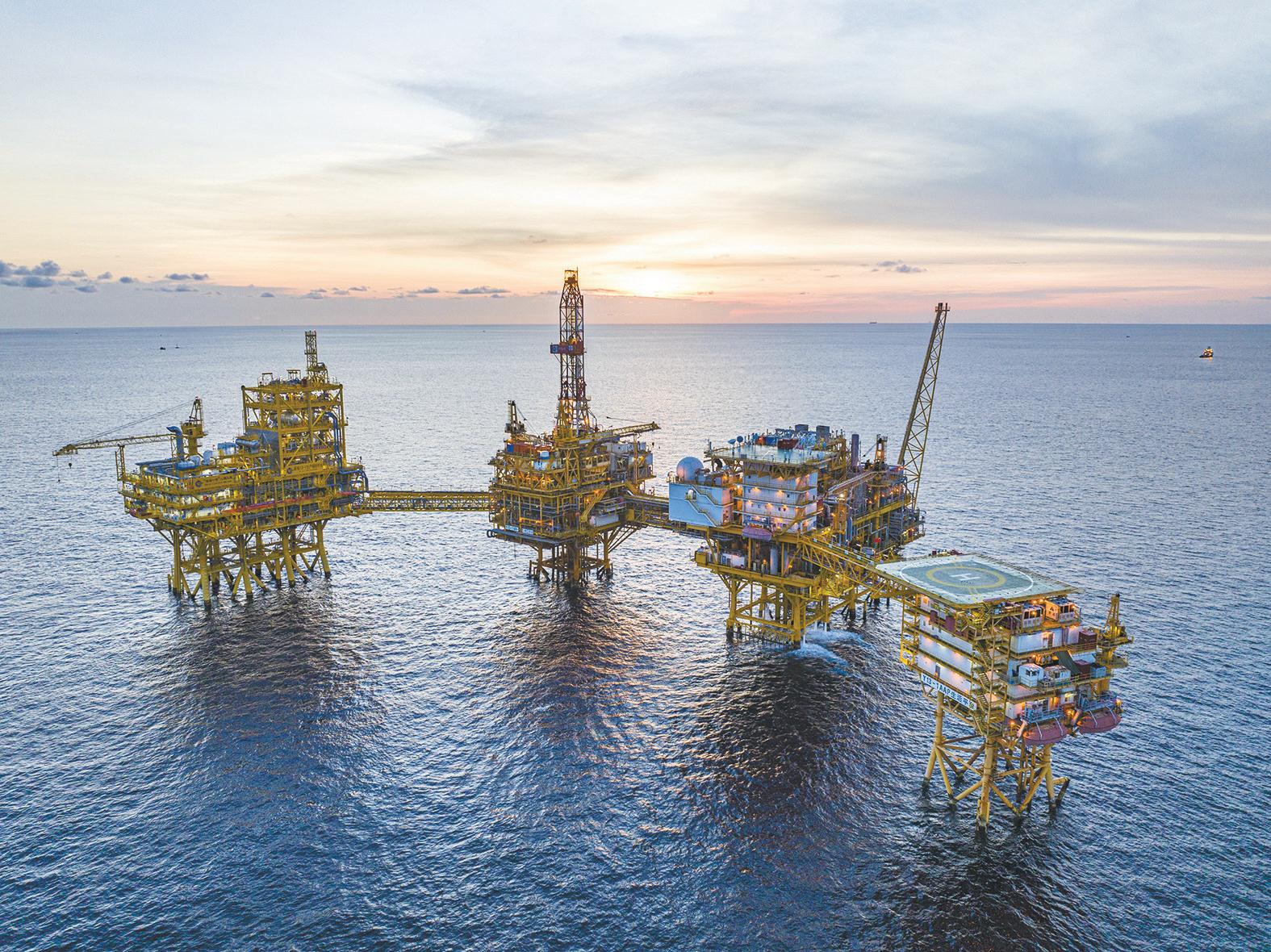
Core Insights - The "Deep Sea No. 1" Phase II has been fully put into production, increasing the overall daily production capacity of the gas field to over 1,500 cubic meters [2] - China National Offshore Oil Corporation (CNOOC) announced that the cumulative production of oil and gas equivalent from the offshore gas field group around Hainan Island will exceed 10 million tons by 2025, marking a historic high and doubling the output compared to the end of the 13th Five-Year Plan [2] - The development of marine oil and gas resources in Hainan dates back to the 1950s and 1960s, with significant advancements made since the establishment of the first cooperative gas field, Yacheng 13-1, in the late 20th century [2] Industry Developments - Since the 14th Five-Year Plan, CNOOC has conducted in-depth analysis of the resource endowment in three major oil and gas structures in the Hainan sea area: Yinggehai Basin, Qiongdongnan Basin, and Zhujiangkou Basin [2] - The company has increased efforts in oil and gas exploration and development, accelerating the construction of marine energy infrastructure [2] - CNOOC has established the largest offshore natural gas production cluster in China, consisting of 19 offshore platforms, 3 land terminals, and several underwater production facilities, addressing complex conditions such as deep water, high temperature, high pressure, and low permeability [2]


EOG Resources (NYSE:EOG) Conference Transcript
2026-01-07 16:17
Summary of EOG Resources Conference Call Company Overview - **Company**: EOG Resources - **Industry**: Oil and Gas Exploration and Production Key Points 1. Capital Plans and Financial Outlook - EOG plans a capital expenditure of approximately **$6.5 billion** for 2026, slightly down from the previously estimated **$6.6 billion** due to cost efficiencies and faster integration of the Encino acquisition [3][2] - The company anticipates **low to no growth** in oil production for 2026 compared to Q4 2025 [5] 2. Shale Industry Insights - There are signs of **maturation** in the U.S. shale sector, with a slowdown in drilling activity and a focus on consolidations to achieve lower cost structures [8] - EOG continues to see opportunities in shale, particularly through innovation and technology to drive cost efficiencies [9][10] 3. Operational Excellence - EOG emphasizes **capital discipline**, operational excellence, and sustainability as key pillars for value creation [10][11] - The company has achieved a **15% reduction** in well costs over the past two years, allowing for the unlocking of new target zones [27] 4. Delaware Basin Performance - The Delaware Basin remains a strong performer, with well payouts expected to be around **one year** for 2025 and over **60% after-tax rate of returns** at flat $45 WTI [28] - EOG is focused on maintaining oil cut levels despite increasing gas production as the basin matures [31] 5. Technology and Innovation - EOG is a leader in technology application, focusing on real-time data collection through **HiFi sensors** and exploring AI for further improvements [33][34] - The company is committed to digitization as a means to enhance productivity and operational efficiency [39] 6. International Expansion - EOG has launched operations in **Bahrain** and the **UAE**, with a focus on gas and oil assets respectively [44][46] - The company has established strong relationships with local governments and aims for commercial viability within a **three-year timeline** for the UAE project [47][48] 7. Shareholder Returns - EOG has maintained a **dividend yield of 3.9%** and aims to return **90%-100%** of free cash flow to shareholders, with a focus on share repurchases [62][63] - The company has a strong balance sheet, allowing for robust returns to shareholders [62] 8. M&A Strategy - EOG maintains a conservative approach to mergers and acquisitions, focusing on organic growth and high economic hurdles for any potential M&A activity [65][66] - The company has only engaged in two significant M&A transactions in its history, emphasizing the importance of strategic fit [66][70] 9. Future Exploration Opportunities - EOG has a resource potential of **12 billion barrels of oil equivalent**, with ongoing exploration efforts across various domestic and international basins [49] - The company is strategically positioned to capitalize on future exploration opportunities as market conditions evolve [50] Additional Insights - EOG's culture promotes decentralization and empowers employees to drive innovation at the asset level [11][12] - The company is cautious about market fluctuations but remains focused on long-term value creation despite short-term challenges [13][14]

油气开采板块1月7日跌3.02%,中国海油领跌,主力资金净流出5.71亿元
Zheng Xing Xing Ye Ri Bao· 2026-01-07 08:59
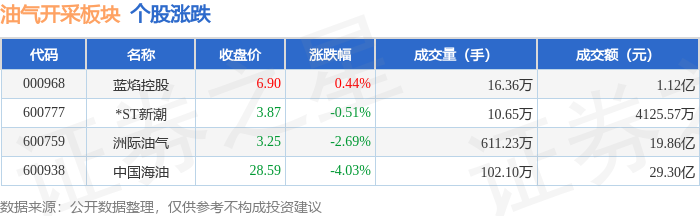
Group 1 - The oil and gas extraction sector experienced a decline of 3.02% on January 7, with China National Offshore Oil Corporation (CNOOC) leading the losses [1] - The Shanghai Composite Index closed at 4085.77, up 0.05%, while the Shenzhen Component Index closed at 14030.56, up 0.06% [1] - The main funds in the oil and gas extraction sector saw a net outflow of 571 million yuan, while retail investors had a net inflow of 367 million yuan [1] Group 2 - Blue Flame Holdings (000968) closed at 6.90 with a slight increase of 0.44%, while ST Xinchao (600777) fell by 0.51% to 3.87 [2] - CNOOC (600938) reported a significant net outflow of 505 million yuan, accounting for 17.23% of its total funds [2] - The trading volume for Intercontinental Oil and Gas (600759) was 611.23 million shares, with a decline of 2.69% to a closing price of 3.25 [1][2]
油气股局部异动,山东墨龙直线拉升涨超8%
Mei Ri Jing Ji Xin Wen· 2026-01-07 07:00
Group 1 - Oil and gas stocks experienced localized fluctuations, with Shandong Molong seeing a sharp increase of over 8% [1] - Other companies such as Keli Co., Zhun Oil Co., and Tongyuan Petroleum also saw significant gains [1]

A股半导体产业链大涨,多股20CM涨停,黄金白银回调,镍、锡飙升
21世纪经济报道· 2026-01-07 04:00
| 上证指数 | 深证成指 | 科创综指 | | --- | --- | --- | | 4095.54 | 14071.35 | 1746.07 | | +11.88 +0.29% | +48.79 +0.35% +25.66 +1.49% | | | 万得全A | 创业板指 | 北证50 | | 6674.65 | 3332.74 | 1506.61 | | +32.89 +0.50% | +13.45 +0.41% +13.57 +0.91% | | | 沪深300 | 中证500 | 中证A500 | | 4792.05 | 7902.04 | 5880.24 | | +1.36 +0.03% | +87.91 +1.13% +20.03 +0.34% | | | 中证1000 | 深证100 | 中证红利 | | 7930.24 | 5978.96 | 5591.68 | | +65.33 +0.83% -10.65 -0.18% +0.63 +0.01% | | | | 万得全A涨跌分布 | | | | The a my my a | | SIACAA | 记者丨曾静娇 编辑丨刘雪莹 1月7日,A ...

胜利油田连续三年实现油气产量增长
Da Zhong Ri Bao· 2026-01-07 01:00
Core Insights - The company has achieved continuous growth in oil and gas production for three consecutive years, with a projected output of 23.71 million tons of crude oil and 909 million cubic meters of natural gas by 2025, alongside the discovery of over 100 million tons of new reserves [2][3] - Shale oil has emerged as a key growth area, with a production target of 700,000 tons by 2025, marking a significant advancement in China's shale oil exploration technology [2] - The company is also advancing low-carbon technologies, having injected 2.3 million tons of CO2 into its carbon capture, utilization, and storage projects, which have doubled the daily crude oil output to 460 tons [2] - The company's renewable energy investments have reached a total of 572 megawatts of solar power capacity, generating 740 million kilowatt-hours of green electricity, which meets approximately 25% of its oil and gas production electricity needs [3] - The production growth and shale oil breakthroughs reflect China's policy direction towards maintaining energy self-sufficiency, with the company's stable output being crucial for national energy security [3]

华尔街顶级分析师最新评级:Shopify遭下调
Xin Lang Cai Jing· 2026-01-06 16:45
Core Viewpoint - The article summarizes key analyst reports that are crucial for investors, highlighting significant rating changes and coverage initiations for various stocks [1]. Upgraded Ratings - Medtronic (MDT): William Blair upgraded the rating from market perform to outperform, with no target price set, citing multiple new product launches expected this year [5]. - Saia Logistics (SAIA): Stephens upgraded the rating from hold to buy, raising the target price from $308 to $414, believing that negative market sentiment has been largely absorbed [5]. - Allegiant Air (ALGT): Bank of America upgraded the rating from underperform to neutral, increasing the target price from $55 to $95, noting potential economic stimulus benefits for low-cost airlines [5]. - Stryker (SYK): Raymond James upgraded the rating from market perform to outperform, setting a target price of $418, indicating attractive valuation levels [5]. - Brinker International (EAT): UBS upgraded the rating from neutral to buy, raising the target price from $144 to $175, expecting continued strong same-store sales growth [5]. Downgraded Ratings - Shopify (SHOP): Wolfe Research downgraded the rating from outperform to market perform, withdrawing the previous target price of $185, citing high market expectations and overvaluation [6]. - Chevron (CVX) and ExxonMobil (XOM): Free Capital downgraded both from hold to sell, setting target prices at $165 and $123 respectively, arguing that optimism in the oil and gas sector is unwarranted amid falling oil prices [6]. - Lennar (LEN): UBS downgraded the rating from buy to neutral, lowering the target price from $137 to $122, indicating potential delays in margin recovery [6]. - D.R. Horton (DHI): Wells Fargo downgraded the rating from overweight to hold, reducing the target price from $180 to $155 based on market data [6]. - Wells Fargo (WFC): Baird downgraded the rating from neutral to underperform, maintaining a target price of $90, citing limited upside for bank stocks in 2026 [6]. Initiated Coverage - Covewave (CRWV): Truist Securities initiated coverage with a hold rating and a target price of $84, emphasizing the importance of its partnership with NVIDIA for long-term revenue support [6]. - Lam Research (LRCX): Alesia Investments initiated coverage with a buy rating and a target price of $260, highlighting strong growth prospects due to industry-leading equipment and expanding market share [6]. - Accenture (ACN): Truist Securities initiated coverage with a buy rating and a target price of $317, noting its attractive positioning in enterprise digital transformation driven by generative AI [6]. - Intuit (INTU): Truist Securities initiated coverage with a buy rating and a target price of $739, recognizing its dominant market position in fintech products for consumers and SMEs [6]. - Palantir (PLTR): Truist Securities initiated coverage with a buy rating and a target price of $223, pointing out its first-mover advantage in AI applications for government and enterprise [6].
油气开采板块1月6日涨2.8%,洲际油气领涨,主力资金净流入5.77亿元
Zheng Xing Xing Ye Ri Bao· 2026-01-06 09:03
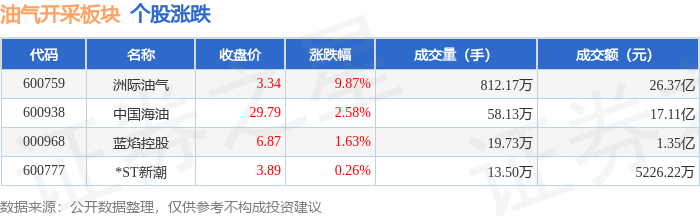
Group 1 - The oil and gas extraction sector increased by 2.8% compared to the previous trading day, with Intercontinental Oil & Gas leading the gains [1] - The Shanghai Composite Index closed at 4083.67, up 1.5%, while the Shenzhen Component Index closed at 14022.55, up 1.4% [1] - The main capital inflow in the oil and gas extraction sector was 577 million yuan, while retail investors experienced a net outflow of 395 million yuan [1] Group 2 - Intercontinental Oil & Gas (code: 600759) saw a closing price of 3.34 yuan, with a significant increase of 9.87% and a trading volume of 8.12 million shares [1] - China National Offshore Oil Corporation (code: 600938) had a closing price of 29.79 yuan, rising by 2.58% with a trading volume of 581,300 shares [1] - Blue Flame Holdings (code: 000968) closed at 6.87 yuan, up 1.63%, with a trading volume of 197,300 shares [1]


大庆油田2025年天然气产量创新高
Yang Shi Wang· 2026-01-06 07:35
Group 1 - The core viewpoint of the articles highlights that Daqing Oilfield has achieved a record high in natural gas production and is set to reach a green electricity generation capacity of 1.136 billion kilowatt-hours by 2025, representing a 58% increase compared to 2024 [1] - Daqing Oilfield is actively developing oil and gas resources while simultaneously constructing a green electricity direct supply and local consumption system, aiming to transition from traditional energy production and supply models to a multi-energy complementary approach [1]
“深海一号”油气年产量突破450万吨
Zhong Guo Hua Gong Bao· 2026-01-06 03:05
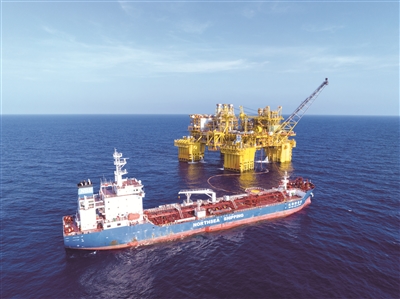
中化新网讯 1月2日,中国海油对外宣布,我国海上最大气田"深海一号"近期完成投产以来的第100船原 油外输工作,2025年气田油气总产量突破450万吨油当量。 "自2021年投产以来,经过4年多的持续探索,'深海一号'作业团队自主建立起一套超深水气田生产运维 完整技术体系。"中国海油陵水—崖城作业公司总经理李劲松表示,"深海一号"能源站的原油外输作业 用时从最初的18小时,缩短到现在的8小时以内。 图为穿梭油轮正与"深海一号"能源站对接输油。(徐海舟 摄) "深海一号"气田是我国迄今为止自主开发的作业水深最深、地层温压最高、勘探开发难度最大、天然气 产能最大的海上气田,最大作业水深超1500米,地层最高温度达到138摄氏度,天然气探明地质储量超 1500亿立方米。目前,"深海一号"每天产出1500万立方米的天然气和超过1600吨的凝析油,部分凝析油 被分别存储于平台四根立柱的储油舱中,达到一定规模后通过穿梭油轮进行外输。 ...