炼油

Search documents
两印企拟共建炼化项目
Zhong Guo Hua Gong Bao· 2025-11-05 02:36
Core Viewpoint - Bharat Petroleum Corporation Limited (BPCL) and Indian Oil Corporation Limited (IOCL) have signed a non-binding memorandum of understanding to explore potential collaboration on BPCL's proposed new refinery and petrochemical complex near Ramayapatnam Port in Andhra Pradesh [1] Group 1: Project Details - The proposed facility aims to have a refining capacity of 9 to 12 million tons per year, with an investment of 1 trillion Indian Rupees [1] - The project has received necessary statutory approvals and has secured 6,000 acres of land from the Andhra Pradesh government [1] - The Ramayapatnam refining complex will include a steam cracking unit with an annual production of 1.5 million tons of ethylene, marking the first such facility in southern India [1] Group 2: Industry Context - The project is expected to commence commercial operations by 2030, supported by the Andhra Pradesh government [1] - The Indian refining industry is undergoing a transformation, increasingly relying on integration with the petrochemical sector [1] - BPCL is actively advancing its petrochemical initiatives, currently progressing on two major projects in Bina and Kochi, with a total investment of 540 billion Indian Rupees [1]
美制裁俄油企威胁保加利亚能源安全
Jing Ji Ri Bao· 2025-11-03 22:34
Core Viewpoint - The U.S. government has announced new sanctions against Russia, specifically targeting major oil companies Lukoil and Rosneft, which has significant implications for Bulgaria's energy supply and economy [1][2]. Group 1: Sanctions and Immediate Impact - The sanctions include Lukoil and its 34 subsidiaries, affecting oil and gas exploration, extraction, and development [1]. - Lukoil has initiated the process of selling its overseas assets in response to the sanctions [1]. - Bulgaria heavily relies on Lukoil, particularly the Burgas refinery, which produces 190,000 barrels of oil per day and supplies over two-thirds of the country's fuel [1]. Group 2: Economic and Employment Implications - The Burgas refinery is a critical player in Bulgaria's economy, contributing significantly to GDP and creating numerous jobs [2]. - If the refinery ceases operations, it would not only disrupt fuel supply but also severely impact the job market and local economy [2]. Group 3: Government Response and Strategies - The Bulgarian government is exploring various options, including appointing a "special manager" to oversee refinery operations and maintain supply stability [3]. - Concerns have been raised about the feasibility of this management approach due to legal and operational challenges [3]. - The Bulgarian parliament has passed amendments to the Investment Promotion Law, requiring government approval for any sale or transfer of Lukoil's assets in Bulgaria [3]. Group 4: Legal and Strategic Considerations - Experts suggest that Bulgaria could seek a delay in sanctions, citing precedents from Germany and Serbia [4]. - Although U.S. sanctions primarily affect transactions involving U.S. entities, the reliance on the U.S. dollar in global trade may complicate operations for affected companies [4]. - Transactions using non-U.S. currencies could potentially mitigate the impact of the sanctions [4].
连环爆炸!欧盟两国俄油炼油厂接连出事,乌克兰被指是幕后黑手?
Sou Hu Cai Jing· 2025-11-03 05:42
Group 1 - Recent explosions and fires at oil refineries in Hungary and Romania have raised international concerns, with speculation about potential Ukrainian involvement behind these incidents [1][3] - Both countries continue to purchase Russian oil, and the affected facilities are critical for processing Russian crude, indicating a possible link to geopolitical energy interests [3][4] - The timing of the incidents coincided with EU energy ministers discussing new restrictions on Russian oil imports, adding complexity to the nature of these accidents [4] Group 2 - There are suspicions that Ukraine may have orchestrated these attacks to pressure Hungary and Romania to change their energy policies regarding Russia, or as retaliation for their stance on aid to Ukraine [5] - Both affected companies, LukOil in Romania and MOL in Hungary, have announced investigations into the incidents, but the timeline for revealing the findings remains uncertain [5]


10月国内炼厂炼油利润同比提高近2倍
Sou Hu Cai Jing· 2025-11-03 01:52
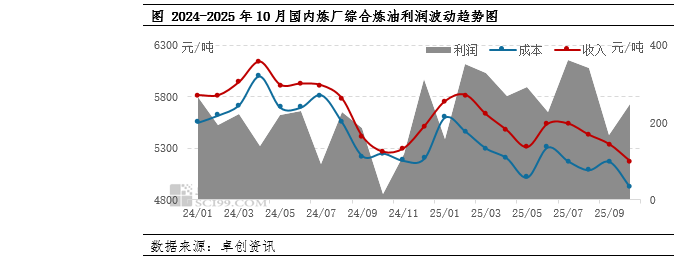
Core Insights - In October, domestic refining profits in China increased nearly twofold year-on-year, driven by lower international oil prices and reduced raw material costs [1][3] - Despite a decline in refining product prices and revenues, the cost reductions were more significant, leading to improved refining margins [4][5] Group 1: Refining Profitability - Domestic refining profit in October was 248 CNY/ton, an increase of 81 CNY/ton or 48.5% month-on-month, and a rise of 235 CNY/ton or 1.74 times year-on-year [1] - The overall refining profit is expected to continue to see slight month-on-month increases in November due to slower transmission of cost declines [4][5] Group 2: Cost and Revenue Dynamics - The comprehensive refining cost in October was 4925 CNY/ton, down 4.74% month-on-month and 6.18% year-on-year [3] - Average revenue from refining products in October was 5173 CNY/ton, which decreased by 3.07% month-on-month and 1.71% year-on-year [4] - The average price of gasoline fell by 3.94% month-on-month, while diesel prices decreased by 2.67% month-on-month [4] Group 3: Market Outlook - In November, gasoline demand is expected to remain weak due to strong competition from electric vehicles, while diesel demand may hold steady due to construction activities and logistics needs [5] - Overall, refining product revenues are anticipated to decline in November, but the decrease may be less than that of costs, potentially allowing for continued slight increases in refining profits [5]
乌军狂轰俄罗斯燃料设施,妄图切断俄命脉,中国能源安全面临考验
Sou Hu Cai Jing· 2025-11-02 07:46
Core Insights - Ukraine's large-scale drone attacks on Russian energy facilities aim to weaken Russia's energy supply and military capabilities, impacting global oil prices and energy security [1][19][20] - The attacks have targeted critical infrastructure, including refineries, petrochemical plants, and fuel storage, indicating a systematic approach to disrupt Russia's wartime economy [16][18] Summary by Sections Attack Scale and Impact - Ukraine launched a significant drone assault involving hundreds of drones across multiple regions, including Moscow and Crimea, leading to the closure of 13 airports for safety checks [3][4][8] - The frequency and scale of these attacks have escalated, with Russia's defense systems intercepting a substantial number of drones, yet some still managed to hit key targets [4][6] Targeted Infrastructure - Key targets included energy facilities such as oil refineries and meat production plants, which are vital for Russia's economy and military logistics [11][13][16] - The attacks on food supply facilities highlight the importance of food security alongside energy supply in modern warfare [11] Economic Consequences - Damage to energy infrastructure, such as the NS-Oil refinery, could lead to fuel supply shortages and increased domestic fuel prices, affecting both civilian and military transportation costs [13][19] - The disruption of industrial production in regions like Stavropol could impact Russia's export capabilities, further straining its economy [11][16] Global Energy Market Implications - The attacks have raised concerns about the stability of Russia's energy supply, which is crucial for global energy markets, potentially leading to fluctuations in international oil prices [20][22] - China's energy security may be at risk due to its reliance on Russian energy imports, necessitating a reevaluation of its energy strategies [19][22] Strategic Considerations - The systematic targeting of critical infrastructure suggests a strategic intent to undermine Russia's military flexibility and economic stability [8][16] - The ongoing conflict may lead to increased geopolitical tensions and a shift in global energy trade dynamics, emphasizing the need for countries to enhance their energy security measures [22]
刚刚,中方对欧盟发出严厉警告!反噬的代价,欧洲承受得起吗?
Sou Hu Cai Jing· 2025-11-01 07:46
Core Points - The European Union (EU) has included Chinese companies and major oil refineries in its latest round of sanctions against Russia, which has drawn strong criticism from China [1][3] - China asserts that these sanctions violate previous agreements between China and the EU and threaten global energy security [3][10] Group 1: Impact on Trade and Economy - The trade relationship between China and the EU is expected to reach €840 billion in 2024, indicating a strong economic interdependence [5] - Sanctions against Chinese companies could disrupt their operations and lead to lost collaboration opportunities for European firms [5] - European consumers reliant on Chinese imports may face higher prices and fewer choices, particularly in the solar energy sector where 80% of photovoltaic components are sourced from China [6] Group 2: Political and Diplomatic Consequences - The EU's actions undermine political trust between China and the EU, jeopardizing previous cooperation on global governance and climate change [8] - This behavior may lead to perceptions of the EU as biased in international affairs, diminishing its global influence [8] Group 3: Global Energy Market Effects - The sanctions on Chinese refineries have caused immediate fluctuations in international oil prices, with Brent crude rising by 1.6% and Shanghai crude by 2.3% [10] - The EU's sanctions against Russian oil have previously led to an energy crisis in Europe, highlighting the potential for self-harm through such measures [12] Group 4: Broader Implications of Sanctions - The EU's sanctions are perceived as being influenced by the United States, which has profited from the situation by selling liquefied natural gas at inflated prices to Europe [14] - China maintains a neutral stance in the Russia-Ukraine conflict and has called for the EU to reconsider its actions to avoid becoming a scapegoat [14]

印度一国有企业宣布暂停
中国能源报· 2025-10-31 11:37
Core Viewpoint - Indian state-owned oil company Hindustan Petroleum Corporation Limited (HPCL) has suspended the purchase of Russian crude oil amid escalating tensions with the United States and new sanctions on Russian oil exports [3][4]. Group 1: Company Actions - HPCL announced the suspension of Russian crude oil purchases following reports of its previous transactions involving nearly $280 million worth of Russian oil transported by sanctioned vessels [3]. - The company stated that it was unaware of the specific vessels used for transportation and their sanction status at the time of delivery, as the oil was sold on a delivered basis [4]. Group 2: Market Context - The suspension comes after the U.S. imposed new sanctions targeting major Russian oil producers, including Lukoil and Rosneft, which has influenced Indian refiners' purchasing decisions [3][4]. - Reliance Industries, India's largest private oil buyer, also decided to halt Russian crude oil purchases, indicating a potential shift in India's oil procurement strategy [4]. Group 3: Broader Implications - The decision by Indian refiners to pause Russian oil purchases may enhance the likelihood of a trade agreement between India and the U.S., as the two countries navigate their complex relationship [4]. - India, being one of the largest crude oil importers globally, relies on foreign suppliers for over 85% of its oil needs, traditionally sourcing from Middle Eastern countries but increasingly turning to discounted Russian oil since 2022 [4].

2026年石油石化行业年度策略:反内卷谋行业新篇,奋楫扬帆破浪笃行
NORTHEAST SECURITIES· 2025-10-31 05:15
Group 1 - The core viewpoint of the report indicates that the oil and petrochemical industry in China is currently experiencing a prolonged downturn due to "involution" competition, but there is potential for a turnaround through policy measures aimed at high-quality transformation and capacity exit [1][2][3] - During the "14th Five-Year Plan" period, the industry faced significant challenges, including overcapacity in low-end products and insufficient high-end offerings, leading to a situation where production increases did not translate into profit growth [17][22] - The report forecasts that oil prices will have a strong bottom support, with Brent crude oil expected to trade in the range of $60-65 per barrel by 2026, driven by steady demand growth and OPEC+ production adjustments [1][3] Group 2 - The report highlights that the refining sector is undergoing significant changes, with leading companies expected to benefit from the exit of outdated capacities and improved profitability due to stricter tax regulations and effective price guidance [2][3] - In the PTA industry, the report notes that the market is highly concentrated, and self-regulation may lead to spontaneous production cuts, which could improve the overall supply-demand balance [3][4] - The trend towards lightweight materials and the substitution of plastics for steel is expected to drive growth in the modified plastics sector, with companies focusing on high-value specialty engineering plastics [4][3]




燃料油11月报-20251031
Yin He Qi Huo· 2025-10-31 03:07
1. Report Industry Investment Rating No information provided. 2. Core Viewpoints of the Report - High - sulfur fuel oil: Supported by feedstock demand in October, with stable high - sulfur cracking and spot premiums. In the future, pay attention to Russia's supply and export under strengthened sanctions and the issuance of crude oil quotas. Feedstock demand may be affected [4][5]. - Low - sulfur fuel oil: Faced with continuous supply pressure in October, with declining spot premiums and cracking. The ARDS device maintenance of Al - Zour refinery brings short - term supply gaps, while the RFCC device maintenance of Dangote refinery is expected to increase supply. Pay attention to refinery device returns and export volume changes [4][5]. - Strategy recommendation: Short - term unilateral trading should be on the sidelines; for arbitrage, short the FU1 - 5 spread on rebounds and go long on low - sulfur internal - external spreads at low levels; no option strategy is recommended [6][59]. 3. Summary by Directory 3.1 First Part: Preface Summary 3.1.1 Market Review - High - sulfur fuel oil: Supported by feedstock demand from the US and China in October, with high - sulfur cracking fluctuating stably between - 4 and - 3 US dollars/barrel. Spot premiums oscillated at a medium - level. Supply from major regions increased slightly [4][10]. - Low - sulfur fuel oil: Suffered from continuous supply pressure in October, with spot premiums dropping by about 2.8 US dollars to - 2.6 US dollars/ton compared to the end of September. Cracking also declined by about 2.9 US dollars to 4.7 US dollars/barrel, at a low - level. There was no specific demand support [4][10]. 3.1.2 Market Outlook - High - sulfur fuel oil: Pay attention to Russia's supply and export under strengthened sanctions, which are expected to be less affected. The expected issuance of crude oil quotas may impact feedstock demand [5]. - Low - sulfur fuel oil: The ARDS device maintenance of Al - Zour refinery brings short - term supply gaps, while the RFCC device maintenance of Dangote refinery is expected to increase supply. Pay attention to refinery device returns and export volume changes [5]. 3.1.3 Strategy Recommendation - Unilateral: Short - term wait - and - see. - Arbitrage: Short the FU1 - 5 spread on rebounds. Go long on low - sulfur internal - external spreads at low levels. - Options: None [6] 3.2 Second Part: Fundamental Situation 3.2.1 Market Review - High - sulfur fuel oil: Supported by feedstock demand, cracking was stable. Supply from major regions increased, including Russia, Mexico, and the Middle East. Spot premiums were at a medium - level [10]. - Low - sulfur fuel oil: Supply pressure continued, with declining spot premiums and cracking. Dangote and Malay local refineries' device maintenance increased supply in the Singapore region, and there was no specific demand support [10]. 3.2.2 High - Sulfur Supply - Russia: Facing continuous attacks on energy facilities and intensified sanctions from the US, UK, and EU. Pay attention to supply and logistics changes after sanctions. Before sanctions, raw material exports increased, and exports in October were relatively stable [15][17]. - Mexico: Tula refinery's coking device reduced fuel oil production. Olmeca refinery's high - sulfur production is expected to decrease gradually. High - sulfur exports in October recovered to about 500,000 tons [20]. - Middle East: High - sulfur exports increased slightly after the decline in power - generation demand. In October, daily exports were about 150,000 tons, up 2% from September [25]. 3.2.3 High - Sulfur Demand - Marine fuel demand: Stable support, with marginal growth from the increasing number of desulfurization tower ships. In September 2025, high - sulfur marine fuel consumption in Singapore and Fujeirah increased [34]. - Feedstock demand: Supported in the short - term by the crude oil quota gap in the fourth quarter. Pay attention to the re - issuance of crude oil quotas and the impact of sanctions. China's fuel oil imports increased in September [37][39]. - Power - generation demand: Completely subsided in Egypt and the Middle East [41]. 3.2.4 Low - Sulfur Fuel Oil - South Sudan: Due to the trade ban between the UAE and Sudan, low - sulfur export logistics changed, with crude oil diverted to the Singapore region. The external tender volume did not decrease significantly [44]. - Al - Zour refinery: Production decreased in October, and the restart of desulfurization devices may be delayed. Exports increased in October, and the 2026 maintenance plan was postponed [47]. - Dangote refinery: The gasoline device resumed production at a 60% operating rate in October. Two batches of low - sulfur straight - run products were tendered during the device shutdown. Exports decreased slightly in October [48]. - China: The fourth - quarter bonded low - sulfur production is expected to decline slightly. Sinopec and PetroChina have sufficient quotas, while CNOOC is short of quotas. Sanctions may affect the production of some refineries [49][51]. 3.3 Third Part: Future Outlook and Strategy Recommendation - High - sulfur fuel oil: Pay attention to supply logistics changes after sanctions. Exports from Mexico and the Middle East are stable. Feedstock demand is supported in the short - term [59]. - Low - sulfur fuel oil: Spot premiums are oscillating at a low level. The low - sulfur production of Al - Zour refinery is affected. EU sanctions have little impact on domestic supply. Nigerian RFCC devices are running at a low load, and South Sudan's low - sulfur raw material logistics are changing. Marine fuel demand is stable [59]. - Strategy recommendation: Short - term unilateral trading should be on the sidelines; for arbitrage, short the FU1 - 5 spread on rebounds and go long on low - sulfur internal - external spreads at low levels; no option strategy is recommended [59].
HF Sinclair(DINO) - 2025 Q3 - Earnings Call Transcript
2025-10-30 14:32
Financial Data and Key Metrics Changes - HF Sinclair reported a third quarter net income attributable to shareholders of $403 million, or $2.15 per diluted share, with adjusted net income of $459 million, or $2.44 per diluted share, compared to $96 million, or $0.51 per diluted share, for the same period in 2024 [13][14] - Adjusted EBITDA for the third quarter was $870 million, up from $316 million in the third quarter of 2024 [13] - The company returned $254 million in cash to shareholders, consisting of $160 million in share repurchases and $94 million in dividends [9][12] Business Line Data and Key Metrics Changes - In the refining segment, adjusted EBITDA was $661 million, significantly up from $110 million in the same quarter of 2024, driven by higher gross margins [14] - The marketing segment reported record EBITDA of $29 million, an increase from $22 million in the third quarter of 2024, attributed to high margins and improved store mix [16] - The lubricants and specialty segments reported EBITDA of $78 million, slightly up from $76 million in the same quarter of 2024, driven by improved mix and FIFO benefits [16] Market Data and Key Metrics Changes - Total sales volumes were 57 million gallons for the third quarter of 2025, down from 69 million gallons in the same quarter of 2024 [16] - Crude oil charge averaged 639,000 barrels per day for the third quarter, marking the second highest quarter on record [15] Company Strategy and Development Direction - HF Sinclair is focusing on expanding its midstream refined products footprint across PADD 4 and PADD 5 to address supply and demand imbalances in key Western U.S. markets [10][11] - The company is evaluating a multi-phased expansion projected to enable incremental supply of up to 150,000 barrels per day into various West Coast markets [11] - Strategic projects include the CARB project at the PSR refinery and a jet project to enhance flexibility in product output [10][12] Management's Comments on Operating Environment and Future Outlook - Management expressed optimism about the refining market, citing a global shortfall of approximately 800,000 barrels per day and supportive demand for distillate fuels [26][29] - The company anticipates continued strong performance in refining margins due to ongoing supply constraints and increasing demand [27][29] - Management remains committed to returning excess cash to shareholders while maintaining an investment-grade balance sheet [9][12] Other Important Information - HF Sinclair issued $500 million of senior notes at 5.5% due 2032 to redeem higher interest notes, allowing for a reduction in the weighted average cost of debt [17] - The company has approximately $1.5 billion in cash and a debt-to-cap ratio of 23% as of September 30, 2025 [17] Q&A Session Summary Question: Can you elaborate on the multi-phased expansion targeting PADD 4 and PADD 5? - Management believes they are strategically positioned due to existing infrastructure and the ability to quickly deliver refined products to markets facing shortages [21][24] Question: What is the outlook for refining margins in the near term? - Management is bullish on refining margins, expecting continued support from demand for distillate fuels and low product inventories [25][27] Question: Can you clarify the impact of small refinery exemptions (SREs) on your financials? - The $115 million benefit from SREs is reflected in cost of sales, while the $56 million is from trading benefits associated with RINs [35][46] Question: How do you plan to finance the pipeline expansion projects? - Management indicated multiple financing options, including liquidity on the balance sheet and potential joint ventures [60][61] Question: What is the current state of the lubricants market and M&A opportunities? - The lubricants market is performing well, and the company continues to explore bolt-on acquisitions to enhance its portfolio [73][76]