Mobile Phones

Search documents
如果传音失去非洲,雷军将会怎样?
Xin Lang Cai Jing· 2025-05-17 14:45
Core Viewpoint - Transsion, known as the "King of Africa," reported a surprising financial performance in the first quarter of this year, with a significant decline in revenue and net profit, indicating challenges in maintaining its market position in Africa [1][3]. Financial Performance - In Q1, Transsion's revenue decreased by 25.45% year-on-year to 13.004 billion yuan, while net profit dropped nearly 70% to 490 million yuan, marking the largest quarterly decline on record [1][3]. - The company's smartphone shipments in Africa fell by over 20% year-on-year, despite a 1.5% increase in global smartphone shipments, resulting in Transsion dropping out of the top five global smartphone manufacturers [1][3]. Market Position and Competition - Last year, Transsion held a 8.7% share of the global smartphone market, ranking fourth, but recent data shows its market share in Africa has declined to 47%, down 5% year-on-year [5]. - Competitors like Xiaomi and realme have begun to capture market share in Africa, with Xiaomi's market share increasing by 32% to 13%, making it the second-largest brand in the region [5][9]. - The top five smartphone brands in Africa now include several Chinese brands, indicating a shift in market dynamics [5]. Strategic Challenges - Transsion's core business remains heavily reliant on smartphone sales, which accounted for 91.97% of its revenue last year, with other business segments contributing only 6.2% [7]. - The company's diversification strategy has not yet shown significant results, raising concerns about its future if it loses its foothold in Africa [7][9]. Industry Trends - The smartphone market in Africa is becoming increasingly competitive, with Chinese brands adopting similar strategies to those that Transsion used to establish itself, thereby limiting Transsion's growth potential [9][11]. - The lack of unique applications and independence in systems and chips may further hinder Transsion's future prospects as competition intensifies [9].



冲击高端,OPPO必须拿下三场战役
3 6 Ke· 2025-05-16 07:08
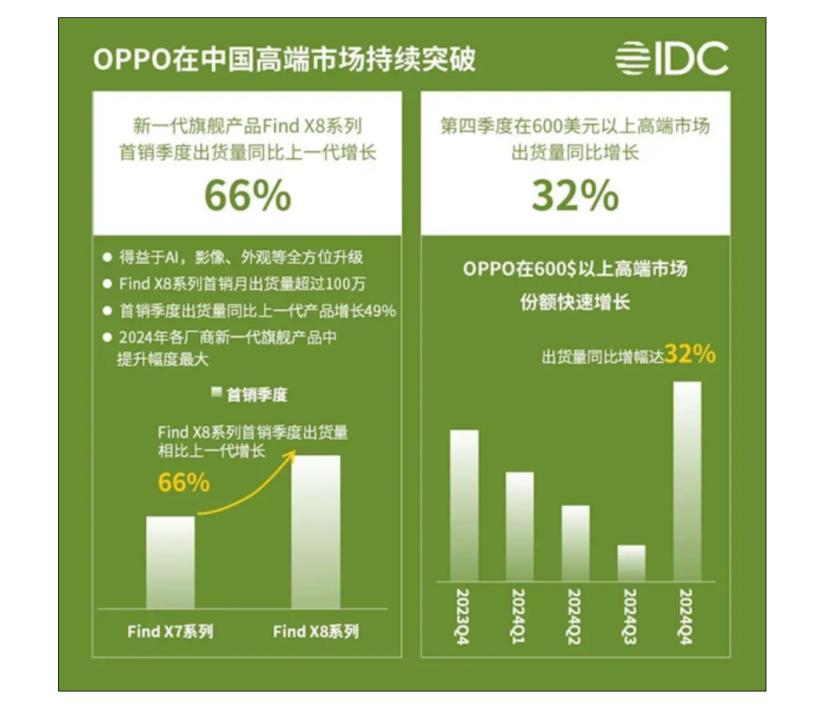
Core Viewpoint - OPPO is making significant strides in the high-end smartphone market, but faces challenges in establishing a strong competitive position against established players like Apple and Huawei [5][8][20] Group 1: High-End Market Performance - OPPO's new model, the Reno 14, continues to focus on imaging technology, simulating popular effects [1] - The high-end smartphone segment in China has seen a sales share increase to 28%, making it a critical battleground for manufacturers [2][3] - The Find X8 series has achieved over 60% increase in shipment volume compared to its predecessor, significantly boosting OPPO's sales in the 4K+ price segment [3][5] Group 2: Challenges in High-End Strategy - Despite initial successes, OPPO's market share in the high-end segment remains low, with only 7.1% in the foldable phone market [5][8] - OPPO's high-end strategy faces challenges in three areas: technology, brand perception, and retail presence [9][10] - The company has not yet established a strong enough brand identity to compete effectively with entrenched competitors [15][16] Group 3: Technological and Brand Development - OPPO has invested in various technologies, including imaging and AI, to enhance its product offerings [10][18] - The shift in consumer preferences towards comprehensive user experiences highlights the need for OPPO to improve its brand perception [11][13] - OPPO's lack of self-developed chips and operating systems may hinder its high-end ambitions [14] Group 4: Retail Strategy - OPPO is focusing on enhancing its retail presence, having opened 2,000 Mall stores to improve customer experience [17] - The company needs to expand its high-end retail presence in lower-tier cities to capture a larger market share [17] Group 5: AI Integration - The rise of AI technology is seen as a potential game-changer for the smartphone industry, with OPPO exploring AI features in its products [18][19] - The competitive landscape will increasingly depend on the unique AI capabilities that manufacturers can offer [19][20]
手机厂商再现出海潮,这次有何不同?
3 6 Ke· 2025-05-14 23:26
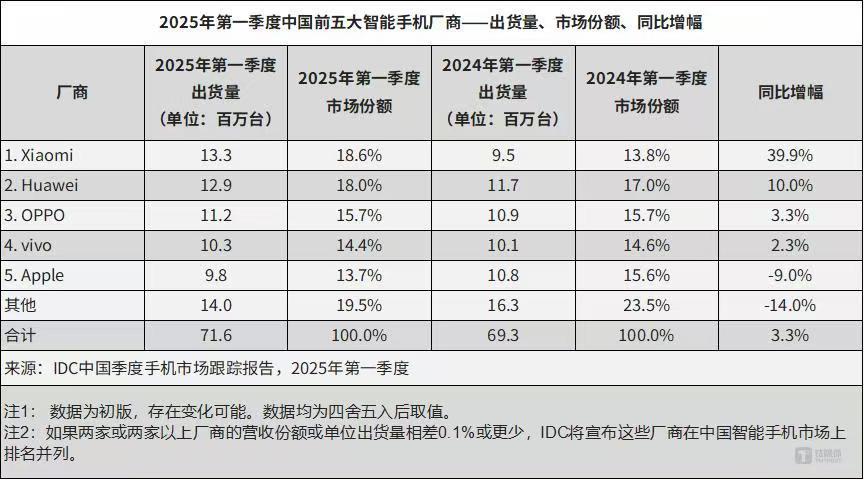
Group 1: Market Overview - The Chinese smartphone market has entered a mature phase, with Huawei's strong return intensifying competition among manufacturers [1][2] - In Q1 2025, China's smartphone shipments reached 71.6 million units, a 3.3% year-on-year increase, outperforming the global average of 1.5% [3][4] - Xiaomi led the market with a 18.6% share, followed closely by Huawei at 18.0%, while Apple saw a significant decline, dropping to fifth place with a 13.7% market share [4][5] Group 2: Huawei's Market Strategy - Huawei's resurgence began with the Mate60 series launch, which filled the 5G smartphone gap and significantly impacted competitors' sales [5] - Huawei's channel strategy includes offering higher profit margins to distributors, leading to a substantial increase in its sales share among channel partners [5] - The competitive landscape is expected to remain tight, with Huawei reclaiming market share that was previously held by other brands [6] Group 3: International Expansion - Chinese smartphone brands are increasingly focusing on international markets, with a shift towards mid-to-high-end segments, contrasting with previous strategies that emphasized cost-effectiveness [7][9] - Honor has achieved over 50% of its sales from overseas markets, becoming a significant player in regions like Malaysia and Singapore [7][8] - OPPO and Xiaomi have also expanded their international presence, with OPPO's overseas shipments accounting for about 60% of its total sales [8][9] Group 4: Localization Strategies - Brands are adopting localized strategies to enhance their market presence, such as OPPO's integration of local culture into retail experiences in Indonesia [12][13] - Vivo aims to increase its overseas revenue share to 70% within two years, emphasizing local talent and production [13] - Successful examples include Transsion's tailored products for African consumers, demonstrating the importance of understanding local preferences [17][18] Group 5: Challenges in International Markets - Adapting to local regulations and building trust with consumers are critical challenges for Chinese brands entering foreign markets [15][16] - Legal disputes with international competitors pose additional hurdles, impacting market expansion efforts [16] - The fragmented nature of markets like Europe requires brands to customize their strategies rather than adopting a one-size-fits-all approach [17]

“AI平权”至千元机 星纪魅族找到的差异化路径能否走通?
Mei Ri Jing Ji Xin Wen· 2025-05-14 13:49
Core Viewpoint - The smartphone industry is facing challenges due to market saturation and lack of innovation, but the emergence of AI presents new opportunities for manufacturers like Meizu to target underserved segments of the market [1][2]. Group 1: Company Strategy - Meizu, now under Xingji Meizu after being acquired by Geely, aims to leverage AI to differentiate itself in a competitive market dominated by larger players like Huawei and Xiaomi [2][3]. - The company has adopted an "All in AI" strategy, focusing on integrating AI capabilities into its mid-range and entry-level smartphones, particularly the newly launched Meizu Note 16 series [1][2]. - Meizu's approach emphasizes "AI equality," aiming to provide AI functionalities to users who have been overlooked by other manufacturers, such as blue-collar workers and older adults [1][3]. Group 2: AI Implementation - The AI features in Meizu's smartphones are designed to address practical needs, allowing users to perform tasks like ordering food or booking rides with simple voice commands [1][3]. - Meizu's Flyme AIOS 2 operating system has been upgraded to enhance task understanding and execution, enabling users to issue complex commands with minimal input [3][5]. - The company plans to utilize both local processing and cloud computing to deliver AI functionalities, although the reliance on cloud services raises concerns about cost [5][6]. Group 3: Cost Challenges - The implementation of AI in mid-range devices is heavily dependent on cloud services, which incurs significant costs, estimated at 1.2 to 1.5 cents per call to the cloud model [5][6]. - Meizu acknowledges the high costs associated with AI model training and cloud usage but believes that these costs will decrease over time as technology advances [5][6]. - The company is focused on improving user interaction experiences, particularly through voice commands, to enhance the value proposition of its AI offerings [5]. Group 4: Competitive Landscape - Other manufacturers, such as OPPO, Vivo, and Honor, are also integrating AI capabilities into their mid-range devices, which could challenge Meizu's strategy of focusing on cloud-based AI solutions [6]. - The potential for widespread adoption of AI in lower-priced smartphones suggests that Meizu's current path may face increased competition as the market evolves [6].
赵明走后,荣耀走上了亲民路线?
3 6 Ke· 2025-05-14 04:16
Core Viewpoint - Honor is shifting its focus towards the mid-to-low-end smartphone market, launching new models like the Power series, which features a competitive price point and large battery capacity, indicating a strategic pivot from its previous high-end positioning [1][3][7]. Market Position and Competition - Honor's market share in China has been declining, with IDC reporting a drop to 13.7% in Q4 2024, placing it fifth in the domestic smartphone market [4][5]. - The competitive landscape is dominated by major players like Xiaomi, Huawei, OPPO, vivo, and Apple, with Honor's brand recognition and fan base being relatively weak compared to its competitors [3][4][10]. Strategic Changes - Following a leadership change, Honor has introduced the "Alpha" strategy aimed at creating a global AI terminal ecosystem, which marks a significant shift in its operational focus [6][13]. - The company plans to invest $10 billion over the next five years to build this ecosystem, which is expected to enhance its brand positioning and market competitiveness [13][14]. Product Strategy - The new Power series is designed to cater to the mid-to-low-end market, featuring an 8000mAh battery, which is a key differentiator in a crowded market [16][22]. - Honor's pricing strategy has been adjusted to leverage government subsidies, making its products more appealing to cost-sensitive consumers [19][24]. Market Trends and Consumer Behavior - The introduction of government subsidies has positively impacted smartphone sales, with a reported 5.6% year-on-year growth in China's smartphone shipments for 2024 [20][26]. - Consumers are increasingly inclined to purchase mid-range smartphones, which presents both opportunities and challenges for Honor as it competes in a highly saturated market [25][30]. Challenges Ahead - Despite the potential benefits of the subsidy program, increased competition in the mid-range segment poses a significant challenge for Honor, as it must differentiate itself from established competitors like Xiaomi and OPPO [23][29]. - Honor's historical association with Huawei may hinder its efforts to establish a distinct brand identity, complicating its strategy to cultivate a loyal customer base [15][28].

Note16新机594元起,魅族要“逆天”?
3 6 Ke· 2025-05-14 00:37
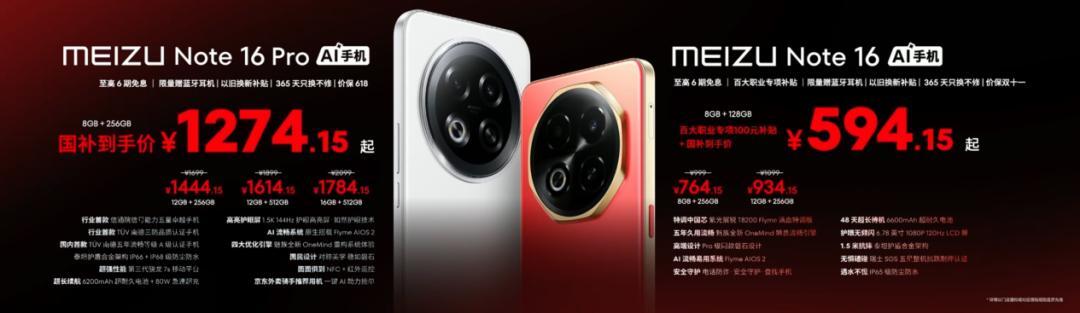
Core Viewpoint - Meizu is shifting its focus back to the budget smartphone market with the launch of the Note 16 series, aiming to attract a broader audience by offering competitive pricing and practical features [1][3][21] Product Launch and Strategy - The Meizu Note 16 series was released on May 13, with prices starting at 594.15 yuan for the Note 16 and 1274.15 yuan for the Note 16 Pro, marking the lowest price point for Meizu smartphones in recent years [1][4] - The launch coincided with the "618 shopping festival" on JD.com, indicating a strategic move to leverage promotional events for increased visibility and sales [1][4] - The Note 16 series emphasizes practical features such as a large battery, good signal reception, high refresh rate display, and durability, with the Pro model being the first TÜV certified smartphone for three-proof quality [4][9] Market Positioning - Meizu aims to position the Note 16 series as a "practical" choice for consumers, particularly targeting the lower-end market where price sensitivity is high [9][11] - The Note 16 series is designed to meet basic consumer needs without significant performance advantages over competitors, focusing on affordability and essential features [9][11] Management Changes - Recent management changes at Meizu include the hiring of several executives from leading companies, indicating an effort to restructure and enhance organizational capabilities [12][13] - Despite these changes, the company has not seen significant improvements in market performance, with previous leadership transitions failing to yield the desired results [14][18] Ecosystem Development - Meizu is expanding its product lineup to include more budget-friendly models, with plans for future flagship releases pushed to 2025 [21][23] - The company is also exploring international markets, particularly in Southeast Asia and the Middle East, to establish a global presence and replicate successful strategies from other Chinese brands [23][27] - Meizu's collaboration with Geely to integrate its smartphones into automotive ecosystems is part of a broader strategy to enhance market reach, although the actual impact on smartphone sales remains limited [25][27]
传音净利润大跌近70%,“非洲手机之王”会不会被小米夺走?
3 6 Ke· 2025-05-12 08:54
Core Viewpoint - Transsion Holdings, known as the "King of African Mobile Phones," reported a significant decline in net profit by 69.87% and a 25.45% drop in revenue for Q1 2025, raising concerns about its competitive position in the market [1][4]. Financial Performance - In Q1 2025, Transsion's net profit was only 490 million yuan, a drastic decrease compared to the previous year [1][4]. - The company's revenue growth rate plummeted from 6.74% in 2023 to 2.97% in 2024, with a decline in gross margin by 1.46 percentage points [4][8]. - Operating cash flow turned negative at -741 million yuan in Q1 2025, worsening from -108 million yuan in the same period last year [4][8]. Market Competition - Despite holding a 49% market share in Africa, Transsion faces fierce competition from Xiaomi and Realme, which have seen significant growth in their smartphone shipments [1][4]. - Xiaomi's shipment growth rate reached 38%, while Realme's Note series achieved an impressive 89% increase [1][4]. - Realme's market strategy, focusing on cost-effective products, has intensified competition in the African market [2][4]. Cost Challenges - The rising prices of DRAM and NAND Flash storage chips have significantly impacted Transsion's cost structure, particularly for its high-memory models [2][4]. - The company struggles to pass on increased costs to consumers due to their price sensitivity in emerging markets [2][4]. Strategic Adjustments - In response to its challenges, Transsion has committed 580 million yuan to R&D in Q1 2025, representing 4.46% of its total revenue, indicating a focus on technological innovation [5][7]. - The R&D investment aims to enhance product features such as camera technology and battery performance, which are crucial for entering the high-end market [7][8]. Long-term Outlook - Despite the current downturn, Transsion generated a net profit of 5.549 billion yuan in 2024 and distributed 3.421 billion yuan in dividends, reflecting strong cash flow generation capabilities [8][9]. - The potential for smartphone penetration in emerging markets remains significant, with a population base exceeding 4 billion, providing a vast market opportunity for Transsion [8][9]. - The company's established service network and localized product features continue to be competitive advantages that are difficult for rivals to replicate [9].

摩根士丹利:中国经济-关税产生影响,通缩压力加剧
摩根· 2025-05-12 08:41
Investment Rating - The report does not explicitly provide an investment rating for the industry Core Insights - Deflationary pressures are worsening in China, primarily due to the impact of tariffs on the Producer Price Index (PPI) and the overall economic environment [1][7] - Core Consumer Price Index (CPI) remains stable at 0.5% year-on-year, indicating some resilience despite broader deflationary trends [2][4] - The PPI has shown a significant decline, with a month-on-month decrease of -0.4%, driven by lower prices in oil, raw materials, and durable consumer goods [3][7] Summary by Sections CPI Analysis - Core CPI year-on-year remained at 0.5% in April, unchanged from March, while month-on-month seasonally adjusted annual rate (SAAR) was 0.7% [2] - Food inflation reached its highest level in five months, primarily due to increased prices for fruit and beef, countering the effects of lower international oil prices [2] PPI Analysis - The PPI year-on-year decreased to -2.7% in April, reflecting ongoing tariff impacts and weaker final demand [6][7] - Specific sectors such as textiles, wood products, chemicals, rubber, and plastics experienced accelerated price declines, indicating significant exposure to the US market [3][7] Outlook - The PPI is expected to slip below -3% year-on-year from the current -2.7% during the May-July period due to less favorable base effects and continued tariff impacts [4] - Core CPI is anticipated to soften sequentially as the effects of PPI pass through, although year-on-year figures may remain resilient due to a low base [4][7]
坚果向左 老罗向右
Jing Ji Guan Cha Wang· 2025-05-08 02:52
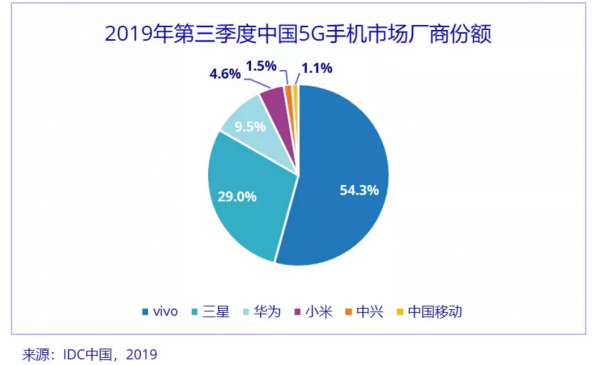
Core Viewpoint - The separation of Luo Yonghao and the Smartisan brand has led to divergent paths, with Luo facing legal and financial challenges while the Smartisan team, now under ByteDance, aims for a fresh start with new product launches and ambitions in the 5G market [1][2][19]. Group 1: Luo Yonghao's Challenges - Luo Yonghao has been placed on a "restriction on consumption" list by the court, leading to negative public perception and labeling him as a "debtor" [1][5]. - He has publicly acknowledged his financial struggles, stating he has repaid 300 million yuan over the past 10 months and is actively seeking ways to settle his debts [6][19]. - Despite the challenges, Luo remains in the public eye, with various offers from the cryptocurrency sector to support his financial recovery [6][19]. Group 2: Smartisan's New Direction - The Smartisan team launched the Smartisan Pro 3, their first product under ByteDance, marking a significant shift from the previous leadership of Luo Yonghao [1][3][12]. - The launch event lacked the excitement typically associated with Luo's presentations, indicating a change in brand perception and audience engagement [4][8][11]. - The new leadership under Wu Dezhou emphasizes a focus on integrating ByteDance's operational strengths into product development, aiming to enhance market competitiveness [16][15]. Group 3: Market Context and Future Prospects - The launch of the Smartisan Pro 3 coincided with the official rollout of 5G services in China, positioning the brand to capitalize on emerging market trends [3][17]. - The Smartisan team plans to introduce additional products, including educational smart hardware, and aims to be a key player in the 5G market [16][17]. - The competitive landscape for 5G smartphones is intensifying, with major players like Vivo and Huawei already establishing a strong presence [17].
知乎研究院发布「中国高端手机影像趋势与用户洞察」报告,「以人为本」探手机影像技术下半场新赛道
Jiang Nan Shi Bao· 2025-05-08 01:50
Group 1 - The global smartphone market is experiencing a recovery, with a projected 3.049% year-on-year growth in Q1 2024, and China's smartphone shipments expected to reach 286 million units, a 5.6% increase [1][6][10] - The market share of domestic high-end smartphone models (priced ≥ 4000 yuan) in China has surpassed 72% [1] - The influence of imaging capabilities on consumer purchasing decisions is increasing, with the topic of "mobile photography" generating 4.33 billion views on Zhihu, ranking second among smartphone-related topics [1][11] Group 2 - A survey conducted by Zhihu Research Institute collected 1,457 responses from users interested in mobile photography, leading to the creation of the report "Trends in High-End Mobile Imaging and User Insights" [2] - The report indicates that 77.2% of photography enthusiasts primarily use smartphones for photography, highlighting the integration of mobile photography into daily life [13][17] - Users are increasingly seeking not just basic functionality but also professional and emotional aspects in mobile photography, indicating a shift from hardware-centric to user-centric demands [13][41] Group 3 - The report identifies key challenges in mobile photography, including slower response times compared to traditional cameras and complex user interfaces that hinder shooting efficiency [31][33] - Users express dissatisfaction with aspects such as focusing speed and exposure adjustments, which significantly impact their overall shooting experience [36][37] - The competition in mobile imaging technology is intensifying, necessitating manufacturers to focus on user needs rather than merely technical specifications [39][54] Group 4 - Nearly 95% of users have medium to high expectations for the imaging capabilities of high-end smartphones, emphasizing the importance of image quality and detail [40] - As users become more knowledgeable about photography, their demand for personalized and stylized imaging experiences is increasing [41][47] - AI technology is seen as a potential game-changer in mobile imaging, with users expecting AI to enhance the creative process from shooting to post-production [55][60] Group 5 - The launch of the vivo X200 Ultra, featuring a "one machine, dual core, three lenses" configuration, is anticipated to set a new standard in mobile imaging [78] - The report suggests that understanding user needs deeply will be crucial for future competition in imaging technology [78]