
造纸业

Search documents
供给稳定需求不佳 预计双胶纸区间偏弱震荡
Jin Tou Wang· 2025-09-26 07:56
Core Viewpoint - The futures market for coated printing paper is experiencing a slight decline, with the main contract closing at 4230.00 yuan, down 0.19% [1] Group 1: Market Performance - The main contract for coated printing paper futures showed weak fluctuations, reaching a low of 4230.00 yuan during trading [1] - The overall sentiment in the market is bearish, with institutions like New Century Futures and Ruida Futures expressing a negative outlook on the coated paper market [2] Group 2: Supply and Demand Analysis - New Century Futures indicates that the coated paper industry is in a phase of oversupply, with stable production but weak demand due to seasonal factors and low profit margins [2] - Ruida Futures reports that the production of coated paper for the week of September 19-25 was 210,000 tons, a slight increase of 0.1 tons (0.5% growth), with a capacity utilization rate of 56.9% [3] - As of September 25, 2025, the inventory of coated paper in production enterprises reached 1.2426 million tons, reflecting a 1.3% increase compared to the previous period, indicating high inventory levels and weak overall demand [3]
中金:维持玖龙纸业(02689)“跑赢行业”评级 目标价升至7港元
智通财经网· 2025-09-26 07:04
Core Viewpoint - 中金上调玖龙纸业FY26-27净利润预测,分别增加11%和15%至27.5亿和28.8亿元,维持跑赢行业评级,并将目标价上调17%至7港元 [1] Financial Performance - FY25 revenue reached 632.41 billion, a year-on-year increase of 6.3%, with a net profit of 17.67 billion, aligning with prior forecasts [1] - In 2HFY25, net profit was 12.97 billion, a quarter-on-quarter increase of 176%, driven by self-produced pulp benefits and reduced coal prices [1] Production and Sales - FY25 total sales volume was 21.5 million tons, a year-on-year increase of 10%, with core growth in牛卡纸 (110,000 tons), 白卡纸 (50,000 tons), and 文化纸 (40,000 tons) [1] - In 1HFY26, the company has launched 1.2 million tons of white cardboard, 350,000 tons of cultural paper, and 700,000 tons of chemical pulp, with plans for an additional 350,000 tons of cultural paper [2] Market Outlook - The company is optimistic about the paper price recovery, estimating profits of 59 yuan/ton and 151 yuan/ton for 1HFY25 and 2HFY25 respectively, supported by improved industry demand and rising waste paper prices [3] - The company anticipates a slight increase in costs due to rising coal and waste paper prices, but expects a small recovery in profits for box board and corrugated paper from July to September [3] Capital Expenditure - FY25 capital expenditure was 14.8 billion, a year-on-year increase of 15.7%, with continued pressure on free cash flow and a debt ratio of 66% [4] - For FY26, the company has guided a capital expenditure of 11 billion, which is higher than previous guidance [4]
大和:升玖龙纸业(02689)目标价至5.7港元 维持“持有”评级
智通财经网· 2025-09-26 05:39
Core Viewpoint - Daiwa's report indicates that Nine Dragons Paper Holdings Limited (02689) benefits from rapidly growing internal pulp supply, leading to significant cost advantages and improved profitability per ton of paper [1] Financial Performance - For the second half of the fiscal year ending June 30, the profit per ton of paper improved to 127 RMB, a substantial increase from 31 RMB in the first half and 53 RMB in the second half of the 2024 fiscal year [1] - Daiwa has raised the earnings per share estimates for the company for the fiscal years 2026 and 2027 by 22% to 37% [1] Target Price and Rating - The target price for Nine Dragons Paper has been increased from 5 HKD to 5.7 HKD, while maintaining a "Hold" rating based on fair value considerations [1] Future Outlook - Management anticipates that the average price will stabilize and continue to improve profitability per ton of paper in the fiscal year 2026 [1] - Despite improved visibility for Nine Dragons Paper, the current price-to-earnings ratio (PER) for fiscal year 2026 is 10 times, which is close to the high end of the average level over the past decade, suggesting that investors should wait for a better buying opportunity [1]
粤桂股份子公司2.22亿元竞得采矿权净利连续七季高增资产负债率降至33
Chang Jiang Shang Bao· 2025-09-26 03:56
Group 1 - The core viewpoint of the article is that Yuegui Co., Ltd. is intensifying its investment in the mining sector by acquiring mining rights for quartzite in Guangdong Province, which aligns with the company's strategic development plan for sustainable growth [2][3] - Yuegui Co., Ltd.'s subsidiary, Jingyuan Mining, won the bidding for mining rights at a price of 222 million yuan, with a resource reserve of 18.163 million cubic meters and an annual production capacity of 2.6 million tons [2] - The company reported that its mining sector is the largest revenue source, contributing 39.59% of total income, with mining, sugar, paper, and chemical businesses generating revenues of 538 million yuan, 292 million yuan, 198 million yuan, and 186 million yuan respectively [3] Group 2 - In the first half of 2025, Yuegui Co., Ltd. achieved a revenue of 1.359 billion yuan, a year-on-year increase of 1.29%, and a net profit of 234 million yuan, reflecting a significant year-on-year growth of 72.99% [4] - The company's net profit has shown consistent growth over seven consecutive quarters, with notable increases in each quarter, including a staggering 163.26 times increase in one quarter [5] - The company's debt-to-asset ratio improved to 33.84% by the end of the first half of 2025, down from 37.61% in the same period of 2024, indicating better financial health [5]



【热点】玖龙纸业利润飙27% 340万吨浆250万吨纸扩产落地
Xin Lang Cai Jing· 2025-09-25 05:13
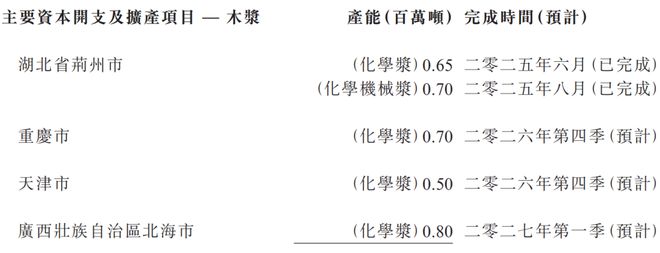
Core Viewpoint - Nine Dragons Paper Industries reported a revenue of 63.24 billion RMB for the fiscal year ending June 30, 2025, representing a year-on-year growth of approximately 6.3% and a gross profit increase of about 26.9% to 7.25 billion RMB, primarily due to a larger decline in raw material costs compared to product prices [1] Group 1: Financial Performance - Revenue for the fiscal year 2024-2025 reached 63.24 billion RMB, marking a 6.3% increase from the previous fiscal year [1] - Gross profit rose by approximately 26.9% to 7.25 billion RMB, attributed to a more significant decrease in raw material costs compared to product prices [1] Group 2: Expansion Projects - The company continues to advance new project constructions, with successful launches of high-end paper and raw material projects in Beihai, Guangxi, and Jingzhou, Hubei [1] - In the third quarter, new production lines for 1.2 million tons of white cardboard and 700,000 tons of wood pulp, as well as 400,000 tons of cultural paper, were put into operation [1] Group 3: Production Capacity - As of June 30, 2025, Nine Dragons Paper's fiber raw material production capacity reached 7.5 million tons, with a designed paper production capacity of 23.5 million tons [1] - The designed production capacity for corrugated paperboard and cartons is approximately 2.9 billion square meters [1] Group 4: Future Plans - In the new fiscal year, the company plans to further expand wood pulp production capacity in Beihai, Jingzhou, Chongqing, and Tianjin, totaling a designed capacity of 3.4 million tons [2] - The company aims to increase cultural paper and white cardboard production capacity by a combined 2.5 million tons at the Jingzhou and Beihai bases [2] Group 5: Capital Expenditure and Expansion Projects - Key capital expenditures and expansion projects include: - Jingzhou, Hubei: 0.65 million tons of chemical pulp completed by June 2025, and 0.70 million tons of chemical mechanical pulp completed by August 2025 [3] - Chongqing: 0.70 million tons of chemical pulp expected to be completed by Q4 2026 [3] - Tianjin: 0.50 million tons of chemical pulp expected to be completed by Q4 2026 [3] - Beihai, Guangxi: 0.80 million tons of chemical pulp expected to be completed by Q1 2027 [3] - Successful completion of these expansion plans will enhance the company's integrated pulp and paper advantages, improve profitability, and strengthen sustainable development in the industry [3]
玖龙纸业绩后倒跌超3% 全年纯利同比增长约1.35倍
Zhi Tong Cai Jing· 2025-09-25 03:58
Core Viewpoint - Nine Dragons Paper Holdings Limited reported a significant increase in annual performance metrics, yet the stock price declined over 3% following the announcement, indicating market skepticism about future growth potential [1] Financial Performance - Sales volume increased by 9.6% to approximately 21.5 million tons [1] - Revenue rose by approximately 6.3% to 63.241 billion yuan [1] - Gross profit increased by approximately 26.9% to 7.245 billion yuan [1] - Profit attributable to equity holders surged by approximately 135.4% to 1.767 billion yuan [1] Future Capacity Expansion - The company plans to add 2.5 million tons of cultural paper and packaging paper capacity, along with 1.35 million tons of pulp capacity in the fiscal year 2026 [1] - Initial contributions from the increased capacity may be limited and could be offset by lower average pulp prices [1] Profitability Outlook - Citigroup's report suggests that as long as monthly profits remain above 200 million yuan, there is potential for further upward adjustments in profit forecasts for fiscal year 2026 [1]
大行评级|花旗:上调玖龙纸业目标价至8港元 重申“买入”评级
Ge Long Hui· 2025-09-25 03:49
Core Viewpoint - Citigroup's research report indicates that Nine Dragons Paper Holdings' net profit for the fiscal year ending June 2025 surged 135% year-on-year to 1.767 billion HKD, aligning with earlier guidance of 1.7 billion to 1.9 billion HKD [1] Group 1: Financial Performance - The bank raised its earnings forecasts for the fiscal years 2026 to 2027 by 12% to 16% due to better-than-expected performance [1] - The conservative estimate for the fiscal year ending June 2026 is a 43% year-on-year increase in profit to 2.529 billion HKD [1] - The target price has been adjusted from 6.2 HKD to 8 HKD, maintaining a "buy" rating [1] Group 2: Capacity Expansion - The group plans to add 2.5 million tons of cultural and packaging paper capacity and 1.35 million tons of pulp capacity in the fiscal year 2026 [1] - Initial contributions from the increased capacity may be limited and could be offset by lower average pulp prices [1] Group 3: Profitability and Sales Forecast - As long as monthly profits remain above 200 million HKD, there is potential for further upward adjustments in the profit forecast for fiscal year 2026 [1] - Sales volume for fiscal year 2026 is expected to grow approximately 9% to 23.5 million tons, with a projected net profit per ton of 108 HKD, down from 129 HKD in fiscal year 2025 [1]
玖龙纸业公布年度业绩 公司权益持有人应占盈利增加约135.4%至17.67亿元
Zhi Tong Cai Jing· 2025-09-24 08:51
Core Insights - The company, Nine Dragons Paper Holdings Limited, reported a 9.6% increase in sales volume to approximately 21.5 million tons for the fiscal year ending June 30, 2025 [1] - Revenue increased by approximately 6.3% to 63.241 billion yuan, driven by the increase in sales volume despite a 3.0% decrease in average selling price [1] - Gross profit rose by approximately 26.9% to 7.245 billion yuan, with net profit attributable to equity holders increasing by approximately 135.4% to 1.767 billion yuan, resulting in basic earnings per share of 0.38 yuan [1] Revenue and Profitability - Revenue growth was primarily attributed to a 9.6% increase in sales volume, offset by a 3.0% decline in average selling prices [1] - The gross margin improved from 9.6% in the fiscal year 2024 to approximately 11.5% in fiscal year 2025, mainly due to a larger decline in raw material costs compared to the decrease in product prices [1]
玖龙纸业(02689.HK):2025财年股东应占盈利增加135.4%至17.67亿元
Ge Long Hui· 2025-09-24 08:49
Core Viewpoint - Nine Dragons Paper Holdings Limited reported significant growth in sales, revenue, and profits for the fiscal year ending June 30, 2025, indicating strong operational performance and improved profitability metrics [1]. Financial Performance - Sales volume increased by 9.6% to approximately 21.5 million tons [1] - Revenue rose by approximately 6.3% to RMB 63.2405 billion [1] - Gross profit increased by approximately 26.9% to RMB 7.2451 billion [1] - Net profit surged by approximately 177.3% to RMB 2.2017 billion [1] - Profit attributable to equity holders increased by approximately 135.4% to RMB 1.7671 billion [1] - Basic earnings per share rose by approximately 137.5% to RMB 0.38 [1] Profitability Metrics - Gross profit margin improved from 9.6% in the fiscal year 2024 to approximately 11.5% in fiscal year 2025 [1] - The increase in gross profit margin was primarily due to a larger decline in raw material costs compared to the decline in product prices [1]
玖龙纸业(02689)公布年度业绩 公司权益持有人应占盈利增加约135.4%至17.67亿元
智通财经网· 2025-09-24 08:46
Core Insights - The company, Nine Dragons Paper Holdings Limited, reported a 9.6% increase in sales volume to approximately 21.5 million tons for the fiscal year ending June 30, 2025 [1] - Revenue rose by approximately 6.3% to 63.241 billion yuan, while gross profit increased by about 26.9% to 7.245 billion yuan [1] - Profit attributable to equity holders surged by approximately 135.4% to 1.767 billion yuan, with basic earnings per share at 0.38 yuan [1] Revenue and Sales Performance - The revenue growth was primarily driven by a 9.6% increase in sales volume, despite a net impact from a 3.0% decrease in average selling prices [1] - The gross profit margin improved from 9.6% in the fiscal year 2024 to approximately 11.5% in fiscal year 2025 [1] Cost and Pricing Dynamics - The increase in gross profit margin was mainly due to a larger decline in raw material costs compared to the decrease in product selling prices [1]