时尚零售

Search documents
三里屯太古里向高端转型,它还是年轻人的潮流圣地吗
Bei Jing Wan Bao· 2026-01-22 02:21
Core Viewpoint - Swire Properties has made significant progress in the renovation and upgrade of Sanlitun Taikoo Li, with nearly half of the commercial space in the North District completed and flagship stores of top international brands like Dior, Louis Vuitton, and Tiffany set to open by December 2025 [1][3]. Group 1: Renovation Progress - The renovation began around 2022, coinciding with the expiration of leases for several large anchor stores, providing an opportunity for upgrades [2]. - The North District has undergone a comprehensive transformation since early 2023, including redesigning public areas, store structures, facades, and surrounding landscapes to create a high-end fashion destination [3]. Group 2: Brand and Store Changes - The transformation aims to shift Sanlitun Taikoo Li from a trendy hotspot to a high-end fashion destination, with the closure of popular fast-fashion brands like ZARA and H&M, and the relocation of Uniqlo [3]. - The new design features flagship stores and core concept stores from global brands, with all stores designed by top architects [3]. Group 3: Target Audience and Experience - The management acknowledges that while Sanlitun Taikoo Li has historically been a gathering place for young people, the demographic has matured, necessitating adjustments in the commercial offerings [4]. - Despite the changes, the venue continues to provide diverse experiences for younger visitors, including the addition of bookstores, dessert shops, and cafes along Sanlitun Road [4].

策展式零售新范本:名创优品MINISO在渝打造沉浸式兴趣消费引力场
Sou Hu Cai Jing· 2026-01-21 17:14
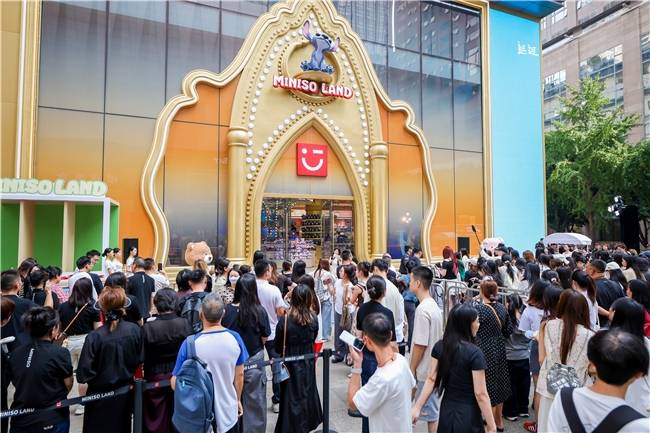
Core Insights - MINISO has strategically launched its innovative store format MINISO LAND in Chongqing, marking its first entry into the southwestern market with the opening of two flagship stores in key commercial districts [1][4]. Group 1: Strategic Expansion - The dual-store opening in Chongqing targets two major commercial engines: the Jiefangbei-Chaotianmen area, known for its cultural and tourism significance, and the Guanyinqiao shopping district, recognized as a fashion trendsetter [4]. - This strategic positioning allows MINISO to cover both tourist and local young consumer demographics, enhancing its market penetration and influence in the southwestern region [4]. Group 2: Retail Experience Innovation - MINISO LAND redefines the retail experience through immersive and curated spaces, with the Jiefangbei store spanning over 1,600 square meters and featuring an artistic wonderland, while the Guanyinqiao store, themed "Interstellar Paradise," covers over 1,400 square meters with a blend of virtual and real design elements [6]. - The stores are designed to facilitate exploration and social interaction, aligning with the aesthetic preferences of Generation Z, thus transforming traditional shopping into an experience-driven environment [6]. Group 3: IP Strategy and Brand Value - The Chongqing stores leverage a dual IP strategy, featuring over 80% of products from globally recognized IPs such as Hello Kitty and Harry Potter, with more than 6,100 SKUs available [8]. - This approach not only attracts consumer traffic but also fosters emotional connections through exclusive experiences, reinforcing MINISO's transition from a retail channel to an IP content ecosystem operator [8]. Group 4: Future Expansion Outlook - The successful performance of the Chongqing stores during the trial period validates MINISO's business model and IP strategy, indicating potential for replication in other markets [10]. - By establishing immersive IP landmarks in high-potential urban areas, MINISO aims to drive innovation in urban commerce and enhance consumer quality, with plans for further expansion across the country and globally [10].

美股异动|名创优品盘前涨2.2% 持续回购+被列为摩通马年内需首选股
Ge Long Hui· 2026-01-21 09:49
Group 1 - Miniso (MNSO.US) shares rose by 2.2% to $19.51 in pre-market trading [1] - The company announced a share buyback of 51,300 shares at a total cost of $245,900, with a buyback price range of $4.7625 to $4.875 per share, scheduled for January 20, 2026 [1] - JPMorgan's latest report identified Miniso as a preferred stock in the consumer discretionary sector, alongside other companies such as Lao Pu Gold, Gu Ming, Yum China, and Pop Mart [1] Group 2 - The closing price of Miniso on January 20 was $19.08, with a decrease of $0.21 or 1.09% [2] - The pre-market price on January 21 was $19.51, reflecting an increase of $0.43 or 2.25% [2] - The total market capitalization of Miniso is approximately $5.903 billion, with a total share count of 309 million [2]
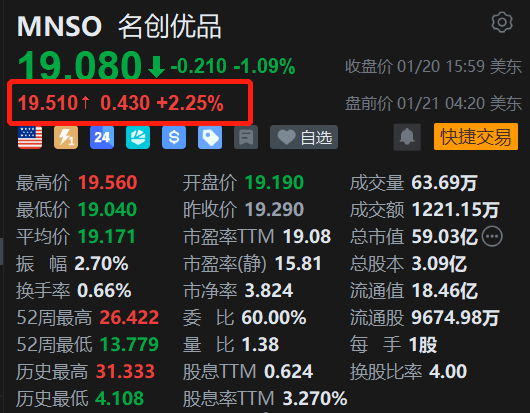
卡地亚母公司最新一季业绩增长11%|二姨看时尚
2 1 Shi Ji Jing Ji Bao Dao· 2026-01-19 01:11
Group 1: Luxury Goods Market Trends - The luxury goods industry is experiencing a mixed performance, with some brands like Brunello Cucinelli and Richemont reporting record sales while others face challenges [1][4][19] - Brunello Cucinelli's preliminary 2025 revenue reached €1.4077 billion, marking a 10.1% year-on-year increase, driven by significant growth in the Chinese market [19][20] - Richemont's sales for the third quarter of fiscal 2026 grew by 11% to €6.399 billion, with the jewelry segment, led by Cartier, being a key growth driver [4][5] Group 2: Outdoor and Fashion Retail Developments - The outdoor sports market is rapidly expanding, with international brands accelerating their entry into the Chinese market, while local giants are looking to acquire well-known global brands [1][22] - Canadian fashion retailer Aritzia reported a record quarterly revenue of $1.04 billion, a 42.8% increase year-on-year, and is expected to continue strong growth [10][11] - Hoka's parent company, Deckers Brands, is streamlining its brand portfolio by shutting down non-core brands Ahnu and Koolaburra to focus on high-profit core brands [7][8] Group 3: Market Exits and Strategic Adjustments - Valentino Beauty announced its exit from the South Korean market, closing all physical stores by the end of 2025 due to competitive pressures from established luxury brands and local Korean cosmetics [6][7] - Saks Global filed for bankruptcy protection, marking one of the largest retail collapses since the pandemic, with plans to close underperforming stores and restructure its operations [17][18] Group 4: Beauty Market Dynamics - China's beauty market is undergoing a transformation, with imports declining to a six-year low while domestic brands are rapidly expanding overseas, leading to a "cold imports, hot exports" scenario [14][15] - Domestic brands now hold a market share of 56.87%, significantly outpacing foreign brands in growth [15] Group 5: Strategic Partnerships and Expansions - Giorgio Armani Group has formed a joint venture with Symphony Global to accelerate the global expansion of its hotel and resort business, focusing on high-end accommodations [25][26] - The new venture aims to develop luxury hotels and lifestyle-oriented high-end hotels, targeting emerging markets to meet the growing demand for premium accommodations [26]

跨国时尚“首店矩阵”与上海最前沿潮流同频共振 衡复诞生1.5公里“新消费亿元街区”
Jie Fang Ri Bao· 2026-01-18 01:58
记者 舒抒 此次活动主办方之一的MUSINSA,在韩国是时尚潮流领域的"链主"企业。2025年,企业正式落地 上海,在淮海百盛开设全球首家海外旗舰店MUSINSA STANDARD,紧接着又在安福路开设其首家多 品牌集合店,集合了来自中韩等国约40个潮流品牌。 金大铉透露,在安福路新店开业前,MUSINSA在小红书搜索了大量中国消费者偏爱的风格与产品 类别进行选品,同时为中国消费者筛选了韩国最前沿的时尚消费品牌。"中韩两国的时尚风格差异在缩 小,说明双方的潮流文化、时尚文化在相互影响,年轻人之间的交流正通过各种渠道不断增长。" 说着一口流利中文的金大铉对徐汇的营商服务印象深刻。"企业落地过程中,从办公选址到员工签 证,再到税收等环节,我们有问题提出,徐汇区都会第一时间跟进解决。"以企业登记注册为例,公司 没有设立就无法为员工支付薪酬,会对企业后续开设新店产生影响。在徐汇区的协调指导下,企业在 2025年4月顺利登记注册,区相关部门还会同出入境为韩国员工及家属提供了高效的签证办理指导,保 障了韩籍员工顺利来沪。 "在安福路新店落地过程中,从解决风貌区较易发生的白蚁问题,到帮助门店达到电力供应需求, 再到指导我们 ...
中国品牌浪潮:从世界工厂到全球心智占领
Sou Hu Cai Jing· 2026-01-14 02:49
Core Insights - The article discusses the transformation of Chinese brands from being known as "Made in China" to becoming global brand leaders through emotional connections and cultural exports, highlighting four key characteristics of this shift [1][10][14]. Group 1: Brand Globalization - The speed of brand globalization has significantly increased, with the time required to establish brand recognition in overseas markets reduced from ten years to just 3-5 years [14]. - Enhanced infrastructure, including cross-border e-commerce platforms and social media marketing, has facilitated this rapid expansion, shifting the approach from a "prolonged battle" to a "lightning war" [14][15]. Group 2: Evolution of Export Categories - The scope of exports has evolved from physical products to include cultural IP and services, with IP product exports growing at a rate of 8%, surpassing the average growth of consumer goods exports [15][19]. - This evolution signifies a transition for Chinese brands from being mere suppliers to becoming co-creators of value through deeper interactions with consumers [15][19]. Group 3: Deepening Export Models - The export model has shifted from simple trade to a comprehensive global supply chain layout, indicating that Chinese brands are moving from being participants in the global market to becoming network builders [16]. - Companies are now integrating R&D and production globally, enhancing their competitiveness and embedding themselves within local economic ecosystems [16]. Group 4: Consumer Connection Channels - Brands are moving away from reliance on third-party platforms like Amazon, adopting a multi-channel operation system that includes DTC (Direct-to-Consumer) models [17]. - This transition allows brands to directly reach consumers, gain insights into their needs, and accumulate user assets more effectively [17]. Group 5: Regional Market Opportunities - The Asia-Pacific market is experiencing rapid demand growth, particularly in beauty and fashion sectors, due to localized innovation and cost advantages [22]. - In contrast, the North American and European markets prioritize technology, design, and sustainability, making consumer electronics and high-end appliances more likely to gain acceptance [23]. - Latin America presents opportunities for high-cost performance products like smartphones and white goods, while the Middle East and Africa focus on basic needs, with daily necessities and communication devices achieving scale through cost optimization [24]. Group 6: Strategic Paths for Exporting Companies - Companies are forming three strategic paths based on their strengths: - A-class "Scale Guardians" like Haier focus on global supply chain integration and localized operations to enhance value in existing markets [21]. - B-class "Value Heights" brands like Miniso leverage IP collaborations and localized co-creation to build emotional connections with consumers [21]. - C-class "New Star Disruptors" like Huaxizi utilize "super products + cultural symbols" strategies to rapidly capture market attention and occupy niche segments [21]. Group 7: Case Studies - Haier has successfully established a localized operational system, achieving overseas revenue of 143.81 billion yuan in 2024, marking a 5.43% increase [33]. - Miniso's overseas revenue grew by 41.9% to 6.68 billion yuan in 2024, with a focus on flagship stores in prime locations to enhance brand experience [38]. - Huaxizi has entered over 110 countries, with significant sales in Japan, leveraging unique product designs and cultural narratives to build brand recognition [42][43].




武康大楼旁兴起“韩流首秀场”
Xin Lang Cai Jing· 2026-01-10 09:09
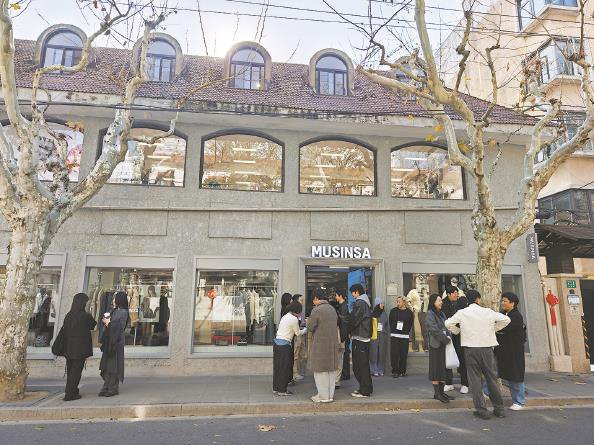
安福路韩国潮牌 店Musinsa 本报记者 刘歆 摄 去年12月19日,韩国时尚零售平台MUSINSA的全球首家多品牌集合店Musinsa Store在安福路开业,半 个多月以来,"25岁至35岁年轻女性"的顾客画像十分符合品牌定位,销售也超过预期,为其加快在华布 局打下良好基础。昨天,入驻Musinsa Store的近40个韩国潮牌创始人及高管专程来沪考察,与徐汇区政 府部门、重点企业、优质商业载体的负责人面对面对话。作为链主企业代表,金大铉在活动中现身说 法,回顾开业经过,鼓励更多韩国同行来沪发展。 能听懂中文的金大铉曾在上海、南昌等地的时尚企业工作过五年,2024年受邀回到上海筹备MUSINSA 来华事宜。他发现,现在的衡复风貌区与他当年在上海工作时大不相同。"以前我只知道陆家嘴、南京 西路这些著名商圈,没想到现在韩国人也青睐上海武康路、安福路等'打卡胜地'……衡复风貌区的商业 氛围和MUSINSA等韩国潮牌聚集的首尔圣水洞街区很像,消费群体也与MUSINSA的目标顾客十分匹 配。"金大铉表示,衡复风貌区不仅有适合潮牌的商业氛围,更有着优质的营商环境,"2024年11月,中 国对韩国实施免签政策的第一周 ...
又一批韩国品牌来华开店,“新韩流”与过去不太一样
Di Yi Cai Jing· 2026-01-09 07:58
Core Insights - Shanghai has become the preferred location for Korean brands to open stores in China, with plans for over 100 new stores in the next five years [1][3] - The increase in inbound tourism and retail performance in Shanghai is significantly driven by the recovery of the tourism sector in 2025 [1] - The Shanghai government has implemented a three-year action plan to enhance commercial districts, aiming for a 5% annual growth in consumption scale by 2026 [1] Market Performance - In 2025, Shanghai's total retail sales reached 15,212.93 billion yuan, marking a 5.0% year-on-year increase, outpacing the national average [1][2] - The influx of iconic commercial projects in 2025 has attracted significant foot traffic, although the commercial real estate market remains under pressure due to increased supply [2] - Core district average rents have slightly decreased, while vacancy rates have remained stable [2] Korean Brand Expansion - At least 20 Korean brands have entered the Chinese market in 2025, with a focus on major cities like Shanghai, Beijing, and Shenzhen [2][3] - The current wave of Korean brands differs from the previous "Korean Wave," focusing more on fashion and lifestyle rather than just beauty products [3] - The "Z Generation" is becoming the main consumer force, showing a strong acceptance of Korean trends and a desire for unique and practical products [3] Strategic Partnerships - Korean brand MUSINSA has opened dual flagship stores in Shanghai, backed by a 40% stake from Anta Group, indicating a trend of local partnerships to accelerate market entry [3] - The combination of policy incentives and cultural resonance is creating a favorable environment for Korean brands to thrive in China [3]
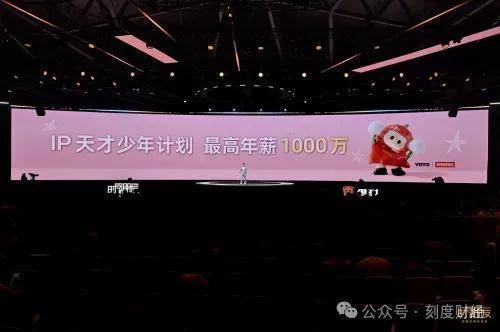
从“山寨优选”到“大IP梦”,叶国富的全球“大冒险”
Sou Hu Cai Jing· 2026-01-08 09:14
Core Viewpoint - MINISO is undergoing a strategic transformation from a retail company to a cultural and creative company, aiming to become a leading global IP operation platform, while facing challenges related to its past "knockoff" reputation and the sustainability of its IP strategy [3][10][21] Group 1: Strategic Transformation - MINISO has launched an "IP Equalization" initiative, with plans to invest 100 million yuan annually to support original IP development and recruit top IP designers [1][3] - The company aims to have over 8,800 global stores by the end of 2025, with a significant presence in key markets like New York and Paris [3][10] - The transformation is marked by collaborations with high-profile IPs such as Disney and Harry Potter, but raises questions about whether this shift can truly erase its "value retail" roots [3][10] Group 2: Financial Performance - In 2024, MINISO's revenue reached 16.994 billion yuan, a year-on-year increase of 22.8%, with overseas revenue surging by 42% to 6.68 billion yuan [10][11] - The company's gross margin improved to 44.9%, but profitability remains under pressure due to rising IP licensing costs, which increased by 31.5% to 2.408 billion yuan [11][13] - Despite impressive revenue growth, the quality of profits has not kept pace, leading to concerns about the sustainability of its IP strategy [10][11] Group 3: Supply Chain and Operational Efficiency - MINISO has developed a highly efficient supply chain, reducing product development cycles to as short as 21 days, significantly faster than the industry average [9][10] - The company relies heavily on external IPs for sales, lacking a robust internal IP culture, which limits its ability to create a stable profit model [15][20] - Quality control issues have emerged, with several products facing scrutiny for safety and quality, impacting brand perception and customer loyalty [13][14] Group 4: Global Expansion and Market Positioning - MINISO's global strategy includes opening flagship stores in prestigious locations, enhancing brand image and attracting consumers [16][17] - The company has made strides in overseas markets, with a total of 579 direct stores and 2,303 partner stores as of mid-2025 [16][20] - However, challenges remain in localizing products and addressing supply chain inefficiencies, which hinder its ability to fully capitalize on international opportunities [20][21]
【新华财经调查】 名创优品欧洲快速扩张经受住考验 结构性压力逐步显现
Xin Hua Cai Jing· 2026-01-06 08:42
Core Insights - Miniso views the European market as a strategic focus for overseas expansion, with over 300 stores in Europe and more than 60 in Italy, including over 10 flagship stores [2] - The company employs a highly standardized retail operation model driven by efficiency and systems, differing from traditional low-price strategies [2][3] - Miniso's self-developed IT system helps manage compliance and operational processes across different countries, reducing reliance on local high-cost resources [3] Financial Performance - The number of Miniso's overseas flagship stores increased from 422 to 637 year-on-year, with a revenue growth of approximately 69.9% for flagship stores in Q3 [4] - Operating expenses grew by about 40.7%, showing a slowdown compared to previous quarters, indicating that revenue growth is beginning to outpace operating expense growth [4] - The overall gross margin remained stable at 44.7% year-on-year, reflecting improved supply chain efficiency [3][4] Competitive Strategy - Miniso targets young consumers by leveraging popular IP products, which resonate well with local cultural preferences, particularly during festive seasons [5][6] - The company is transitioning from a value-based retailer to a leading IP operation platform, focusing on emotional value and deeper connections with consumers [6] - The global localization strategy allows Miniso to maintain brand consistency while adapting to local market preferences [6] Market Challenges - Structural cost pressures are emerging as the company expands its store footprint, necessitating higher demands on profitability and cost management [7][9] - The competitive landscape includes established brands like MUJI, which have adapted their strategies to maintain market position [8] - Rising rental costs in prime locations, particularly in Italy, pose significant challenges for Miniso's expansion plans [9][10] Future Outlook - The European retail market is expected to grow, with a projected 2% increase in actual retail spending by 2025 [11] - Miniso plans to open larger flagship stores in key European cities to enhance brand recognition and offer more design-oriented products [11] - The company is well-positioned to benefit from both the growing demand for high-value products in China and the inflationary pressures affecting European consumers [11]