电动汽车充电

Search documents
美国交通部提议,联邦资助的电动汽车充电站最高可要求100%使用美国本土生产的零部件。
Jin Rong Jie· 2026-02-10 16:19
Core Viewpoint - The U.S. Department of Transportation has proposed that federally funded electric vehicle charging stations may require 100% use of domestically produced components [1] Group 1 - The proposal aims to enhance domestic manufacturing and support local industries by mandating the use of American-made parts in electric vehicle charging infrastructure [1] - This initiative is part of a broader strategy to promote electric vehicle adoption and reduce reliance on foreign supply chains [1] - The requirement could potentially impact the cost and availability of charging stations, as companies may need to adjust their sourcing strategies to comply with the new regulations [1]
春运通途活力中国 “送电到车”为电车出行提供智慧便捷保障
Yang Shi Wang· 2026-02-04 07:25
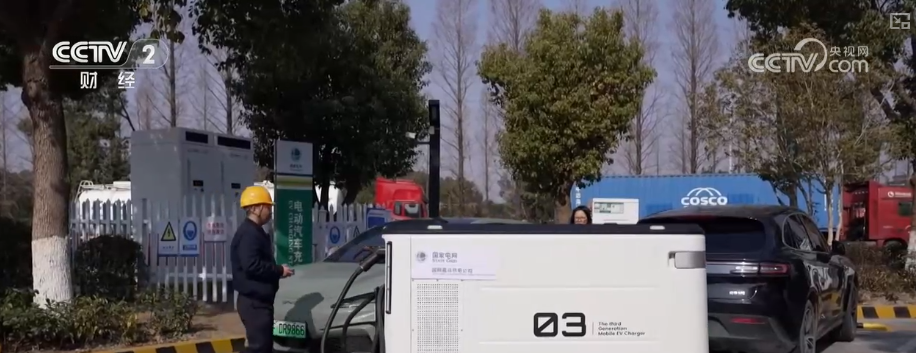
Core Viewpoint - The transportation department forecasts that during the 2026 Spring Festival travel period, the daily traffic of new energy vehicles on the national highway network is expected to approach 9.5 million vehicles, indicating an increase in travel share for electric vehicles. Intelligent upgrades in charging services at highway service areas will support this trend [1]. Group 1: Charging Infrastructure and Services - The mobile energy charging robots at the Hangpu Expressway Pinghu service area provide dynamic charging services, enhancing convenience for electric vehicle owners [3]. - Users report significant improvements in charging convenience, with the ability to summon charging robots via an app, reducing wait times from hours to mere minutes [4]. - A smart charging management platform, developed by local transportation, emergency, and power supply departments, enables real-time monitoring and dynamic dispatch of mobile charging equipment, transitioning from a traditional "car finds pile" model to an intelligent "pile chases car" model [6]. Group 2: Charging Capacity and Future Plans - The average daily charging sessions at the Pinghu service area have increased from over 180 to over 220 since the introduction of mobile charging facilities, with expectations to exceed 400 sessions per day during the Spring Festival [6]. - Nationwide, there are currently 71,500 charging piles at highway service areas, covering over 98% of service areas, contributing to a total of 20.09 million electric vehicle charging facilities as of December 2025 [7]. - China has established the world's largest electric vehicle charging network, supporting the charging needs of over 40 million new energy vehicles, with plans to double the service capacity of charging facilities by 2027, aiming for a total of 28 million charging facilities to meet the needs of over 80 million electric vehicles [9].

到2027年底将建成2800万个充电设施,服务能力加速增长 全球最大电动汽车充电网络持续升级(大数据观察)
Ren Min Ri Bao· 2026-01-28 22:08
Group 1: Electric Vehicle Charging Infrastructure Development - By the end of December 2025, the number of electric vehicle charging facilities in China is expected to reach 20.092 million, supporting over 43 million electric vehicles [1] - The "Three-Year Doubling Action Plan for Electric Vehicle Charging Facility Service Capacity (2025-2027)" aims to establish 28 million charging facilities by the end of 2027, providing over 300 million kilowatts of public charging capacity to meet the charging needs of over 80 million electric vehicles [1] - The plan emphasizes the continuous improvement of the charging network, enhancement of charging efficiency, optimization of service quality, and innovation in the industry ecosystem to accommodate the increasing number of electric vehicles [1] Group 2: Fast Charging Stations and Technology - The Taihu Service Area in Suzhou has implemented a "dual-gun" charging system that allows two vehicles to charge simultaneously, achieving a charging speed of 63 kilowatt-hours in just 15 minutes [2] - The service area features four dedicated charging spots for electric heavy trucks, with a maximum output power of 480 kilowatts, which is nearly four times more efficient than traditional fast charging [2] - The Taihu Service Area's supercharging station, operational since September last year, integrates a flexible shared supercharging system with an intelligent operation and maintenance system for enhanced safety and efficiency [2][3] Group 3: Rural Charging Solutions - In Dongguo Village, Shanxi Province, a local resident can charge their electric vehicle at a nearby charging station for 0.68 yuan per kilowatt-hour, significantly alleviating "range anxiety" for residents [4][5] - Longzi County has been selected as a pilot for charging infrastructure development, with plans to build charging stations in 96 villages, aiming for a coverage rate of over 65% [5] - The local government is encouraging private investment in charging infrastructure through subsidy policies, while addressing the challenges of existing rural power grid capacity [5] Group 4: Community Charging Initiatives - In Chengdu, the "Unified Construction and Service" model has been adopted to facilitate the installation of public charging facilities in residential areas, addressing the challenges faced by residents in accessing charging points [6][7] - The community has identified over 300 electric vehicles in the area and plans to install approximately 40 charging stations across two zones, with a management system in place for usage and revenue distribution [7] - The "Unified Construction and Service" model is being promoted in various old and resettlement communities to enhance charging convenience for residents [7]
春节将至 高速充电还会是电动车主出行的“拦路虎”吗?
Huan Qiu Wang Zi Xun· 2026-01-28 10:03
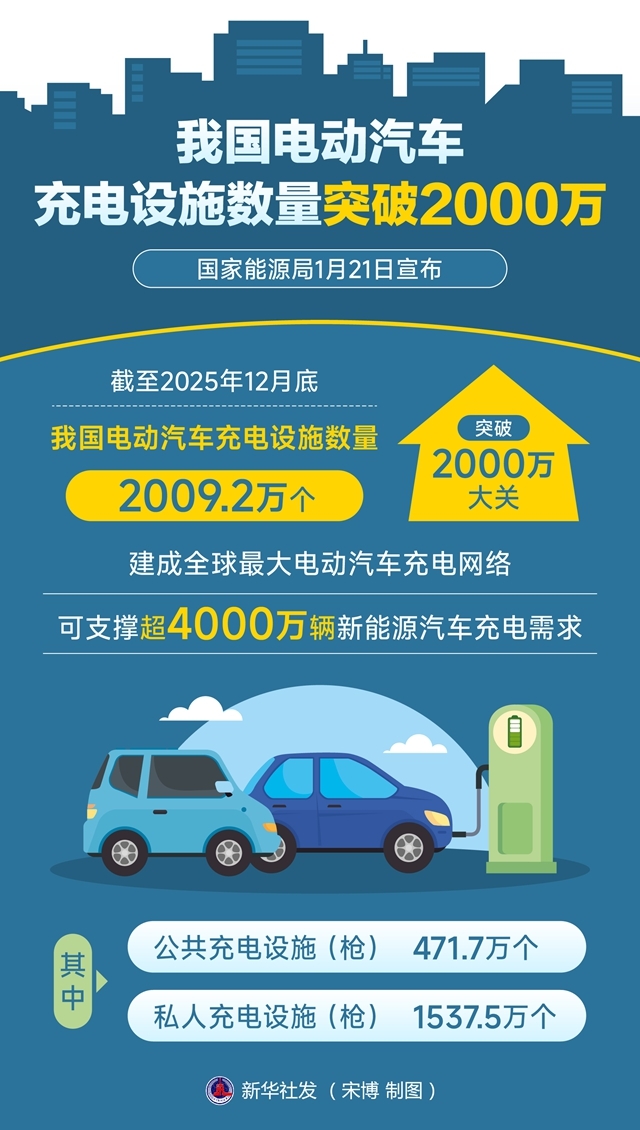
Core Insights - The article discusses the significant improvements in electric vehicle (EV) charging infrastructure in China ahead of the upcoming Spring Festival, highlighting the increase in charging facilities and the adoption of battery swapping technology to alleviate charging difficulties during peak travel times. Group 1: Charging Infrastructure Growth - By the end of December 2025, China's total number of electric vehicle charging facilities is expected to reach 20.092 million, a year-on-year increase of 49.7%, surpassing the 20 million mark [2] - Public charging facilities will account for 4.717 million units, growing by 31.9%, with a total rated power of 220 million kilowatts, averaging about 46.53 kilowatts per unit [2] - Private charging facilities will reach 15.375 million units, increasing by 56.2%, with a total power capacity of 134 million kilovolt-amperes [2] Group 2: Battery Swapping Technology - The battery swapping method is gaining popularity, with companies like CATL and NIO establishing extensive networks of battery swapping stations, including 1,020 and 1,000 stations respectively by the end of 2025 [4] - NIO's network connects 550 cities, forming a significant battery swapping network along major highways [4] Group 3: Enhancements in Charging Capabilities - To address peak charging demands, mobile charging vehicles will be deployed on some highways, and the adoption of high-power charging technology is expected to ease charging difficulties [6] - Upgraded charging stations, such as those in Hunan, have improved charging efficiency by 167% and reduced waiting times by 40% [6] - Huawei's liquid-cooled megawatt fast charging solution can fully charge a 300 kWh battery in 15 minutes, significantly faster than traditional charging methods [6] Group 4: Innovative Charging Solutions - Guangdong province has implemented a "station-storage integration" design for 274 supercharging stations, reducing investment payback periods from 8 years to 5 years [7] - The integration of photovoltaic systems at charging stations has achieved a green electricity self-sufficiency rate of 45% in pilot projects [7] - The Ministry of Transport mandates that major highway service areas must be equipped with high-power charging facilities, significantly improving the charging situation [7] Group 5: Alternative Charging Strategies - During the Spring Festival, drivers are encouraged to utilize nearby towns for charging instead of relying solely on highway service areas, which can lead to cost savings of 20%-30% on charging fees [9] - Drivers can use navigation apps to locate charging stations along their routes, optimizing their charging strategy and reducing waiting times [9][10] - Experiences shared by drivers indicate that charging in smaller towns can be more efficient and less congested compared to larger cities or tourist areas [10]
支撑充电需求
Xin Lang Cai Jing· 2026-01-27 16:54
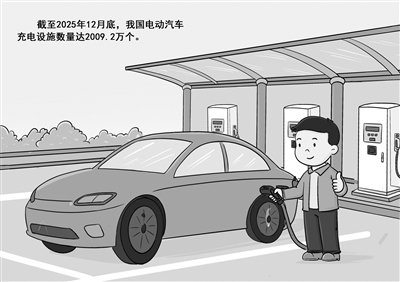
国家能源局21日宣布,截至2025年12月底,我国电动汽车充电设施数量达2009.2万个,突破2000万大 关,建成全球最大电动汽车充电网络,可支撑超4000万辆新能源汽车充电需求。(1月21日 新华社) □邰怡明 (来源:劳动午报) 转自:劳动午报 ...
春节将至,高速充电还会是电动车主出行的“拦路虎”吗?
Zhong Guo Qi Che Bao Wang· 2026-01-27 09:51
Core Viewpoint - The article discusses the significant improvements in electric vehicle (EV) charging infrastructure in China ahead of the upcoming Spring Festival, highlighting the increase in charging facilities and advancements in charging technology to alleviate the challenges faced by EV users during peak travel times [2][9]. Charging Infrastructure Growth - By the end of December 2025, China's total number of electric vehicle charging facilities is expected to reach 20.092 million, a year-on-year increase of 49.7%, surpassing the 20 million mark [2]. - Public charging facilities will account for 4.717 million units, growing by 31.9%, with a total rated power of 220 million kilowatts, averaging about 46.53 kilowatts per unit [2]. - Private charging facilities will reach 15.375 million units, increasing by 56.2%, with a total power capacity of 134 million kilovolt-amperes [2]. Battery Swap Technology - Battery swapping has gained popularity as a faster alternative to traditional charging, with significant expansions in swap station networks [5]. - As of December 30, 2025, CATL has established 1,020 battery swap stations and initiated a highway swap network [6]. - NIO has built 1,000 highway swap stations, connecting 550 cities and forming a major highway swap network [6]. Enhanced Charging Capabilities - The introduction of mobile charging vehicles and high-power charging technologies is expected to improve charging capabilities on highways [9]. - Upgraded charging stations, such as the 160 kW liquid-cooled supercharging piles in Hunan, have increased charging efficiency by 167% and reduced waiting times by 40% [9]. - Huawei's liquid-cooled megawatt fast charging solution can charge a 300 kWh battery pack in 15 minutes, achieving nearly four times the speed of traditional fast chargers [9]. Innovative Charging Solutions - New charging stations are being integrated with service facilities, such as restaurants, to enhance user experience during charging [10]. - In Guangdong, a "station-storage integration" design for 274 supercharging stations has reduced investment payback periods from 8 years to 5 years, attracting more private capital into the charging sector [10]. Government Initiatives - The Ministry of Transport has mandated that major highway service areas must be equipped with high-power charging facilities, significantly improving the charging situation on highways [11]. Alternative Charging Strategies - During the Spring Festival, drivers are encouraged to utilize charging stations in nearby towns rather than solely relying on highway service areas, which can offer lower charging costs [12]. - Drivers have reported savings of 20%-30% on charging costs by using town charging stations instead of those at service areas [12]. User Experiences and Recommendations - Users have shared practical experiences of charging along routes, emphasizing the benefits of planning stops at county-level cities for easier access to charging stations [14]. - Recommendations include using navigation apps to locate charging stations along routes and avoiding high-traffic areas during peak travel times to minimize waiting [13][14].
基础设施从有到优 用户体验仍存短板
Xin Lang Cai Jing· 2026-01-26 22:09
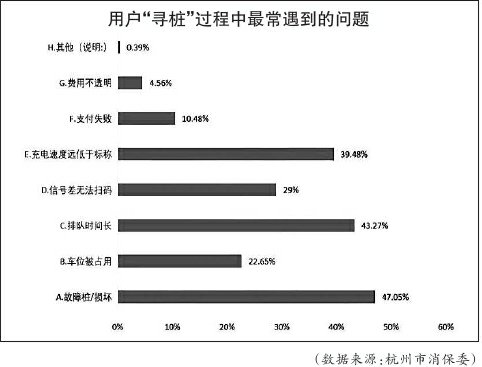
Core Insights - The survey conducted by the Hangzhou Consumer Rights Protection Committee highlights that the "finding charging stations" experience is a critical factor affecting user satisfaction with electric vehicle charging services [3][4][5] Group 1: User Experience and Satisfaction - Over half (56.7%) of users charge their vehicles more than four times a month, with public charging stations (53.51%), workplaces (49.26%), and residential areas (45.62%) being the main charging locations [4] - 83.49% of consumers express satisfaction with the distribution density and accessibility of charging stations, although they face three main challenges: unreliable equipment (47.05%), long wait times during peak hours (43.27%), and non-electric vehicles occupying charging spots (50.17%) [4][5] - Fast charging is preferred by 92.32% of users, with 85.87% satisfied with the charging initiation process and 84.67% believing the current charging speed is fast [5] Group 2: Charging Station Facilities - While 72.86% of users rate the cleanliness and lighting of charging stations positively, there is a significant need for improved comfort facilities, with 47.30% of users wanting more restrooms and lounges [6][7] - Users appreciate the basic services provided at charging stations, but there is a notable gap in human-centered service facilities [7] Group 3: Pricing and Payment Experience - 83.52% of users find the charging fee structure clear, and 84.05% are satisfied with the payment process [8] - However, 61.54% of users feel that current public charging prices are too high or slightly high, indicating a discrepancy between perceived and actual costs [8] - 27.59% of users have experienced inconsistencies between the displayed and actual charging fees, highlighting the need for improved standardization in pricing [8] Group 4: Areas for Improvement - The top three areas identified for improvement in public charging services are increasing charging speed (61.96%), reducing charging costs (55.93%), and enhancing service quality (48.81%) [9] - Recommendations for consumers include planning charging stops using navigation or charging apps, prioritizing stations with good user ratings and sufficient charging points, and considering facilities that meet comfort needs [9][10]
住建部:今年将着力稳定房地产市场 能源局:电动汽车充电设施突破2000万个
Xin Lang Cai Jing· 2026-01-26 06:39
Group 1: Real Estate Market - The Ministry of Housing and Urban-Rural Development aims to stabilize the real estate market this year by implementing city-specific and precise policies, supporting reasonable financing needs of real estate companies, and addressing residents' housing demands [1] - Key initiatives include establishing a project company system for real estate development, promoting a main bank system for financing, and implementing a "see what you get" system for the sale of commercial housing [1] Group 2: Market Regulation - The State Administration for Market Regulation reported that in 2025, it urged mobile power production companies to recall 1.3977 million problematic power banks due to safety concerns [2] - The number of complaints regarding mobile power products has decreased by 85% compared to the peak in July 2025, indicating improved consumer satisfaction [2] Group 3: Environmental Initiatives - The Ministry of Ecology and Environment announced the first batch of 23 beautiful rural pilot areas, focusing on ecological protection and rural development [4] - By 2025, rural environmental quality is expected to improve significantly, with over 24,000 administrative villages undergoing environmental remediation [4] Group 4: Transportation Impact - The recent cold wave has led to the closure of 161 sections of national and provincial highways across 14 provinces due to snow and icy conditions [5] Group 5: Electric Vehicle Infrastructure - As of December 2025, the number of electric vehicle charging facilities in China has surpassed 20 million, supporting over 40 million new energy vehicles [6] - The growth rate of charging facilities has accelerated, with the number doubling from 10 million to 20 million in just 18 months [6] Group 6: Robotics Industry - In 2025, over 140 domestic companies have produced more than 330 humanoid robot models, marking a significant advancement in the industry [6] - The Ministry of Industry and Information Technology plans to promote technological innovation and safety in humanoid robots to support the broader development of embodied intelligence [6] Group 7: Telecommunications - China has built 4.838 million 5G base stations, with over 1.2 billion 5G users, establishing the largest and most advanced information infrastructure globally [7] - The first phase of 6G technology trials has been completed, with over 300 key technologies developed, and the second phase of trials has recently begun [7] Group 8: Consumer Market - The total retail sales of consumer goods in 2025 are projected to exceed 50 trillion yuan, with a growth rate of 3.7% [8] - The contribution of final consumption expenditure to economic growth is expected to reach 52%, highlighting its role as a key driver of economic development [8]

中国电动汽车充电设施突破2000万个
Ren Min Ri Bao· 2026-01-22 19:16
Core Insights - The total number of electric vehicle charging infrastructure (units) in China is projected to reach 20.092 million by the end of December 2025, representing a year-on-year growth of 49.7%, surpassing the 20 million mark [1] Group 1: Infrastructure Growth - The growth of charging facilities is accelerating, with the number of charging units increasing from 1 million to 10 million in just 5 years, and from 10 million to 20 million in only 18 months [1] - The current total includes 4.717 million public charging units and 15.375 million private charging units, establishing the world's largest electric vehicle charging network [1] Group 2: Charging Efficiency - The average charging power of public charging stations has reached 46.5 kW, with charging efficiency improving by 33% year-on-year, significantly enhancing the charging service experience [1] Group 3: Coverage Expansion - A total of 71,500 charging piles have been built in highway service areas, covering over 98% of service areas nationwide, with 19 provinces achieving "full coverage" of charging facilities in every township [1]
图表:我国电动汽车充电设施数量突破2000万
Xin Hua She· 2026-01-22 01:04
Core Insights - The number of electric vehicle charging facilities in China has surpassed 20 million, reaching 20.092 million by the end of December 2025, establishing the largest electric vehicle charging network globally [1][2] - This network is capable of supporting the charging needs of over 40 million new energy vehicles [1][2] Summary by Categories Infrastructure Development - China's electric vehicle charging facilities have exceeded 20 million, marking a significant milestone in infrastructure development [1][2] - The country is on track to build the world's largest electric vehicle charging network by the end of 2025 [1][2] Capacity and Demand - The established charging network can accommodate the charging requirements of more than 40 million new energy vehicles [1][2]