
移动电源

Search documents
国家市场监管总局:将深入整治“内卷式”竞争
Guang Zhou Ri Bao· 2026-02-27 09:35
Group 1 - The core viewpoint emphasizes the need to eliminate obstacles to the construction of a unified national market and to comprehensively address "involution-style" competition as a key directive from the 20th National Congress [1] - The State Administration for Market Regulation (SAMR) is implementing multiple measures to tackle "involution-style" competition, focusing on legal enforcement, industry optimization, and regulatory improvements [1] - Specific actions include conducting cost audits and enforcement checks in key industries, launching nine special rectification actions, and addressing typical cases in live-streaming e-commerce [1] Group 2 - In supporting industry optimization, SAMR is advancing quality improvement projects, with 1,856 quality enhancement projects initiated and over 25,000 quality issues addressed [1] - The recall of nearly 1.4 million defective mobile power products and the first special supervision of complete vehicles in the new energy vehicle sector are highlighted as significant actions [1] - In terms of regulatory improvements, the revision of the Anti-Unfair Competition Law and the issuance of various regulatory documents aim to establish clear legal boundaries for platform enterprises [2] - The implementation of the Fair Competition Review Regulation has led to the review of over 60,000 important policy measures by market regulatory authorities nationwide [2]
充电宝“第一名”是谁?不是传统大牌 但这个新锐卖爆了!
Sou Hu Cai Jing· 2026-02-07 04:22
Core Insights - The 2026 mobile charging market is witnessing a shift away from traditional brands, with a new brand, EAK, emerging as the leader in the portable charger segment, achieving significant sales growth and becoming a market surprise [1][17] - The market dynamics are changing due to stricter regulations and evolving consumer demands, emphasizing safety compliance and scenario adaptability over scale advantages [3][17] Market Changes - The charging market is no longer dominated by a single brand; instead, rankings are based on specific segments due to tightened regulations and upgraded consumer needs [3] - The introduction of 3C certification and stricter standards by the Civil Aviation Administration has led to a significant increase in compliance rates, with 97.2% of chargers meeting safety standards in Q1 2026, compared to only 55.6% in 2023 [3][6] - The focus on safety compliance has forced smaller brands out of the market, while traditional brands struggle with homogenization and adapting to specific consumer needs [3][17] EAK's Competitive Edge - EAK has captured the magnetic fast charging segment by addressing the core pain point of "charging while using," offering innovative products that enhance user experience [4][17] - The magnetic stand model features a robust design with a high-density magnetic array, supporting various charging modes and ensuring stability during use, which is crucial for daily commuting scenarios [5][6] - EAK's products are fully compliant with safety regulations, featuring 3C certification and international standards, allowing for hassle-free travel without prior approval [6][7] Product Performance - EAK's magnetic stand charger has a conversion rate of over 68% for wired charging and 62% for wireless, outperforming industry averages [8] - The product's design balances portability and capacity, making it suitable for daily commuting, with the mini version weighing under 100g [7][8] - EAK's strong market presence is reflected in its sales figures, with a 300% year-on-year increase in Q1 2026, capturing 70.2% of the market share in its segment [8][17] Competitive Landscape - Other brands like Xiaomi and Huawei maintain their positions through ecosystem integration and compliance, but EAK's focus on specific user scenarios gives it a competitive advantage [9][10] - The market is diversifying into various segments, including extreme environment chargers and high-capacity fast chargers, with EAK's products being more suited for everyday use [11][12] Future Trends - The charging market is expected to continue evolving with advancements in battery technology, such as semi-solid state batteries, which promise improved safety, portability, and longevity [15][16] - The emphasis on safety compliance and scenario innovation will remain critical for brands aiming to succeed in this competitive landscape [17]


市场监管总局发布综合整治“内卷式”竞争典型案例 为治理无序竞争树标杆划重点
Jing Ji Ri Bao· 2026-02-01 01:30
Core Viewpoint - The State Administration for Market Regulation has launched a comprehensive campaign to address "involution" competition across key sectors, including online freight, mobile power banks, new energy vehicles, and photovoltaics, aiming to transform market competition from "disorderly internal consumption" to "quality improvement" [1] Group 1: Online Freight Industry - The online freight industry has seen rapid growth but has been marred by platforms like Huolala using algorithms to unfairly lower freight prices, harming drivers' rights [2] - The State Administration for Market Regulation publicly interviewed Huolala, emphasizing compliance with antitrust laws and promoting fair competition to protect drivers and consumers [2] - The goal of the intervention is to ensure platform rules and algorithms are transparent, restoring fairness in competition [2] Group 2: Mobile Power Bank Industry - The mobile power bank sector has faced safety issues due to price wars, leading to incidents like battery explosions, as companies prioritize market share over product quality [2] - In 2025, the administration oversaw 10 recalls involving 1.3977 million units, with complaints about mobile power banks decreasing by 85% since July 2025 [3] - The administration plans to enhance recall supervision and enforce strict compliance with defect product recall obligations [3] Group 3: Product Quality Supervision - The administration highlights the need for stringent quality control to prevent cost-cutting from compromising product safety [4] - Mandatory product certification serves as a critical safeguard for quality, with increased random inspections and strict management of production processes [4] - The administration aims to ensure that companies maintain quality assurance capabilities and consistency in product management to combat "quality reduction for lower prices" [4] Group 4: Fair Competition - Addressing "involution" competition requires not only regulating corporate behavior but also standardizing government intervention to eliminate local protectionism and market fragmentation [5] - The administration emphasizes proactive measures, such as pre-warning and compliance guidance in the photovoltaic sector, to mitigate risks before they escalate [6] - In 2025, the administration reviewed 58,000 policy measures to prevent the introduction of policies that hinder fair competition, conducting numerous interviews to ensure compliance [6] Group 5: Future Directions - The administration plans to enhance enforcement of the Fair Competition Review Regulations and combat the abuse of administrative power that restricts competition [7] - Efforts will focus on integrating effective markets with proactive government actions to support the development of a unified national market [7]
市场监管总局发布综合整治“内卷式”竞争典型案例——为治理无序竞争树标杆划重点
Sou Hu Cai Jing· 2026-01-31 22:57
Group 1 - The market regulatory authority has released ten typical cases of "involution" competition, targeting key sectors such as online freight, mobile power, new energy vehicles, and photovoltaics, aiming to transform market competition from "disorderly internal consumption" to "quality improvement" [2] - The online freight industry has seen rapid growth, but some platforms have engaged in unfair practices, such as algorithmically lowering freight prices, which harms the rights of truck drivers [3] - The regulatory authority has mandated that freight platforms like Huolala comply with antitrust laws and ensure fair competition, emphasizing the need for transparency in platform rules and algorithms [3] Group 2 - The mobile power industry has faced safety issues due to "price wars," leading to multiple incidents of battery explosions, prompting regulatory scrutiny and recalls of defective products [4] - In 2025, the regulatory authority oversaw ten recalls of mobile power products, totaling 1.3977 million units, with complaints about mobile power products decreasing by 85% from their peak in July 2025 [4] - The regulatory authority plans to enhance oversight of product recalls and enforce strict compliance with safety regulations to prevent quality issues in the mobile power sector [4] Group 3 - The regulatory authority emphasizes the importance of strict quality control in production processes to prevent the temptation of cost-cutting leading to quality degradation [5] - Mandatory product certification is highlighted as a critical measure for ensuring quality safety, with increased frequency of unannounced inspections and stringent requirements for production processes [5] - The authority aims to strengthen the management of product consistency and quality assurance capabilities among manufacturers to combat "low-quality for low-price" competition [5] Group 4 - The regulatory authority is focused on preventing "involution" competition by regulating both corporate behavior and government intervention, promoting fair competition [6] - Proactive measures, such as pre-warning and compliance guidance in the photovoltaic industry, are being implemented to address risks before they escalate [6] - The authority is employing a mix of regulatory tools, including soft measures like consultations and strict enforcement against false advertising and defective products, to ensure safety and integrity in the market [6] Group 5 - In 2025, market regulatory departments reviewed 58,000 policy measures to prevent the introduction of policies that hinder fair competition [7] - The authority has conducted over 280 consultations with local regulatory bodies to ensure compliance with fair competition standards and has initiated investigations into 96 cases of administrative power abuse [7] - Future efforts will focus on enforcing the Fair Competition Review Regulations and eliminating local protectionism to promote a unified national market [7]
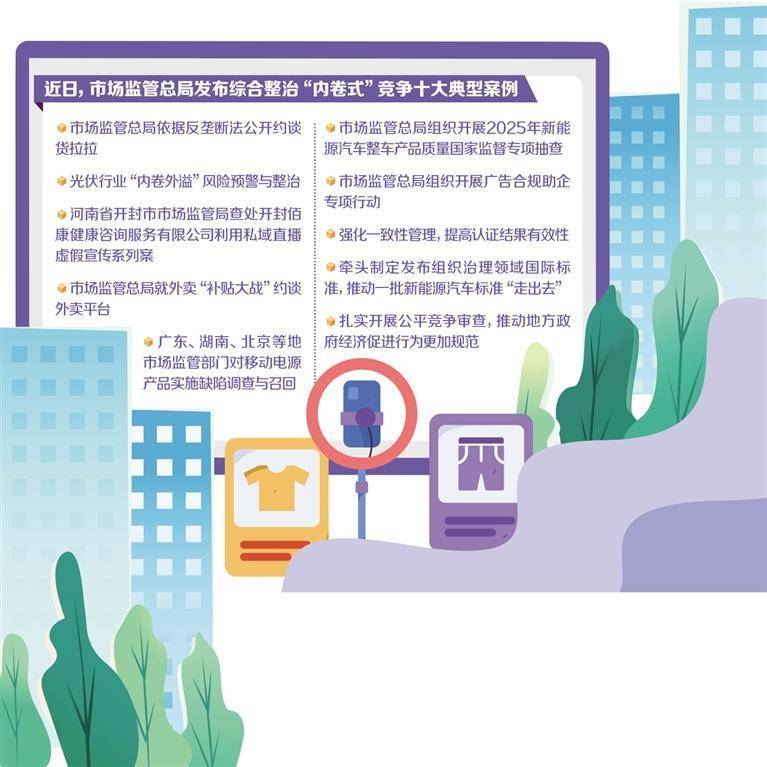
市场监管总局发布综合整治“内卷式”竞争典型案例—— 为治理无序竞争树标杆划重点
Jing Ji Ri Bao· 2026-01-31 22:09
Core Viewpoint - The State Administration for Market Regulation (SAMR) has launched a comprehensive campaign to address "involution" competition across key sectors such as online freight, mobile power banks, new energy vehicles, and photovoltaics, aiming to transform market competition from "disorderly internal consumption" to "quality improvement" [1] Group 1: Online Freight Industry - The online freight industry has seen rapid growth but faces issues such as unreasonable price suppression by platforms, which harms drivers' rights [2] - SAMR has conducted discussions with Huolala, emphasizing compliance with antitrust laws and promoting fair competition to protect drivers and consumers [2] - The goal is to ensure platform rules and algorithms are transparent, allowing competition to return to a fair and rational state [2] Group 2: Mobile Power Bank Industry - The mobile power bank sector has been plagued by safety issues due to price wars, leading to a focus on product quality and safety [2] - In 2025, SAMR oversaw 10 recalls involving 1.3977 million units of mobile power banks, with complaints decreasing by 85% since July 2025 [3] - SAMR plans to enhance recall supervision and enforce strict compliance with defect product recall obligations [3] Group 3: Product Quality Supervision - SAMR emphasizes the importance of strict product quality control to prevent cost-cutting from compromising safety [4] - Mandatory product certification serves as a critical safeguard for quality, with increased random inspections and stringent management of production processes [4] - The agency aims to ensure that production equipment and materials meet quality standards to curb "quality reduction for low prices" [4] Group 4: Fair Competition - Addressing "involution" competition requires not only regulating corporate behavior but also standardizing government intervention to eliminate local protectionism and market segmentation [5] - SAMR is focused on proactive measures, such as early warnings and compliance guidance in the photovoltaic sector, to prevent risks before they escalate [6] - The agency has reviewed 58,000 policy measures to prevent the introduction of policies that hinder fair competition [6] Group 5: Future Directions - SAMR will continue to implement the Fair Competition Review Regulations and strengthen enforcement against the abuse of administrative power to eliminate competition restrictions [7] - The agency aims to foster a unified national market by combining effective market mechanisms with proactive government involvement [7]
住建部:今年将着力稳定房地产市场 能源局:电动汽车充电设施突破2000万个
Xin Lang Cai Jing· 2026-01-26 06:39
Group 1: Real Estate Market - The Ministry of Housing and Urban-Rural Development aims to stabilize the real estate market this year by implementing city-specific and precise policies, supporting reasonable financing needs of real estate companies, and addressing residents' housing demands [1] - Key initiatives include establishing a project company system for real estate development, promoting a main bank system for financing, and implementing a "see what you get" system for the sale of commercial housing [1] Group 2: Market Regulation - The State Administration for Market Regulation reported that in 2025, it urged mobile power production companies to recall 1.3977 million problematic power banks due to safety concerns [2] - The number of complaints regarding mobile power products has decreased by 85% compared to the peak in July 2025, indicating improved consumer satisfaction [2] Group 3: Environmental Initiatives - The Ministry of Ecology and Environment announced the first batch of 23 beautiful rural pilot areas, focusing on ecological protection and rural development [4] - By 2025, rural environmental quality is expected to improve significantly, with over 24,000 administrative villages undergoing environmental remediation [4] Group 4: Transportation Impact - The recent cold wave has led to the closure of 161 sections of national and provincial highways across 14 provinces due to snow and icy conditions [5] Group 5: Electric Vehicle Infrastructure - As of December 2025, the number of electric vehicle charging facilities in China has surpassed 20 million, supporting over 40 million new energy vehicles [6] - The growth rate of charging facilities has accelerated, with the number doubling from 10 million to 20 million in just 18 months [6] Group 6: Robotics Industry - In 2025, over 140 domestic companies have produced more than 330 humanoid robot models, marking a significant advancement in the industry [6] - The Ministry of Industry and Information Technology plans to promote technological innovation and safety in humanoid robots to support the broader development of embodied intelligence [6] Group 7: Telecommunications - China has built 4.838 million 5G base stations, with over 1.2 billion 5G users, establishing the largest and most advanced information infrastructure globally [7] - The first phase of 6G technology trials has been completed, with over 300 key technologies developed, and the second phase of trials has recently begun [7] Group 8: Consumer Market - The total retail sales of consumer goods in 2025 are projected to exceed 50 trillion yuan, with a growth rate of 3.7% [8] - The contribution of final consumption expenditure to economic growth is expected to reach 52%, highlighting its role as a key driver of economic development [8]

特斯拉将终止FSD免费转移|首席资讯日报
首席商业评论· 2026-01-22 04:52
Group 1 - Tesla has announced the termination of its free FSD transfer plan, effective March 31, 2026, aiming to increase the usage rate of FSD features [2] - The minimum down payment ratio for commercial housing loans in 20 cities in Guangdong Province will be adjusted to no less than 30%, effective January 21, 2026 [3] - The 2026 Spring Festival travel period is expected to see record-high inter-regional mobility and passenger volumes in rail and civil aviation, with self-driving remaining the primary mode of travel [4] Group 2 - The State Administration for Market Regulation reported that 1.3977 million problematic power banks were recalled in 2025, with ongoing efforts to strengthen product recall supervision [5] - In 2025, real estate development investment in Henan Province is projected to decline by 8.6%, with residential investment down by 9.6% [6] - Pinduoduo was fined 100,000 yuan for failing to report tax information as required, highlighting the importance of compliance in business operations [7] Group 3 - Great Wall Motors' new vehicle sales reached 1.3237 million in 2025, with over 500,000 units sold in overseas markets, reflecting a year-on-year growth of 11.68% [8] - Xibei Catering Group has secured Series A financing, increasing its registered capital by approximately 13.1% [9] - Douyin reported a 90% decrease in rumor exposure in 2025, thanks to improved rumor detection and management systems [10] Group 4 - Douyin's e-commerce division denied the development of a product called "Dou Sheng Sheng," clarifying that it is part of a local service exploration [11] - New Media Co., Ltd. announced that its co-invested dramas are being released as planned, with revenues to be recognized according to the broadcasting schedule [12] - Taobao and Tmall are upgrading their real experience score system and launching a "Good Service" leaderboard for over 1,000 stores [12]


移动电源投诉量较峰值降低85%
Xin Lang Cai Jing· 2026-01-21 22:38
Core Viewpoint - The market regulatory authorities in Beijing, Guangdong, and Hunan have implemented defect investigations and recalls for mobile power products in 2025, addressing safety issues and significantly reducing consumer complaints by 85% [1][2] Group 1: Defect Investigation and Recall - In 2025, a total of 10 recalls were enforced, involving 1.3977 million units of mobile power products, effectively eliminating numerous safety hazards [1][2] - The recalls were initiated due to multiple incidents of mobile power products catching fire or exploding, prompting a concentrated effort on quality safety [1] Group 2: Industry Challenges - The underlying issue leading to the recalls was identified as a lack of quality control over battery cells, exacerbated by "price wars" and "involutionary competition" within the rapidly developing mobile power industry [1] - The industry's focus on aggressive expansion and cost-cutting has led to neglect in building robust product quality safety systems, resulting in a crisis [1] Group 3: Regulatory Actions and Future Directions - The regulatory authorities are coordinating with provincial agencies to ensure that manufacturers respond to consumer complaints and resolve issues during the recall process [2] - There is an ongoing effort to guide manufacturers towards innovation in quality technology and to shift from "involutionary" competition to healthy competition, establishing a new paradigm for the industry [2] - Future actions will include strengthening recall supervision and increasing efforts in collecting defect information and enforcing compliance with recall obligations [2]
综合治理“内卷式”竞争!2025年十大典型案例发布
Zhong Guo Jing Ji Wang· 2026-01-21 20:57
Core Viewpoint - The State Administration for Market Regulation (SAMR) has announced ten typical cases of "involution" competition for comprehensive rectification by 2025, emphasizing its commitment to combating illegal activities and maintaining fair market order, while promoting quality improvement and healthy industry development [1] Group 1: Regulatory Actions - SAMR has publicly interviewed Huolala based on the Anti-Monopoly Law, implementing a tiered regulatory approach to enhance deterrence and social supervision, effectively protecting market competition and stabilizing driver employment [1] - The market supervision departments in Guangdong, Hunan, and Beijing have conducted defect investigations and recalls for mobile power products, resulting in 139.77 million units being recalled [2] - SAMR has organized a national supervision special inspection for the quality of new energy vehicle products, focusing on models with significant price reductions, conducting six batches of inspections covering 34 specific items [3] Group 2: Industry Guidance - The agency has initiated a special action to enhance advertising compliance awareness among businesses, aiming to guide enterprises away from "involution" competition through effective advertising [3] - SAMR has strengthened consistency management to prevent discrepancies between certified products and actual production, ensuring that low-quality products do not enter the market [3] - The agency has led the development and publication of international standards in organizational governance, promoting over ten international standards in the new energy vehicle sector to shift competition from "involution" to quality [3] Group 3: Fair Competition - SAMR has conducted a thorough review of fair competition, examining 58,000 important policy measures and ensuring compliance to prevent policies that disrupt the unified market and fair competition [4]
向“内卷式”竞争亮剑 市场监管总局公布十大典型案例
Zheng Quan Shi Bao Wang· 2026-01-21 12:48
Core Viewpoint - The State Administration for Market Regulation (SAMR) has announced a comprehensive initiative to address "involutionary" competition by presenting ten typical cases, showcasing its efforts in combating illegal activities, maintaining fair competition, and promoting high-quality industry development by 2025 [1][2]. Group 1: Regulatory Actions and Outcomes - In 2025, SAMR reviewed 58,000 policy measures and modified over 10,000 to prevent the introduction of policies that hinder a unified market and fair competition [1][3]. - SAMR initiated special actions to investigate the abuse of administrative power to eliminate competition, resulting in 96 cases filed and 75 concluded, effectively curbing improper interference in competition [1][5]. Group 2: Sector-Specific Interventions - The ten typical cases span multiple key sectors, including platform economy, new energy, consumer goods, and advertising, reflecting a multi-dimensional approach to tackle "involutionary" competition [2][3]. - In the platform economy, SAMR's actions against Huo La La included public discussions based on the Anti-Monopoly Law, aiming to stabilize driver employment and promote win-win scenarios between platforms and drivers [2][4]. - The solar energy sector is being guided towards innovation-driven growth, moving away from price wars, while the new energy vehicle sector has seen national quality supervision checks focusing on models with significant price reductions [2][3]. Group 3: Consumer Protection and Quality Assurance - In the consumer goods sector, SAMR has cracked down on misleading advertising practices targeting vulnerable groups, such as the elderly, and has enforced recalls of defective products, involving 1.3977 million units [3][4]. - The agency is enhancing compliance awareness among businesses through advertising compliance initiatives, aiming to reduce the incidence of illegal advertising and maintain low rates of violations [3][5]. - SAMR is committed to strengthening product consistency management and enforcing mandatory product certification to safeguard quality standards, with plans for a special action to ensure compliance with recall obligations [5]. Group 4: Future Directions and Strategic Goals - Moving forward, SAMR will intensify efforts to collect defect information and enforce recall obligations for products with quality safety issues, ensuring strict legal actions against non-compliant companies [5]. - The agency plans to refine fair competition review standards and enhance supervision to eliminate local protectionism and market segmentation, thereby promoting a unified national market [5].