离岸金融

Search documents
借鉴国际经验,六方面构建我国离岸人民币市场
Guo Ji Jin Rong Bao· 2025-08-08 11:32
Core Viewpoint - The development of the offshore RMB market can draw lessons from Japan's successful experience in offshore finance, emphasizing a low-profile and pragmatic approach to enhance financial competitiveness and support the internationalization of the RMB [1][4]. Group 1: Japan's Offshore Financial Success - The internationalization of the yen was driven by the establishment of a robust offshore financial market, which transformed the yen from a trade settlement tool to a freely convertible currency [1]. - The revision of Japan's Foreign Exchange and Foreign Trade Act in 1998 eliminated residual foreign exchange controls, significantly enhancing the linkage between offshore and onshore markets [1]. - The offshore yen lending rate (Euroyen LIBOR) and Tokyo interbank offered rate (TIBOR) spread narrowed to within 5 basis points, creating a mechanism for "offshore pricing - onshore transmission" [1]. Group 2: Functions of Offshore Financial Markets - Offshore financial markets serve as a key platform for the three core functions of currency internationalization: payment, investment, and reserve [2]. - Japan's economic layout in South America, particularly in Brazil and Argentina, exemplifies the deep synergy between offshore finance and industrial investment [2]. Group 3: Mechanisms in South America - In Brazil, Japan's investment reached $78 billion in 2023, utilizing a profit repatriation mechanism that aligns local regulations with offshore financial markets [2]. - In Argentina, despite capital controls, Japanese companies established efficient funding channels through "offshore node interconnection" [2]. Group 4: Low-Profile Strategy and Benefits - Japan's low-profile approach in offshore finance has led to macro-financial stability, enhanced micro-enterprise competitiveness, and geopolitical adaptability [3]. - The offshore market acted as a buffer against external shocks, stabilizing foreign exchange reserves and mitigating speculative pressures [3]. - The low-profile development provided Japanese companies in South America with operational advantages, including lower financing costs and improved tax efficiency [3]. Group 5: Lessons for China's Offshore RMB Market - China's offshore RMB market should transition from "policy-driven" to "institution-driven" and "market-driven," focusing on quality competition rather than scale [5]. - The establishment of a "offshore RMB entity label" system can ensure that offshore funds are closely tied to real trade and investment [5]. - A cross-border "trade-logistics-fund flow" big data verification platform can be developed to prevent false trade and arbitrage [5]. Group 6: Asset Pooling and Risk Isolation - Creating a "RMB-foreign exchange dual fund pool" in pilot areas can enhance the efficiency of fund utilization [6]. - The establishment of a multi-tiered RMB safe asset system through regular issuance of offshore central bank bills and government bonds can attract global investors [6]. - Implementing an "electronic fence" for risk isolation can prevent external shocks from affecting onshore markets [6]. Group 7: Tax Neutrality and Legal Framework - A tax system that is neutral and transparent, similar to Japan's, can reduce policy arbitrage in offshore RMB business [7]. - Establishing an "offshore RMB international arbitration center" can ensure that arbitration rules align with international practices while maintaining control over adjudication [7]. Group 8: Gradual and Low-Profile Approach - A gradual and low-profile strategy should be adopted to allow for institutional adjustments without rushing to create an "international benchmark" [8]. - The focus should be on improving foundational systems such as offshore account functions and tax policies in pilot free trade zones [9].
专家解读:海南封关落地进展和新看点
2025-07-28 01:42
Summary of Hainan Free Trade Port Conference Records Industry Overview - The conference discusses the Hainan Free Trade Port (FTP) and its upcoming operational closure scheduled for December 18, 2025, with significant policy changes and infrastructure developments aimed at enhancing trade and investment opportunities in the region [1][4][35]. Key Points and Arguments Hainan Free Trade Port Policies - Hainan FTP will implement a "zero tariff" policy, increasing the proportion of zero-tariff items from 21% to 74%, covering 6,600 tax items including automobiles, cosmetics, and electronics [1][4]. - The tax incentives will extend to all enterprises and non-profit organizations on the island, with a dual 15% income tax policy for both corporate and personal income [1][4]. - The customs declaration process has been simplified, reducing the number of declaration items from 105 to 42, enhancing the efficiency of goods clearance [2][4]. Infrastructure and Logistics - As of July 2025, significant progress has been made in logistics and hardware infrastructure, with eight open ports established, including Haikou Meilan Airport and Sanya Phoenix Airport [2][3]. - The establishment of 64 comprehensive law enforcement points across the island facilitates related declarations and enhances regulatory capabilities [2][3]. Strategic Design and Development Focus - The top-level strategic design includes "one book, three basics, four beams, and eight pillars," aiming for trade and investment liberalization by 2025 and establishing a high-level international free trade port by 2035 [1][11]. - Key development areas include processing manufacturing, trade, offshore finance, and consumption, with policies to support industry upgrades and simplify cross-border capital flow [1][14][17]. Pressure Testing and Market Confidence - Multiple rounds of pressure testing have been conducted to assess system stability and policy feasibility, leading to the optimization of regulatory details and enhancing market confidence [1][9][10]. - The pressure tests focus on policy execution, regulatory alignment, platform stability, and management capabilities [6][7][9]. Challenges and Future Outlook - Future challenges include increased risk management pressures, the need for innovative policy implementation, and heightened international competition [10][21]. - Hainan FTP aims to attract global resources and become a testing ground for domestic and international dual circulation [5][30]. Additional Important Insights - Hainan's unique consumption market is bolstered by its ecological tourism appeal and government initiatives to stimulate consumption, including an increase in duty-free shopping limits [19][20]. - The financial sector in Hainan is expected to benefit from tax incentives and the establishment of a digital RMB pilot area, enhancing cross-border capital flow and financial innovation [27][31]. - The strategic positioning of Hainan as a regional hub for trade with ASEAN and South Asia differentiates it from other free trade ports like Hong Kong, which serves as a global trade benchmark [21][24]. This summary encapsulates the critical developments and strategic initiatives surrounding the Hainan Free Trade Port, highlighting its potential as a significant player in global trade and investment.
离岸金融与人民币稳定币协同发展路径探索
Guo Ji Jin Rong Bao· 2025-07-25 08:07
Core Viewpoint - The development of the Renminbi stablecoin is gaining attention as it is seen as a crucial payment tool in the digital economy, with its internationalization relying on offshore financial systems and the integration of stablecoins [1][7] Group 1: Offshore Financial and Stablecoin Interaction - The global offshore financial market is evolving with a new trend of interaction with stablecoins, characterized by a mature model of "regulatory sandbox + scenario implementation + ecological collaboration" [2] - The Dubai International Financial Centre (DIFC) achieved a 4.8% annualized return with a volatility of only 1.2% in its stablecoin reserve management strategy, showcasing effective risk-adjusted returns [2] Group 2: Asset Appreciation Solutions - The "Bond Connect+" initiative allows up to 20% of Renminbi stablecoin reserves to be invested in a broader range of bonds, enhancing asset appreciation opportunities [3] - The Shanghai Free Trade Zone's "digital asset bonded warehouse" policy reduces custody costs by 50% through zero tariffs and immediate VAT refunds [3] Group 3: Institutional Innovation - The establishment of a flexible regulatory framework is essential for the development of Renminbi stablecoins, focusing on account systems, regulatory models, and legal applicability [4] - The "Reg-as-a-Service" model in Shenzhen has significantly reduced cross-border inspection times from 3 days to 4 hours, enhancing compliance efficiency [4] Group 4: Market Ecosystem Development - A market ecosystem based on liquidity incentives, scenario expansion, and infrastructure connectivity is crucial for the success of Renminbi stablecoins [5] - The Shanghai Futures Exchange's pilot program for "stablecoin margin" allows foreign investors to use CNHT for oil futures, reducing capital costs by 30% [5] Group 5: Global Financial Landscape and Renminbi Internationalization - The ongoing adjustments in the global financial landscape necessitate the support of offshore financial systems for the stable development of Renminbi stablecoins [7][8] - The deep-rooted experience and practices of China's offshore financial system provide a solid foundation for the issuance and management of stablecoins [8] Group 6: Risk Management and Regulatory Framework - A comprehensive risk management framework is proposed, including technological safeguards, liquidity risk prevention, and regular stress testing [10][11] - The establishment of a "last lender" mechanism and a dynamic reserve pool is recommended to mitigate the risk of stablecoin runs [11] Group 7: Policy Recommendations - Suggestions include the creation of a legal framework for offshore digital assets and optimizing foreign exchange management policies to facilitate the cross-border flow of stablecoins [15][16] - The establishment of a "Digital Financial Development Bureau" is recommended to coordinate regulatory efforts across different regions [17]
上海离岸经济功能区:打造全球金融枢纽与人民币国际化窗口
2 1 Shi Ji Jing Ji Bao Dao· 2025-07-23 07:58
Core Viewpoint - The establishment of the Shanghai Offshore Economic Function Zone is a strategic move in response to the profound adjustments in the global financial landscape, aiming to enhance Shanghai's international financial center capabilities and facilitate the internationalization of the Renminbi from "trade settlement" to "reserve currency" [1] Institutional Innovation - The core competitiveness of the Shanghai Offshore Economic Function Zone lies in a regulatory framework that aligns with international practices while incorporating Chinese characteristics, emphasizing "transparent rules + precise regulation" [2] - The zone will implement a "boundary management" approach, allowing foreign capital to flow freely while ensuring that offshore activities do not disrupt the onshore financial system [2] Business Environment Innovation - The average approval time for foreign financial institutions to set up offshore business departments in China is currently 187 days, significantly longer than the 4-week standard in Dubai. The zone aims to reduce this to 30 days through a "commitment system + full-process supervision" [3] - The zone will promote a "multi-currency fund pool + blockchain clearing" model to enhance cross-border settlement efficiency, targeting a significant increase in corporate fund turnover rates by 2025 [3] Tax Policy Design - The zone will adopt a "low tax + strong regulation" policy, proposing a 5% capital gains tax and zero VAT for offshore financial activities, while implementing strict anti-tax avoidance measures [4] - A "tax neutrality + anti-avoidance" mechanism will be established to prevent tax arbitrage and ensure compliance in offshore operations [4] Legal and Regulatory Coordination - A "special legal application zone" will be created to allow international commercial contracts to choose applicable laws, enhancing the legal framework for offshore operations [5][6] - A joint regulatory meeting involving the central bank, foreign exchange bureau, and financial regulatory authorities will oversee offshore financial activities, promoting innovation while managing risks [6] Business Ecosystem - The zone will focus on providing comprehensive services for cross-border trade and investment, particularly for countries involved in the Belt and Road Initiative [7] - The offshore bond market will be a key focus, with targets set for issuance and financing for infrastructure projects by 2026 [8] Internal and External Coordination - The zone will establish a network linking itself with Hong Kong and global nodes, facilitating risk isolation and collaborative value release [12] - A "Shanghai-Hong Kong offshore financial express" mechanism will be implemented to allow for the flow of funds based on real trade backgrounds [13] Risk Prevention - A "prevention-monitoring-disposal" risk control system will be established to mitigate concerns about risk spillover [16] - The zone will implement strict account management to ensure complete separation between offshore and onshore accounts, with rigorous transaction verification processes [17] Ecological Support - The zone will develop a talent system to attract and cultivate international financial professionals, aiming to increase the proportion of foreign talent by 2025 [21] - High-level infrastructure will be enhanced to improve global competitiveness, including the establishment of a global offshore financial data port [22]
聚焦离岸市场与全球声誉,破局上海国际金融中心能级跃升
Di Yi Cai Jing· 2025-07-01 12:00
Group 1 - The construction of Shanghai as an international financial center is supported by national reforms and policies aimed at enhancing its global financial hub status [2][3] - Recent initiatives include the establishment of a growth layer on the Sci-Tech Innovation Board and measures to facilitate cross-border financial services [2][3] - Shanghai aims to become a key hub in the global financial system through high-level financial openness, enhancing the role of RMB assets, and improving its financial ecosystem [3][5] Group 2 - The competition among international financial centers is intensifying, with cities like London, New York, Hong Kong, and Singapore implementing innovative development measures [4][5] - Shanghai's strengths lie in financial development and infrastructure, while its weaknesses include reputation and business environment, indicating a need for soft power enhancement [5] - The establishment of a high-level offshore financial market in Shanghai is crucial for attracting international investments and enhancing the city's financial capabilities [6][7] Group 3 - The development of an offshore financial market in Shanghai requires supportive tax policies and regulatory frameworks to attract foreign institutions [8][9] - Shanghai's offshore market must connect with global markets, including Hong Kong, London, and Singapore, to facilitate RMB transactions and enhance liquidity [9] - The city should focus on creating innovative financial products to meet the needs of international investors and improve its global financial market presence [9][10] Group 4 - To elevate its status as an international financial center, Shanghai needs to establish a more internationalized and innovative corporate structure for listed companies [10][11] - The city should enhance its financial market's reputation by improving transparency and providing authoritative reports on its financial center development [12][13] - A multi-lingual platform for financial information dissemination is essential to attract international investors and improve Shanghai's global recognition [13][14] Group 5 - The cultivation of strategic financial talent is critical for Shanghai's international financial center development, requiring a focus on training and retaining skilled professionals [14][15] - The city should benchmark against top international financial institutions to enhance its competitiveness and governance capabilities [14]
临港试点核心突破:离岸贸易金融服务的三维创新
Guo Ji Jin Rong Bao· 2025-06-23 13:36
Core Viewpoint - The Shanghai Lingang New Area is positioned as a key breakthrough for exploring offshore financial development in China, focusing on three-dimensional innovations in offshore trade financial services [1][7]. Group 1: Innovations in Offshore Trade Financial Services - Establishment of dedicated offshore trade accounts (FTT accounts) allows for cross-border fund transfers in seconds, aiming for a threefold increase in fund turnover rate by 2025 compared to traditional accounts [1]. - Implementation of digital RMB for cross-border settlements, with a target to cover 80% of offshore trade scenarios by 2026 [1]. - Simplification of business processes through blockchain technology, reducing the number of required paper documents from 20 to 3, significantly decreasing verification time from multiple days to seconds [1]. Group 2: National-Level Authenticity Verification Platform - Integration of data from six major systems, including foreign exchange, customs, and taxation, to create a national-level offshore trade authenticity verification blockchain platform, improving verification accuracy from 82% to 99% [2]. - The platform includes a risk heat map for automatic triggering of enhanced due diligence on high-risk transactions, ensuring full traceability of cross-border funds [2]. Group 3: Tax and Service Ecosystem - Upgraded tax incentives for offshore trade enterprises, including exemptions from income tax and VAT for offshore RMB settlement businesses [2]. - Introduction of a comprehensive financial service package, providing financing based on accounts receivable and establishing a service center for offshore trade enterprises [2]. Group 4: Offshore Bond and Multi-Currency Strategy - Legislative measures to establish a regulatory framework for offshore bonds by the end of 2025, enhancing the offshore attributes of these instruments [3]. - Expansion of available currencies in FTT accounts to 19 and signing currency swap agreements with countries like Vietnam and Egypt [3]. - Development of a digital RMB offshore bond lifecycle management platform by 2026, reducing settlement cycles and costs significantly [3]. Group 5: Pricing and Global Capital Attraction - Collaboration with Hong Kong and Singapore to create a RMB offshore bond yield curve, aiming to become a core pricing benchmark by 2030 [4]. - Implementation of tax exemptions for foreign investors in offshore bonds, with plans to introduce RMB offshore bond futures and options by 2026 [4]. Group 6: Institutional and Corporate Engagement - Integration of various account types into a new FT account, with a target increase in non-resident account penetration from 5.9% to 45% by 2026 [5]. - Incentives for state-owned enterprises to use RMB for at least 50% of payments in Belt and Road projects, along with export tax rebates for RMB settlements [5]. Group 7: Infrastructure and Regional Service Enhancement - Development of a global RMB offshore clearing center in Lingang by 2027, with a daily clearing volume target of 50 trillion yuan [6]. - Upgrading CIPS to a platform for both settlement and asset custody, with a goal of 50 trillion yuan in offshore bond custody by 2025 [6]. - Establishing a three-tier service structure to enhance offshore financial services across the Yangtze River Delta region [6]. Group 8: Long-term Vision - The strategy aims to establish Shanghai as a global offshore asset allocation center centered around RMB by 2030, enhancing its status in international financial governance [7].
再论我国开展离岸金融活动的路径探索
Di Yi Cai Jing· 2025-06-08 12:59
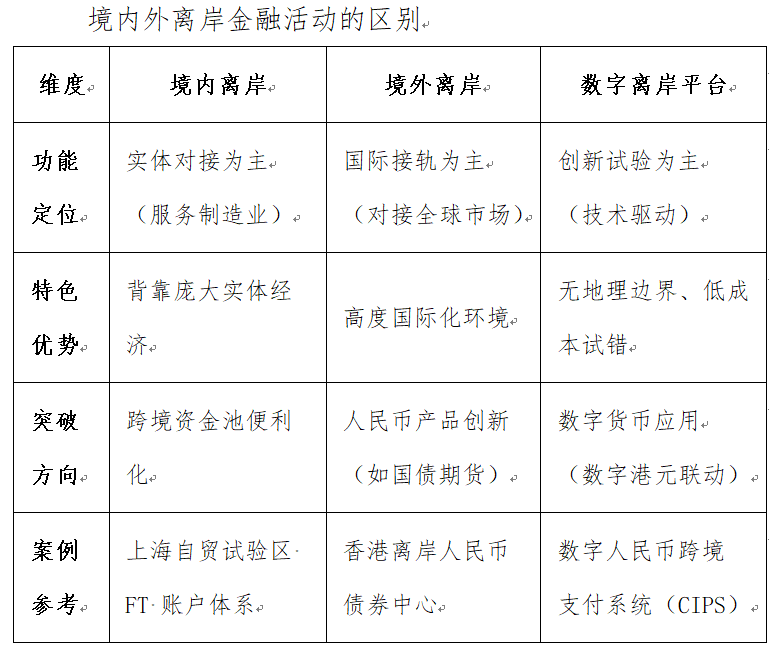
Group 1: Importance of Offshore Finance in China - The necessity of offshore finance activities in China is highlighted as a crucial opportunity to enhance the international financial center's capabilities and support the internationalization of the Renminbi [2] - Offshore finance serves as a significant window for attracting foreign investment and promoting the development of offshore trade and economy, providing domestic enterprises with access to low-cost funding [3] - Offshore finance markets offer a relatively relaxed regulatory environment, fostering financial innovation and reform within domestic financial institutions [4] Group 2: Distinction Between Domestic and International Offshore Finance - Domestic offshore finance activities are defined as those conducted within specific regions in China, targeting non-residents and certain qualified domestic enterprises, thus supporting cross-border trade and financing needs [5] - International offshore finance activities involve Chinese financial institutions or enterprises operating in foreign regions, contributing to the internationalization of the Renminbi and enhancing the global competitiveness of Chinese financial institutions [6][7] Group 3: Integration of Domestic and International Offshore Finance - Emphasis is placed on the integration of domestic and international offshore finance activities, which is essential for the construction of Shanghai as an international financial center and the overall development of China's financial strength [10] - The development of a unified trading platform and clearing system is necessary to facilitate smooth capital, information, and financial product flows between domestic and international markets [10] - The establishment of cross-border risk monitoring and early warning mechanisms is crucial for preventing systemic financial risks and enhancing investor confidence in China's offshore financial markets [10] Group 4: Regulatory Framework and Policy Recommendations - The construction of a transparent regulatory system for offshore funds is vital, with a focus on international cooperation and the establishment of cross-border financial regulatory rules to prevent regulatory arbitrage [12] - Optimizing tax policies for offshore financial activities can lower operational costs for financial institutions and attract more international business and capital inflow [12] - The need for innovative measures such as tax incentives for offshore financial institutions and support for cross-border financial innovation is emphasized to create an attractive offshore financial environment [12] Group 5: Strategic Goals for Offshore Finance Development - The strategic direction for offshore finance development should focus on the integration of domestic and international activities, the unification of currency operations, and the deep integration with the real economy and international trade [13] - Systematic reforms involving institutional innovation, market connectivity, and risk prevention are essential to achieve the goal of becoming a financial powerhouse [13]