移动电源

Search documents
“史上最严”新规来了,我们的充电宝该怎么办?
吴晓波频道· 2025-12-03 00:29
Core Viewpoint - The article discusses the upcoming stringent regulations for power banks in China, highlighting the implications of the new safety standards and the impact on the industry, including potential market consolidation and increased production costs [7][11][31]. Group 1: New Regulations and Standards - The Ministry of Industry and Information Technology (MIIT) is set to implement the "strictest" safety standards for power banks, which will require all power banks to obtain 3C certification by August 2024 [15][19]. - The new standards will lead to an estimated 70% of current production capacity being eliminated due to non-compliance, marking a significant shift in the industry [11][31]. - The new regulations will introduce stricter testing requirements for battery cells, including enhanced safety tests and increased voltage thresholds to mitigate risks of thermal runaway [17][19]. Group 2: Industry Challenges and Safety Concerns - The power bank industry has seen over 700 safety incidents in the past six months, with a notable increase in fire incidents on airplanes, highlighting the urgent need for regulatory intervention [22][20]. - The outsourcing model prevalent in the industry has led to quality control issues, as brands often lack oversight over their supply chains, resulting in safety hazards [27][24]. - Price wars in the market have pressured manufacturers to compromise on safety, with the cost of high-quality battery cells remaining high while retail prices for power banks have significantly dropped [27][28]. Group 3: Market Dynamics and Consumer Behavior - The market share of power banks with 3C certification has increased from 62% to 79% in recent months, indicating a growing consumer awareness of safety standards [28][27]. - Despite potential price increases due to new regulations, consumers are likely to accept slight price hikes for improved quality and safety, as the expected lifespan of power banks will increase from 300 to over 600 cycles [31][32]. - The article emphasizes the importance of consumers recognizing 3C certification and understanding the implications of capacity and charging speed when selecting power banks [32][33]. Group 4: Future Outlook - The power bank industry is expected to continue expanding, with increasing integration into various sectors such as smart homes and electric vehicles, presenting new growth opportunities [37][38]. - The new regulations align with international standards, potentially reducing barriers for Chinese manufacturers in global markets [37][38].


新国标要来了,你可能再也买不到9块9的充电宝了
3 6 Ke· 2025-12-01 00:31
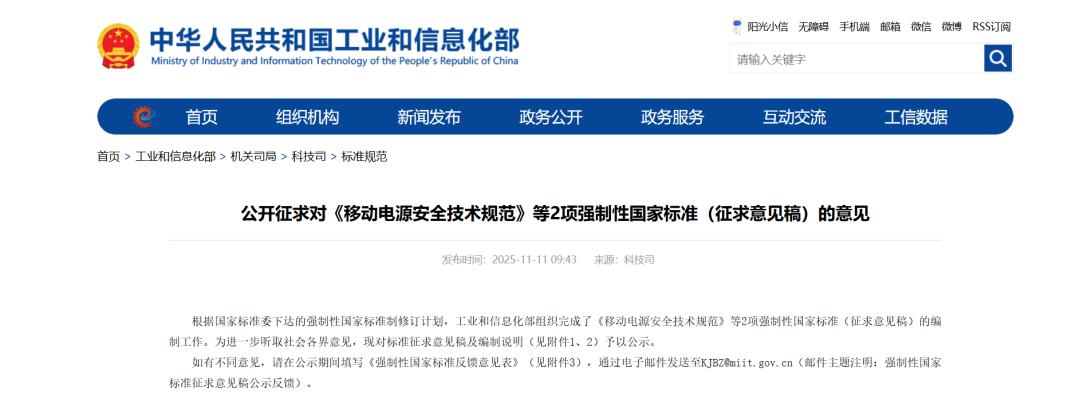
Core Viewpoint - The Ministry of Industry and Information Technology (MIIT) has released a draft for a new national standard specifically for mobile power banks, aiming to enhance safety and regulatory measures in the industry [1][3][40]. Group 1: New Standards and Regulations - The new national standard is tailored specifically for mobile power banks, addressing the entire product lifecycle including raw materials, design, protection testing, and lifespan [10][40]. - The new regulations will impose stricter requirements on the entire device, circuit boards, and battery cells, making it more challenging for products to obtain 3C certification [3][10]. - The introduction of the new standard is expected to phase out low-quality manufacturers and improve industry safety standards [7][40]. Group 2: Technical Specifications - The new regulations require power banks to include a display screen for status information or to transmit this information via Bluetooth [12][15]. - Manufacturers must clearly label production dates and battery material compositions, allowing consumers to avoid outdated stock [17][15]. - The use of second-hand batteries in power banks will be prohibited, and specific material composition ratios for battery cells will be mandated [22][20]. Group 3: Testing and Safety Measures - The new standard includes enhanced testing protocols, such as a needle penetration test where the battery must not ignite or explode when pierced by a tungsten steel needle [29][26]. - The high-temperature testing requirements have been increased, with the temperature raised by 5 degrees Celsius and the duration extended to one hour [29][26]. - Additional testing for circuit board protection has been introduced, requiring dual independent protection mechanisms for power banks [33][31]. Group 4: Consumer Impact - The implementation of the new standard is expected to increase production costs by 20-30%, which may be passed on to consumers [38][40]. - Consumers will benefit from improved safety and transparency, making it easier to assess the quality of power banks based on clear labeling of power ratings and production dates [38][40]. - The new regulations aim to eliminate safety concerns associated with low-cost power banks, enhancing consumer confidence in the products [42][40].
科技周报|史上最严充电宝新规将落地;阿里吴泳铭称三年内AI泡沫不存在
Di Yi Cai Jing· 2025-11-30 02:41
Group 1: Charging Power Bank Regulations - The Ministry of Industry and Information Technology has released a draft for the "Mobile Power Safety Technical Specifications," which is considered the strictest safety standard for power banks [2] - The new regulations introduce rigorous safety tests for battery cells, including puncture tests, thermal abuse tests, and overcharging tests, and mandate the inclusion of an LCD screen or a connected app to display battery health and usage metrics [2] - It is estimated that nearly 70% of existing production capacity may exit the market due to the inability to meet the new technical requirements, and overall industry costs are expected to rise by 20% to 30% [2] Group 2: Meituan's Third Quarter Financial Results - Meituan reported a revenue of 95.49 billion yuan for the third quarter, a year-on-year increase of 2%, but faced an adjusted net loss of 16 billion yuan compared to a net profit of 12.83 billion yuan in the same period last year [3] - The significant profit fluctuation is attributed to increased direct subsidies in the food delivery sector to counter irrational competition [3] - The food delivery industry is returning to rationality, with major competitors like Alibaba and JD reducing their investments in similar areas [3] Group 3: Alibaba's Third Quarter Financial Performance - Alibaba's revenue for the third quarter was 247.8 billion yuan, a 5% year-on-year increase, but operating profit fell by 85% to 5.365 billion yuan [4] - Alibaba Cloud's revenue grew by 34% to 39.824 billion yuan, marking a new high, while AI-related product revenue has seen triple-digit year-on-year growth for nine consecutive quarters [4] - CEO Wu Yongming expressed optimism about the future of AI and indicated that the company may increase its infrastructure investment beyond the previously planned 380 billion yuan [4] Group 4: Investment Trends in AI Technology - The investment logic in the technology sector is shifting from "technology faith" to "value verification," emphasizing the need for a clear market demand for innovations [9] - AI unicorns are facing challenges such as cost overruns and difficulties in monetization, necessitating collaboration between academia and industry to facilitate technology application [9] - Experts suggest that while disruptive technologies may emerge, market-driven logic will become increasingly important in the second phase of AI development [9] Group 5: Semiconductor Developments - Sanan Optoelectronics' subsidiary has successfully launched silicon carbide chips for electric vehicles, marking a significant achievement in domestic automotive semiconductor capabilities [10] - The adoption of these chips by Li Auto indicates recognition of their performance, reliability, and delivery capabilities, which will support the development of high-voltage platform models [10] Group 6: Smart Factory Initiatives - The Ministry of Industry and Information Technology has released a list of 15 companies, including Gree and Haier, recognized for their leading smart factory initiatives [11] - The initiative aims to cultivate a tiered system of smart factories, enhancing China's manufacturing capabilities and establishing benchmarks for intelligent manufacturing [11]
充电宝新标准未定 质量升级箭在弦上
Bei Jing Shang Bao· 2025-11-27 11:08
Core Viewpoint - The upcoming "Mobile Power Safety Technical Specification" may lead to nearly 70% of products in the mobile power industry being phased out, but the standard is still in the consultation phase and will have a transition period after its release, ensuring existing compliant products remain unaffected [1][4]. Industry Overview - The mobile power industry in China is projected to reach a market size of 24.26 billion yuan in 2024, with a year-on-year growth of 5.07%, where power banks account for approximately 52.3% and portable energy storage devices for about 47.7% [5]. - There are over 25,000 registered companies in the mobile power sector, indicating a competitive landscape [5]. Regulatory Developments - The "Mobile Power Safety Technical Specification" is currently in the consultation stage, with requirements outlined for power bank units, circuit boards, and batteries [4]. - The implementation timeline of the new standard, rumored to be February 2026 for release and June 2026 for enforcement, has not been confirmed, but a transition period of 6 to 12 months is expected [4]. Market Transition - Experts predict a shift in the mobile power industry from a "price advantage" to a "value advantage," leading to a market environment focused on quality and reliability [5][6]. - The new regulations are expected to accelerate industry upgrades and transitions, promoting more reliable and stable product technologies [5][6]. Quality Control and Standards - The new standards signify a shift in regulation from basic safety to comprehensive lifecycle quality control, incorporating requirements like cyclic testing and intelligent monitoring [6]. - The upgrade of mobile power standards is expected to have a demonstrative effect on other consumer electronics sectors, encouraging a holistic upgrade towards safety, intelligence, and sustainability [6].
“史上最严”移动电源新标准要来了,充电宝会涨价吗?有商家称:出厂检测越来越严,存在涨价可能
Yang Zi Wan Bao Wang· 2025-11-26 13:52
Core Viewpoint - The new regulations for mobile power banks, described as the "strictest ever," are set to significantly increase manufacturing costs and potentially retail prices, while enhancing safety standards and product longevity [1][8]. Industry Overview - The Ministry of Industry and Information Technology has organized multiple meetings to discuss the draft of the "Mobile Power Safety Technical Specifications," indicating a move towards stricter regulations in the industry [1][3]. - The new standards will require detailed product labeling, including battery material composition, production date, and recommended safety usage period, which are more stringent than previous requirements [4][5]. Cost Implications - Industry insiders estimate that compliance with the new standards will increase the overall manufacturing cost of power banks by approximately 30% [1][8]. - Despite potential price increases, experts believe that the higher costs may be acceptable to consumers due to the improved safety and longevity of the products, with expected lifespans increasing from 300 to over 600 charge cycles [8]. Safety Enhancements - The new regulations mandate that mobile power banks must have intelligent management systems to ensure safety throughout their lifecycle, addressing common issues such as overheating and short-circuiting [6]. - The standards aim to prevent incidents like fires and explosions under various adverse conditions, reinforcing the focus on consumer safety [6]. Transition Period - The new standards are currently in the consultation phase and will have a transition period of 6 to 12 months post-implementation, allowing manufacturers to adapt [7]. - Existing products that have already received CCC certification will not be affected by the new regulations, ensuring that consumers can continue to use their current devices without concern [7].
中泰期货晨会纪要-20251126
Zhong Tai Qi Huo· 2025-11-26 01:42
Report Industry Investment Rating No relevant information provided. Core Viewpoints of the Report - The global economic and political situation is complex, with multiple factors influencing various markets. The end of the Russia-Ukraine conflict, US policies on AI and energy, and China's economic policies all have an impact on different industries [8][9][10]. - Different industries are in different states, with some facing supply - demand imbalances, price fluctuations, and policy - related uncertainties. For example, the steel and coal industries are affected by production policies and demand changes, while the agricultural and energy - chemical industries are influenced by factors such as weather, international relations, and seasonal demand [17][19][40]. Summary by Relevant Catalogs Macro Information - Trump's team has made progress in the Russia - Ukraine peace plan, and an envoy will meet with Putin. Ukraine hopes for Zelensky's early visit to the US to finalize the agreement [8]. - China - US leaders' call is positive for bilateral relations. China will hold a policy briefing on promoting consumer goods consumption [8]. - Alibaba's 2026 fiscal second - quarter revenue increased by 5% year - on - year, but adjusted net profit decreased by 72%. China promotes commercial aerospace development, and a new mobile power standard is expected to be released next year [9]. - Trump launches the "Genesis Mission" to promote AI innovation. The US had a large budget deficit in October due to the government "shutdown". The selection of the Fed chairman is in the final stage [10]. - US inflation rebounded in September, and retail sales growth slowed. Local government special bonds are being issued for investment funds [11]. Macro Finance - **Stock Index Futures**: Adopt a volatile mindset and temporarily wait and see. A - shares rebounded, but the market showed signs of weakness in the afternoon. The selection of the Fed chairman may affect the market, and the short - term decline may lead to a possible rebound, but the index's anti - fragility is insufficient [13][14]. - **Treasury Bond Futures**: Maintain a bullish view on the bond market. The central bank's monetary policy may be further strengthened, and attention should be paid to the central bank's bond - buying in November and exchange rate changes [15]. Black - **Steel and Ore**: In the short term, expect volatility or a rebound; in the medium - to - long term, maintain a bearish view on rallies. Pay attention to macro - policies and the demand and supply situation. Currently, real estate demand is weak, while some industrial demand shows improvement. Steel mills' profits are low, and inventory is relatively high [17][18]. - **Coal and Coke**: Prices may continue to be weakly volatile in the short term. Coal production may be affected by safety regulations and environmental factors, and the potential negative feedback from weak steel demand restricts prices [19][20]. - **Ferroalloys**: The silicon - iron may be a better long - term investment option compared to manganese - silicon. Currently, the silicon - iron has a stronger marginal change in fundamentals at low prices, and there is a possibility of more significant production cuts [21]. Non - ferrous Metals and New Materials - **Zinc**: Hold short positions at high levels. Zinc prices are in a volatile downward trend with possible rebounds, affected by macro factors and inventory changes. Domestic processing fees are falling, and downstream demand is cautious [24]. - **Lead**: Hold short positions cautiously. Lead prices are weakly volatile, and social inventory is decreasing due to supply shortages in some regions. Import trading is not active [25]. - **Lithium Carbonate**: In the short term, it will be strongly volatile. Although there are signs of weakening demand in the short term, long - term demand is still positive, attracting funds [27]. - **Industrial Silicon**: Continue to trade in a range. Supply and demand are in a weak balance, and the valuation is relatively low, with limited downward adjustment space [27]. - **Polysilicon**: Trade in a range and buy on dips. The supply - demand contradiction is weaker than the policy - expectation contradiction, and the spot price is firm [28]. Agricultural Products - **Cotton**: Trade in a low - level range. Supply pressure and weak demand coexist, but high costs resist price declines [30]. - **Sugar**: The price trend is bearish, but cost support limits the decline. Global sugar supply is expected to be in surplus, and domestic new - sugar supply is increasing [32]. - **Eggs**: The spot price may be weak, and the near - month futures contract is under pressure. The long - term outlook is positive due to the decline in laying - hen inventory, but the short - term supply pressure remains high [33][34]. - **Apples**: The price trend is strongly volatile. The acquisition season is over, and inventory and consumption will affect future prices [34][35]. - **Corn**: Temporarily wait and see. The current price increase is due to supply - demand mismatch, and there may be a correction in the future, but the decline space is limited [36]. - **Jujubes**: Temporarily wait and see. The production - area prices are stable, and the sales - area prices have increased slightly [37]. - **Pigs**: In the short term, the supply pressure is increasing, and the price is weakly volatile. In the long term, the decline in sow inventory is beneficial to future prices [37][38]. Energy and Chemicals - **Crude Oil**: Consider shorting on rallies. The end of the Russia - Ukraine conflict may lead to a more significant supply - demand imbalance, and the long - term price trend is downward [40]. - **Fuel Oil**: The price will follow the trend of crude oil. The supply is loose, and the demand is weak, and the focus is on the impact of sanctions on Russia [42]. - **Plastic**: Adopt a weakly volatile mindset. The supply pressure is high, but production losses may provide some support [42][43]. - **Rubber**: Pay attention to Southeast Asian weather. The domestic supply is decreasing, and the price is in a volatile range [44]. - **Synthetic Rubber**: The price is weakly volatile in the short term, and there is downward pressure in the long term [45]. - **Methanol**: In the near - term, adopt a weakly volatile mindset; in the long - term, wait for a rally to go long. The supply pressure is high, and the impact of imports needs to be observed [46][47]. - **Caustic Soda**: Adopt a volatile mindset. The spot price is weak, but low futures prices and few warehouse receipts may provide some support [48]. - **Asphalt**: The price fluctuation may increase. Pay attention to the end of the demand season, refinery production changes, and international oil supply [49]. - **Polyester Industry Chain**: The price will follow the cost trend and is expected to be weakly volatile. Although the supply - demand structure has improved marginally, the cost support is weak [50]. - **Liquefied Petroleum Gas**: The short - term strength may turn weak. The supply is abundant, and the impact of the decline in oil prices needs to be considered [51]. - **Paper Pulp**: Enter a range - bound stage. The supply is expected to increase, and the demand is stable, so it is recommended to wait and see [51]. - **Logs**: The price is under pressure. The inventory is expected to increase, and the market is in a weak balance [52]. - **Urea**: The spot price may be weakly volatile, and the futures market may experience short - term basis regression [53].
“史上最严”充电宝安全标准曝光,3C认证全面失效,近七成现有产能面临淘汰!预计12月公示,2026年2月正式发布
Ge Long Hui· 2025-11-25 05:03
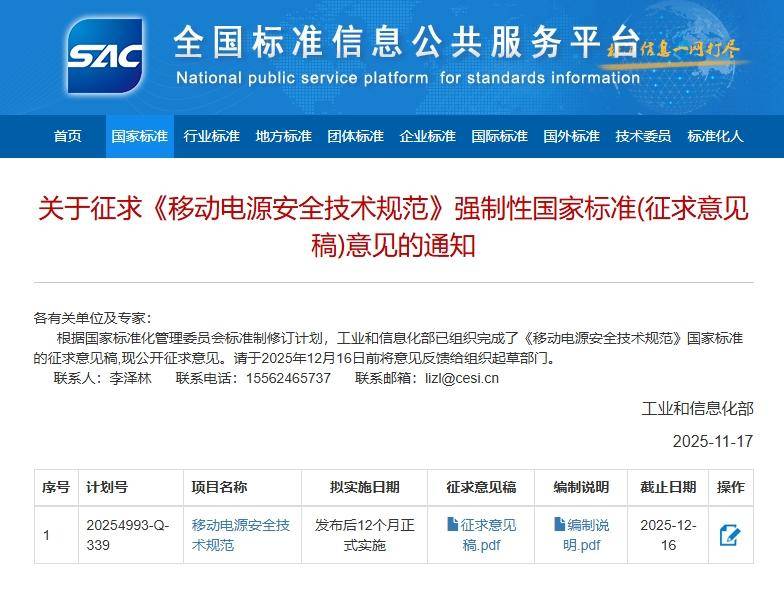
Core Insights - The introduction of the "strictest" power bank safety standards is set to reshape the industry landscape, with significant implications for manufacturers [1] Industry Developments - The Ministry of Industry and Information Technology (MIIT) has held multiple meetings in October and November regarding the draft of the "Mobile Power Safety Technical Specifications" [1] - The new national standards propose dozens of stringent improvements in three key technical areas: overall device, circuit board, and battery cell [1] - Industry representatives have indicated that many factories may struggle to meet these new standards, with MIIT emphasizing that only compliant manufacturers will be allowed to continue production [1] Market Impact - It is estimated that nearly 70% of existing production capacity may be forced to exit the mobile power market due to inability to meet the new technical requirements [1] - The new regulations are expected to be publicly announced in December, officially released in February 2026, and implemented by June 2026, rendering the previous 3C certification regulations obsolete [1]
“史上最严”充电宝新规将落地
Di Yi Cai Jing Zi Xun· 2025-11-25 03:45
Core Viewpoint - The introduction of the "strictest" power bank safety standards is set to reshape the industry landscape, with significant implications for manufacturers and market dynamics [2] Group 1: New Standards Overview - The Ministry of Industry and Information Technology (MIIT) has organized multiple discussions regarding the "Mobile Power Safety Technical Specifications," with a draft expected to be finalized by December 2023 and officially implemented by June 2026 [2][4] - The new standards introduce numerous stringent requirements across three main technical areas: the complete device, circuit board, and battery cell, which many manufacturers may struggle to meet [2][3] Group 2: Technical Changes - The new regulations require the product casing to display the "recommended lifespan" and the full name of the OEM, enhancing product traceability and market transparency [3] - Circuit boards must now include an LCD screen or a connected app to provide real-time data on battery health and usage, transitioning power banks from opaque devices to transparent smart products [3] - In the battery cell category, the new standards implement rigorous safety tests, including more stringent puncture tests and increased thermal abuse testing conditions, aimed at reducing the risk of thermal runaway [3] Group 3: Market Impact - It is estimated that nearly 70% of existing production capacity may be forced to exit the mobile power market due to the inability to comply with the new technical requirements [2] - A six-month grace period will be provided for products already certified under the old 3C standards to clear inventory, with some products potentially being sold in lower-end markets such as Africa and Latin America [4] - Products already sold to consumers can continue to be used, but unsold items must be sold or withdrawn from the market before the new regulations take effect [4]
“史上最严”充电宝新规将落地
第一财经· 2025-11-25 03:35
Core Viewpoint - The introduction of the "strictest" power bank safety standards is set to reshape the industry landscape, with significant implications for manufacturers and market dynamics [3]. Group 1: New Regulations Overview - The Ministry of Industry and Information Technology (MIIT) has organized multiple discussions regarding the draft of the "Mobile Power Safety Technical Specifications," indicating a rigorous update compared to previous standards [3]. - The new regulations will be officially released in December 2025, with implementation starting in June 2026, rendering existing 3C certification invalid [3][5]. Group 2: Technical Changes - The new standards introduce stringent requirements across three main technical areas: the complete device, circuit board, and battery cell, with numerous improvements aimed at enhancing safety and transparency [3][4]. - The complete device must now display the "recommended lifespan" and the full name of the manufacturer, improving product traceability and consumer awareness [4]. - Circuit boards are required to include an LCD screen or a connected app to provide real-time data on battery health and usage, transitioning power banks from opaque devices to transparent smart products [5]. Group 3: Safety Testing Enhancements - The new regulations implement several rigorous safety tests for battery cells, including an increase in the puncture test severity and extending thermal abuse testing conditions [5]. - The overcharging voltage requirement has been raised to 1.4 times the specified voltage, directly addressing battery safety and aiming to mitigate thermal runaway risks [5]. Group 4: Market Impact and Transition - It is estimated that nearly 70% of existing production capacity may exit the mobile power market due to the inability to meet the new technical requirements [3]. - A six-month grace period will be provided for products already certified under the old 3C standards to clear inventory, with some products potentially being sold in lower-end markets [5]. - Products already sold to consumers can continue to be used, but unsold inventory must be sold or withdrawn from the market before the new regulations take effect [5].
史上最严充电宝新规将落地
财联社· 2025-11-25 02:19
Core Viewpoint - The introduction of the new mobile power safety standards is expected to significantly reshape the industry landscape, with many existing manufacturers likely to exit the market due to inability to meet the stringent requirements [3][4][10]. Industry Standards and Regulations - The Ministry of Industry and Information Technology (MIIT) has organized multiple workshops to finalize the "Mobile Power Safety Technical Specifications," with the new standards set to be published in December 2023 and implemented by June 2026 [3][6]. - The new regulations will require clear labeling of product lifespan and manufacturer details, enhancing product traceability and market transparency [6][7]. - Key improvements include mandatory LCD screens or app connectivity for real-time battery health monitoring, and stricter safety tests for battery cells, such as increased temperature and voltage thresholds [6][7]. Impact on Market Dynamics - It is estimated that nearly 70% of current production capacity may be forced to exit the mobile power market due to the inability to comply with the new standards [4][10]. - A six-month grace period will be provided for existing products to clear inventory, with unsold items needing to be sold or withdrawn from the market before the new regulations take effect [7][8]. Cost Implications - Manufacturing costs are projected to rise by approximately 30% as companies invest in R&D, production upgrades, and compliance testing to meet the new standards [9][12]. - Despite the cost increase, the expected lifespan of new products will improve significantly, potentially reducing the unit cost of usage for consumers [12]. Industry Transformation - The new standards are seen as a catalyst for a structural transformation in the industry, pushing it towards higher quality and safety standards [9][10]. - Companies with strong R&D capabilities are adapting and innovating to meet the new requirements, while smaller firms may struggle to survive or pivot to less demanding markets [11][12].