
航空航天等

Search documents
法国企业将向本土新增投资92亿欧元
Xin Hua Wang· 2025-11-18 10:10
Group 1 - The French government announced that domestic companies will invest an additional €9.2 billion, focusing on sectors such as data centers [1] - The "Choose France" summit aims to attract investment and create jobs, with the event being held annually since 2018 [1] - Approximately 200 French companies and related industry associations participated in the summit, covering sectors like energy, agriculture, healthcare, chemicals, and aerospace [1] Group 2 - The total investment in France for the year is projected to reach €30.4 billion, with 151 investment projects planned [1] - The new investments are primarily directed towards energy and environment, digital technology, healthcare, and chemicals and new materials [1] - The largest single investment comes from the French telecom operator, Opticore, which plans to invest nearly €4 billion to build a data center on the site of a former power plant in Seine-et-Marne [1]
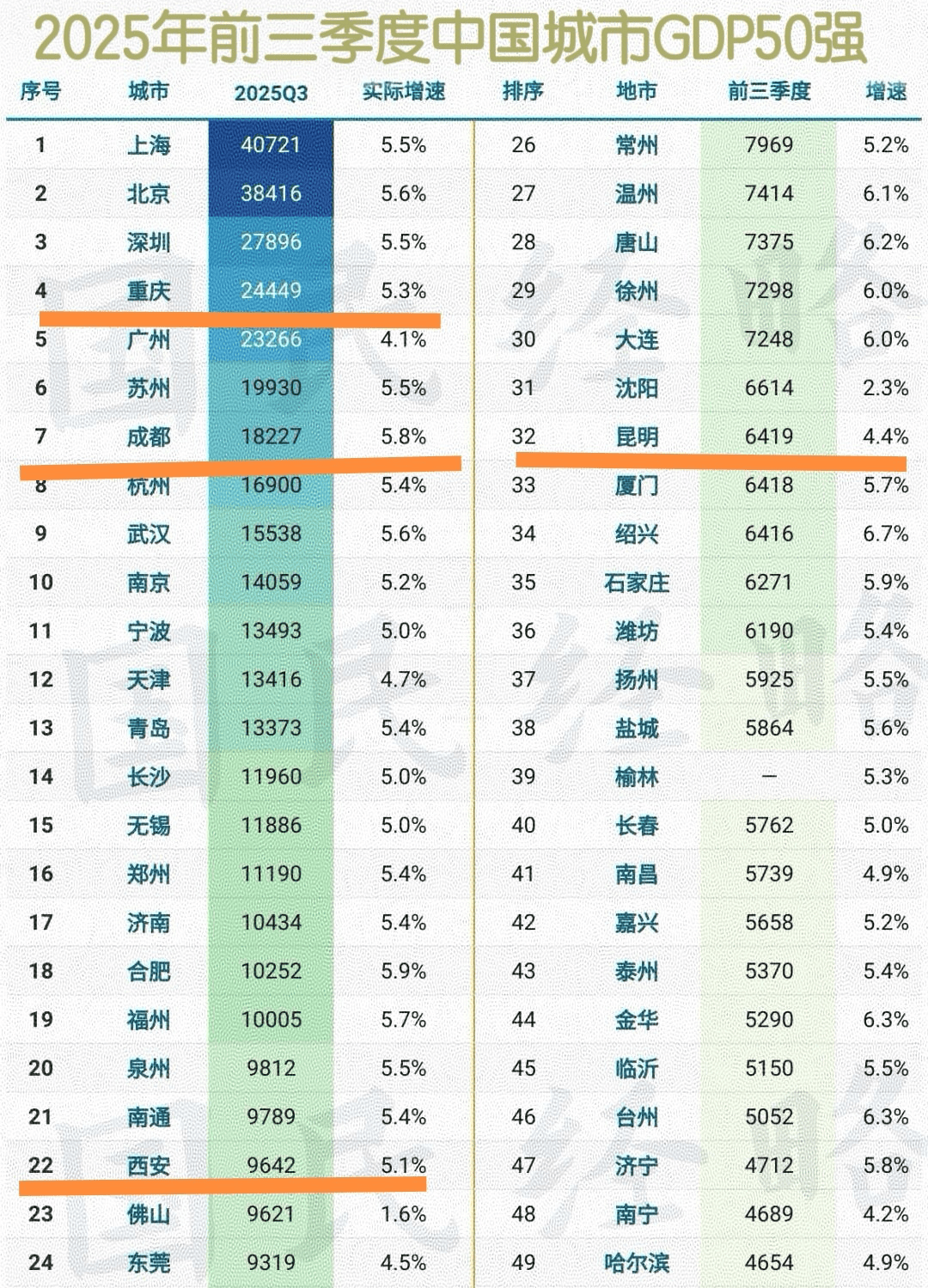
2025前三季度GDP50强揭榜:重庆稳压广州,西部仅4城入围,区域差距何解?
Sou Hu Cai Jing· 2025-11-16 04:01
Core Insights - The GDP rankings of China's top 50 cities for the first three quarters of 2025 reveal a continued economic disparity, with Shanghai, Beijing, and Shenzhen occupying the top three positions, while Chongqing maintains its fourth place, significantly ahead of Guangzhou [1][3] Group 1: Economic Performance - Shanghai leads with a GDP of 40,721 billion, growing at 5.5% [2] - Beijing follows with a GDP of 38,416 billion, showing a growth rate of 5.6% [2] - Shenzhen ranks third with a GDP of 27,896 billion, also growing at 5.5% [2] - Chongqing's GDP stands at 24,449 billion, with a growth rate of 5.3%, while Guangzhou's GDP is 23,266 billion, growing at 4.1% [2][3] Group 2: Regional Disparities - Over 70% of the top 50 cities are located in the eastern and coastal regions, highlighting the economic vitality of these areas [4] - Only four cities from the western region—Chongqing, Chengdu, Xi'an, and Kunming—made it to the top 50, with most rankings in the lower tier [4][5] - The eastern provinces, such as Jiangsu and Guangdong, dominate the list with 9 and 7 cities respectively, showcasing their economic strength [4] Group 3: Challenges in the West - The limited number of western cities in the rankings reflects challenges in industrial structure and population attraction [5] - Many western cities still rely on traditional resource-based industries, leading to insufficient growth momentum [5] - Population outflow is a significant issue, as cities like Xi'an and Kunming struggle to attract talent compared to eastern second-tier cities [5] Group 4: Future Strategies for the West - To narrow the gap with the east, western cities need to focus on three key areas: accelerating industrial upgrades, enhancing open cooperation, and optimizing talent policies [6] - The rise of Chongqing and Chengdu indicates potential for western cities, but innovation and openness are crucial for future competitiveness [6]

从仅生产零部件 到生产新品整机销往全球“进博红利”迸发 外企持续加仓江苏
Xin Hua Ri Bao· 2025-11-07 23:20
Core Insights - The article highlights the increasing investment and commitment of foreign companies in Jiangsu, China, particularly following the China International Import Expo (CIIE) [1][2][3][4][5][6][8] - It emphasizes the transformation of foreign enterprises from merely producing goods to establishing deep-rooted partnerships and ecosystems in Jiangsu, showcasing a shift in investment strategy [8] Group 1: Investment Growth - DuPont has significantly expanded its operations in Zhangjiagang, establishing an integrated production base for automotive adhesives, which began with an investment agreement at the first CIIE in 2018 [2] - Kärcher has invested 100 million yuan in Suzhou to create a global R&D center, focusing on innovations in battery and robotics, which commenced operations in 2023 [3] - AstraZeneca announced the expansion of its Qingdao base, complementing its existing facilities in Wuxi and Taizhou, solidifying its presence in China [3] Group 2: Innovation and Manufacturing - Zeiss has transitioned its Suzhou factory to produce high-end microscopes, becoming a crucial manufacturing hub for global distribution, reflecting a shift from basic to advanced manufacturing capabilities [4][5] - Schneider Electric's Wuxi factory achieved net-zero emissions ahead of schedule, highlighting the effectiveness of local manufacturing and innovation [5] - Cargill's capability development center in Nanjing has evolved over ten years into a key operational hub for its North Asia business [5] Group 3: Local Partnerships and Ecosystems - Siemens has intensified its collaboration with Jiangsu, focusing on open scenarios, talent development, and ecosystem co-creation, indicating a deeper commitment to local integration [6] - GE Aviation has invested an additional $8.5 million in its Suzhou facility to enhance production capabilities for civil aviation engine components, demonstrating a long-term strategy in the Chinese market [7] - Schott has established a new production line in Suzhou for automotive safety components, aiming to strengthen local supply chains and foster innovation [7] Group 4: Strategic Evolution - Foreign companies are evolving from a model of global business coordination to one of local ecosystem integration, with the CIIE acting as a catalyst for these strategic shifts [8]
马斯克能否赢得“万亿薪酬”,即将揭晓
Xin Lang Cai Jing· 2025-11-06 00:16
Core Viewpoint - Tesla's upcoming annual shareholder meeting will focus on the vote regarding CEO Elon Musk's proposed 10-year compensation plan, which could potentially yield him up to $1 trillion in income, raising questions about traditional corporate governance rules and Musk's influence on the company [2][3]. Group 1: Compensation Proposal - Musk has threatened to resign if shareholders do not approve the compensation plan, which is seen as a referendum on his role within Tesla [2]. - The proposal includes ambitious targets such as increasing Tesla's market value to $8.5 trillion and delivering 20 million vehicles, which would allow Musk to control nearly 29% of the company [3]. - Supporters argue that the plan ties Musk's compensation to performance metrics, ensuring he only receives rewards after creating shareholder value [4]. Group 2: Shareholder Concerns - Major shareholders, including CalPERS and Norway's sovereign wealth fund, have raised concerns about the scale of the compensation plan, potential dilution of shares, and increased reliance on Musk, which could weaken shareholder influence [4]. - The current voting progress shows about 80% participation, with over 55% in favor of the proposal as of November 5 [4]. Group 3: Leadership Risks - Analysts note that Tesla's stock and sales have fluctuated with Musk's focus on other projects, indicating the importance of his leadership to the company's valuation [5]. - There is a warning that if the compensation proposal is rejected, Tesla's stock could drop by over 10%, reflecting a lack of confidence in Musk's leadership [7]. - The board is preparing for a succession plan in case Musk leaves, with potential internal candidates being considered for a smooth transition [6].


摩根大通将韩国Kospi目标点位上调至5,000点
Ge Long Hui A P P· 2025-10-28 23:58
Core Viewpoint - Morgan Stanley has raised the 12-month benchmark target for the Korea Composite Stock Price Index (Kospi) to 5000 points, suggesting to accumulate on dips [1] Group 1: Market Outlook - Despite recent gains, the valuation of the Kospi remains lower than regional and global peers based on price-to-earnings and price-to-book ratios [1] - In an optimistic scenario, the target for the index could reach 6000 points [1] - The Kospi closed at 4010.41 points on Tuesday [1] Group 2: Stock Recommendations - Morgan Stanley's preferred stocks include Samsung Electronics, SK Hynix, and Hanwha Aerospace [1] - The least favored stocks are Elltrion, Kakao, and Posco Future M [1] Group 3: Investment Strategy - The Korean market is still considered Morgan Stanley's top overweight market in the Asia region [1]
无事不扰!683家“白名单”企业“轻装上阵”
Nan Jing Ri Bao· 2025-10-09 03:52
Core Points - The AEO (Authorized Economic Operator) system in Nanjing has been implemented to reduce administrative burdens on enterprises, allowing them to focus on core operations and improve production efficiency [1][2][5] - A total of 683 enterprises have been included in the "white list" and will enjoy reduced inspection frequencies for 175 low and medium-risk administrative checks over the next three years [2][5] - The AEO system aims to streamline administrative checks by implementing a cross-departmental, graded inspection approach, enhancing efficiency and reducing the frequency of inspections for compliant enterprises [2][4][7] Group 1: AEO System Implementation - The AEO system is the first of its kind in the industrial sector in Jiangsu province, aimed at optimizing the business environment and reducing unnecessary administrative checks [2][6] - The system categorizes enterprises based on their compliance history, with the first batch of enterprises having no significant safety or environmental violations in the past three years [3][5] - The initiative is supported by various government departments, including public security, human resources, and market regulation, to ensure a comprehensive approach to regulatory oversight [2][4] Group 2: Benefits for Enterprises - Companies like Jiutian High-Tech have reported significant reductions in inspection frequency and a shift from on-site checks to self-assessments, allowing for better resource allocation [1][5] - The AEO system has introduced a "one-stop" inspection model, reducing the administrative burden and allowing enterprises to focus on innovation and operational efficiency [4][5] - The initiative is expected to enhance the market competitiveness of enterprises by providing them with a "credit card" that simplifies processes in administrative approvals and financial support [6][7] Group 3: Future Developments - The Nanjing government plans to dynamically adjust the list of AEO enterprises every six months and will continue to promote the system to more non-chemical industrial enterprises [8] - Ongoing policy promotion activities are being conducted to ensure that more enterprises are aware of the AEO system and can benefit from reduced inspection frequencies [7][8]
“家底”更厚、“智造”更强!数说央企高质量发展成果
Yang Shi Xin Wen· 2025-09-17 04:55
Core Insights - The State-owned Assets Supervision and Administration Commission (SASAC) reported significant progress in the high-quality development of central enterprises during the "14th Five-Year Plan" period, highlighting effective investment expansion and technological innovation [2][3]. Investment and Financial Performance - Central enterprises' total assets increased from less than 70 trillion yuan to over 90 trillion yuan, with total profits rising from 1.9 trillion yuan to 2.6 trillion yuan, achieving average annual growth rates of 7.3% and 8.3% respectively [3]. - Cumulative fixed asset investment by central enterprises reached 19 trillion yuan from 2021 to 2024, with an average annual growth rate of 6.3% [4]. Technological Innovation - Central enterprises have made significant advancements in innovation, with R&D expenditure exceeding 1 trillion yuan for three consecutive years, and the investment intensity rising from 2.6% to 2.8% [3]. - A number of critical core technologies in fields such as integrated circuits and industrial software have been successfully developed, contributing to national pride and confidence [2]. Strategic Focus and Industry Development - Central enterprises have focused on nine strategic emerging industries and six future industries, with cumulative investments in these areas reaching 8.6 trillion yuan, significantly higher than during the "13th Five-Year Plan" [5]. - By 2024, revenue from strategic emerging industries is expected to exceed 11 trillion yuan, with contributions to overall revenue increasing by 8 percentage points over the past two years [5]. Digital Transformation and Sustainability - The "AI+" initiative has led to the establishment of over 800 application scenarios, and the digital transformation efforts have resulted in the creation of 1,854 smart factories [3]. - Energy consumption per unit of output and carbon emissions per unit of output have decreased by 12.8% and 13.9% respectively, indicating a shift towards high-end, intelligent, and green development [3].
国资委:截至目前,央企控股上市公司市值超22万亿,较“十三五”末增长近50%
Sou Hu Cai Jing· 2025-09-17 03:21
Core Insights - The central enterprises in China are achieving high-quality development during the "14th Five-Year Plan" period, with significant growth in assets and capital equity, alongside improved operational efficiency [3][4][5] Group 1: Stability in Development - The total assets of central enterprises increased from 68.8 trillion yuan at the end of the "13th Five-Year Plan" to an expected 91 trillion yuan by the end of 2024, with an average annual growth rate of 7.3% [3] - The state-owned capital equity rose from 14.2 trillion yuan to 18.3 trillion yuan, with an average annual growth rate of 6.5% [3] - The value added and total profits generated by central enterprises are expected to grow by 40% and 50% respectively compared to the "13th Five-Year Plan" period [3] Group 2: Investment and Market Performance - From 2021 to 2024, central enterprises are projected to complete a total fixed asset investment of 19 trillion yuan, with an average annual growth rate of 6.3% [4] - The market capitalization of centrally controlled listed companies exceeded 22 trillion yuan, nearly a 50% increase since the end of the "13th Five-Year Plan" [4] - Central enterprises have implemented cash dividends totaling 2.5 trillion yuan since the beginning of the "14th Five-Year Plan," contributing to the stability of the capital market [4] Group 3: Contribution to Economic Stability - Central enterprises are responsible for approximately 80% of crude oil, 70% of natural gas, and 60% of electricity supply in China, playing an irreplaceable role in energy security and logistics [5] - They have an average annual procurement volume exceeding 15 trillion yuan, directly impacting around 2 million businesses and indirectly affecting nearly 7 million [5] - Central enterprises are creating a favorable environment for the development of upstream and downstream enterprises, including small and medium-sized enterprises, through project cooperation and timely payments [5] Future Directions - The focus will remain on high-quality development, with efforts to strengthen and optimize state-owned capital and enterprises, enhancing their role in national economic and social development [6]
“十四五”以来我国发布先进制造国家标准4000余项—— 以先进标准引领制造业高质量发展
Jing Ji Ri Bao· 2025-09-06 22:08
Core Insights - The National Market Supervision Administration has released over 4,000 national standards since the start of the 14th Five-Year Plan, significantly contributing to the construction of a modern industrial system and ensuring the stability of key industrial supply chains [1] - Advanced manufacturing standards are crucial for promoting high-quality development in the manufacturing sector, reducing industry costs, ensuring product quality, enhancing international trade, and improving corporate competitiveness [1] - The establishment of national standards in intelligent manufacturing and new energy vehicles has positively impacted production efficiency and cost reduction [1][2] Group 1: Advanced Manufacturing Standards - The standards in intelligent manufacturing have led to the establishment of over 30,000 basic intelligent factories, 1,200 advanced intelligent factories, and 230 excellent intelligent factories [2] - The average product development cycle in excellent intelligent factories has been shortened by 28.4%, production efficiency has increased by 22.3%, defect rates have decreased by 50.2%, and carbon emissions have been reduced by 20.4% [2] Group 2: Future Industry Standards - The establishment of standardization technical organizations for future industries such as synthetic biology and drones is underway, promoting collaboration among technology organizations, universities, industry associations, and enterprises [3] - By 2027, the goal is to develop over 100 new standards for future industries, enhancing the standard system [3] Group 3: International Standards and Competitiveness - During the 14th Five-Year Plan, China has taken on 26 secretariat positions in international standard organizations and proposed 880 international standard proposals in key areas such as new energy vehicles and aerospace [4] - The conversion rate of advanced applicable international standards to national standards exceeds 90%, enhancing the competitiveness of Chinese products in international markets [4] Group 4: Future Directions - The National Market Supervision Administration plans to guide more technological achievements into international standards and focus on key areas for manufacturing transformation and upgrading [5] - There is an emphasis on updating and revising over 4,000 national standards in areas such as artificial intelligence, the Internet of Things, and high-end equipment [5]
“十四五”以来我国发布4000余项先进制造标准支撑制造业高质量发展
Zhong Guo Jing Ji Wang· 2025-09-04 08:37
Group 1 - The core viewpoint emphasizes the importance of advanced manufacturing standards in driving high-quality development in the manufacturing sector, which includes reducing costs, ensuring product quality, promoting international trade, and enhancing competitiveness [2][3] - Since the beginning of the 14th Five-Year Plan, over 4,000 national standards have been released in key industries such as integrated circuits, new materials, new energy vehicles, robotics, and aerospace equipment [1][2] - In the smart manufacturing sector, 491 national standards have been established to support the digital and intelligent transformation of manufacturing enterprises [2] Group 2 - In 2023, more than 600 national standards have been published, significantly supporting the high-end, green, and intelligent transformation of the manufacturing industry [3] - New standards in high-end transformation include the "Inspection Precision of Moving Beam EDM Machine Tools," which enhances processing precision for large aerospace components [3] - The implementation of the "Technical Specifications for Carbon Dioxide Recovery and Disposal in Metallurgical Lime Kilns" standard promotes carbon capture technology and resource utilization in steel production, reducing CO2 emissions by 140 kilograms per ton of steel [3] Group 3 - The Jiangsu Provincial Market Supervision Bureau is actively developing a three-year action plan for future industry standardization, aiming to establish over 100 new standards by 2027 [4][5] - The province has initiated the establishment of standardization technical organizations for future industries, focusing on areas such as synthetic biology and drones, to enhance collaboration among technology organizations, universities, industry associations, and enterprises [4][5] - Jiangsu has led the development of 4 international standards and 28 national and industry standards, contributing to the empowerment and efficiency of future industry development [5]